Author name: Tariq Ahmad

Editorial systems illustration showing data sources, databases, pipelines, validation gates, analytical models, visualization panels, governance controls, security layers, and institutional decision pathways arranged as a circular data lifecycle infrastructure.

Data Systems and Analytics: How Data Infrastructure Enables Measurement, Insight, and Decision-Making

Data Systems and Analytics maps the infrastructure, methods, and governance practices that turn raw data into trustworthy measurement, insight, and decision-making. This article map connects database systems, cloud platforms, pipelines, warehouses, lakes, distributed systems, metadata, lineage, data quality, observability, analytics engineering, semantic layers, visualization, reporting, statistical modeling, forecasting, predictive analytics, privacy, security, and reproducible workflows into one integrated framework. It treats data not as a passive resource, but as an institutional system that must be structured, governed, interpreted, protected, and made reusable over time. Across the series, data infrastructure is examined as the foundation for reliable evidence: how information is collected, transformed, modeled, validated, analyzed, communicated, and used responsibly in operational, scientific, business, public-sector, and AI-enabled environments.

Editorial illustration of artificial intelligence systems shown as a layered sociotechnical architecture, with a central AI governance core connected to data pipelines, model structures, human oversight, institutional review, infrastructure, public systems, and societal impact pathways.

Artificial Intelligence Systems: How Machines Learn, Reason, and Support Decision-Making

Artificial intelligence systems transform data, models, infrastructure, and human judgment into computational forms of prediction, classification, generation, recommendation, and decision support. This pillar introduces AI as a layered systems field rather than a narrow collection of algorithms. It examines symbolic reasoning, machine learning, neural networks, natural language processing, computer vision, reinforcement learning, data governance, model validation, explainability, safety, fairness, infrastructure, organizational deployment, and regulatory oversight. The article also emphasizes the mathematical and computational foundations of responsible AI, including probability, optimization, evaluation metrics, drift monitoring, subgroup diagnostics, reproducible workflows, and audit-ready metadata. By connecting technical design to governance, institutional risk, and human oversight, the series frames artificial intelligence as one of the defining infrastructures of modern knowledge.

Editorial scientific illustration of institutional psychology as a governance behavior systems architecture, showing rules, norms, legitimacy, trust, compliance, procedural justice, institutional memory, collective action, reform pathways, fragmentation pressure, and institutional resilience.

Institutional Psychology: How Institutions Shape Human Behavior and Social Systems

Institutional psychology studies how rules, norms, authority, legitimacy, trust, incentives, memory, and learning shape human behavior inside governance systems, organizations, markets, legal orders, and public institutions. This article introduces institutional psychology as a behavioral theory of institutions, explaining how formal rules become psychologically effective through expectation, compliance, norm internalization, authority recognition, procedural trust, social enforcement, and repeated enactment. It connects psychology with institutional economics, sociology, law, political science, public administration, organizational analysis, behavioral economics, systems thinking, and governance research. The article also uses mathematical models, R workflows, and Python simulations to explore institutional effectiveness, alignment, fragmentation, memory, and adaptation over time. Rather than treating institutions as static structures, it shows how institutional order is continually produced, contested, remembered, and transformed through human cognition, collective behavior, legitimacy, and coordinated action under conditions of uncertainty, stress, and change.

Editorial scientific illustration of organizational psychology as an institutional behavior systems architecture, showing leadership structures, team networks, communication pathways, trust systems, psychological safety, decision corridors, burnout pressure, and organizational resilience.

Organizational Psychology: How Human Behavior Shapes Work, Leadership, and Institutions

Organizational psychology examines how human behavior shapes work, leadership, teams, culture, decision-making, motivation, conflict, and institutional performance. It studies organizations not simply as charts, roles, or management structures, but as living behavioral systems shaped by perception, incentives, identity, trust, authority, communication, power, and shared meaning. This article introduces organizational psychology as a field for understanding why people cooperate, resist, lead, disengage, innovate, conform, burn out, or adapt inside formal institutions. It connects individual psychology with group dynamics, organizational design, leadership practice, and institutional outcomes, showing how workplaces become sites of both human possibility and structural constraint. A serious account of organizational psychology must therefore examine performance and productivity alongside dignity, fairness, psychological safety, accountability, and the unequal distribution of voice and power across organizational life.

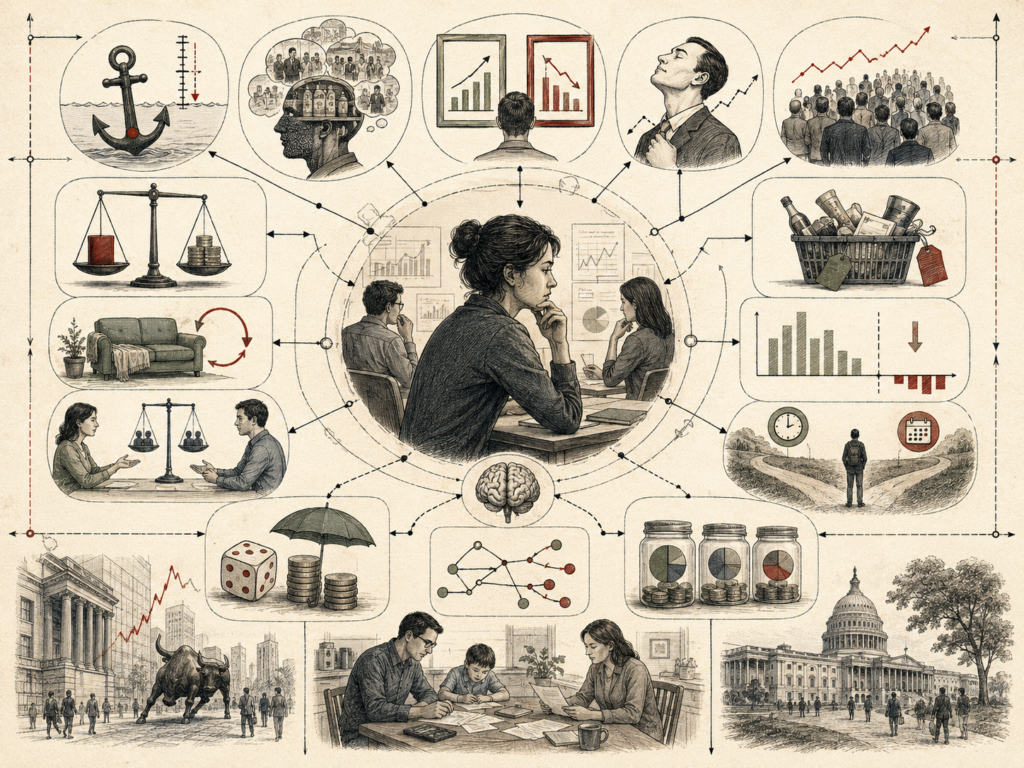
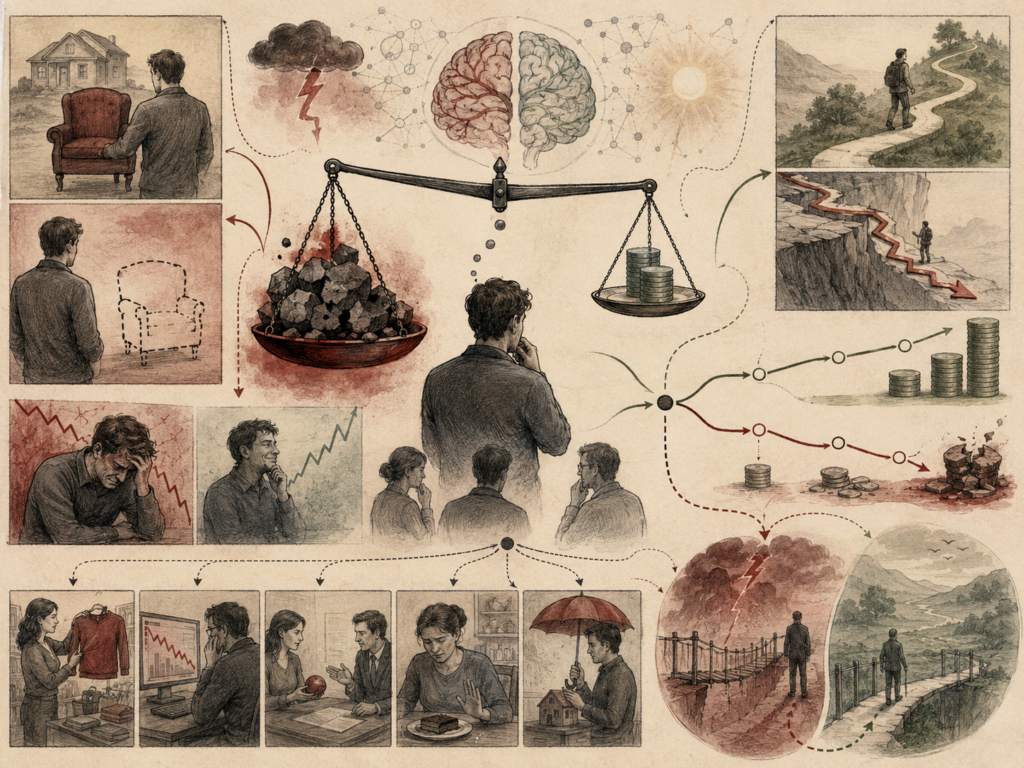
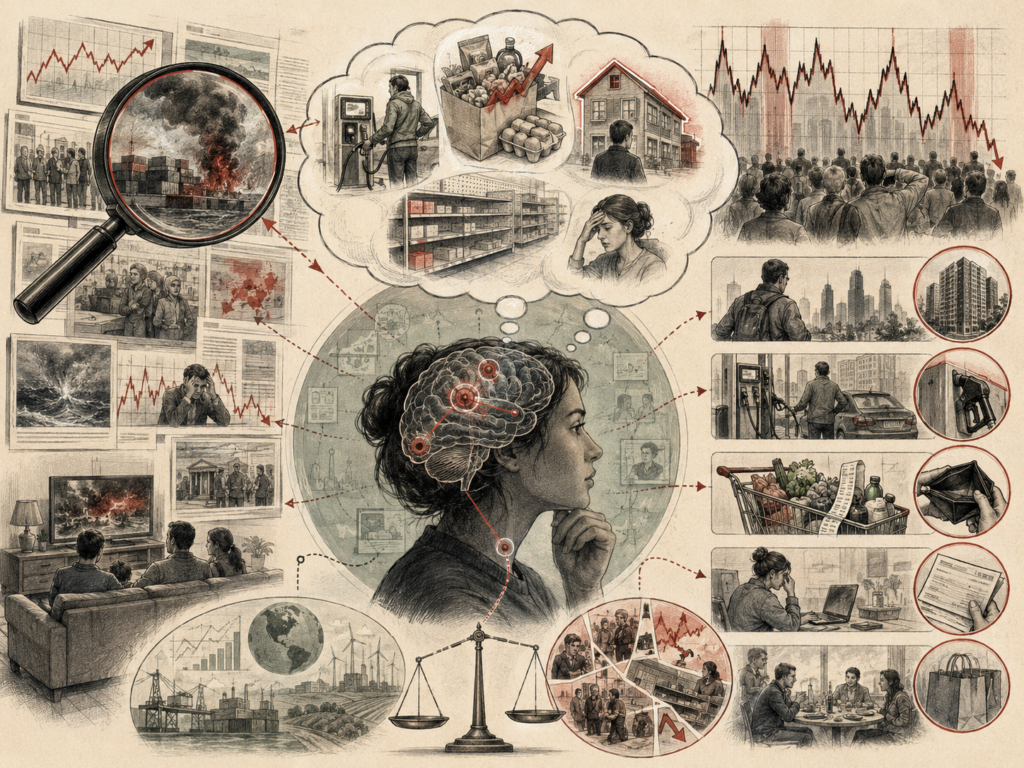
Editorial scientific illustration of behavioral economics as a decision systems architecture, showing bounded rationality, incentives, risk perception, framing effects, loss aversion, heuristics, time discounting, social influence, choice architecture, markets, policy systems, and sustainability pathways.

Behavioral Economics: How Psychology Shapes Economic Decision-Making

Behavioral economics studies how psychological processes shape economic decision-making under risk, incentives, and uncertainty, explaining why real human behavior often departs from the assumptions of perfect rationality. This article introduces the field as an interdisciplinary framework linking psychology, economics, decision science, and institutional analysis, while tracing its intellectual emergence through bounded rationality, prospect theory, heuristics, loss aversion, choice architecture, behavioral finance, and social preferences. It also maps the full article series across decision theory, bias, intertemporal choice, finance, policy, digital systems, and sustainability, and develops a formal analytical framework with substantial R and Python sections using fully commented code. The broader argument is that behavioral economics is not simply a critique of classical theory, but a more realistic account of how incentives, cognition, context, and institutions combine to shape actual economic behavior.

Editorial scientific illustration of futures thinking as an anticipatory reasoning systems architecture, showing branching future pathways, scenario planning, strategic foresight, horizon scanning, weak signals, uncertainty, backcasting, decision readiness, technology foresight, climate futures, institutional adaptation, sustainability transitions, and long-horizon responsibility.

Futures Thinking: Strategic Foresight for Complex Systems

Futures Thinking explores how individuals, organizations, and societies prepare for uncertainty by examining multiple possible futures rather than relying on a single forecast. The article argues that the future is not fixed or singular, but shaped by the interaction of human choices, institutions, technologies, ecological systems, and geopolitical forces. It develops this through the practical importance of long-range thinking, the distinction between prediction and preparation, the role of assumptions, major foresight methods, and the relationship between futures thinking, strategy, sustainability, and complex systems. The article also serves as the central architecture page for the wider knowledge series, organizing its methods, applications, governance themes, and strategic synthesis.

Editorial scientific illustration of resilience thinking as a viability-under-disturbance systems architecture, showing shocks, stress, adaptive capacity, recovery, transformation, thresholds, feedback loops, redundancy, diversity, infrastructure resilience, community resilience, governance capacity, vulnerability, equity, and long-term viability.

Resilience Thinking: Adaptation, Disturbance, and Transformation in Complex Systems

Resilience Thinking introduces resilience as a systems-oriented framework for understanding how ecological, social, economic, and institutional systems absorb disturbance, adapt to change, and reorganize while maintaining or renegotiating core functions under uncertainty. The article argues that disturbance, volatility, and structural disruption are not exceptions to normal system behavior but ordinary conditions of life in complex systems. It develops the field through adaptive capacity, thresholds, feedback loops, diversity, redundancy, modularity, transformation, and learning, while showing how resilience differs from equilibrium-based models of stability and from narrower ideas of recovery. The article also situates resilience within sustainability, governance, disaster risk reduction, and strategic decision-making, emphasizing that long-term viability depends not only on efficiency or continuity, but on the capacity to adapt, reorganize, and judge when transformation is necessary. It includes an evergreen mathematical lens, along with advanced R and Python workflows for mapping resilience dimensions and simulating viability under repeated disturbance.

Editorial scientific illustration of systems modeling as a formal-systems architecture, showing system boundaries, feedback loops, stock-and-flow reservoirs, scenario pathways, network dependencies, calibration and validation structures, infrastructure systems, ecological systems, climate feedback, public-policy corridors, governance institutions, shock propagation, cascading failure, resilience buffers, and responsible model interpretation.

Systems Modeling: Formal Methods for Understanding Complex Systems

Systems modeling examines how formal models are used to understand, simulate, and analyze complex systems composed of interacting components. Rather than focusing on isolated variables, it studies how feedback loops, nonlinear relationships, time delays, and structural dependencies generate behavior across time. This pillar introduces the field as a whole, explaining why systems modeling matters, what major methods it includes, and how it supports analysis in sustainability, governance, infrastructure, economics, and technology. It emphasizes that models do not eliminate uncertainty, but help make it more explicit, structured, and usable for decision-making. By clarifying how system structure produces outcomes, systems modeling allows researchers and policymakers to compare interventions, explore plausible futures, identify leverage points, and reason more carefully about long-term change in dynamic, interconnected worlds.

Editorial scientific illustration of content frameworks as a knowledge architecture and editorial systems framework, showing pillar structures, topic clusters, narrative pathways, educational scaffolds, conceptual models, message architecture, taxonomies, metadata layers, internal-link networks, content audits, digital knowledge systems, strategic ideation, storytelling, and scalable publishing workflows.

Content Frameworks: Designing Knowledge Architecture for Scalable Content Systems

Content frameworks turn scattered articles, concepts, methods, and resources into scalable knowledge architecture. This article map introduces the Content Frameworks series as a structured guide to designing, governing, and maintaining content systems that support learning, research, strategic communication, and institutional memory. It shows how pillar pages, topic clusters, internal links, narrative pathways, metadata, taxonomies, templates, and editorial workflows work together to create coherent bodies of knowledge. The map also emphasizes responsible use: frameworks should clarify complexity without flattening uncertainty, context, or judgment. Readers can use this guide to move from foundational ideas to applied methods, governance questions, and advanced framework design. Across the series, content frameworks are treated not as rigid templates, but as living systems that help organizations explain ideas, connect knowledge, scale editorial work, and build durable public understanding across articles, repositories, publications, and reusable editorial platforms.

Scroll to Top