Author name: Tariq Ahmad

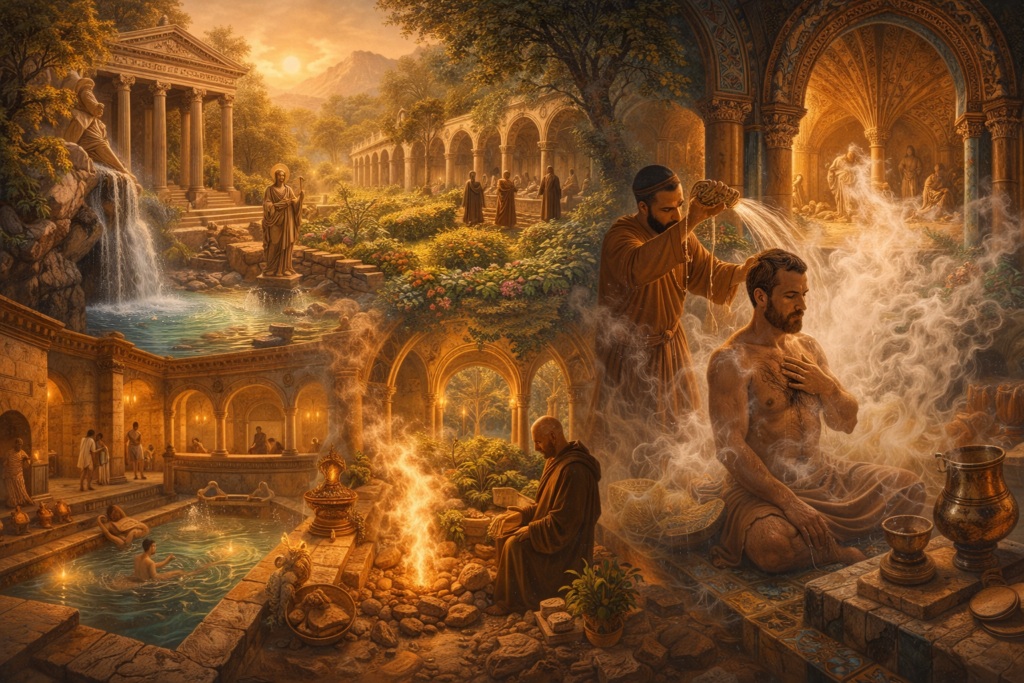
Editorial illustration of healing spaces, baths, and sacred environments featuring a sanctuary spring, Roman bath architecture, Islamic ablution and steam bathing, monastic garden space, and layered atmospheres of purification and restoration

Healing Spaces, Baths & Sacred Environments: Water, Ritual, and the Architecture of Restoration

Healing spaces, baths, and sacred environments examine the places, structures, and landscapes through which cultures have pursued cleansing, restoration, ritual healing, bodily care, and the renewal of life. This category explores sacred springs, temple healing, Epidaurus, Roman baths, hammams, Islamic ablution, monastic infirmaries, hospices, pilgrimage environments, therapeutic gardens, and the modern afterlife of healing architecture, revealing how water, atmosphere, architecture, ritual, and environmental design have long shaped the restoration of body and spirit.
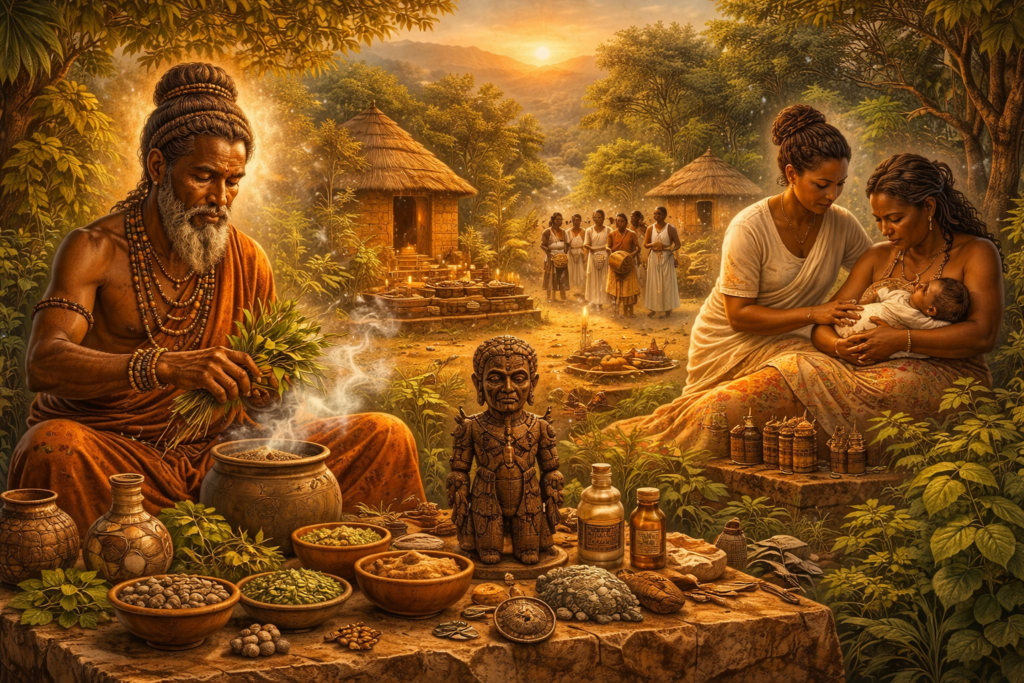
Editorial illustration of African healing traditions featuring a healer preparing herbs, ritual and protective objects, women providing maternal care, ancestral symbolism, and a communal landscape of restoration

African Healing Traditions: Body, Spirit, Community, and the Work of Restoration

African healing traditions examine the diverse systems of care through which African societies have understood illness, vitality, danger, protection, and restoration across bodily, spiritual, communal, ecological, and moral dimensions of life. This category explores herbal medicine, divination, ancestral mediation, ritual healing, women’s and household care, material forms of protection, social diagnosis, regional healing worlds, colonial suppression, public-health integration, and diaspora afterlives, revealing African healing traditions as major civilizational systems of practical care, ritual knowledge, and relational restoration.

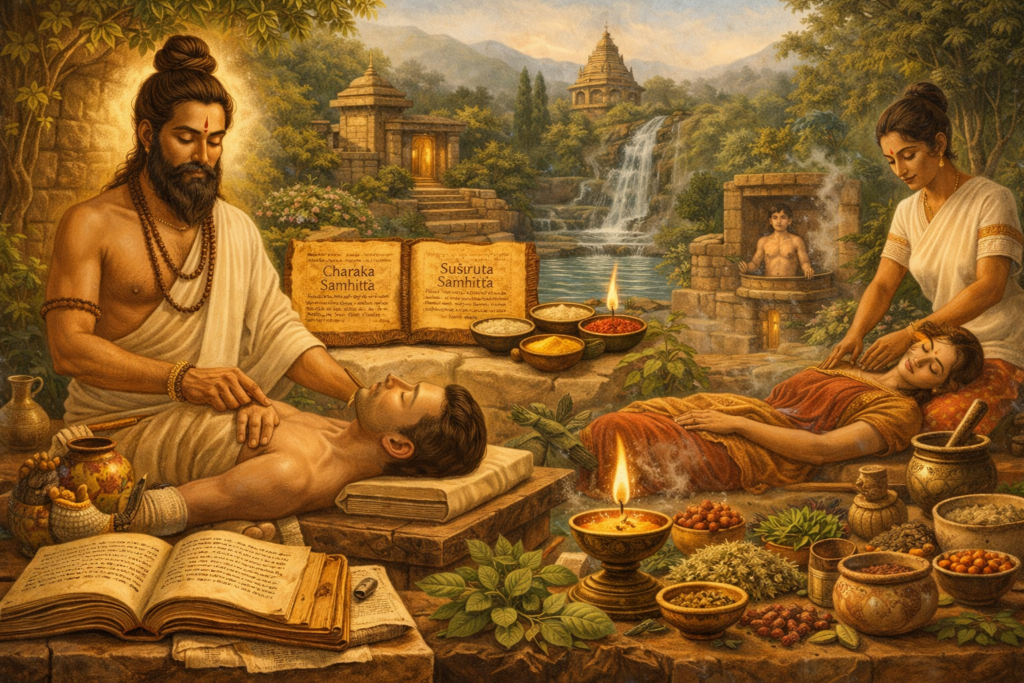
Editorial illustration of Ayurveda and South Asian healing traditions featuring a practitioner taking pulse, classical medical manuscripts, herbs and preparation vessels, oil massage, steam therapy, and a serene healing landscape

Ayurveda and South Asian Healing Traditions: Balance, Constitution, and the Art of Healing

Ayurveda and South Asian healing traditions examine the medical systems of South Asia through concepts of balance, constitution, digestion, vitality, environment, regimen, and the disciplined care of life. This category explores classical Ayurvedic medicine through doṣa, dhātu, mala, agni, ojas, prakṛti, the Charaka and Suśruta traditions, dietetics, purification, rejuvenation, surgery, women’s health, and the wider plural healing world of South Asia, including intersections with Yoga, Siddha, and Unani, revealing one of the world’s great civilizational frameworks for embodiment, care, and the ordering of life.

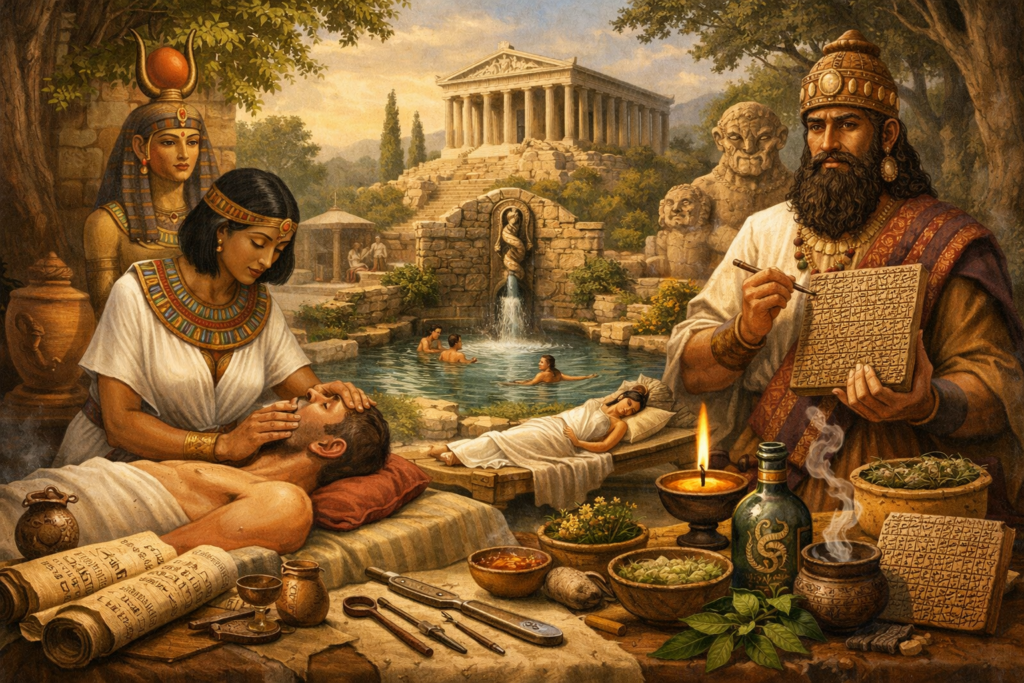
Editorial illustration of ancient Near Eastern and Mediterranean healing traditions featuring an Egyptian healer, a Mesopotamian tablet-bearing specialist, sacred spring and temple healing, herbs, ritual vessels, papyri, and early surgical tools

Ancient Near Eastern and Mediterranean Healing Traditions: Ritual, Remedy, and the Origins of Healing

Ancient Near Eastern and Mediterranean healing traditions examine the medical, ritual, and environmental systems through which ancient societies interpreted illness, protection, bodily disorder, and restoration within larger religious and natural worlds. This category explores Egyptian medicine, Mesopotamian healing, temple and sanctuary care, sacred springs, incantation, pharmacology, surgery, women’s health, specialist healers, and the transmission of early healing knowledge into later Mediterranean medicine, revealing the deep civilizational background from which later classical medical traditions emerged.

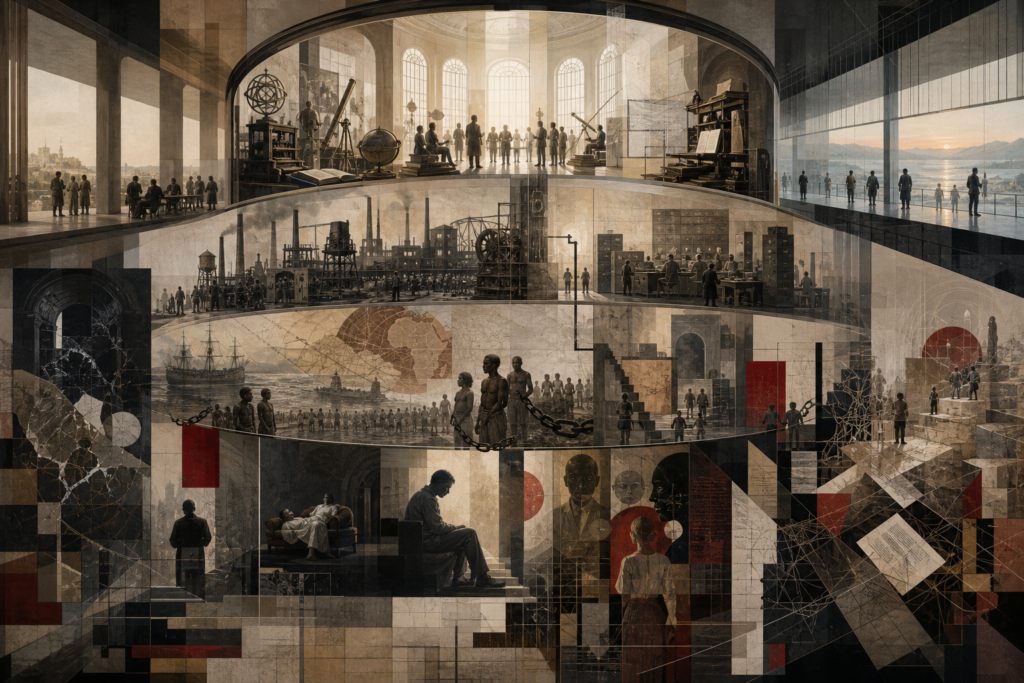
Layered editorial illustration of Enlightenment, modernity, and postmodern thought, showing reason, science, public debate, industrial modernity, colonial power, slavery, bureaucracy, fractured subjectivity, language, structure, and historical critique within a complex architectural chamber.

Enlightenment, Modernity, and Postmodern Thought: Reason, Freedom, and the Crisis of Modernity

Enlightenment, modernity, and postmodern thought trace the great arguments through which the modern world tried to understand reason, freedom, knowledge, history, subjectivity, and power. This category follows the rise of modern philosophy through the Scientific Revolution, Enlightenment critique, liberal and revolutionary politics, German idealism, romanticism, Marxism, phenomenology, existentialism, feminism, critical theory, structuralism, post-structuralism, and postmodern philosophy, while also examining the deeper genealogies and hidden contradictions of modernity, including Hellenistic, Latin, and Arabic-Islamic inheritances, colonial violence, slavery, and the buried Afro-Islamic archive within Atlantic modernity.

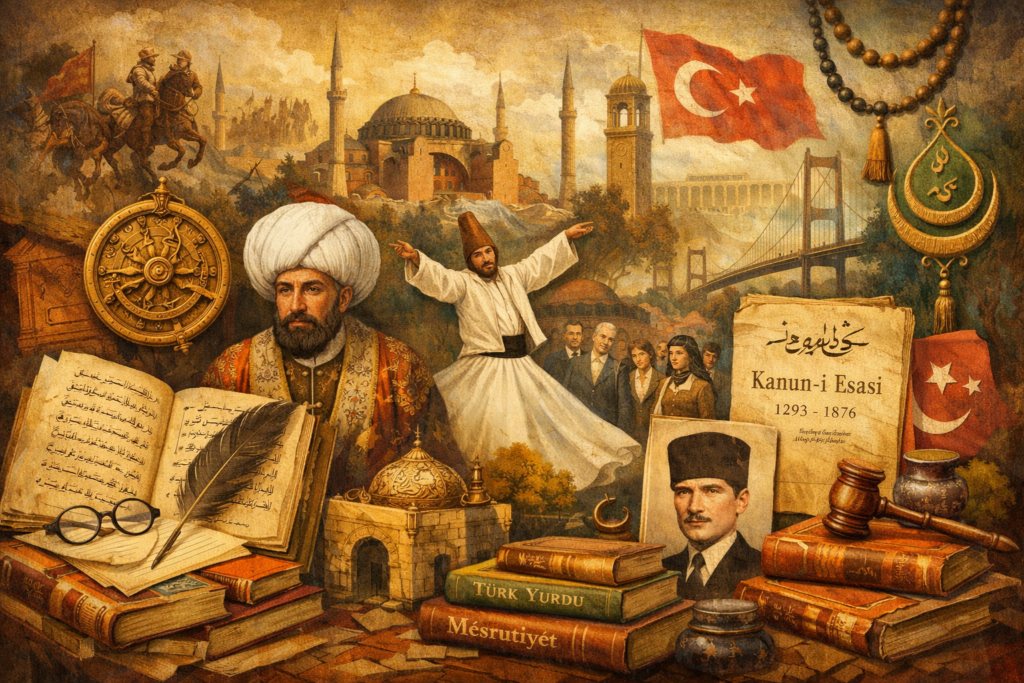
Editorial illustration of Ottoman and Turkish thought featuring imperial architecture, manuscripts, legal texts, Sufi symbolism, literary culture, reform-era documents, and layered memories of empire and republic across Anatolia and the Ottoman world

Ottoman and Turkish Thought: Law, Memory, and the Search for Order

Ottoman and Turkish thought preserves one of the great intellectual archives for understanding how civilizations negotiate sovereignty, law, religion, literature, reform, and historical transformation across long stretches of time. Shaped by Turkic, Islamic, Persianate, Byzantine, Mediterranean, and Balkan inheritances, this tradition developed across Anatolia and the wider Ottoman world through dynastic legitimacy, jurisprudence, theology, Sufi devotion, poetic culture, historical writing, administrative reason, educational institutions, and later struggles over constitutionalism, nationalism, secularism, and republican identity. It is not a narrow national canon or a simple imperial ideology, but a layered and contested field in which legal order, spiritual authority, political memory, and civilizational self-understanding were repeatedly reworked under conditions of expansion, crisis, reform, and rupture.

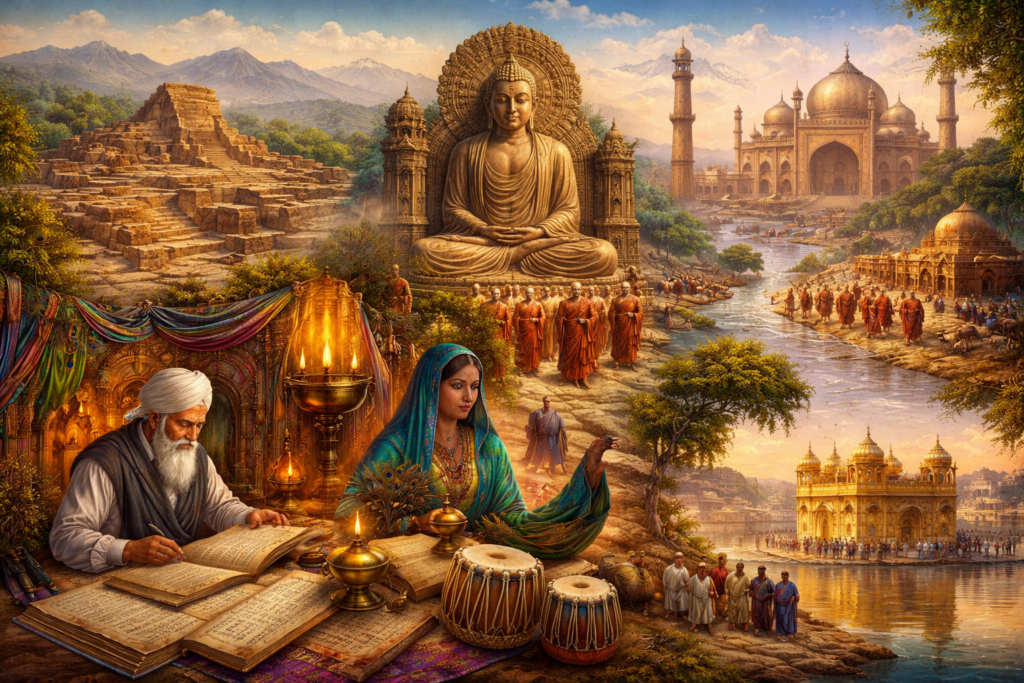
Editorial illustration of Indus Region intellectual life featuring Harappan ruins, Gandharan Buddhist imagery, Sindhi and Punjabi devotional culture, manuscripts, river landscapes, shrines, and Sikh sacred architecture across northwest South Asia

Indus Region Thought: Civilizational Memory, Sacred Exchange, and the Intellectual Worlds of the Northwest

Indus Region thought preserves one of the great connective intellectual zones of world history: a layered regional tradition shaped by Harappan urban symbolism, Vedic and Brahmanical encounter, Gandharan Buddhism, Sindhi Sufi devotion, Punjabi ethical and poetic worlds, Sikh theology, Persianate political culture, and the long afterlives of colonial archaeology and partition. Stretching across the Indus basin and its surrounding corridors, this civilizational world shows how thought develops not only through formal doctrine, but through cities, shrines, sculpture, song, scripture, legal practice, pilgrimage, frontier exchange, and regional memory. By treating Sindh, Punjab, Gandhara, and the wider northwest as a polycentric zone of sacred geography, multilingual transmission, artistic form, and historical fracture, this article presents the Indus region as a major archive of coexistence, continuity, devotion, sovereignty, and loss.

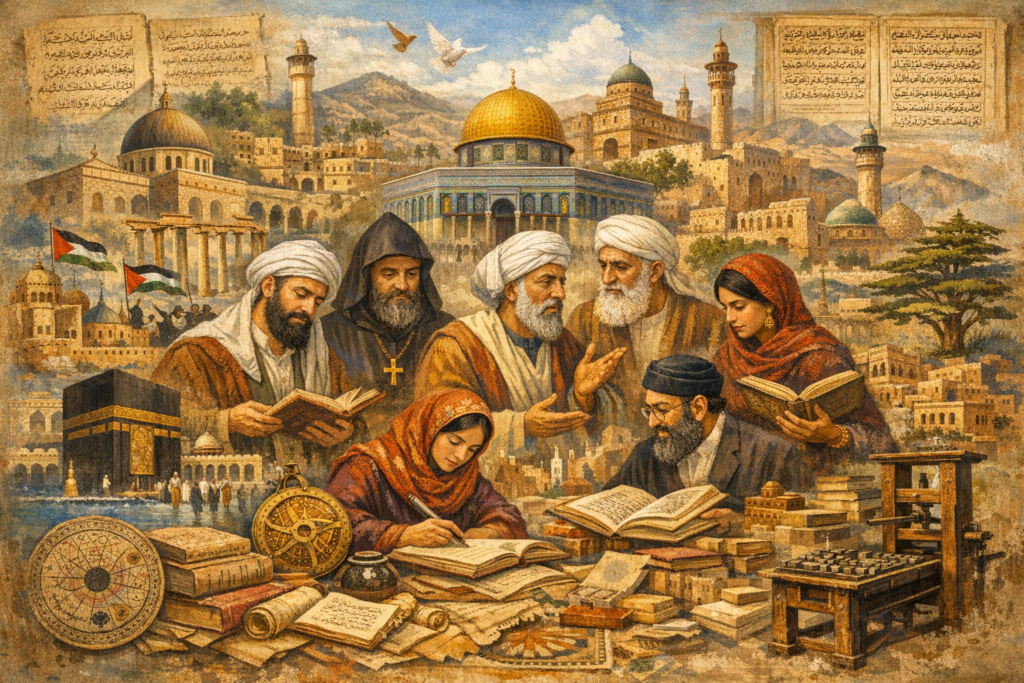
Editorial collage of Arabian and Levantine intellectual life showing scholars, manuscripts, books, sacred architecture, printing technology, and symbolic cityscapes associated with Palestine, Lebanon, Syria, Iraq, and the wider Arab East

Arabian and Levantine Thought: Revelation, Language, Memory, and Renewal

Arabian and Levantine thought preserves one of the world’s great intellectual traditions: a vast and internally diverse field in which revelation, grammar, law, theology, poetry, philosophy, reform, memory, and exile have shaped reflection across the Arabian Peninsula, the Levant, and Iraq. From pre-Islamic poetry and Qur’anic revelation to Arabic grammar, jurisprudence, kalām, adab, Christian and Jewish Arabic thought, Nahda reformism, Palestinian intellectual life, Lebanese and Syrian public culture, Iraqi philosophical and literary worlds, Yemeni scholarship, and Omani Ibāḍī traditions, this article explores how language, faith, historical vulnerability, and the struggle for dignity formed a dense and enduring civilizational web. By treating Palestine, Lebanon, Syria, Iraq, Yemen, Oman, the Hijaz, and Najd as constitutive rather than peripheral, it presents the Arab East as a polycentric zone of thought in which scripture, literary form, political conflict, and cultural renewal remain inseparably linked.

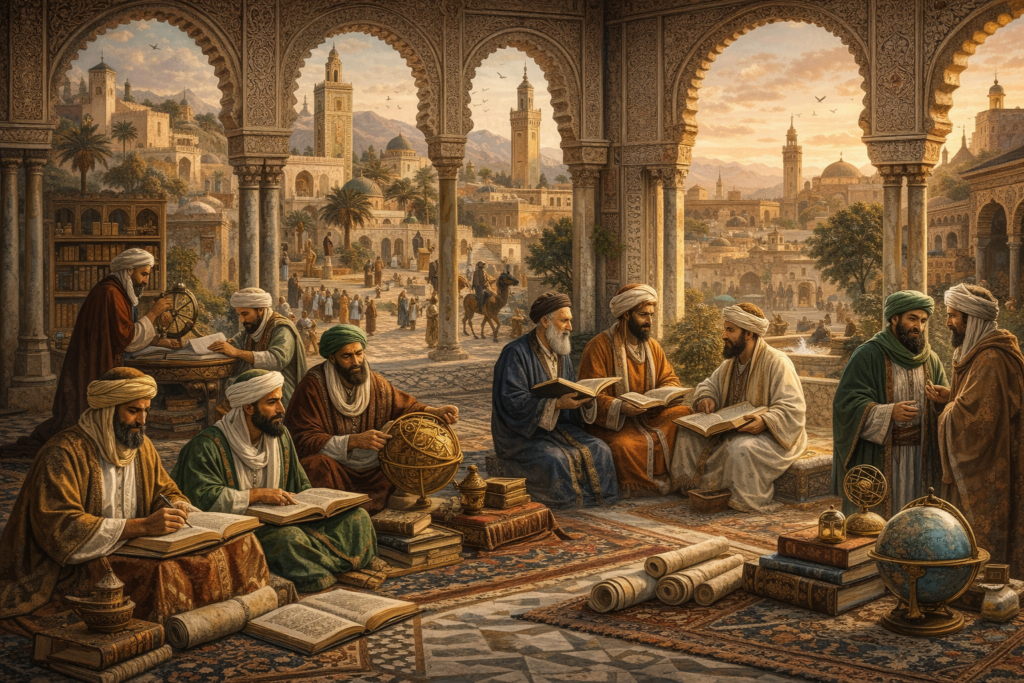
Editorial illustration of Maghrebi and Andalusi intellectual life featuring scholars in a North African and Andalusi courtyard, manuscripts, astronomical instruments, books, arches, and a layered urban landscape of domes, towers, and gardens

Maghrebi and Andalusi Thought: Law, Reason, Mysticism, and Civilization in the Western Islamic World

Maghrebi and Andalusi thought preserves one of the great intellectual traditions of the western Islamic world: a world in which law, theology, philosophy, mysticism, literature, science, and history developed together across North Africa and al-Andalus. Shaped by Amazigh, Arab, Islamic, Jewish, African, and Mediterranean inheritances, this tradition reveals how thinkers in cities such as Kairouan, Fez, Marrakesh, Cordoba, Seville, and Granada reflected on reason and revelation, legal authority, political legitimacy, spiritual discipline, social order, and the rise and fall of civilization. This article explores Maghrebi and Andalusi thought in its full civilizational range, from Maliki jurisprudence, Ashʿari theology, falsafa, and Sufism to Jewish-Arabic philosophy, scientific inquiry, dynastic statecraft, post-Andalusi exile, and historical reflection on urban life, decline, and collective memory, showing how the western Islamic world became a major center of philosophical, legal, and civilizational thought.

Scroll to Top