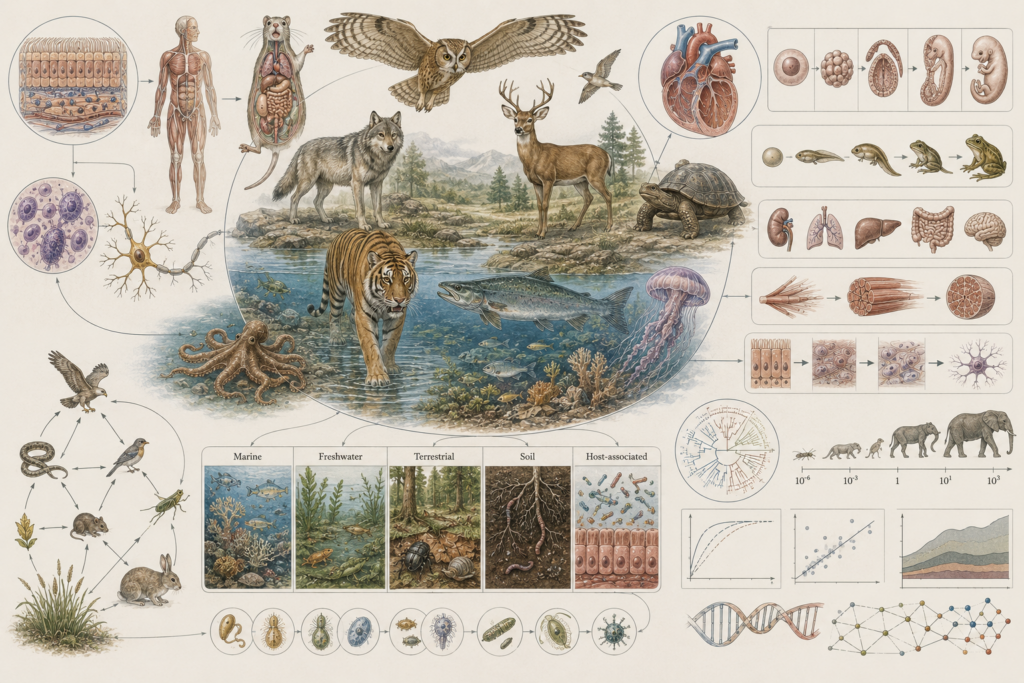
Research-grade systems biology illustration showing diverse animals across terrestrial, freshwater, marine, soil, and host-associated environments, with tissue structures, organ systems, development, food webs, phylogeny, microbiomes, and quantitative modeling elements.

Animal Biology and the Organization of Complex Life

Animal biology and the organization of complex life examine how multicellular heterotrophic organisms build tissues, organs, body plans, sensory systems, and coordinated behaviors through development, physiology, ecology, and evolutionary history. Animals are central to biology because they represent one of the most consequential expressions of multicellular organization: living systems in which specialized cells are integrated into tissues, tissues into organs, and organs into coordinated whole organisms capable of sensation, movement, predation, symbiosis, reproduction, and ecological transformation. This article explores what animals are, how metazoan complexity is organized, how animal form and function emerge through development and evolution, and why animal biology matters across ecology, marine and freshwater systems, disease ecology, conservation, and comparative life science.
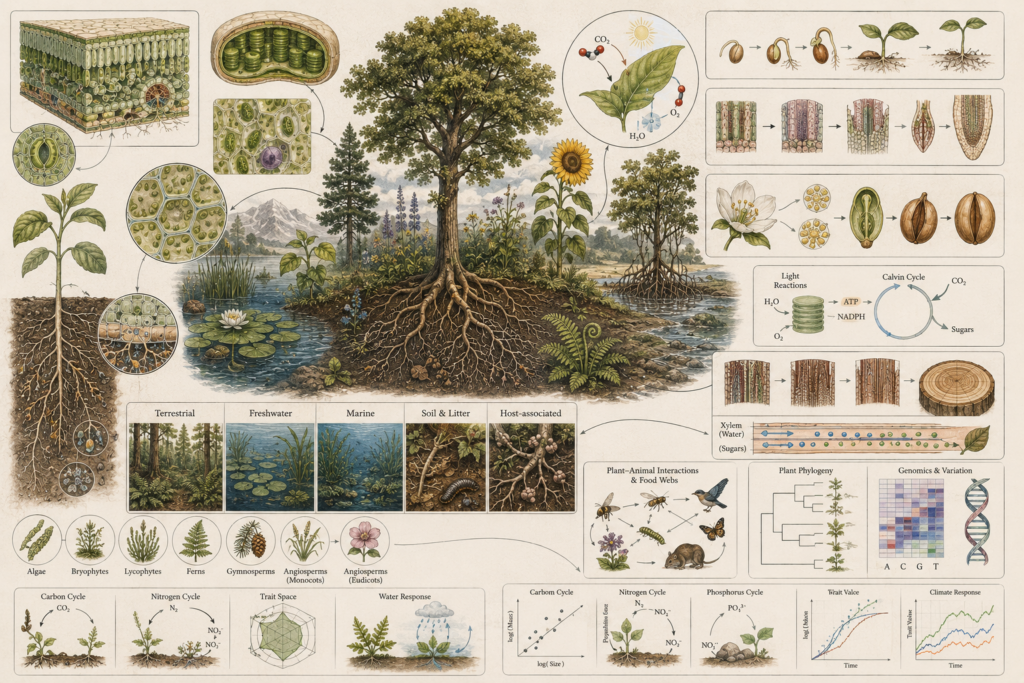
Research-grade botanical systems illustration showing plant life across terrestrial, freshwater, soil, and ecological contexts, with roots, leaves, flowers, seeds, vascular tissues, chloroplasts, photosynthesis, plant development, phylogeny, food webs, and environmental-response diagrams.

Plant Biology and the Life of Primary Producers

Plant biology and the life of primary producers examine how photosynthetic organisms capture energy, fix carbon, build biomass, structure ecosystems, and sustain the trophic, atmospheric, hydrological, and biogeochemical foundations of life on Earth. Plants are central to biology because primary producers do not merely occupy one ecological category among others. They form the energetic and material base upon which most ecosystems depend. Through photosynthesis, primary producers convert light energy, carbon dioxide, water, and mineral nutrients into organic matter that supports food webs, drives carbon cycling, influences climate, shapes soils, regulates water exchange, and creates the living architecture of terrestrial and many aquatic systems.

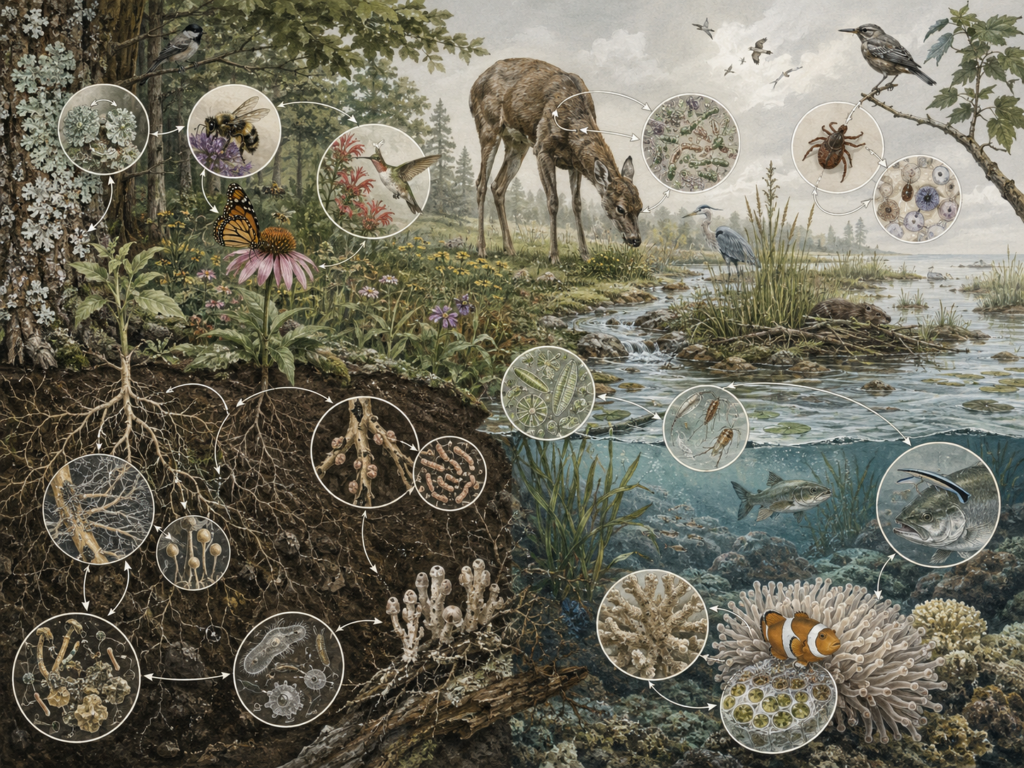
Research-grade ecological systems illustration showing plants, pollinators, lichens, mycorrhizal roots, microbes, parasites, host animals, aquatic organisms, coral, algae, fish, and subtle interaction pathways across terrestrial, freshwater, and marine habitats.

Coevolution, Symbiosis, and the Dynamics of Mutual Change

Coevolution, symbiosis, and the dynamics of mutual change examine how species reciprocally shape one another’s evolutionary trajectories, how long-term biological associations generate cooperation, conflict, dependence, and innovation, and how mutual change reorganizes organisms, ecosystems, and the history of life. Coevolution is central to biology because species do not evolve in isolation. Predators and prey, hosts and pathogens, plants and pollinators, corals and symbionts, roots and fungi, animals and microbes, and many other partners alter one another’s selective environments across time. Symbiosis matters because close biological association can range from mutual benefit to commensalism to parasitism, and because these relationships often become major drivers of development, physiology, ecology, and evolutionary transformation. This article explores coevolution as reciprocal evolutionary influence, symbiosis as intimate interspecies association, and mutual change as a dynamic process that can produce adaptation, escalation, stabilization, integration, and dependence. It also extends the topic into quantitative and computational biology through frequency change, interaction dynamics, and host-symbiont logic.

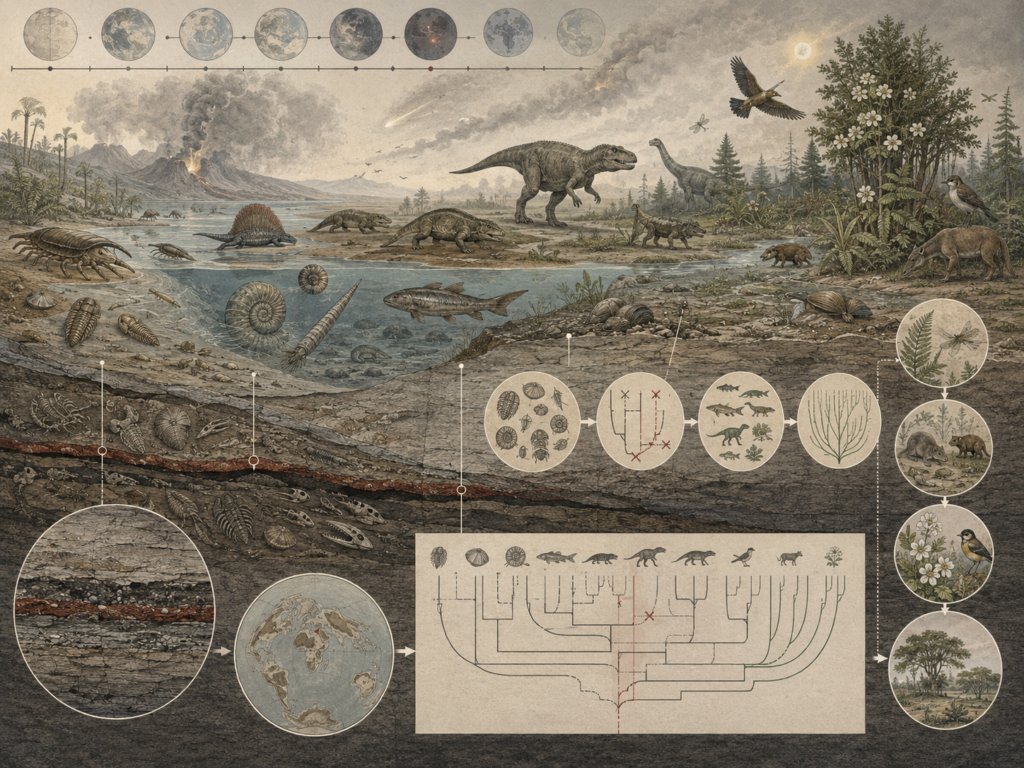
Research-grade evolutionary systems illustration showing deep time, fossil layers, ancient marine life, dinosaurs, extinction events, geological strata, phylogenetic branching, ecological recovery, and biological transformation across Earth history.

Extinction, Contingency, and Biological Transformation

Extinction, contingency, and biological transformation examine how the loss of lineages reshapes the history of life, how chance and historical sequence influence evolutionary outcomes, and how biological systems are repeatedly transformed through crises, survivals, radiations, and altered ecological possibility. Extinction is one of the central processes in biology because the history of life has been shaped not only by adaptation, diversification, and persistence, but also by disappearance, interruption, and irreversible loss. Contingency matters because evolutionary history is not fully predetermined: which lineages survive, which innovations spread, and which worlds become biologically possible often depend on prior accidents, timing, environmental shocks, and the uneven structure of inheritance across populations and clades. This article explores extinction as both background process and mass event, contingency as the historical dependence of outcomes on prior pathways and chance disruptions, and biological transformation as the reorganization of ecosystems, lineages, body plans, and evolutionary opportunities across deep time.

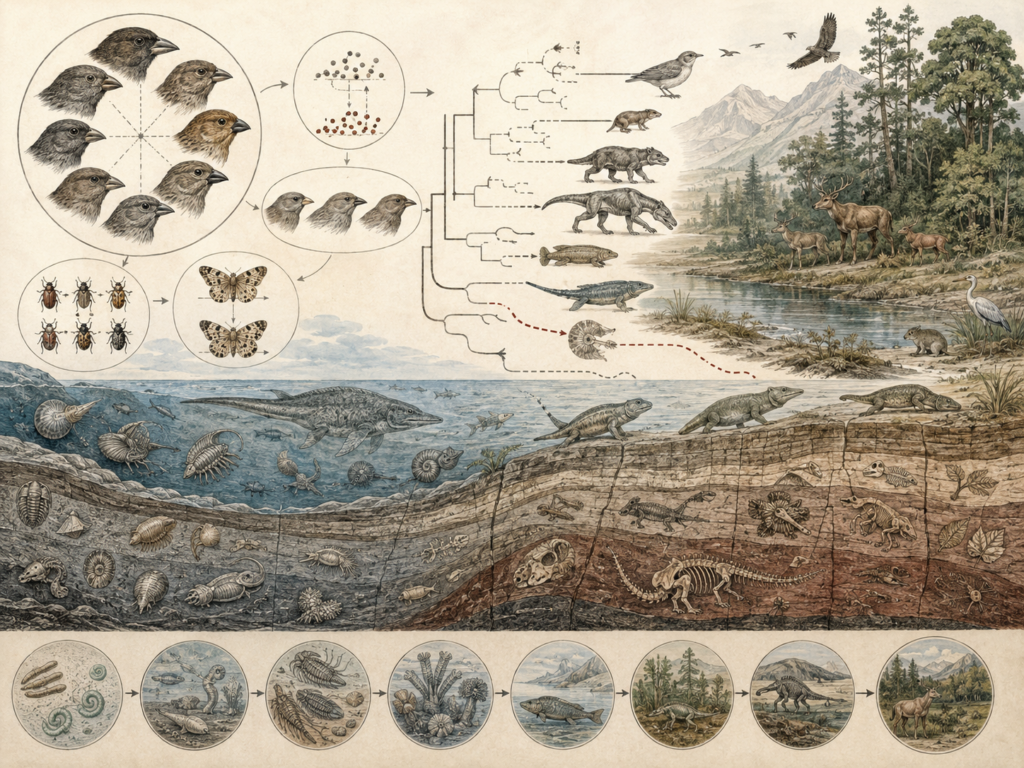
Research-grade evolutionary biology illustration showing variation within populations, inheritance, selection, phylogenetic branching, fossil strata, ancient marine life, extinct vertebrates, modern ecosystems, and biological change across deep time.

Microevolution, Macroevolution, and Deep Time

Microevolution, macroevolution, and deep time examine how small-scale genetic changes within populations connect to large-scale evolutionary patterns across species, lineages, and the vast history of life on Earth. Evolution is not divided into separate worlds of “small” and “large” change so much as expressed across different scales of time, evidence, and biological organization. This article explores microevolution as change in allele frequencies within populations, macroevolution as the large-scale pattern of diversification, extinction, stability, and innovation across the tree of life, and deep time as the geological and historical framework required to understand how these processes unfold. It also shows how fossils, comparative biology, genomics, and phylogenetic reasoning allow scientists to connect short-term population change with long-term evolutionary history. Finally, it extends the topic into quantitative and computational biology through allele-frequency models, branching logic, evolutionary rates, and R- and Python-based workflows, while connecting the subject to sustainability-adjacent fields such as ecology, conservation biology, restoration ecology, evolutionary biology, marine biology, freshwater biology, plant science, soil biology, microbiology, agroecology, forestry, disease ecology, and systems biology.

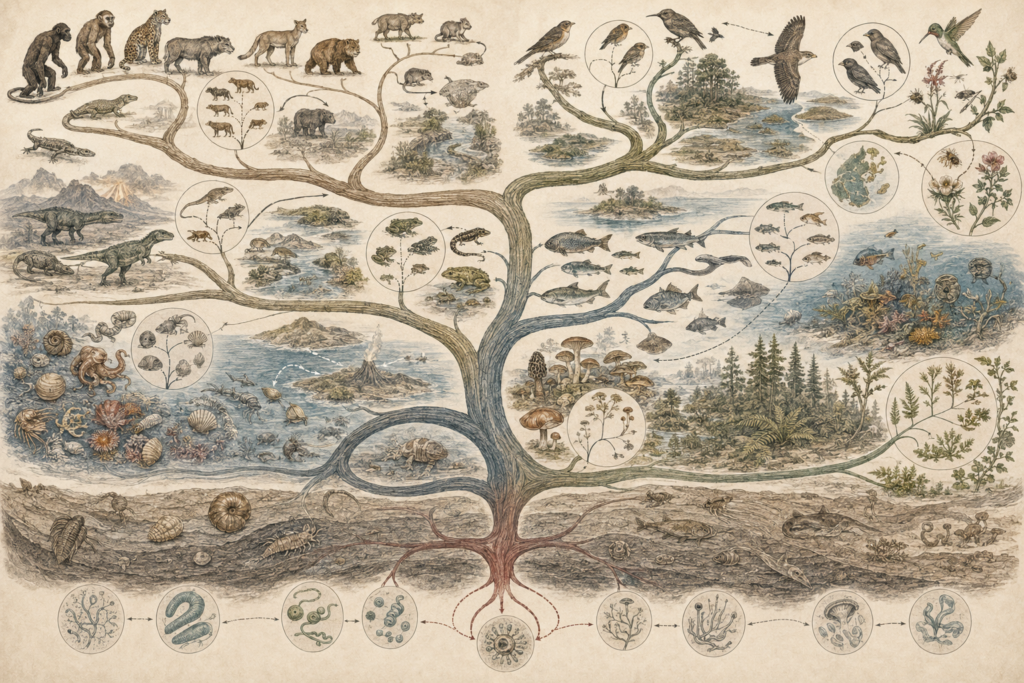
Research-grade evolutionary biology illustration showing a branching tree of life with mammals, birds, reptiles, amphibians, fish, invertebrates, plants, fungi, microbes, marine ecosystems, terrestrial habitats, fossils, and subtle speciation pathways.

Speciation, Diversity, and the Tree of Life

Speciation, diversity, and the tree of life examine how new species arise, how evolutionary branching generates the diversity of organisms on Earth, and how phylogenetic reasoning helps biology reconstruct the historical relationships among living and extinct lineages. Speciation is one of the central processes in biology because the richness of life does not emerge from variation within populations alone, but from the repeated splitting, divergence, and persistence of lineages across deep time. This article explores speciation as the origin of new species, diversity as the historical outcome of branching evolution under ecological, developmental, and geological conditions, and the tree of life as the framework through which common ancestry and evolutionary relatedness are represented. It also examines how reproductive isolation, divergence, extinction, phylogenetics, and comparative biology shape modern understanding of biodiversity, while extending the topic into quantitative and computational biology through branching models, frequency change, distance reasoning, and R- and Python-based workflows.

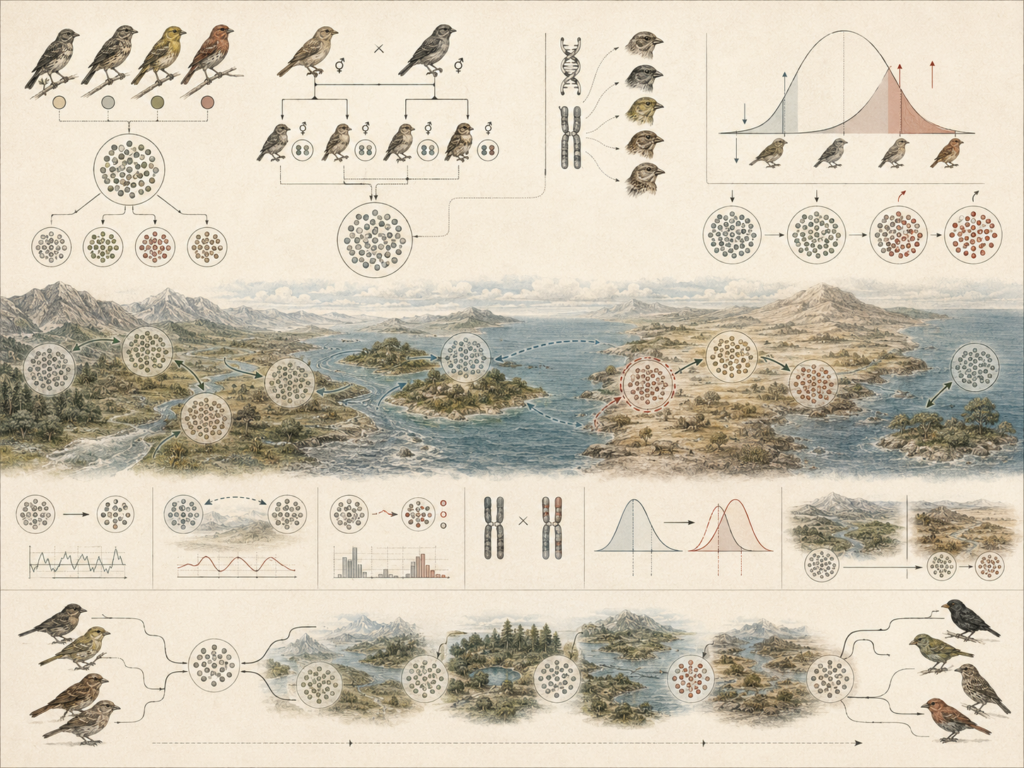
Research-grade population genetics illustration showing bird populations, inheritance patterns, chromosomes, allele-frequency changes, trait variation, geographic isolation, gene flow, selection, drift, and mathematical population models across connected landscapes.

Population Genetics and the Mathematics of Inheritance

Population genetics and the mathematics of inheritance examine how allele frequencies change through time, how heredity operates at the level of whole populations rather than isolated pedigrees alone, and how mathematical models help explain the evolutionary consequences of selection, drift, mutation, migration, and reproduction. Population genetics is one of the central bridges between classical genetics and evolutionary biology because it turns inheritance into a quantitative science of variation, frequency, and change across generations. This article explores allele and genotype frequencies, the Hardy–Weinberg principle, the mathematics of equilibrium and deviation, and the major forces that alter genetic composition in populations. It also shows why population genetics matters for ecology, conservation, medicine, microbiology, agriculture, and the long-term resilience of living systems. Finally, it extends the topic into quantitative and computational biology through probability models, frequency calculations, and selection dynamics.

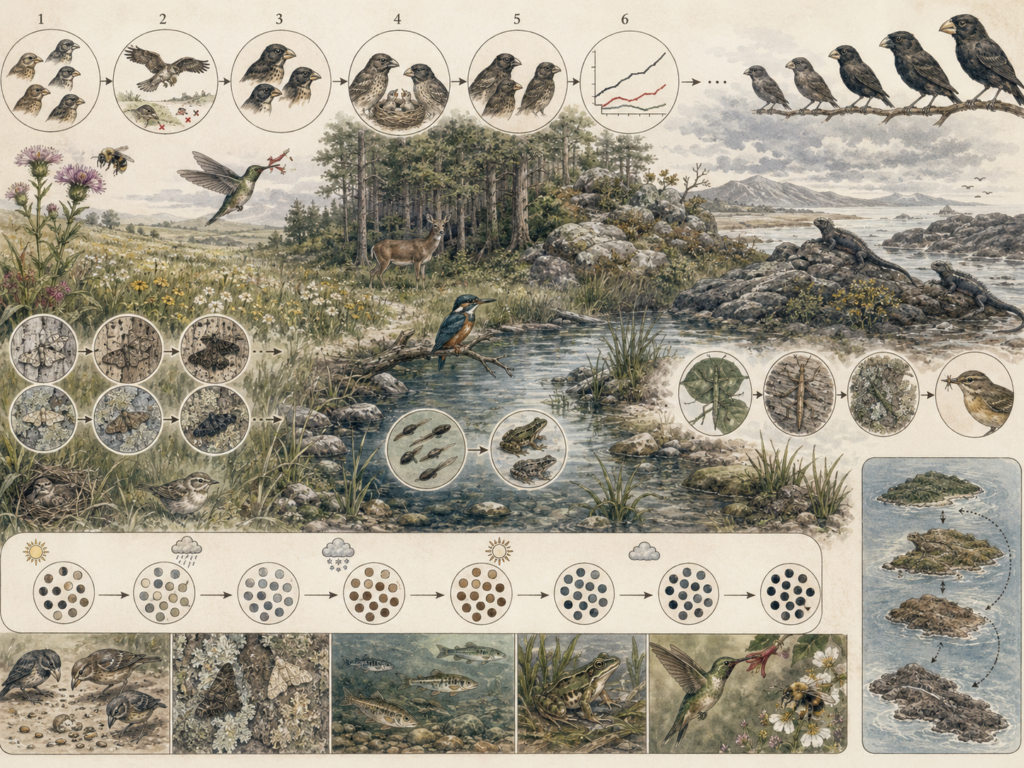
Research-grade evolutionary biology illustration showing birds, insects, amphibians, fish, reptiles, pollinators, island populations, trait variation, selection pressure, survival differences, adaptation sequences, and allele-frequency change across connected habitats.

Natural Selection, Adaptation, and Fitness

Natural selection, adaptation, and fitness examine how inherited variation affects survival and reproduction, how populations change through time under environmental pressures, and how biological traits become fitted, often imperfectly, to particular ecological conditions. Natural selection is one of the core mechanisms of evolution because it links variation to differential reproductive success, allowing some traits, combinations, and lineages to become more common across generations. This article explores how natural selection works, how fitness is defined in evolutionary biology, why adaptation must be understood historically rather than teleologically, and how selection interacts with mutation, drift, constraint, development, and ecological context. It also extends the topic into quantitative and computational biology through allele-frequency models, selection coefficients, fitness comparisons, and R- and Python-based workflows, while connecting the subject to sustainability-adjacent fields such as ecology, conservation biology, restoration ecology, evolutionary biology, marine biology, freshwater biology, plant science, soil biology, microbiology, agroecology, forestry, disease ecology, and systems biology.

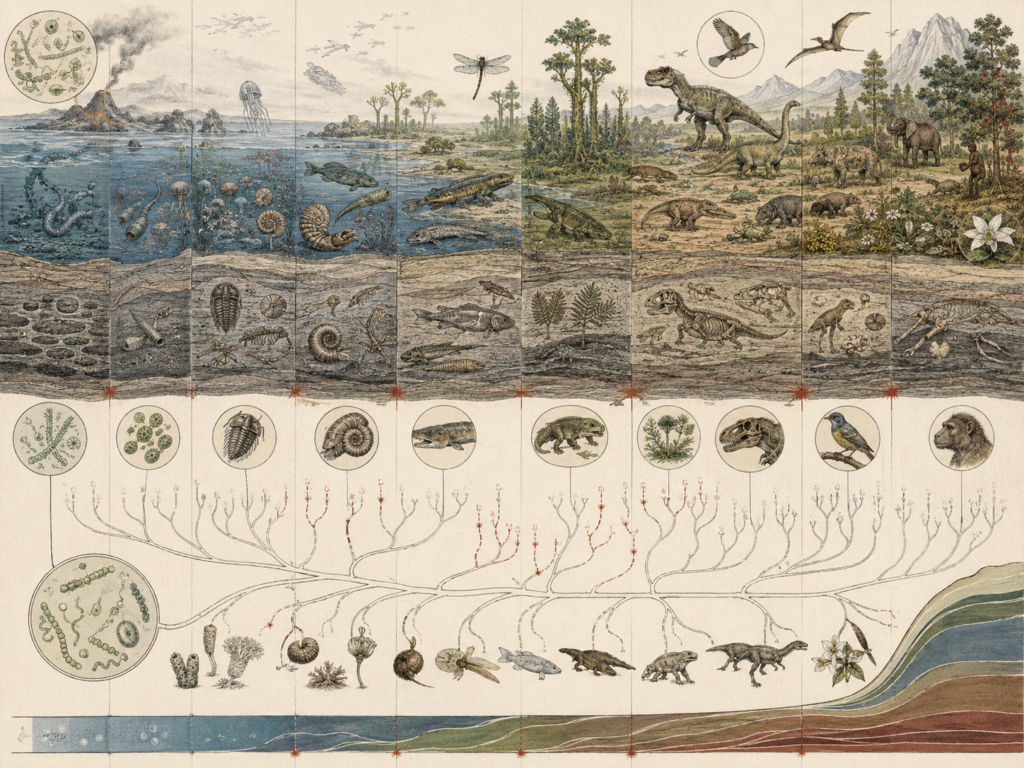
Research-grade evolutionary biology illustration showing the history of life across deep time, with microbial origins, ancient oceans, fossil strata, marine invertebrates, fish, amphibians, reptiles, dinosaurs, birds, mammals, flowering plants, geological layers, extinction markers, and phylogenetic branching.

Evolution and the History of Life

Evolution and the history of life examine how living systems change through time, how hereditary variation is sorted through selection and other evolutionary processes, and how the diversity of organisms on Earth emerged from shared ancestry across deep geological history. Evolution is one of the central principles of biology because it explains both the unity and the diversity of life: unity through common descent, and diversity through inherited modification, selection, drift, recombination, extinction, and ecological divergence. This article explores evolution as descent with modification, the major processes that generate evolutionary change, the fossil and comparative evidence through which the history of life is reconstructed, and the long unfolding of life from early microbial worlds to complex multicellular systems, ecological radiations, and the modern biosphere. It also extends evolutionary biology into quantitative and computational analysis through population models, allele-frequency change, phylogenetic reasoning, and R- and Python-based workflows, while connecting the subject to sustainability-adjacent fields such as ecology, conservation biology, restoration ecology, evolutionary biology, marine biology, freshwater biology, plant science, soil biology, microbiology, agroecology, forestry, disease ecology, and systems biology.

Scroll to Top