Non-figurative editorial illustration of blank manuscripts, scrolls, stone-tablet forms, olive branches, luminous pathways, water traces, and sacred geometry representing Torah, halakhah, sharia, and Christian moral law.

Torah, Halakhah, Sharia, and Christian Moral Law

Torah, halakhah, sharia, and Christian moral law are often compared too quickly, as though they were identical systems or simple opposites. In Jewish tradition, Torah is divine instruction and covenantal teaching, while halakhah is the lived path of Jewish law developed through scripture, rabbinic interpretation, practice, and communal discipline. In Islam, sharia is the divinely given path of guidance, while fiqh is human juristic understanding of that guidance. In Christianity, moral law is interpreted through Jesus, the Gospel, love of God and neighbor, the Holy Spirit, conscience, natural law, ecclesial tradition, and debates over law and grace. This article compares sacred law across the Abrahamic traditions while preserving real differences over covenant, revelation, commandment, salvation, community, and divine authority.

Non-figurative editorial illustration of blank parchment, an open codex, mountain thresholds, an iron-like barrier structure, luminous pathways, sea and desert horizons, and restrained sacred geometry representing Dhu al-Qarnayn, power, justice, and sacred geography.

Dhu al-Qarnayn, Power, Justice, and Sacred Geography

Dhu al-Qarnayn stands in the Qur’an as a ruler of power, movement, judgment, and moral responsibility. His story in Sūrat al-Kahf describes a figure whom Allah establishes in the land and grants access to means, allowing him to travel westward, eastward, and to a region between two barriers where vulnerable people seek protection from Gog and Magog. He does not use power merely for conquest or wealth. He distinguishes between wrongdoing and righteousness, refuses tribute as the motive for public defense, builds with collective labor, and attributes his achievement to the mercy of his Lord. This article reads Dhu al-Qarnayn as a sacred figure beyond prophets: a ruler whose story teaches justice, restraint, infrastructure, sacred geography, and the accountability of power before God.

Non-figurative editorial illustration of blank parchment, scrolls, gold-toned manuscripts, desert stone thresholds, olive branches, incense, luminous pathways, and an empty throne-like architectural space representing the Queen of Sheba in biblical and Qur’anic sacred history.

The Queen of Sheba in Biblical and Qur’anic Sacred History

The Queen of Sheba stands at the meeting point of wisdom, power, wealth, diplomacy, sacred geography, and revelation. In the Hebrew Bible, she journeys to Solomon to test his wisdom with hard questions, bringing gold, spices, and precious stones before blessing the God of Israel. In the Qur’an, she appears as a politically intelligent queen who rules a prosperous people, consults her council, resists rash conflict, recognizes the limits of worldly power, and finally submits with Solomon to Allah, Lord of the worlds. Later Jewish, Christian, Islamic, and Ethiopian traditions expand her memory in many directions. This article reads the Queen of Sheba as a sacred figure beyond prophets: a ruler whose encounter with Solomon becomes a meditation on wisdom, humility, sovereignty, monotheism, and the moral transformation of power.

Non-figurative editorial illustration of blank manuscripts, an open book, luminous pathways, olive branches, water traces, stone thresholds, and sacred geometry representing light, wisdom, and knowledge in Abrahamic thought.

Light, Wisdom, and Knowledge in Abrahamic Thought

Light, wisdom, and knowledge form one of the deepest symbolic constellations in Abrahamic thought. In the Hebrew Bible, light is bound to creation, divine command, Torah, wisdom, and moral path. In Christianity, light becomes central to Johannine theology, creation through the Word, Christological revelation, discipleship, and divine illumination. In Islam, the Qur’an speaks of Allah as the Light of the heavens and the earth, while knowledge, guidance, revelation, and wisdom become forms of divine mercy. This article examines light not as a decorative metaphor, but as a disciplined Abrahamic language for truth, guidance, moral clarity, revelation, and nearness to God. It compares Jewish, Christian, and Islamic uses of light while preserving real theological differences over incarnation, revelation, prophecy, and divine unity.

Non-figurative editorial illustration of blank manuscripts, an open book, olive branches, stone thresholds, luminous pathways, vessels, and geometric forms representing Maimonides, Ibn Sina, and the shared philosophical world of Arabic thought.

Maimonides, Ibn Sina, and the Shared Philosophical World of Arabic Thought

Maimonides and Ibn Sīnā stand among the greatest philosophical minds of the medieval Abrahamic world. One was a Jewish jurist, physician, and philosopher writing in Judeo-Arabic; the other was a Muslim philosopher-physician whose metaphysics, psychology, medicine, and logic reshaped Islamic, Jewish, and Christian thought. They did not belong to the same religious tradition, and they did not agree on all questions. Yet both inhabited the shared philosophical world of Arabic thought: Aristotle, al-Fārābī, metaphysics, divine unity, intellect, prophecy, law, medicine, and the disciplined pursuit of truth. This article examines Maimonides and Ibn Sīnā not as symbols of easy interfaith harmony, but as evidence of a deeper intellectual reality: Jewish and Muslim philosophy developed through shared languages, shared questions, and serious theological difference.

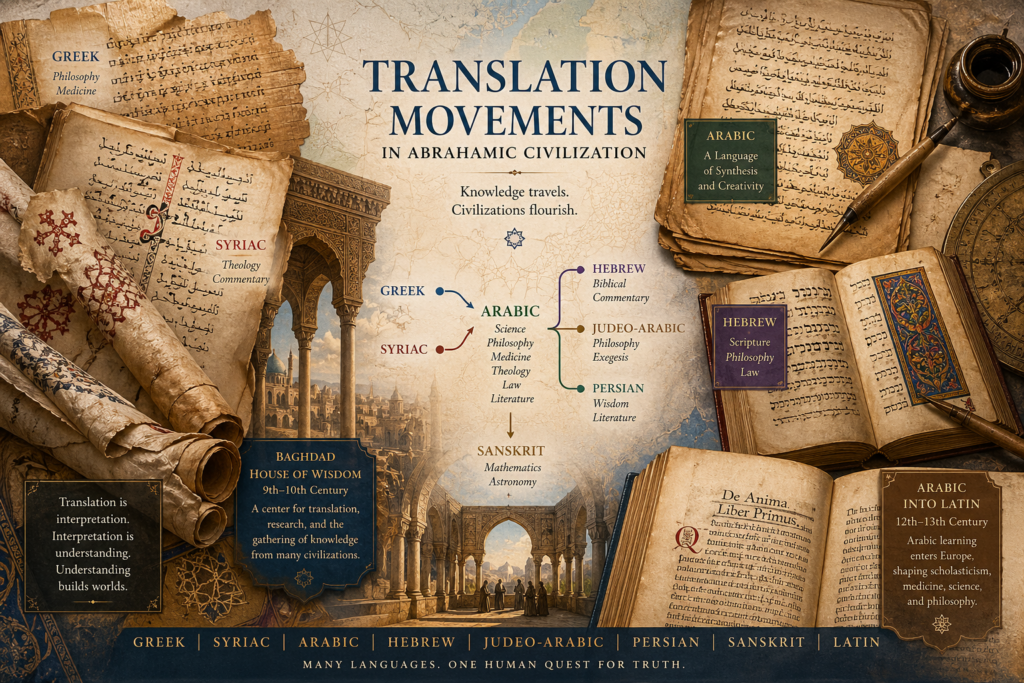
Editorial collage of manuscripts, scrolls, books, maps, scholarly pathways, and architectural details representing translation movements across Greek, Syriac, Arabic, Hebrew, Judeo-Arabic, Persian, Sanskrit, and Latin knowledge worlds.

Translation Movements in Abrahamic Civilization

Translation movements in Abrahamic civilization were not mechanical acts of carrying words from one language into another. They were acts of interpretation, preservation, transformation, and argument. Greek medicine, Syriac theology, Arabic philosophy, Jewish biblical commentary, Christian apologetics, Islamic law, Persian wisdom, Indian mathematics, and Latin scholasticism all moved through multilingual networks shaped by Muslims, Christians, Jews, and others. This article examines translation as one of the great shared knowledge practices of Abrahamic history. It shows how Arabic became a major language of science, philosophy, medicine, theology, and scripture; how Syriac Christian translators helped shape Arabic intellectual culture; how Jewish scholars wrote in Arabic and Judeo-Arabic; and how later Latin translation carried Arabic learning into Europe.

Non-figurative editorial illustration of blank medical manuscripts, open books, botanical materials, apothecary vessels, water channels, stone architecture, and luminous geometry representing Jewish, Christian, and Muslim physicians in the medieval Islamic world.

Jewish, Christian, and Muslim Physicians in the Medieval Islamic World

Medicine in the medieval Islamic world was not the achievement of one community alone. It was a shared knowledge world in which Muslim, Christian, Jewish, Syriac, Persian, Greek, Arabic, and Judeo-Arabic traditions interacted through translation, hospitals, pharmacology, clinical observation, philosophy, ethics, and daily care. Muslim physicians such as al-Rāzī, Ibn Sīnā, al-Zahrāwī, and Ibn al-Nafīs helped shape medical theory and practice; Christian physicians and translators such as Ḥunayn ibn Isḥāq and the Bukhtīshūʿ family transmitted and transformed Greek and Syriac medicine; and Jewish physicians such as Maimonides, Ibn Jumayʿ, and Ibn Abī al-Bayān practiced, wrote, and taught within Arabic medical culture. This article examines medicine as a shared Abrahamic and civilizational field, while avoiding both romanticized harmony and sectarian erasure.

Non-figurative editorial illustration of blank manuscripts, scrolls, codex pages, olive branches, stone thresholds, luminous pathways, and restrained geometry representing Arabic as a shared language of Jewish, Christian, and Muslim knowledge.

Arabic as a Shared Language of Jewish, Christian, and Muslim Knowledge

Arabic became one of the great shared languages of Abrahamic intellectual life. In the medieval Islamic world, Muslims used Arabic for Qur’anic revelation, law, theology, philosophy, science, and administration; Christians used Arabic for biblical translation, theology, apologetics, liturgy, medicine, and philosophy; and Jews used Arabic and Judeo-Arabic for biblical commentary, law, philosophy, commerce, poetry, and everyday communication. This article examines Arabic as a shared language of Jewish, Christian, and Muslim knowledge without reducing it to a single religious identity. Arabic carried revelation, argument, translation, medicine, metaphysics, grammar, legal reasoning, and interreligious debate. It also clarifies why the word “Allah” should be understood as the Arabic word for God within a shared Semitic and Abrahamic linguistic world, not as the name of a separate deity.

Non-figurative editorial illustration of blank parchment, scrolls, stone thresholds, water traces, olive branches, luminous pathways, and sacred geometry representing Khidr, hidden knowledge, and the limits of human understanding.

Khidr, Hidden Knowledge, and the Limits of Human Understanding

Khidr stands in Islamic sacred memory as the mysterious teacher of hidden knowledge, known through the Qur’anic account of Moses’ journey in Sūrat al-Kahf. The Qur’an does not name him directly, but later Muslim tradition identifies him as al-Khiḍr: a servant of Allah granted mercy and knowledge from the divine presence. His encounter with Moses is one of the Qur’an’s most challenging lessons on human limitation. A damaged boat, a slain youth, and a repaired wall appear morally bewildering until their hidden meanings are disclosed. This article reads Khidr as a figure of divine wisdom, patience, humility, and interpretive restraint, while warning against misuse of the story as a license for lawlessness, spiritual elitism, or contempt for ordinary moral responsibility.

Scroll to Top