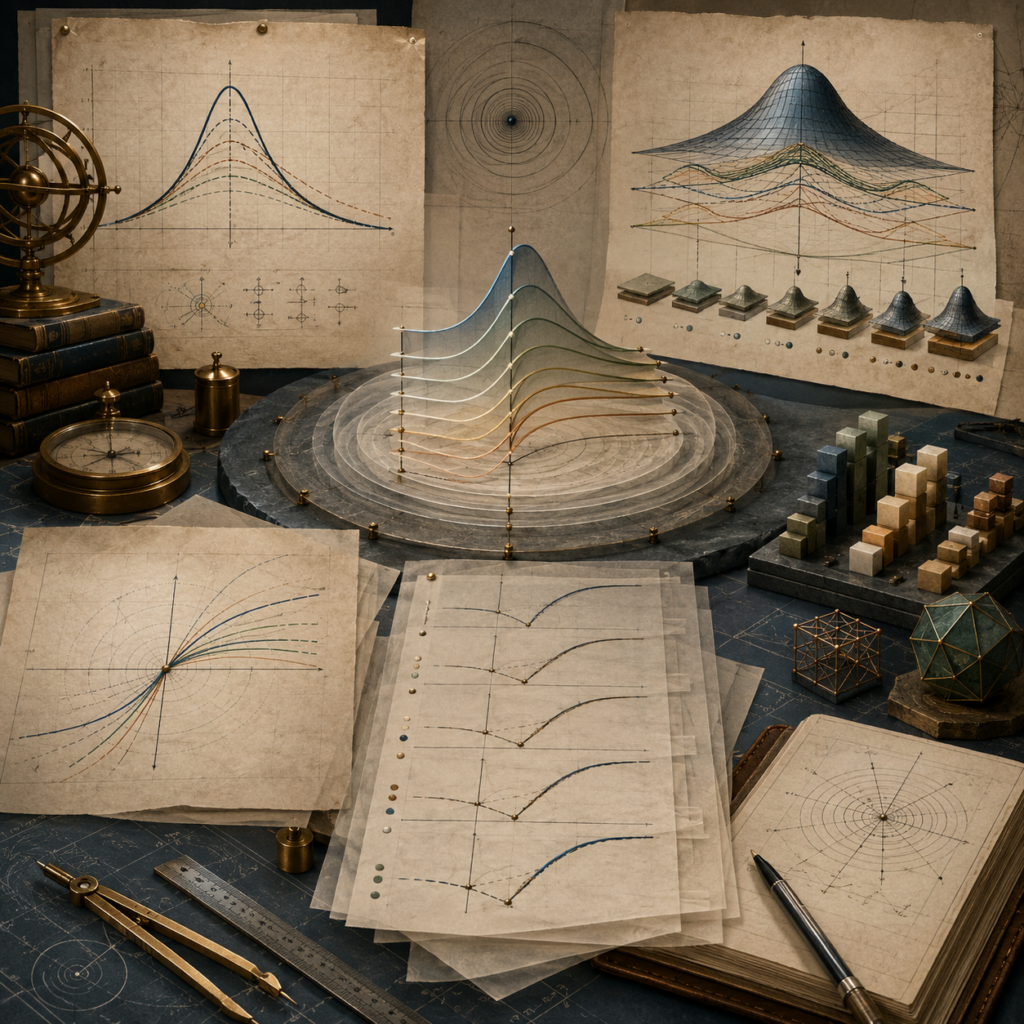
Total Differentials and Local Approximation: How Calculus Estimates Multivariable System Change
Total differentials extend partial derivatives into a disciplined estimate of how a multivariable system changes when several inputs shift at once. This article explains how partial derivatives, displacement vectors, tangent planes, gradient notation, local linear approximation, error propagation, feasible movement, constraints, reference states, and local validity shape systems modeling. It shows why total differentials are not global forecasts: they are first-order approximations tied to a specific point, small perturbations, smoothness assumptions, and meaningful movement through input space. In computational workflows, total differentials support uncertainty propagation, sensitivity accounting, scenario adjustment, approximation-error checks, and feasibility review. The article emphasizes that differential claims should state the reference point, displacement vector, partial derivatives, constraints, and local-validity region before supporting responsible interpretation across complex systems, especially when small perturbations are used to explain uncertainty, policy adjustment, or near-baseline change in dynamic, constrained, nonlinear models.