Singular Value Decomposition: How Linear Algebra Reveals Rank, Stability, and Low-Rank Structure
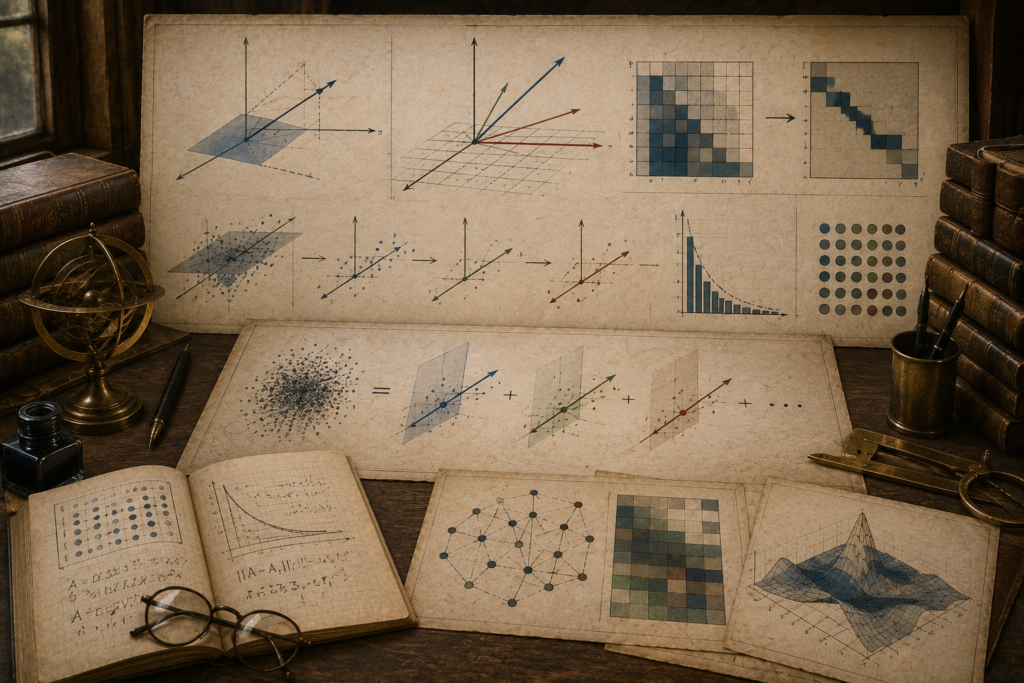
Singular value decomposition explains how a matrix can be separated into stable directions, ordered strengths, and structured approximation components. This article introduces the SVD factorization, singular values, left singular vectors, right singular vectors, singular spectra, rank, numerical rank, condition numbers, least-squares recovery, Moore-Penrose pseudoinverses, low-rank approximation, compression, denoising, truncated SVD, sparse SVD, large-scale computation, dimensionality reduction, and interpretation governance. It shows how SVD supports measurement systems, infrastructure monitoring, economic structure, environmental simulations, public health indicators, information systems, machine learning feature reduction, inverse problems, and scientific computing workflows. The article emphasizes that SVD requires clear matrix construction, preprocessing, scaling, centering, rank tolerance, retained-rank choice, pseudoinverse thresholds, reconstruction error review, residual interpretation, and validation because singular components reveal mathematical directions, not automatic causes, categories, or truths across systems where approximation choices shape evidence, stability, compression, interpretability, accountability, judgment, and responsible decision-making.