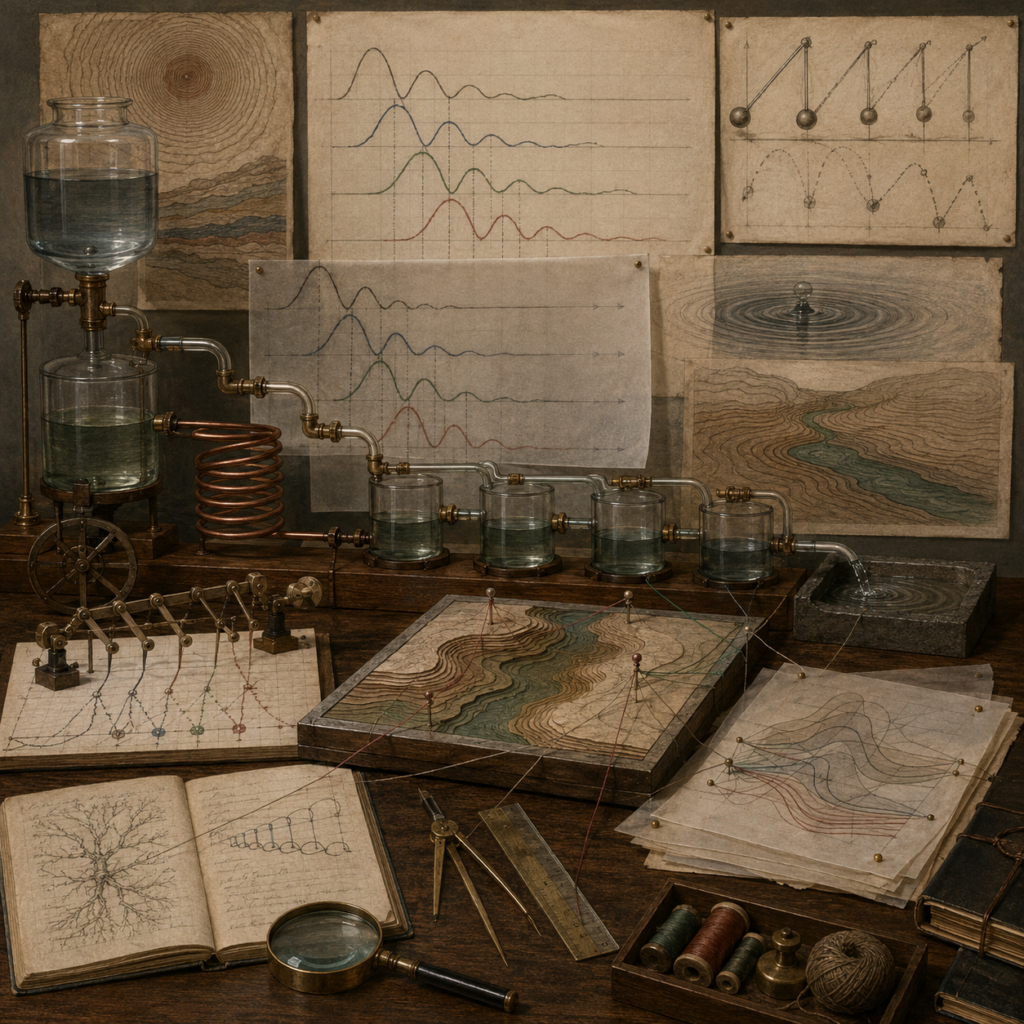
Delay, Memory, and Time-Lagged Dynamics
Delay, memory, and time-lagged dynamics explain why systems often respond after causes have already occurred. This article introduces instantaneous and delayed response, feedback with delay, lagged variables, memory and history, distributed delays, delay differential equations, overshoot, oscillation, policy resistance, numerical simulation, and responsible interpretation. It shows why delay matters for systems modeling: transport time, information lag, decision delay, biological incubation, infrastructure repair, resource regeneration, and institutional response can all reshape trajectories. In computational workflows, delay audits support delayed-adjustment simulations, history-function records, lagged-state lookup, response metrics, delay sweeps, solver-method documentation, SQL assumption registries, calculator scripts, and generated outputs. The article emphasizes documenting delay length, history assumptions, memory kernels, lag mechanisms, time step, interpolation method, feedback strength, uncertainty, and interpretive limits across public-health, climate, supply-chain, ecological, infrastructure, financial, organizational, and coupled human-natural systems.