
Last Updated June 15, 2026
Phase lines, phase planes, and phase portraits help modelers see the qualitative structure of dynamic systems. Instead of focusing only on exact formulas or single time-series plots, they reveal direction of change, equilibrium points, stability, thresholds, trajectories, basins of attraction, and local patterns of motion.
In systems modeling, phase reasoning is useful for population dynamics, predator-prey systems, epidemiology, climate feedback, resource regeneration, infrastructure stress, economic adjustment, urban congestion, control systems, ecological recovery, and coupled human-natural systems.
This article introduces phase lines, phase planes, and phase portraits for systems modeling, including one-dimensional phase lines, two-dimensional phase planes, vector fields, nullclines, equilibria, stability, trajectories, separatrices, basins of attraction, numerical simulation, and responsible interpretation.
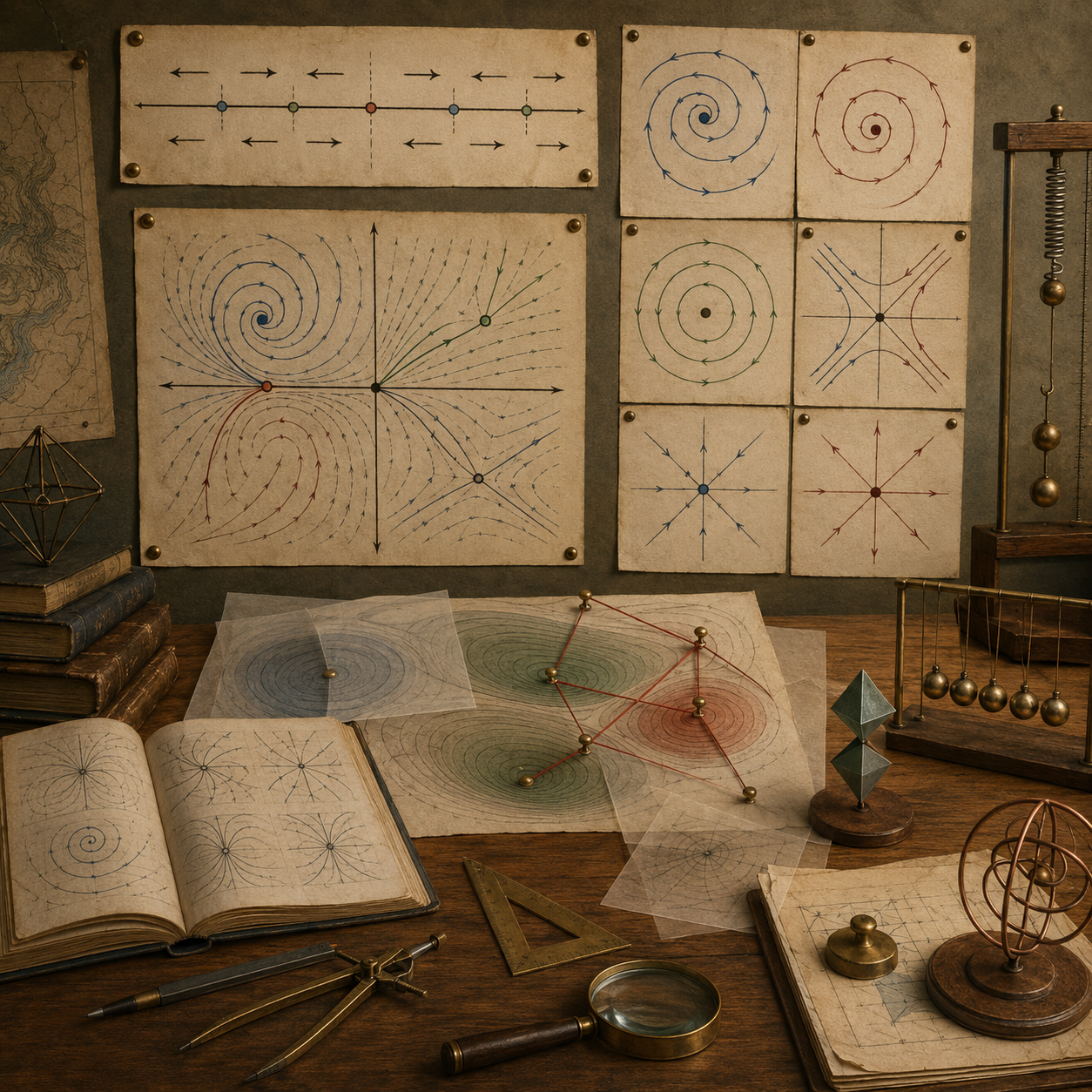
A phase line shows how a one-dimensional system moves along a single state axis. A phase plane shows how a two-state system moves through a two-dimensional state space. A phase portrait combines equilibria, arrows, trajectories, nullclines, and local patterns to summarize the behavior of a dynamic system without requiring a closed-form solution.
Why Phase Reasoning Matters
Phase reasoning matters because many dynamic systems are easier to understand through direction, stability, and geometry than through exact solutions. A phase line or phase portrait can show where change stops, where it accelerates, where it reverses, where trajectories converge, and where different futures separate.
x’ = f(x)
\]
Interpretation: A scalar system moves along a one-dimensional state axis according to the sign and size of \(f(x)\).
\mathbf{x}’=\mathbf{F}(\mathbf{x})
\]
Interpretation: A multi-state system moves through state space according to a vector field.
In systems modeling, phase reasoning shifts attention from isolated outputs to structural behavior. It asks how the system moves, where it tends, what separates outcomes, and how initial conditions shape trajectories.
| Question | Phase concept | Systems meaning |
|---|---|---|
| Where does change stop? | Equilibrium point. | A balance point, boundary state, threshold, or operating condition. |
| Which way does the system move? | Direction arrow or vector field. | Growth, decline, recovery, depletion, or interaction. |
| What path does the system follow? | Trajectory. | Dynamic history through state space. |
| What separates outcomes? | Separatrix or basin boundary. | Threshold between recovery, persistence, collapse, or regime shift. |
Phase diagrams do not replace equations. They make equations interpretable by showing the qualitative structure of motion.
Phase Lines
A phase line represents a one-dimensional autonomous differential equation along a single axis. It marks equilibrium points and uses arrows to show whether the state increases or decreases between them.
\frac{dx}{dt}=f(x)
\]
Interpretation: The sign of \(f(x)\) determines whether \(x\) moves right or left along the phase line.
If \(f(x)>0\), the state increases. If \(f(x)<0\), the state decreases. If \(f(x)=0\), the state is at equilibrium.
| Phase-line element | Mathematical meaning | Systems interpretation |
|---|---|---|
| Point on line. | A possible state value. | Population, stock, concentration, adoption level, or pressure level. |
| Equilibrium mark. | \(f(x)=0\) | Balance, boundary, threshold, or steady state. |
| Right arrow. | \(f(x)>0\) | Growth, accumulation, recovery, or expansion. |
| Left arrow. | \(f(x)<0\) | Decline, depletion, decay, or contraction. |
Phase lines are compact but powerful. They reveal stability and threshold behavior without requiring a closed-form solution for \(x(t)\).
Equilibria on a Phase Line
Equilibria occur where \(f(x)=0\). On a phase line, their stability can be read from surrounding arrows.
x’ = x(1-x)(x-a)
\]
Interpretation: This nonlinear scalar system has multiple equilibrium points.
The equilibrium values are:
x^*=0,\quad x^*=a,\quad x^*=1
\]
Interpretation: These points divide the phase line into intervals with different directions of motion.
When arrows point toward an equilibrium from both sides, it is stable. When arrows point away from it, it is unstable. When arrows point toward from one side and away from the other, it is semistable.
| Arrow pattern | Stability type | Systems meaning |
|---|---|---|
| Arrows point inward. | Stable. | Small disturbances tend to be corrected. |
| Arrows point outward. | Unstable. | Small disturbances tend to grow. |
| Inward from one side, outward from the other. | Semistable. | The point behaves like a one-sided threshold. |
| No sign change, derivative inconclusive. | Requires deeper analysis. | Higher-order structure may determine behavior. |
Phase lines are especially useful for explaining thresholds, alternative stable states, carrying capacity, extinction, saturation, and recovery dynamics.
Phase Plane
A phase plane represents a two-dimensional dynamic system. Each point in the plane corresponds to a pair of state values, such as population and resource level, susceptible and infected groups, or position and velocity.
\frac{dx}{dt}=f(x,y)
\]
\frac{dy}{dt}=g(x,y)
\]
Interpretation: The two rates describe how the state point \((x,y)\) moves through the plane.
The phase plane changes the modeling question. Instead of asking only how \(x\) changes over time, it asks how the pair \((x,y)\) moves through possible system states.
| Phase-plane object | Mathematical role | Systems interpretation |
|---|---|---|
| Point \((x,y)\). | System state. | Current condition of two interacting variables. |
| Vector. | Direction of motion. | How both states change together. |
| Trajectory. | Path through state space. | Dynamic history from an initial condition. |
| Equilibrium. | Point where both rates are zero. | Balance, coexistence, steady operation, or threshold state. |
Phase planes are central for systems of differential equations because interaction is often more important than any single variable alone.
Vector Fields
A vector field assigns a direction and magnitude of motion to each point in state space. For a two-dimensional system:
\mathbf{F}(x,y)=
\begin{bmatrix}
f(x,y)\\
g(x,y)
\end{bmatrix}
\]
Interpretation: The vector field tells the system how to move from each point in the phase plane.
At each state \((x,y)\), the vector \((f(x,y),g(x,y))\) points in the direction of change. Short vectors may indicate slow change. Long vectors may indicate rapid change.
| Vector-field feature | Meaning | Systems interpretation |
|---|---|---|
| Direction. | Where the system moves next. | Joint increase, decline, recovery, or transition. |
| Magnitude. | How fast the state changes. | Rapid adjustment, slow drift, or near-balance. |
| Convergence. | Vectors point toward a region. | Attraction, stabilization, or recovery. |
| Divergence. | Vectors point away from a region. | Instability, dispersion, or runaway response. |
Vector fields make the rules of motion visible. They help modelers see whether trajectories are likely to converge, diverge, spiral, cycle, or cross into different regimes.
Trajectories
A trajectory is the path a system follows through state space from an initial condition. In a phase plane, trajectories show the relationship between variables as the system evolves.
(x(0),y(0)) \rightarrow (x(t),y(t))
\]
Interpretation: The initial condition determines a path through the phase plane.
Different initial conditions can lead to different paths. In linear systems, trajectories may converge, diverge, or spiral in predictable ways. In nonlinear systems, they may approach different attractors, cross thresholds, cycle, or follow complex patterns.
| Trajectory pattern | Meaning | Systems interpretation |
|---|---|---|
| Converging path. | Moves toward equilibrium. | Recovery, stabilization, or return to operating state. |
| Diverging path. | Moves away from equilibrium. | Instability, amplification, or failure. |
| Spiral path. | Rotates while approaching or departing. | Oscillatory recovery or escalating cycles. |
| Closed path. | Repeats around a loop. | Sustained cycle or periodic behavior. |
| Separated paths. | Different initial states lead to different outcomes. | Basins, thresholds, and regime dependence. |
Trajectories are not just curves. They are histories of modeled change through state space.
Nullclines
Nullclines are curves where one component of motion is zero. For a two-dimensional system:
f(x,y)=0
\]
g(x,y)=0
\]
Interpretation: The first nullcline shows where \(x\) stops changing; the second shows where \(y\) stops changing.
Where nullclines intersect, both derivatives are zero. Those intersection points are equilibria.
f(x^*,y^*)=0,\quad g(x^*,y^*)=0
\]
Interpretation: The intersection of nullclines identifies a two-dimensional equilibrium point.
| Nullcline feature | Mathematical meaning | Systems interpretation |
|---|---|---|
| \(x\)-nullcline. | \(dx/dt=0\) | The first state pauses while the second may still change. |
| \(y\)-nullcline. | \(dy/dt=0\) | The second state pauses while the first may still change. |
| Nullcline intersection. | Both rates are zero. | Equilibrium or balance point. |
| Regions between nullclines. | Signs of \(dx/dt\) and \(dy/dt\) differ. | Direction of system movement changes by region. |
Nullclines make interaction structure easier to interpret. They show where each variable’s direction changes and how those changes organize phase-plane behavior.
Phase Portraits
A phase portrait is a qualitative summary of a dynamic system in state space. It typically includes vector-field arrows, trajectories, equilibria, nullclines, stability classifications, and sometimes basins or separatrices.
\mathbf{x}’=\mathbf{F}(\mathbf{x})
\]
Interpretation: A phase portrait visualizes the flow generated by the vector field.
Phase portraits are useful because they reveal the geometry of motion. A time-series plot can show what happened from one initial condition. A phase portrait can show what may happen from many initial conditions.
| Portrait component | Purpose | Systems meaning |
|---|---|---|
| Vector field. | Shows local direction of motion. | How the system moves from each state. |
| Trajectories. | Shows paths from initial conditions. | Possible histories of change. |
| Equilibria. | Shows balance points. | Operating states, thresholds, collapse points, or coexistence states. |
| Nullclines. | Shows where state rates vanish. | Boundaries of directional change. |
| Separatrices. | Shows boundaries between outcomes. | Thresholds between basins or regimes. |
A good phase portrait is not decorative. It is an analytical map of possible system behavior under a defined model.
Stability Patterns
Phase portraits help classify local stability patterns around equilibrium points. A two-dimensional system can approach, depart, spiral, cycle, or split along different directions.
\mathbf{u}’=A\mathbf{u}
\]
Interpretation: Near an equilibrium, local behavior is often approximated by a linear system.
The qualitative pattern depends on the local structure of the vector field, often summarized by eigenvalues of the linearized system.
| Pattern | Phase-portrait behavior | Systems interpretation |
|---|---|---|
| Stable node. | Trajectories approach directly. | Disturbances decay without oscillation. |
| Unstable node. | Trajectories move away. | Disturbances amplify. |
| Saddle. | Some directions approach, others depart. | Threshold-like instability or separatrix structure. |
| Stable spiral. | Trajectories spiral inward. | Damped oscillatory recovery. |
| Unstable spiral. | Trajectories spiral outward. | Escalating oscillation or destabilization. |
| Center. | Closed or near-closed loops. | Persistent oscillation under idealized assumptions. |
Stability patterns are local unless global analysis is provided. A stable-looking local portrait may not describe behavior after large shocks or outside the plotted region.
Separatrices and Basins of Attraction
A basin of attraction is the set of initial conditions that approach the same equilibrium or attractor. A separatrix is a boundary separating different long-run outcomes.
\mathbf{x}(0)\in B(A) \Rightarrow \mathbf{x}(t)\to A
\]
Interpretation: Initial conditions inside basin \(B(A)\) approach attractor \(A\).
Separatrices are important because they often mark thresholds. A small change near a separatrix may redirect the system toward a different equilibrium, regime, or failure state.
| Concept | Meaning | Systems interpretation |
|---|---|---|
| Basin of attraction. | Initial states leading to the same outcome. | Region of recovery, persistence, collapse, or stable operation. |
| Basin boundary. | Boundary between basins. | Threshold between different futures. |
| Separatrix. | Trajectory or curve dividing outcomes. | Critical transition boundary. |
| Small basin. | Few initial states approach the attractor. | Fragile stability. |
| Large basin. | Many initial states approach the attractor. | Robust stability. |
Basins and separatrices are crucial for resilience analysis because they shift attention from a single equilibrium to the range of disturbances the system can absorb before changing regimes.
Numerical Simulation
Phase portraits are usually built numerically. A grid of state-space points is evaluated under the vector field, and trajectories are computed from selected initial conditions.
\mathbf{x}_{n+1}=\mathbf{x}_n+\Delta t\,\mathbf{F}(\mathbf{x}_n)
\]
Interpretation: An explicit Euler update approximates motion through state space.
More accurate solvers are often used in practice, but the Euler update makes the basic idea visible: state plus a small step in the direction of the vector field.
| Numerical task | Purpose | Responsible practice |
|---|---|---|
| Vector-field grid. | Shows local direction across state space. | Choose meaningful state ranges and scales. |
| Trajectory simulation. | Shows paths from initial conditions. | Use multiple initial states, not just one. |
| Nullcline computation. | Identifies where rates vanish. | Check intersections and domain meaning. |
| Step-size comparison. | Checks solver sensitivity. | Separate numerical artifact from modeled behavior. |
| Domain validation. | Checks whether states remain meaningful. | Avoid interpreting invalid simulated values. |
Numerical phase portraits are model outputs. They depend on equations, parameters, plotted ranges, solver methods, step sizes, and initial conditions.
Systems Modeling Interpretation
Phase lines, phase planes, and phase portraits are interpretive tools for dynamic systems. They help modelers see whether a system tends toward a steady state, cycles around an equilibrium, diverges from a balance point, crosses a threshold, or depends strongly on initial conditions.
For a one-state system, a phase line can reveal whether a carrying capacity is stable, whether zero is unstable, or whether a threshold separates recovery from collapse. For a two-state system, a phase plane can reveal whether interacting variables move toward coexistence, oscillate, spiral outward, or divide into separate basins.
These diagrams are especially valuable when the exact solution is unavailable or less important than the qualitative structure. In systems modeling, the goal is often not just to compute one trajectory. It is to understand the possible pattern of trajectories under a transparent set of assumptions.
Mathematical Deepening
This section adds a more formal layer for mathematically advanced readers. Phase analysis connects derivatives, equilibrium points, sign analysis, vector fields, nullclines, trajectories, local linearization, stability classification, separatrices, and basins of attraction.
One-Dimensional Phase Analysis
Sign of the Rate
The sign of \(f(x)\) determines whether the state moves left or right.
Equilibrium Points
Equilibria occur where \(f(x)=0\).
Stability from Arrows
Arrow direction around equilibrium reveals stability, instability, or semistability.
Threshold Behavior
Unstable or semistable equilibria often behave like transition boundaries.
Two-Dimensional Phase Analysis
State Space
Each point represents a pair of state variables.
Vector Field
Each vector shows the local direction and speed of change.
Nullclines
Nullclines show where one component of motion is zero.
Trajectories
Trajectories show paths through state space from initial conditions.
Qualitative Structures
Nodes
Trajectories approach or depart without oscillation.
Spirals
Trajectories rotate while approaching or leaving equilibrium.
Saddles
Some directions approach while others depart.
Cycles
Trajectories repeat or circulate through state space.
Modeling Governance
State Ranges
Phase diagrams should use meaningful state-space ranges.
Parameter Values
Portraits should document the parameter values used to generate them.
Initial Conditions
Trajectory interpretation depends on selected starting states.
Solver Settings
Step size and solver choice can distort phase behavior.
Examples from Systems Modeling
Phase lines, phase planes, and phase portraits are useful wherever dynamic systems have equilibria, thresholds, feedback, interaction, or alternative outcomes.
Logistic Growth
A phase line shows zero as an unstable equilibrium and carrying capacity as a stable equilibrium.
Predator-Prey Systems
A phase plane shows cycles, coexistence points, and interaction-driven trajectories.
Epidemiological Models
Phase portraits show movement between susceptible, infected, and recovered states.
Resource Regeneration
Phase lines can distinguish recovery basins from depletion basins.
Infrastructure Stress
Phase diagrams can show operating regions, overload thresholds, and failure boundaries.
Climate Feedback
Phase portraits can represent feedback-driven transitions between temperature and carbon states.
Across these examples, phase reasoning clarifies not only what happens from one initial condition, but how the system’s structure organizes many possible paths.
Computation and Reproducible Workflows
Computational workflows for phase lines, phase planes, and phase portraits should record the equations, parameters, state ranges, grid resolution, initial conditions, equilibrium candidates, nullcline equations, solver method, step size, time horizon, domain checks, and interpretation warnings.
Because phase diagrams can be visually persuasive, reproducible workflows should generate audit tables alongside plots. The goal is to make the diagram’s assumptions and construction visible.
Python Workflow: Phase Portrait Audit
The Python workflow below evaluates a predator-prey phase plane. It records vector-field values, nullcline conditions, equilibrium candidates, and warnings.
from __future__ import annotations

from dataclasses import dataclass, asdict
from pathlib import Path
import csv
import json


@dataclass(frozen=True)
class PhaseRecord:
    x: float
    y: float
    dxdt: float
    dydt: float
    x_nullcline_residual: float
    y_nullcline_residual: float
    speed: float
    warning: str


def predator_prey_rates(
    x: float,
    y: float,
    alpha: float,
    beta: float,
    delta: float,
    gamma: float
) -> tuple[float, float]:
    dxdt = alpha * x - beta * x * y
    dydt = delta * x * y - gamma * y
    return dxdt, dydt


def build_phase_grid() -> list[PhaseRecord]:
    alpha = 0.7
    beta = 0.05
    delta = 0.02
    gamma = 0.5

    records: list[PhaseRecord] = []

    for x in range(0, 61, 5):
        for y in range(0, 31, 3):
            dxdt, dydt = predator_prey_rates(
                float(x),
                float(y),
                alpha,
                beta,
                delta,
                gamma
            )

            x_nullcline_residual = dxdt
            y_nullcline_residual = dydt
            speed = (dxdt ** 2 + dydt ** 2) ** 0.5

            records.append(
                PhaseRecord(
                    x=float(x),
                    y=float(y),
                    dxdt=dxdt,
                    dydt=dydt,
                    x_nullcline_residual=x_nullcline_residual,
                    y_nullcline_residual=y_nullcline_residual,
                    speed=speed,
                    warning="Vector-field values depend on parameter values, state ranges, and the assumed interaction structure."
                )
            )

    return records


records = build_phase_grid()

output_dir = Path("outputs")
(output_dir / "tables").mkdir(parents=True, exist_ok=True)
(output_dir / "json").mkdir(parents=True, exist_ok=True)

with (output_dir / "tables" / "phase_portrait_audit.csv").open("w", newline="", encoding="utf-8") as handle:
    writer = csv.DictWriter(handle, fieldnames=asdict(records[0]).keys())
    writer.writeheader()
    for record in records:
        writer.writerow(asdict(record))

(output_dir / "json" / "phase_portrait_audit.json").write_text(
    json.dumps([asdict(record) for record in records], indent=2),
    encoding="utf-8"
)

equilibria = {
    "extinction": [0.0, 0.0],
    "coexistence": [0.5 / 0.02, 0.7 / 0.05]
}

(output_dir / "json" / "phase_portrait_equilibria.json").write_text(
    json.dumps(equilibria, indent=2),
    encoding="utf-8"
)

print("Wrote phase portrait audit.")
This workflow makes the phase portrait’s vector-field values, nullcline residuals, equilibria, and warnings inspectable.
R Workflow: Phase Plane Diagnostics
The R workflow below builds a phase-plane diagnostic table for the same predator-prey example.
predator_prey_rates <- function(x, y, alpha, beta, delta, gamma) {
  dxdt <- alpha * x - beta * x * y
  dydt <- delta * x * y - gamma * y
  c(dxdt = dxdt, dydt = dydt)
}

alpha <- 0.7
beta <- 0.05
delta <- 0.02
gamma <- 0.5

grid <- expand.grid(
  x = seq(0, 60, by = 5),
  y = seq(0, 30, by = 3)
)

records <- list()

for (i in seq_len(nrow(grid))) {
  x <- grid$x[[i]]
  y <- grid$y[[i]]

  rates <- predator_prey_rates(
    x = x,
    y = y,
    alpha = alpha,
    beta = beta,
    delta = delta,
    gamma = gamma
  )

  records[[length(records) + 1]] <- data.frame(
    x = x,
    y = y,
    dxdt = rates[["dxdt"]],
    dydt = rates[["dydt"]],
    x_nullcline_residual = rates[["dxdt"]],
    y_nullcline_residual = rates[["dydt"]],
    speed = sqrt(rates[["dxdt"]]^2 + rates[["dydt"]]^2),
    warning = "Vector-field values depend on parameter values, state ranges, and the assumed interaction structure."
  )
}

results <- do.call(rbind, records)

dir.create("outputs/tables", recursive = TRUE, showWarnings = FALSE)
write.csv(results, "outputs/tables/r_phase_portrait_audit.csv", row.names = FALSE)

equilibria <- data.frame(
  equilibrium = c("extinction", "coexistence"),
  x = c(0, gamma / delta),
  y = c(0, alpha / beta)
)

write.csv(equilibria, "outputs/tables/r_phase_portrait_equilibria.csv", row.names = FALSE)

print(head(results))
print(equilibria)
This workflow records phase-plane structure in tables that can be checked before any visual diagram is interpreted.
Haskell Workflow: Typed Phase Records
Haskell can represent phase-plane samples as typed records with state values, derivative components, speed, and warning text.
module Main where

data PhaseRecord = PhaseRecord
  { x :: Double
  , y :: Double
  , dxdt :: Double
  , dydt :: Double
  , speed :: Double
  , warning :: String
  } deriving (Show)

predatorPreyRates ::
  Double ->
  Double ->
  Double ->
  Double ->
  Double ->
  Double ->
  (Double, Double)
predatorPreyRates x y alpha beta delta gamma =
  let dx = alpha * x - beta * x * y
      dy = delta * x * y - gamma * y
  in (dx, dy)

buildRecord :: Double -> Double -> PhaseRecord
buildRecord xValue yValue =
  let alpha = 0.7
      beta = 0.05
      delta = 0.02
      gamma = 0.5
      (dx, dy) = predatorPreyRates xValue yValue alpha beta delta gamma
      s = sqrt (dx * dx + dy * dy)
  in PhaseRecord
      xValue
      yValue
      dx
      dy
      s
      "Vector-field values depend on parameter values, state ranges, and the assumed interaction structure."

phaseRecords :: [PhaseRecord]
phaseRecords =
  [ buildRecord xValue yValue
  | xValue <- [0,5..60]
  , yValue <- [0,3..30]
  ]

main :: IO ()
main =
  mapM_ print (take 20 phaseRecords)
The typed workflow keeps phase-plane records explicit rather than treating the diagram as an unexamined visual object.
SQL Workflow: Phase-Space Assumption Registry
SQL can document assumptions behind phase diagrams when they support model governance, dashboards, reproducible repositories, or public-facing explainers.
CREATE TABLE phase_space_assumption_registry (
    assumption_key TEXT PRIMARY KEY,
    assumption_name TEXT NOT NULL,
    mathematical_role TEXT NOT NULL,
    systems_modeling_role TEXT NOT NULL,
    review_warning TEXT NOT NULL
);

INSERT INTO phase_space_assumption_registry VALUES
(
  'state_space_range',
  'State-space range',
  'Defines the domain shown in the phase line or phase plane.',
  'Determines which system states are treated as relevant or meaningful.',
  'A phase portrait can mislead if important regions are cropped or invalid regions are shown.'
);

INSERT INTO phase_space_assumption_registry VALUES
(
  'vector_field',
  'Vector field',
  'Assigns a derivative vector to each state-space point.',
  'Shows the local direction and speed of system change.',
  'Vector-field arrows depend on equations, parameters, scaling, and grid resolution.'
);

INSERT INTO phase_space_assumption_registry VALUES
(
  'nullclines',
  'Nullclines',
  'Identify where one component of motion is zero.',
  'Reveal directional boundaries and equilibrium candidates.',
  'Nullclines require domain checks and parameter documentation.'
);

INSERT INTO phase_space_assumption_registry VALUES
(
  'trajectory_selection',
  'Trajectory selection',
  'Chooses initial conditions for simulated paths.',
  'Shows possible histories through state space.',
  'Selected trajectories may overrepresent some outcomes and hide others.'
);

INSERT INTO phase_space_assumption_registry VALUES
(
  'stability_classification',
  'Stability classification',
  'Labels local behavior near equilibria.',
  'Supports interpretation of recovery, instability, spirals, cycles, or thresholds.',
  'Local stability labels should not be treated as global guarantees.'
);

INSERT INTO phase_space_assumption_registry VALUES
(
  'solver_method',
  'Solver method',
  'Defines how trajectories are approximated computationally.',
  'Supports reproducible phase-portrait construction.',
  'Step size and solver choice can distort phase behavior.'
);

SELECT
    assumption_name,
    mathematical_role,
    systems_modeling_role,
    review_warning
FROM phase_space_assumption_registry
ORDER BY assumption_key;
This registry keeps phase-diagram interpretation tied to state ranges, vector fields, nullclines, trajectories, stability classifications, solver methods, and model scope.
GitHub Repository
The companion repository for this article is designed as a reproducible mathematical-modeling workspace. It supports phase-line audits, phase-plane diagnostics, predator-prey vector-field examples, nullcline records, trajectory checks, SQL governance tables, generated outputs, advanced mathematical audit reports, and reusable calculator scripts.
Complete Code Repository
Companion article folder with Python, R, Julia, SQL, Haskell, C, C++, Fortran, Rust, Go, notebooks, documentation, synthetic teaching data, generated outputs, schemas, Canvas-ready workflow artifacts, and reusable calculator scripts for phase lines, phase planes, phase portraits, vector fields, nullclines, trajectories, equilibria, stability patterns, basins of attraction, model governance, and responsible mathematical modeling.
Interpretive Limits and Responsible Use
Phase lines, phase planes, and phase portraits are powerful because they make qualitative dynamics visible. They are risky when diagrams are treated as direct pictures of reality rather than model-based constructions. A phase portrait depends on chosen equations, parameters, state ranges, plotted resolution, initial conditions, solver method, and scaling choices.
Responsible use requires several checks. Define the state variables and meaningful domains. Document equations and parameters. Identify equilibrium candidates and nullclines. State whether stability claims are local or global. Use multiple initial conditions. Record solver methods, step sizes, and time horizons. Check whether simulated trajectories remain in meaningful regions. Explain whether results are theoretical, descriptive, exploratory, scenario-based, or predictive.
The central modeling question is not only “What does the phase portrait show?” It is “What assumptions, ranges, parameters, numerical choices, and interpretive limits produced this portrait?”
Related Articles
- Calculus for Systems Modeling
- Differential Equations and Dynamic Systems
- Systems of Differential Equations
- Nonlinear Differential Equations
- Equilibrium, Stability, and Local Dynamics
- Bifurcation and Qualitative Change
- Chaos and Sensitivity to Initial Conditions
- Predator-Prey Systems
- Climate Feedback Models
- Resource Depletion and Regeneration
Further Reading
- Arnold, V.I. (1992) Ordinary Differential Equations. Berlin: Springer.
- Boyce, W.E., DiPrima, R.C. and Meade, D.B. (2017) Elementary Differential Equations and Boundary Value Problems. 11th edn. Hoboken, NJ: Wiley.
- Hirsch, M.W., Smale, S. and Devaney, R.L. (2013) Differential Equations, Dynamical Systems, and an Introduction to Chaos. 3rd edn. Amsterdam: Academic Press.
- Strogatz, S.H. (2018) Nonlinear Dynamics and Chaos: With Applications to Physics, Biology, Chemistry, and Engineering. 2nd edn. Boca Raton, FL: CRC Press.
- Teschl, G. (2012) Ordinary Differential Equations and Dynamical Systems. Providence, RI: American Mathematical Society.
- Massachusetts Institute of Technology (MIT) OpenCourseWare (2010) Differential Equations. Cambridge, MA: MIT OpenCourseWare.
- OpenStax (2016) Calculus Volume 2. Houston, TX: OpenStax, Rice University.
- Murray, J.D. (2002) Mathematical Biology I: An Introduction. 3rd edn. New York: Springer.
- Perko, L. (2001) Differential Equations and Dynamical Systems. 3rd edn. New York: Springer.
- Jordan, D.W. and Smith, P. (2007) Nonlinear Ordinary Differential Equations: An Introduction for Scientists and Engineers. 4th edn. Oxford: Oxford University Press.
References
- Arnold, V.I. (1992) Ordinary Differential Equations. Berlin: Springer.
- Boyce, W.E., DiPrima, R.C. and Meade, D.B. (2017) Elementary Differential Equations and Boundary Value Problems. 11th edn. Hoboken, NJ: Wiley.
- Hirsch, M.W., Smale, S. and Devaney, R.L. (2013) Differential Equations, Dynamical Systems, and an Introduction to Chaos. 3rd edn. Amsterdam: Academic Press.
- Jordan, D.W. and Smith, P. (2007) Nonlinear Ordinary Differential Equations: An Introduction for Scientists and Engineers. 4th edn. Oxford: Oxford University Press.
- Massachusetts Institute of Technology (MIT) OpenCourseWare (2010) Differential Equations. Cambridge, MA: MIT OpenCourseWare.
- Murray, J.D. (2002) Mathematical Biology I: An Introduction. 3rd edn. New York: Springer.
- OpenStax (2016) Calculus Volume 2. Houston, TX: OpenStax, Rice University.
- Perko, L. (2001) Differential Equations and Dynamical Systems. 3rd edn. New York: Springer.
- Strogatz, S.H. (2018) Nonlinear Dynamics and Chaos: With Applications to Physics, Biology, Chemistry, and Engineering. 2nd edn. Boca Raton, FL: CRC Press.
- Teschl, G. (2012) Ordinary Differential Equations and Dynamical Systems. Providence, RI: American Mathematical Society.