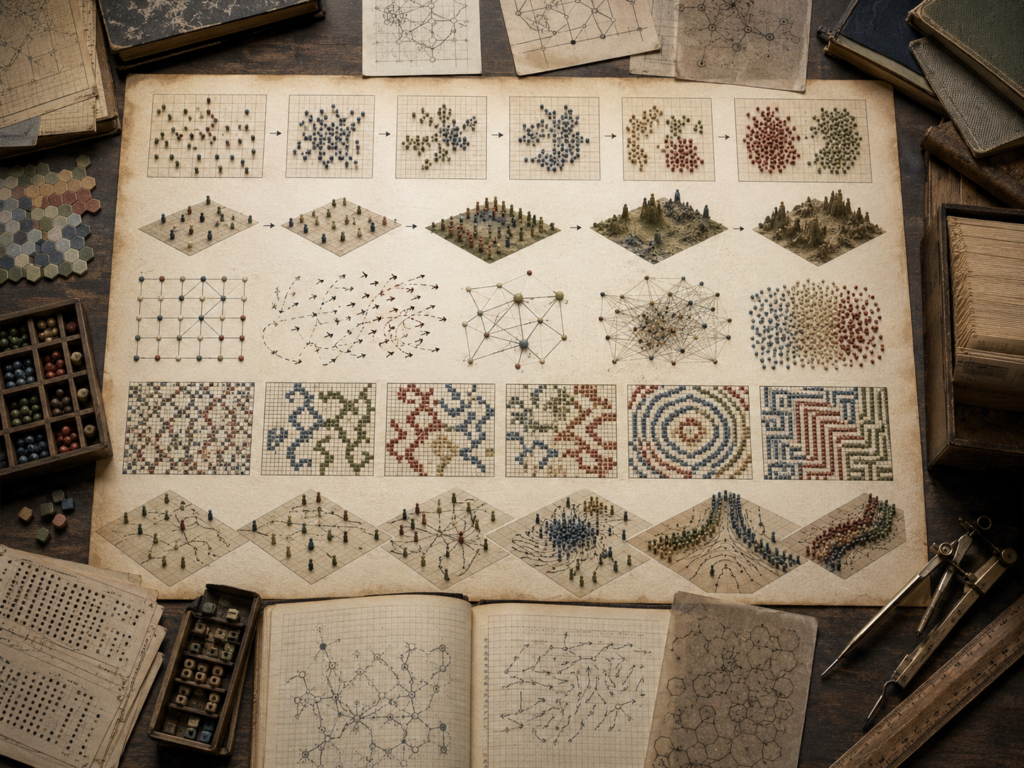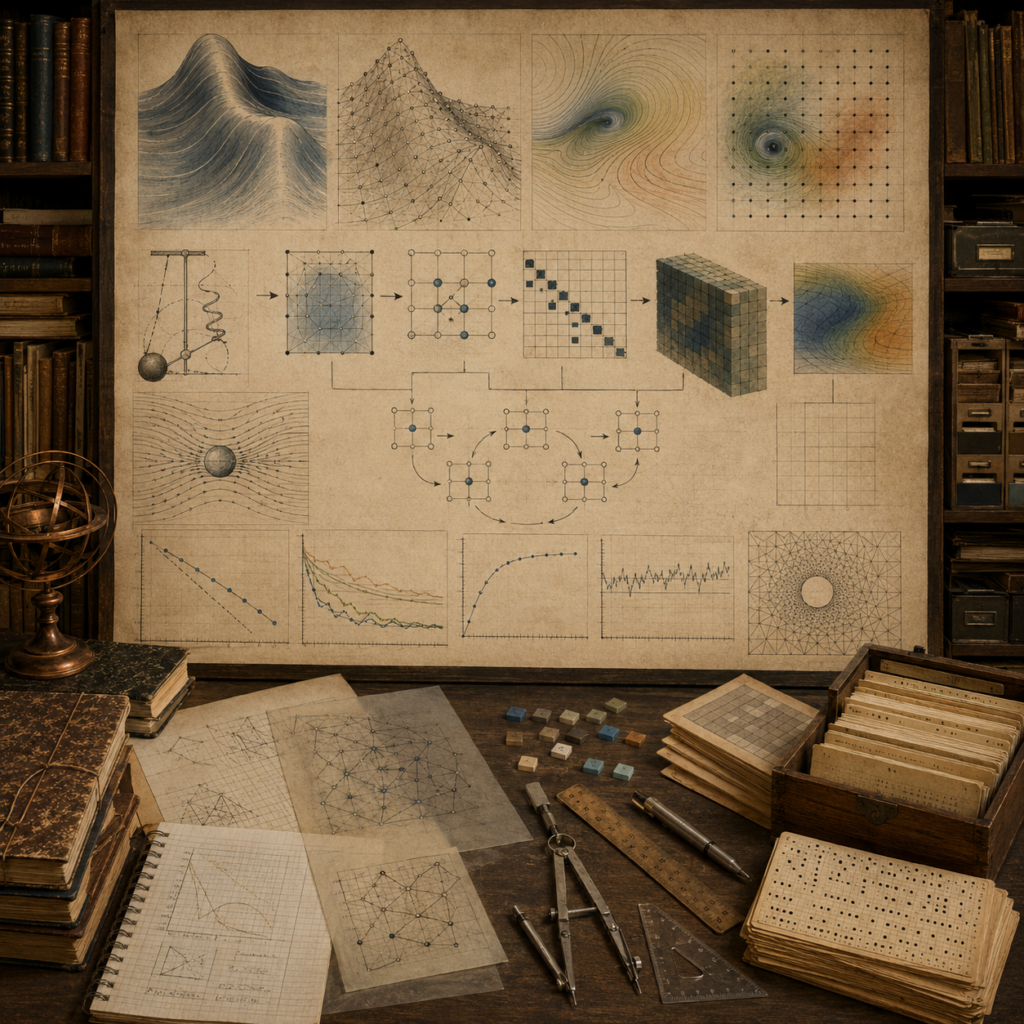
Scholarly editorial illustration of natural, geometric, biological, architectural, and cosmic patterns on textured parchment, including spirals, tessellations, waves, networks, fractals, honeycomb forms, and branching structures.

Mathematics as the Science of Patterns

Mathematics as the Science of Patterns examines mathematics as the disciplined study of order across number, space, structure, logic, change, uncertainty, and computation. The article moves beyond the simple idea of pattern as repetition and shows how mathematical patterns become knowledge only when they are represented, abstracted, generalized, tested, and proved. It explores numerical sequences, spatial symmetry, graph structures, logical proof patterns, dynamic systems, probabilistic regularities, computational discovery, and the dangers of false pattern recognition. By connecting pattern to structure, invariant, proof, and counterexample, the article frames mathematics as both a creative and critical science of form. It also addresses the ethical responsibilities of pattern use in modeling, AI, economics, environmental monitoring, and institutional decision-making, where detected regularities can shape real-world judgments and consequences across research, education, scientific modeling, and public reasoning in high-stakes technical and civic contexts today.

Scholarly editorial illustration showing natural forms, architectural fragments, geometric diagrams, networks, and abstract shapes moving from concrete examples toward generalized mathematical structures.

Abstraction and the Power of Generalization

Abstraction and the Power of Generalization explains how mathematics moves from particular examples to durable structures, transferable methods, and justified claims. The article treats abstraction as the disciplined selection of what matters: cardinality instead of apples, adjacency instead of a transportation system, operation structure instead of a familiar calculation. It then shows how generalization extends insight across classes of objects, but only when domains, assumptions, definitions, invariants, and counterexamples are handled carefully. Through examples from arithmetic, algebra, topology, graph theory, functions, proof, equivalence relations, and structure-preserving maps, the article frames abstraction as one of the deepest engines of mathematical thought. It also addresses the ethical responsibilities of abstraction in modeling, AI, economics, environmental systems, and public decision-making, where what gets omitted can matter as much as what gets preserved across research, teaching, formalization, scientific modeling, and responsible systems analysis.

Scholarly editorial illustration of geometric patterns, tessellations, spirals, networks, fractal forms, and a classical contemplative figure on textured parchment, representing mathematical imagination through structure and abstraction.

Patterns, Structure, and the Mathematical Imagination

Patterns, Structure, and the Mathematical Imagination explores how mathematics begins in noticed regularities but matures into disciplined structural reasoning. The article shows how patterns in sequences, shapes, graphs, symmetries, and transformations become mathematical knowledge only when they are clarified through abstraction, invariance, representation, counterexample, and proof. It treats mathematical imagination not as fantasy, but as the capacity to see hidden form, transfer insight across domains, and ask what remains stable beneath change. From odd-number sums and graph invariants to analogy, symmetry, and counterexample discipline, the article frames mathematics as a creative practice governed by rigorous constraint. It also connects classical mathematical insight with computational workflows for pattern detection, graph reasoning, invariant analysis, and structural metadata. The result is a serious introduction to how imagination and proof work together in mathematical thought across research, education, modeling, and formal verification contexts.

Restrained editorial illustration of geometric constructions, abstract networks, spiral forms, grids, and hand-drawn reasoning diagrams on aged paper, representing mathematical thinking as pattern recognition, abstraction, proof, and structured inquiry.

What Is Mathematical Thinking? Pattern, Proof, Architecture, and Reason

Mathematical thinking is the disciplined practice of recognizing pattern, clarifying structure, testing conjectures, and building proofs that make claims durable. This article introduces mathematical thinking as more than calculation or symbolic manipulation: it is a way of moving from examples to abstraction, from intuition to justification, and from isolated results to coherent architectures of definitions, theorems, counterexamples, and models. It examines pattern recognition, recursion, proof dependency graphs, representation, formalization, computation, and the ethical responsibilities that come with quantification. By connecting classical habits of mathematical reasoning with modern tools such as theorem metadata, graph analysis, and proof-assistant workflows, the article frames mathematics as both a creative and critical discipline. Mathematical thinking becomes a method for asking better questions, exposing assumptions, tracing consequences, and reasoning responsibly about complex systems. It also supports serious research, teaching, formal verification, and interdisciplinary scientific judgment.

Editorial illustration of a diverse design group gathered around a large research table with systems maps, community models, ecological plans, stakeholder figures, feedback diagrams, and institutional sketches.

The Future of Design Thinking

The future of design thinking depends on whether the field can mature beyond workshops, canvases, rapid ideation, and innovation language into a serious practice for working with complexity, power, evidence, artificial intelligence, public value, and long-term stewardship. This article argues that design thinking’s next phase must remain human-centered while becoming more systems-aware, community-accountable, ethically grounded, data-literate, AI-governed, ecologically responsible, and institutionally durable. It examines the movement from users to publics, from prototypes to learning systems, from creativity to governance, and from novelty to responsible change. The article also explores AI-assisted design research, design justice, public-sector innovation, implementation capacity, risk, resilience, climate responsibility, and professional design education. The future of design thinking will be less about methods as rituals and more about design as disciplined public responsibility.

Editorial illustration of a diverse community group and design practitioners gathered around a planning table with public service models, transit systems, civic maps, stakeholder diagrams, and community outcome pathways.

Design Thinking for Social Impact and Public Value

Design thinking for social impact and public value examines how human-centered methods can serve civic, institutional, community, environmental, and mission-driven goals without reducing social problems to simple innovation exercises. This article argues that public value is broader than user experience, adoption, or organizational efficiency. It includes access, dignity, fairness, legitimacy, accountability, trust, sustainability, burden reduction, participation, and long-term stewardship. The article explores problem framing, community authority, co-design, power, justice, systems change, service delivery, policy implementation, evidence, data, public learning, evaluation, scaling, ethical safeguards, and impact measurement. It shows how design thinking becomes more responsible when it connects lived experience to systems, governance, implementation capacity, and repair, while remaining honest about the limits of design in the face of structural inequality and institutional power.

Editorial illustration of a diverse group studying institutional systems, public buildings, service environments, stakeholder networks, governance diagrams, and organizational pathways across a large research table.

Design Thinking for Complex Institutions

Design thinking for complex institutions examines how human-centered methods must change when problems are shaped by rules, authority, budgets, data systems, professional cultures, public trust, and long-term implementation constraints. This article argues that institutional design cannot rely only on empathy interviews, workshops, prototypes, or journey maps. Complex institutions require systems thinking, governance analysis, stakeholder mapping, policy awareness, organizational psychology, burden analysis, and learning infrastructure. The article explores problem framing, decision rights, frontline repair work, service systems, backstage infrastructure, data systems, ethics, unequal burden, prototyping, implementation, resistance, incentives, evaluation, and institutional absorption. It shows how design thinking becomes more serious when it asks not only what people need, but what the institution must change in order to deliver public value, accountability, access, dignity, and lasting institutional capacity.

Editorial illustration of a design research team studying data maps, AI-assisted pattern analysis, stakeholder evidence, interview sketches, systems diagrams, and prototype environments across a large research table.

Design Thinking, Data Systems, and AI-Assisted Research

Design thinking increasingly depends on data systems and AI-assisted research because human-centered inquiry now takes place across complex digital, institutional, behavioral, and informational environments. This article examines how design teams can connect interviews, contextual inquiry, analytics, service logs, survey data, prototype feedback, research repositories, semantic search, and AI-assisted synthesis into a more disciplined evidence system. It argues that AI should support research rather than replace human interpretation, participant knowledge, or ethical judgment. The article explores mixed-methods design intelligence, metadata, provenance, knowledge systems, research pipelines, validation, bias risk, privacy, public-sector applications, service design, behavioral data, and institutional learning. It shows how design thinking becomes stronger when evidence is traceable, findings are validated, uncertainty is documented, and AI-generated outputs remain accountable to human experience.

Editorial illustration of a diverse group gathered around a design research table with equity diagrams, stakeholder maps, accessibility scenes, power relationships, and community portraits.

Ethics, Power, and Inclusion in Design Thinking

Ethics, power, and inclusion are central to design thinking because human-centered methods can still reproduce exclusion when power remains unnamed. This article examines how design processes define problems, recruit participants, interpret evidence, allocate authority, test prototypes, and measure success. It argues that empathy, workshops, and user research are not enough unless affected people have real influence, accessibility is designed from the beginning, and harms can be detected, challenged, and repaired. The article explores design justice, disability access, administrative burden, participation, co-design, public policy, AI, behavioral power, service design, governance, and accountability. It shows how ethical design thinking moves beyond representation toward shared power, transparent trade-offs, responsible measurement, and repair. Design becomes more serious when it asks who benefits, who carries burden, and who can change the outcome.

Scroll to Top