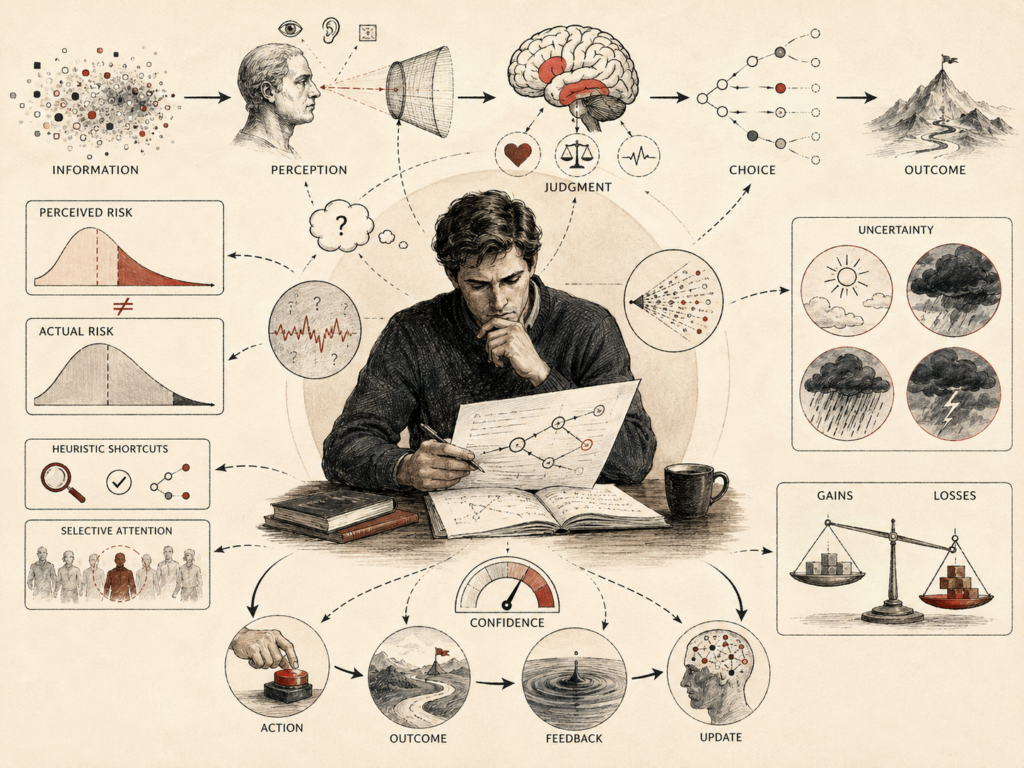
Restrained institutional illustration showing human decision making under uncertainty, with information, perception, judgment, risk estimates, heuristic shortcuts, selective attention, confidence, gains, losses, choices, outcomes, feedback, and belief updating.

Risk Perception and Uncertainty in Human Decision Making

Risk perception refers to the cognitive processes through which uncertain outcomes become psychologically meaningful. Human beings do not respond to risk by calculating probability alone. They interpret uncertainty through a blend of estimated likelihood, perceived consequence, emotional salience, prior experience, and contextual framing. For that reason, risk is not simply discovered in the environment as an objective property. It is cognitively constructed as the mind translates complex uncertainty into judgments about danger, opportunity, vulnerability, and control. This helps explain why people may fear vivid but improbable events, discount familiar but statistically significant dangers, or respond very differently to the same underlying hazard depending on how it is described. In cognitive psychology, risk perception therefore occupies a central place within the study of judgment and decision making under uncertainty. It reveals how attention, memory, heuristics, and affect combine to shape real-world behavior in ways that often diverge from formal rational models while still remaining structured, predictable, and deeply consequential for finance, health, policy, and collective life.
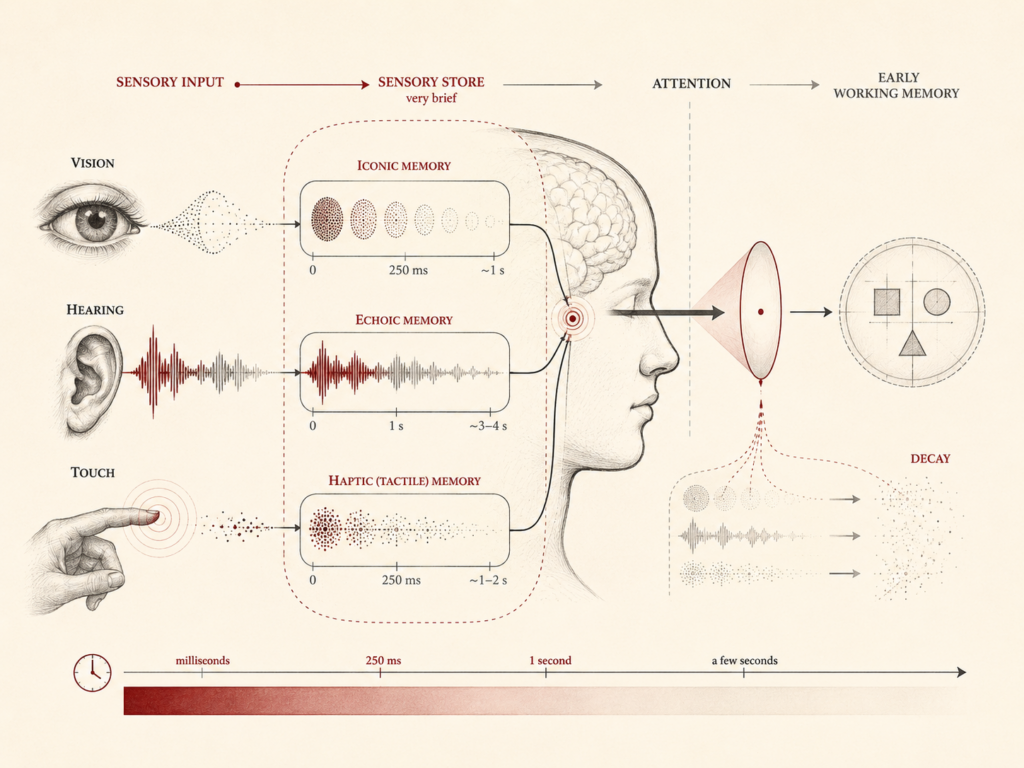
Restrained institutional cognitive psychology diagram showing sensory memory as the earliest stage of information processing, with vision, hearing, and touch entering brief iconic, echoic, and haptic memory stores before attention selects information for early working memory.

Sensory Memory in Cognitive Psychology: The Earliest Stage of Information Processing

Sensory memory is the earliest layer of cognition through which raw sensory input briefly persists after stimulation has ended, allowing the mind to stabilize a rapidly changing stream of experience before it disappears. Rather than acting as a durable storage system, it preserves fleeting traces of visual, auditory, and tactile information long enough for perceptual organization and attentional selection to occur. This short-lived retention is one of the conditions that makes coherent perception possible at all. Without it, vision would be more fragmented across eye movements, speech would be harder to integrate across time, and tactile experience would lose much of its continuity. In cognitive psychology, sensory memory therefore occupies a foundational place within the broader architecture of information processing. It serves as the transitional layer between sensation and higher cognition, capturing far more information than can be consciously processed and making a small portion of that information available for selection by attention and further use in working memory.

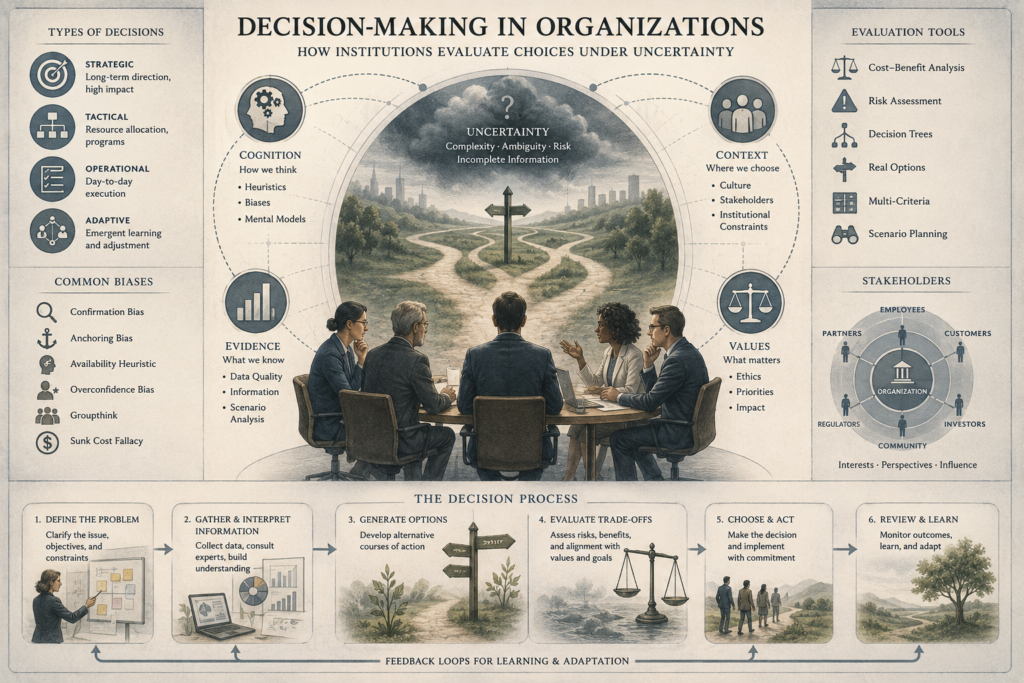
Illustrated institutional infographic showing organizational decision-making under uncertainty, with leaders at a table, branching paths, stakeholder maps, evaluation tools, biases, and feedback loops.

Decision-Making in Organizations: How Institutions Evaluate Choices Under Uncertainty

Organizational decision-making is the institutional process through which organizations interpret information, define problems, distribute authority, evaluate alternatives, and commit themselves to action under uncertainty. Far from a purely rational sequence, it is shaped by bounded cognition, information quality, hierarchy, culture, incentives, communication systems, and power. This article examines how organizations actually make decisions, why judgment degrades under bias and coordination strain, and how institutional design can improve learning, dissent, and accountability. It also introduces a semi-formal model of decision quality, along with substantial R and Python workflows for analyzing decision environments. The result is a more serious view of decision-making as a systemic feature of organizational life rather than a simplified management technique.

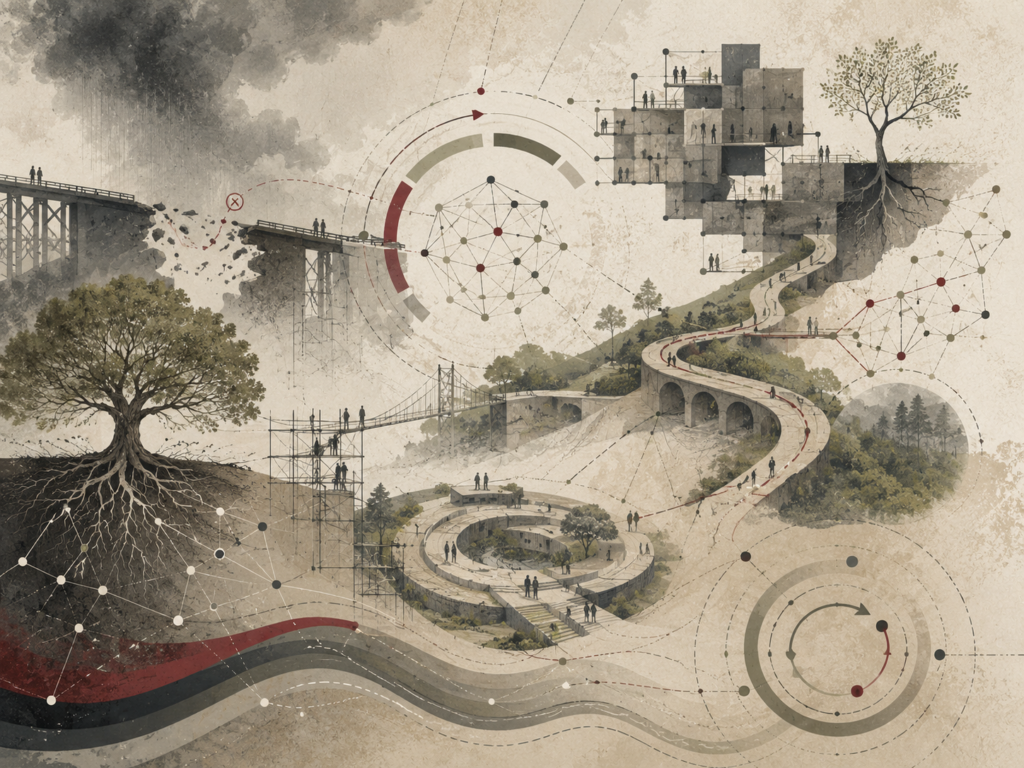
Restrained institutional illustration of damaged bridges, adaptive pathways, rooted trees, network diagrams, circular feedback loops, and modular structures representing organizational resilience in complex systems.

Organizational Resilience in Complex Systems

Organizational resilience is the institutional capacity to endure disruption without losing the ability to function, learn, coordinate, and adapt with purpose. This article treats resilience not as workplace optimism or mere continuity planning, but as a systemic property emerging from robustness, redundancy, leadership, governance, psychological safety, learning, and adaptive design. It examines why modern organizations become vulnerable in complex, interconnected environments, how fragility accumulates beneath apparent stability, and why resilient institutions must preserve both operational capacity and legitimacy under strain. The article also includes a semi-formal resilience model, along with substantial R and Python workflows for analyzing resilience conditions, functional degradation risk, and adaptive recovery across units and scenarios.

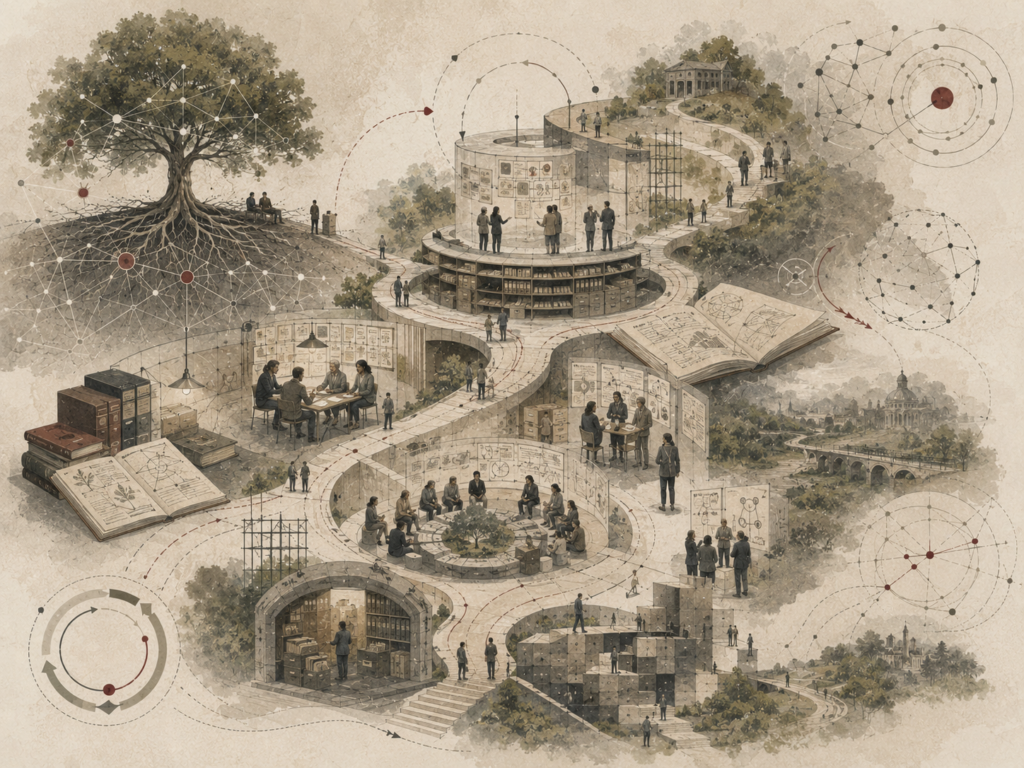
Restrained institutional illustration of knowledge systems, learning circles, archival records, feedback loops, rooted networks, and collaborative spaces representing organizational learning.

Learning Organizations: Knowledge Systems and Institutional Learning

Learning organizations are institutions that convert experience into durable collective intelligence. Rather than treating learning as a matter of employee development alone, this article examines how organizations generate, interpret, preserve, share, and apply knowledge through systems of communication, memory, governance, and reflective practice. It explores the distinction between single-loop and double-loop learning, the role of knowledge systems and institutional memory, the influence of culture and psychological safety, and the connection between learning, innovation, resilience, and dynamic capabilities. A semi-formal model clarifies the determinants of organizational learning capacity, while substantial R and Python sections offer practical analytical starting points for modeling learning, adaptation, and knowledge decay across organizational units.

Restrained institutional illustration of knowledge systems, learning circles, archival records, feedback loops, rooted networks, and collaborative spaces representing organizational learning.

Resistance to Organizational Change

Resistance to organizational change is best understood not as simple reluctance, but as a patterned institutional response to perceived disruption in routines, identity, authority, incentives, and meaning. This article examines resistance as a systemic phenomenon shaped by psychology, organizational inertia, political interests, cultural commitments, and the unequal distribution of risk during transformation. It explores why change initiatives encounter friction, how trust and implementation quality influence adoption, and why some forms of resistance may serve as useful feedback or stabilizing constraint rather than mere obstruction. A semi-formal model clarifies the dynamics of resistance, while substantial R and Python sections provide practical analytical starting points for assessing change-readiness, resistance intensity, and adoption outcomes.

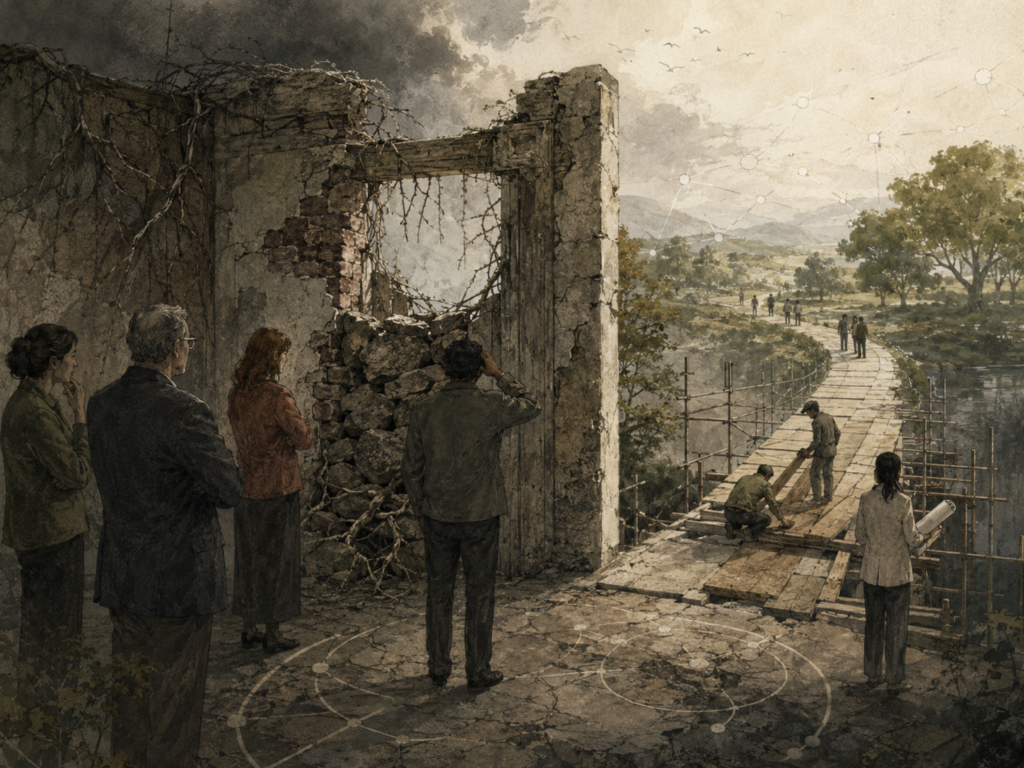
Restrained institutional illustration of people rebuilding damaged civic structures, modular systems, pathways, and scaffolding, representing organizational adaptation and strategic transformation.

Adaptive Organizations: Institutional Change and Strategic Transformation

Organizational change is the institutional process through which organizations revise structures, strategies, cultures, and governing assumptions in response to shifting internal realities and external pressures. This article treats change not as a simple managerial initiative, but as a complex process of interpretation, legitimacy, learning, governance, and coordinated adaptation. It examines institutional pressures, sensemaking, major models of change, leadership and governance alignment, learning and dynamic capabilities, and the barriers that make transformation difficult. A semi-formal model clarifies the determinants of adaptive change capacity, while substantial R and Python sections provide practical starting points for analyzing change-readiness, institutional fragility, and successful adaptation across organizational units operating under uncertainty.

Restrained institutional illustration of leaders reviewing maps above a complex organizational landscape of bridges, civic structures, networks, scaffolding, and branching pathways.

Strategic Decision-Making in Complex Organizations

Strategic decision-making is the institutional process through which organizations interpret uncertainty, define long-term priorities, allocate scarce resources, and commit themselves to consequential paths under conditions of ambiguity and interdependence. This article examines strategy not as a purely technical planning exercise, but as a socio-cognitive, political, and organizational process shaped by bounded rationality, sensemaking, distributed knowledge, power, and adaptive learning. It explores how complex environments, executive bias, coalition dynamics, and information integration influence strategic judgment, and why resilient institutions must treat strategy as an evolving process rather than a fixed blueprint. Substantial R and Python sections model strategic decision quality, strategic risk, and the conditions under which organizations adapt successfully over time.

Restrained institutional illustration of people exchanging information across layered organizational spaces, with meeting rooms, archives, bridges, shared documents, and network pathways.

Information Flow and Organizational Communication

Information flow is the institutional movement of knowledge, signals, interpretations, and operational data that allows organizations to perceive, coordinate, decide, and learn under conditions of complexity. This article treats communication not as a background administrative function but as a core infrastructure of organizational intelligence. It examines how communication networks, information asymmetries, signal distortion, hierarchy delay, digital systems, and psychological safety shape decision quality and institutional risk. A semi-formal model clarifies the determinants of information flow quality, while substantial R and Python sections provide practical starting points for analyzing communication friction, decision error, and cross-functional coordination across organizational units. The result is a more serious account of communication as a structural and epistemic condition of organizational life.

Scroll to Top