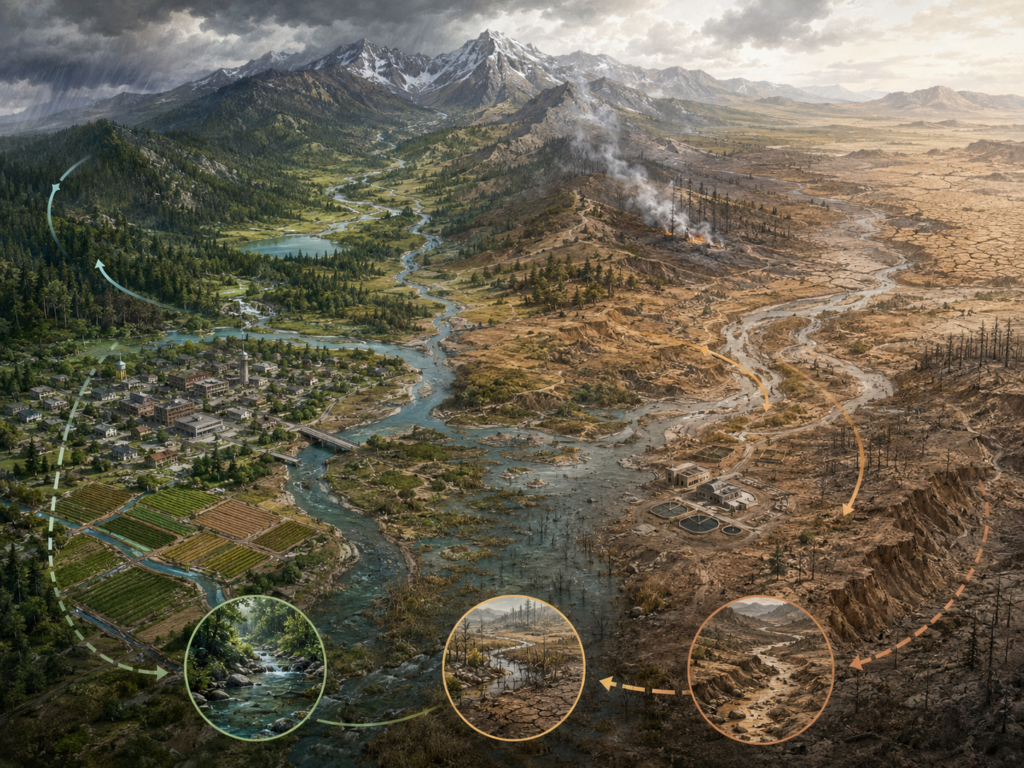
Panoramic systems illustration of a watershed shifting from healthy forest, farms, and rivers into burned slopes, drought, erosion, degraded waterways, and barren land.

System Thresholds and Tipping Points: Nonlinear Change in Complex Systems

System Thresholds and Tipping Points examines how complex systems can absorb pressure for long periods and then shift abruptly once critical boundaries are crossed. The article argues that thresholds are structural boundaries separating alternative regimes, while tipping points are the dynamic moments when reinforcing feedbacks push systems into new patterns of organization. It develops this through nonlinear change, regime shifts, critical transitions, early warning signals, ecological and climate tipping processes, institutional breakdown, hysteresis, and irreversibility. The article emphasizes that resilience depends not only on recovering from disturbance, but on remaining within viable system states before feedback-driven change becomes self-sustaining. It also includes an evergreen mathematical lens, along with advanced R and Python workflows for simulating threshold crossings, hysteresis, and early warning signals in nonlinear systems.


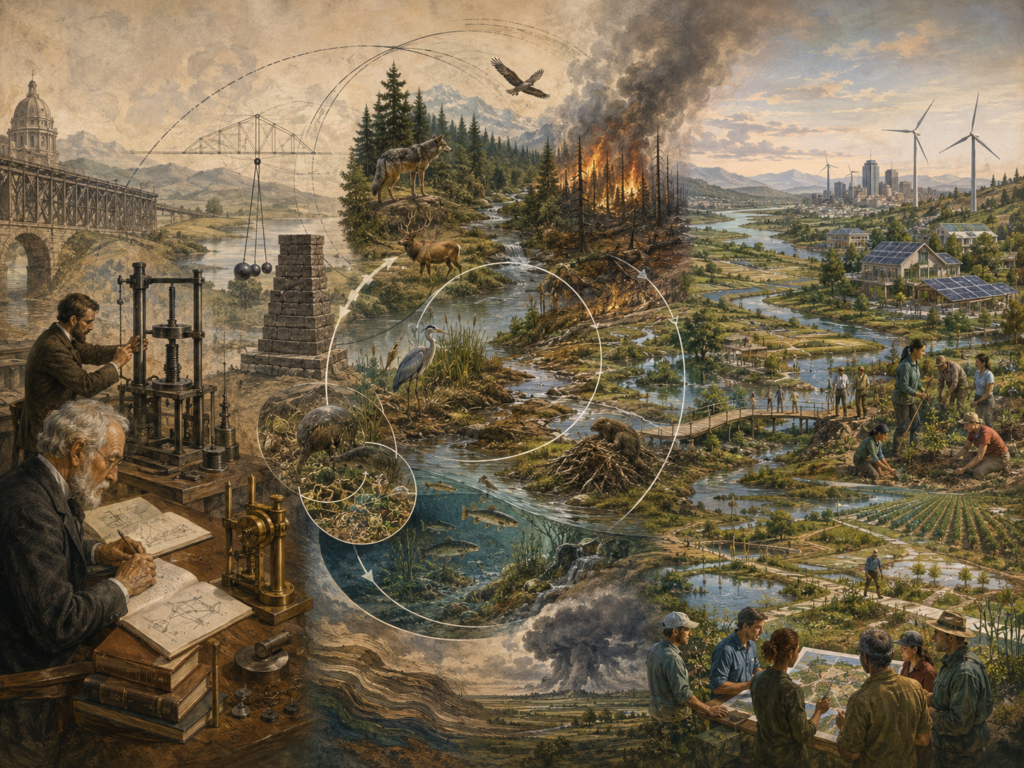
Panoramic ecological systems illustration of a mountain watershed showing forests, wetlands, farms, wildfire disturbance, regrowth, restoration work, and circular adaptive-cycle pathways.

Adaptive Cycles and Panarchy: Dynamics of Growth, Collapse, and Renewal

Adaptive Cycles and Panarchy examines how complex systems move through recurring phases of growth, conservation, release, and reorganization, and how those cycles interact across nested scales. The article argues that resilience depends not on permanent stability, but on the capacity to navigate changing phases without losing essential function or the possibility of renewal. It develops the adaptive cycle through the four phases of exploitation, conservation, release, and reorganization, then extends the analysis through panarchy, where smaller, faster systems generate novelty and larger, slower systems retain memory, constraint, and accumulated structure. The article also explores revolt and remember linkages, social-ecological and institutional applications, strategic lock-in, renewal, and the limits of treating the model as a universal law. It includes an evergreen mathematical lens, along with advanced R and Python workflows for simulating adaptive-cycle phase shifts and cross-scale panarchy dynamics.

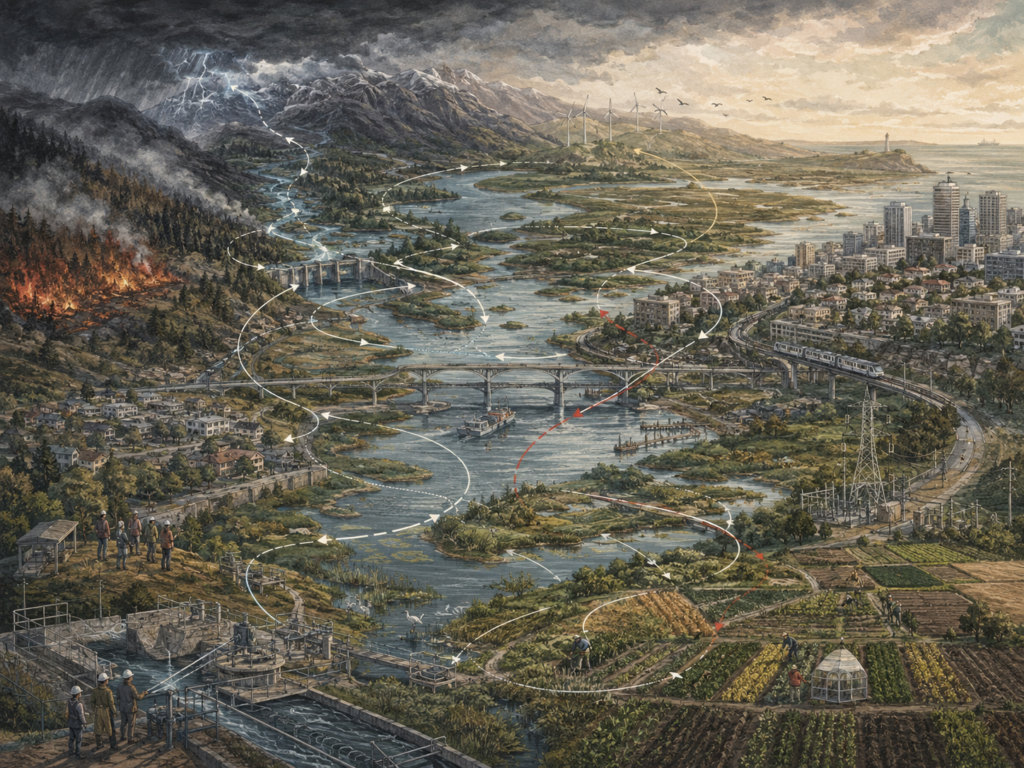
Panoramic systems illustration of a mountain watershed, city, farms, wetlands, renewable energy, transit, restoration crews, and planners adapting to storms, fire, and environmental change.

Adaptive Capacity in Complex Systems: Learning, Flexibility, and Resilience

Adaptive Capacity in Complex Systems examines the room systems have to learn, adjust, and reorganize before disturbance becomes breakdown. The article argues that resilience depends not only on absorbing shocks, but on preserving enough flexibility, diversity, governance capacity, learning ability, and slack to respond intelligently when conditions change. It distinguishes adaptive capacity from robustness, shows why highly ordered systems can become fragile when response options narrow, and explores how adaptation operates across ecological systems, communities, institutions, governance, and climate strategy. It also emphasizes that adaptive capacity sits between persistence and transformation, helping determine whether systems can reconfigure deliberately rather than collapse into forced change. The article includes an evergreen mathematical lens, along with advanced R and Python workflows for comparing adaptive-capacity profiles and simulating viability under repeated disturbance.

Panoramic editorial illustration of a connected watershed, wetlands, farms, city, transit, renewable energy, wildlife, and communities working within one social-ecological system.

Social-Ecological Systems: Integrating Human and Natural Dynamics

Social-Ecological Systems examines the coupled dynamics through which human institutions, livelihoods, technologies, and ecological processes shape one another across time, space, and scale. The article argues that sustainability and resilience cannot be understood by separating society from nature, because governance, infrastructure, markets, biodiversity, and ecosystem change are mutually constitutive parts of the same system. It develops the framework through interdependence, feedback loops, cross-scale dynamics, thresholds, adaptation, co-evolution, Ostrom’s institutional analysis, adaptive governance, and Anthropocene-scale entanglement. The article also emphasizes that SES analysis must remain attentive to power, inequality, and contested outcomes rather than collapsing politics into neutral systems language. It includes an evergreen mathematical lens, along with advanced R and Python workflows for comparing social-ecological system profiles and simulating coupled human-natural dynamics.

Editorial illustration comparing a stable wetland ecosystem with a disturbed but recovering river valley shaped by fire, regrowth, wildlife, and adaptive water flows.

Ecological Resilience and Ecosystem Stability: Dynamics of Persistence and Change

Ecological Resilience and Ecosystem Stability examines two related but distinct ways of understanding how ecosystems respond to disturbance, variability, and long-term environmental change. The article argues that stability concerns resistance, constancy, or return toward a prior state, while ecological resilience concerns how much disturbance an ecosystem can absorb before crossing into a different regime with different structures, functions, and feedbacks. Building on Holling’s foundational distinction, it develops the difference through multiple stable states, disturbance ecology, feedback loops, thresholds, biodiversity, functional diversity, and the ways visible stability can conceal deepening fragility. The article also shows why resilience-oriented conservation often differs from equilibrium-oriented restoration, especially under climate change and shifting ecological baselines. It includes an evergreen mathematical lens, along with advanced R and Python workflows for comparing stability and resilience across ecosystem types and simulating ecological regime shifts under gradual pressure.

Editorial illustration tracing resilience theory from early engineering and equilibrium science through ecological disturbance cycles to modern social-ecological adaptation and restoration.

The History of Resilience Theory: From Ecology to Complex Systems

The History of Resilience Theory traces how resilience moved from a specialized ecological concept into one of the central frameworks for understanding disturbance, adaptation, and long-term viability in complex systems. The article shows that resilience theory emerged as a critique of equilibrium-based thinking, beginning with Holling’s distinction between stability and resilience, and then expanding through nonlinear systems research, adaptive management, panarchy, social-ecological systems, sustainability science, disaster risk reduction, and climate governance. It argues that resilience is not merely about recovery or “bouncing back,” but about how systems absorb shock, persist across thresholds, learn under uncertainty, and transform when existing structures become untenable. The article also includes an evergreen mathematical lens, along with advanced R and Python workflows for modeling the historical shift from equilibrium return to resilience logic in complex adaptive systems.

Triptych-style editorial illustration comparing a stable wetland, a robust storm-resistant bridge, and a resilient recovering landscape after disturbance.

Resilience vs Stability vs Robustness: Understanding System Behavior Under Stress

Resilience vs Stability vs Robustness distinguishes three concepts that are often conflated but answer very different questions about how systems behave under disturbance. The article argues that stability concerns return toward equilibrium, robustness concerns maintaining performance under modeled stress, and resilience concerns remaining viable through disturbance, adaptation, and reorganization even when internal change is necessary. It shows why surface stability can conceal fragility, why robustness against known shocks may still fail under novelty, and why resilience becomes strategically superior when uncertainty deepens, thresholds are real, and adaptation is unavoidable. The article also compares how these terms are used across engineering, ecology, disaster risk reduction, climate governance, and organizational strategy, while adding a normative caution that not all resilient systems are desirable. It includes an evergreen mathematical lens, along with advanced R and Python workflows for comparing system profiles and simulating divergent responses to repeated disturbance.

Editorial illustration of a connected watershed, city, farms, infrastructure, and ecosystems responding to disturbance through adaptive pathways and feedback loops.

What Is Resilience Thinking?

What Is Resilience Thinking? introduces resilience thinking as a systems-oriented framework for understanding how complex ecological, social, economic, and institutional systems absorb disturbance, adapt to change, and reorganize while maintaining core functions and identity. The article argues that resilience thinking rejects equilibrium assumptions and instead treats nonlinear dynamics, thresholds, feedback loops, adaptive capacity, diversity, and transformation as central to long-term viability. It shows how the framework moved from ecological origins into sustainability science, climate adaptation, governance, infrastructure, and strategic decision-making, where uncertainty and structural change are normal rather than exceptional. The article also distinguishes recovery, adaptation, and transformation, and explains why resilience must be understood as a way of analyzing viability under disturbance rather than simply “bouncing back.” It includes an evergreen mathematical lens, along with advanced R and Python workflows for comparing resilience dimensions and simulating viability under repeated shocks.

Painterly editorial illustration of organizational strategy decision-making with leaders studying strategic pathways, stakeholder groups, layered systems maps, tradeoff scales, and uncertain future conditions.

Decision Science in Organizational Strategy: Strategy, Uncertainty, and Institutional Judgment

Decision Science in Organizational Strategy examines how firms make consequential choices when uncertainty, competition, capability, cognition, time, and institutional constraint interact. The article argues that strategy is best understood not as planning or positioning alone, but as organized judgment under conditions where information is incomplete, assumptions are contestable, and adaptation matters as much as commitment. It develops this through strategy as an architecture of choice, the foundations of bounded rationality and dynamic capabilities, different forms of uncertainty, the limits of static competitive analysis, behavioral distortion, systems effects, governance, and the role of data and AI as decision support rather than substitutes for judgment. The article emphasizes that stronger organizational strategy depends not on eliminating uncertainty, but on building decision processes that remain coherent, revisable, and institutionally aligned in its presence.

Scroll to Top