
Last Updated June 1, 2026
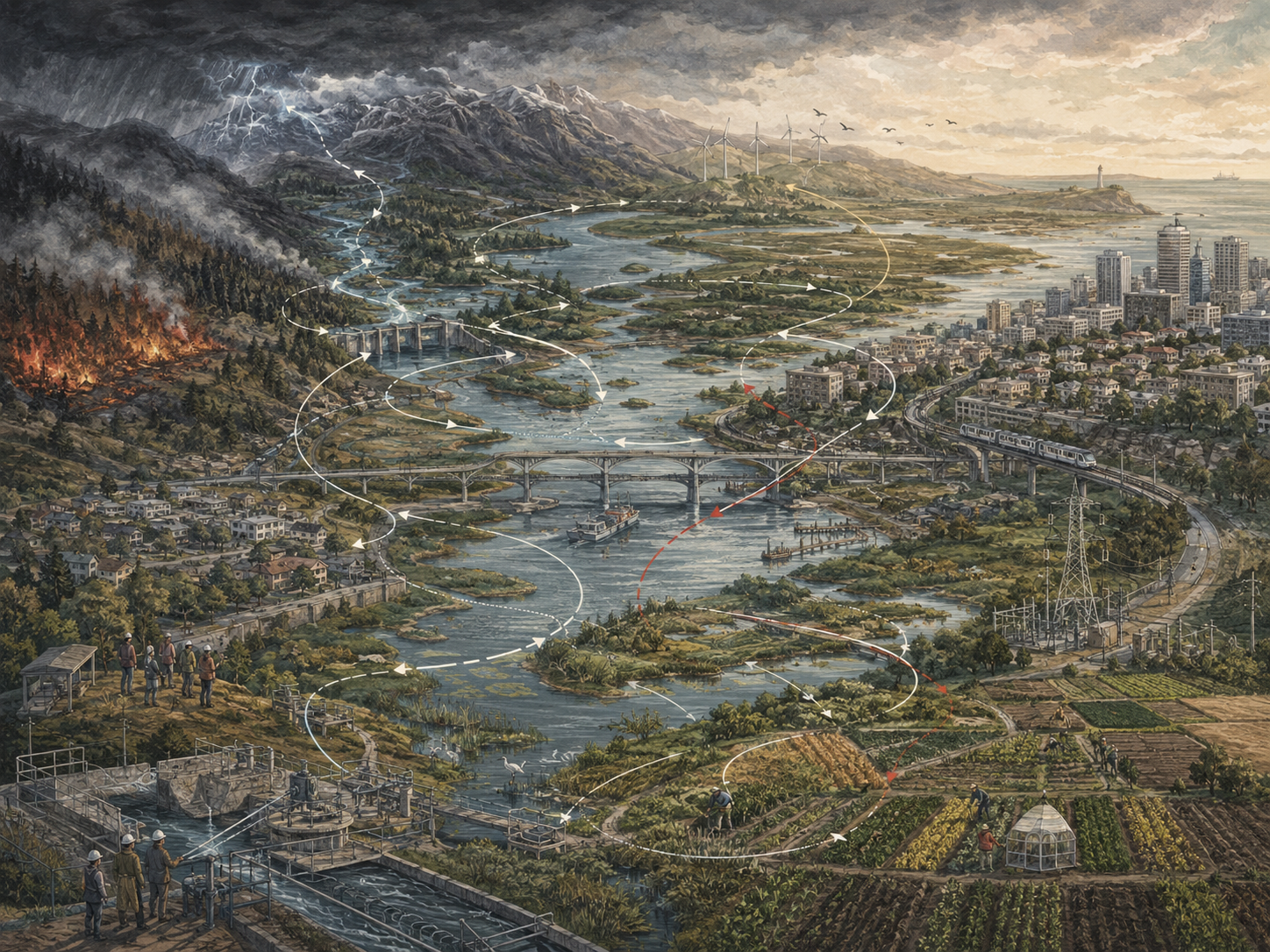
Resilience thinking is a systems-oriented framework for understanding how complex ecological, social, economic, technological, and institutional systems absorb disturbance, adapt to changing conditions, and reorganize without losing the core functions that make them recognizable. It rejects the assumption that systems normally operate in stable equilibrium. Instead, it treats disruption, uncertainty, feedback, threshold behavior, and nonlinear change as normal features of real system behavior.
Originally developed in ecology through the work of C.S. Holling and later expanded across sustainability science, social-ecological systems research, climate adaptation, disaster risk reduction, governance, infrastructure planning, and long-horizon strategy, resilience thinking provides a disciplined way to ask what allows systems to persist, adapt, or transform under stress. It is not simply a theory of “bouncing back.” At its strongest, resilience thinking asks how systems behave across disturbance, how close they are to thresholds, what feedback loops shape their trajectories, how adaptive capacity is built or lost, and whether the system remains viable under changing conditions.
This makes resilience thinking especially important in a world shaped by climate instability, biodiversity loss, economic interdependence, fragile infrastructure, public-health shocks, institutional distrust, technological dependency, and cascading risk. The central question is no longer whether disturbance can be eliminated. It cannot. The central question is whether systems can remain functional, legitimate, adaptive, and just under conditions of uncertainty.
Defining Resilience Thinking
At its core, resilience thinking asks a deceptively simple question: how do systems continue to function in the face of disturbance? Answering that question requires moving beyond linear cause-and-effect reasoning toward a deeper understanding of system structure, feedback dynamics, thresholds, adaptive capacity, memory, diversity, redundancy, and transformation.
In the ecological tradition, resilience is often defined as the capacity of a system to absorb disturbance and reorganize while undergoing change so as to retain essentially the same function, structure, identity, and feedbacks. This definition is important because it does not reduce resilience to speed of recovery. A system may recover quickly from a small disturbance but still be fragile if it is close to a threshold. Another system may change visibly but remain resilient if it preserves core functions, relationships, and adaptive capacity.
Resilience thinking therefore expands analysis from short-term performance to long-term system behavior. It asks whether a system can remain viable across changing conditions, not merely whether it can return to a previous state. This distinction matters because many systems should not simply return to the past. A degraded ecosystem, unequal economy, brittle supply chain, underfunded public-health system, or extractive institution may be resilient in the narrow sense of persistence, but not desirable, sustainable, or just.
For that reason, resilience thinking is both analytical and normative. Analytically, it studies how systems persist, adapt, or transform under stress. Normatively, it forces a deeper question: resilience of what, for whom, against what disturbance, and at whose cost? A serious resilience analysis must therefore examine not only system survival but also function, distribution, legitimacy, ecological constraint, and the burdens placed on vulnerable communities.
Why Resilience Thinking Emerged
Resilience thinking emerged partly as a response to the limits of equilibrium-based ecological and planning models. Earlier approaches often treated ecosystems as systems that return to a stable state after disturbance. Holling’s work challenged this view by showing that ecosystems can contain multiple stable states and that management aimed only at stability may reduce the very flexibility that allows systems to survive unexpected shocks.
The insight was profound: systems can become more efficient and more fragile at the same time. A forest managed to suppress all small fires may accumulate fuel loads that make catastrophic fire more likely. A supply chain optimized for low inventory and just-in-time delivery may perform well under normal conditions but fail under disruption. A financial system engineered for short-term returns may become tightly coupled and vulnerable to cascading failure. A public institution that prioritizes procedural control over learning may appear stable until a crisis reveals deep incapacity.
Resilience thinking became influential because it explained these paradoxes. It showed why the absence of visible disturbance is not the same as health, why efficiency can conceal fragility, why thresholds matter, and why systems need adaptive capacity before crisis arrives. It also gave scholars and practitioners a language for connecting ecology, infrastructure, governance, economics, disaster risk, and climate adaptation within a shared systems framework.
As the field expanded, resilience thinking became central to social-ecological systems research. This broader tradition recognizes that human communities, institutions, technologies, economies, and ecosystems are not separate systems that merely interact from the outside. They are interdependent. Water governance affects ecological thresholds. Land use affects flood risk. Infrastructure design affects social vulnerability. Economic incentives shape resource extraction. Community trust affects disaster response. Resilience thinking helps make those relationships visible.
From Equilibrium to Complexity
Traditional analytical frameworks in economics, engineering, management, and public administration often assume that systems tend toward equilibrium states. In those models, disturbances are treated as temporary deviations from stability, and the goal of system design is often to restore equilibrium as efficiently as possible.
Resilience thinking fundamentally challenges this assumption. Many real-world systems do not operate near a single stable equilibrium. Ecosystems, financial networks, cities, health systems, power grids, supply chains, governance institutions, and digital platforms often exhibit nonlinear behavior. Their future state depends not only on current conditions but also on history, feedback, memory, spatial structure, institutional rules, and cross-scale interaction.
In such systems, small changes can have large consequences. Large interventions can have surprisingly little effect. Delayed feedback can make decision-makers overcorrect or respond too late. Hidden variables can erode system capacity long before visible failure appears. A system can appear stable while moving steadily toward a threshold.
| Equilibrium-centered view | Resilience-thinking view |
|---|---|
| Disturbance is treated as an external interruption. | Disturbance is treated as a normal part of system behavior. |
| The goal is rapid return to a previous state. | The goal is long-term viability, adaptation, or transformation. |
| Efficiency is usually treated as a central design objective. | Efficiency is balanced against redundancy, diversity, flexibility, and learning. |
| Risk is often modeled as a known distribution of possible events. | Uncertainty, surprise, nonlinear change, and deep uncertainty are central concerns. |
| System failure is often interpreted as a breakdown of control. | Failure may reflect threshold crossing, rigidity, maladaptation, or loss of adaptive capacity. |
In complex systems, disturbances are not anomalies. They are part of the operating environment. The relevant analytical problem is therefore not how to eliminate disturbance, but how to understand whether a system has enough adaptive capacity, buffer, diversity, memory, and transformability to remain viable under changing conditions.
This shift aligns resilience thinking closely with Systems Modeling, Systems Thinking, and Decision Science, all of which emphasize dynamic analysis over static equilibrium reasoning.
Resilience, Stability, Robustness, and Vulnerability
Resilience thinking is often confused with related concepts such as stability, robustness, reliability, and recovery. These ideas overlap, but they are not identical. The distinctions matter because different system-design strategies follow from each concept.
Stability usually refers to a system’s tendency to return to a prior state after disturbance. A stable system resists displacement and returns quickly. Stability is valuable in many settings, but it can also hide deeper vulnerability. A system may return efficiently after small disturbances while becoming increasingly unable to survive larger or novel disturbances.
Robustness refers to continued performance under a defined range of conditions. A robust bridge, algorithm, institution, or supply chain can handle expected variation. But robustness often depends on knowing the disturbance range in advance. A system can be robust to known shocks and fragile to unfamiliar ones.
Reliability emphasizes consistent performance. It is especially important in engineering, infrastructure, healthcare, aviation, and safety-critical systems. Reliability matters deeply, but resilience thinking asks a wider question: what happens when assumptions fail, when loads exceed design conditions, when multiple systems fail at once, or when recovery requires improvisation?
Vulnerability refers to susceptibility to harm. It includes exposure to hazards, sensitivity to disturbance, and lack of adaptive capacity. Resilience and vulnerability are related, but not simple opposites. A community may have strong social networks and adaptive capacity while still being highly exposed to climate risk because of historical injustice, poor infrastructure, or unequal land-use decisions.
| Concept | Central question | Potential limitation |
|---|---|---|
| Stability | Does the system return to a prior state? | May overvalue return even when the prior state is harmful or obsolete. |
| Robustness | Can the system withstand known stresses? | May fail under novel, compounding, or outside-design disturbances. |
| Reliability | Does the system perform consistently? | May not address adaptation, reorganization, or surprise. |
| Resilience | Can the system absorb, adapt, reorganize, or transform while retaining essential function? | Can be misused if analysts ignore justice, power, and whose resilience is being protected. |
| Vulnerability | Who or what is exposed, sensitive, and least able to adapt? | Can become deficit-focused if it ignores agency, capability, and structural causes. |
A strong resilience analysis uses these concepts together. It asks not only whether a system returns, withstands, or performs, but also whether it learns, adapts, avoids dangerous thresholds, protects vulnerable people, and remains aligned with long-term ecological and social viability.
Core Components of Resilience Thinking
Resilience thinking is not a single theory. It is a conceptual framework composed of several interrelated ideas that help explain how systems behave under stress. These components are useful across ecology, infrastructure, governance, economics, public health, community planning, and strategic decision-making.
Adaptive capacity
Adaptive capacity is the ability of a system to adjust its behavior, structure, rules, relationships, or resource flows in response to changing conditions. It includes learning, flexibility, experimentation, institutional responsiveness, access to information, social trust, and the ability to mobilize resources before crisis becomes irreversible.
Threshold distance
Threshold distance refers to how close a system is to a critical boundary beyond which it may shift into a different regime. In a lake, this may involve nutrient loading and eutrophication. In infrastructure, it may involve load capacity, maintenance backlog, or cascading dependency. In institutions, it may involve legitimacy, trust, administrative capacity, or compliance. A system can appear functional while moving dangerously close to a threshold.
Feedback loops
Feedback processes shape how systems respond to disturbance. Reinforcing feedback loops amplify change, while balancing feedback loops stabilize behavior. A drought can reduce vegetation, which increases erosion, which reduces soil water retention, which worsens drought effects. Conversely, strong community networks can speed response, distribute resources, and reduce the amplification of harm.
Diversity and redundancy
Diversity in components and redundancy in function provide buffers against failure. Systems with multiple ways to perform essential functions are less vulnerable to single-point failure. Biodiversity, distributed energy resources, diversified supply chains, multiple communication channels, and overlapping institutional capacities can all support resilience.
Modularity
Modularity refers to the degree to which a system is organized into semi-independent parts. Modular systems can limit the spread of disturbance. Highly connected systems may be efficient, but they can also transmit failure rapidly. The goal is not isolation, but appropriate connectivity: enough connection for coordination and learning, not so much that every failure becomes systemic.
Memory and learning
Resilient systems learn from disturbance. Ecological memory may be stored in seed banks, species traits, landscape patterns, or surviving organisms. Institutional memory may be stored in records, routines, professional norms, emergency plans, and experienced personnel. Community memory may be stored in local knowledge, social networks, cultural practices, and shared experience. When memory is lost, systems often repeat mistakes.
Transformability
Transformability is the capacity to create a fundamentally new system when existing structures are no longer viable. This is crucial because resilience is not always desirable if it means preserving an unjust, degraded, or unsustainable regime. Sometimes the most resilient action is not restoration but transformation.
| Component | What it contributes | Example indicator |
|---|---|---|
| Adaptive capacity | Ability to adjust behavior under changing conditions | Response flexibility, learning rate, resource mobilization capacity |
| Threshold distance | Buffer before regime shift or functional collapse | Distance from ecological, financial, infrastructural, or institutional limits |
| Feedback awareness | Understanding of amplification, stabilization, and delay | Mapped causal loops, early-warning indicators, monitoring frequency |
| Diversity | Variation in components, knowledge, strategies, or resources | Species diversity, supplier diversity, skill diversity, income diversity |
| Redundancy | Backup capacity for essential functions | Alternative routes, backup systems, overlapping institutional roles |
| Modularity | Limits cascading failure while preserving coordination | Network clustering, dependency isolation, compartmentalization |
| Memory | Preserves lessons, routines, genetic resources, or local knowledge | Archives, seed banks, after-action reviews, continuity planning |
| Transformability | Capacity to shift to a new regime when the old one is no longer viable | Institutional reform capacity, transition pathways, innovation legitimacy |
Taken together, these components distinguish resilience thinking from simpler notions of recovery. They provide a structured way to analyze how systems persist, adapt, reorganize, or transform over time.
Disturbance as a Normal Condition
Resilience thinking begins from a practical recognition: disturbance is normal. Floods, droughts, fires, pest outbreaks, market shocks, pandemics, cyberattacks, infrastructure failures, institutional crises, and political disruptions are not rare exceptions to an otherwise stable world. They are part of the conditions under which complex systems must operate.
This does not mean all disturbances are natural or unavoidable. Many are intensified by human decisions. Climate change increases the frequency and severity of certain hazards. Land-use decisions increase flood exposure. Underinvestment increases infrastructure fragility. Deregulation can increase financial risk. Inequality can turn hazards into disasters. Resilience thinking does not excuse these causes. It helps analyze how disturbance interacts with system structure.
A disturbance can affect a system in several ways. It may temporarily reduce performance. It may reveal hidden vulnerability. It may trigger cascading failure. It may push a system across a threshold. It may open space for learning and renewal. It may also intensify existing inequalities, because those with the least power often experience the greatest exposure and the fewest recovery options.
Questions for disturbance analysis
Exposure
What disturbances is the system likely to face, and how often might those disturbances occur?
Sensitivity
Which functions, populations, assets, relationships, or ecological processes are most affected?
Buffer capacity
How much disturbance can the system absorb before essential function is compromised?
Adaptive response
What mechanisms allow the system to adjust, learn, redistribute resources, or reorganize?
Distribution
Who absorbs the costs of disturbance, and who benefits from the current system design?
A resilience framework that ignores distribution can become morally thin. It may celebrate the persistence of a system while overlooking the fact that marginalized communities, workers, ecosystems, or future generations are absorbing the shock. Serious resilience thinking must therefore connect disturbance analysis with justice, accountability, and ecological limits.
Thresholds, Tipping Points, and Regime Shifts
Thresholds are central to resilience thinking because many systems do not change smoothly. They can absorb pressure for a long time and then shift rapidly into a different regime. A lake may remain clear as nutrient levels rise, then suddenly become turbid and algae-dominated. A dryland ecosystem may retain vegetation under moderate grazing, then shift toward desertification. A power grid may function under stress until cascading failure spreads. A public institution may retain formal authority while losing legitimacy, then face sudden noncompliance or collapse of trust.
Threshold behavior is difficult to manage because warning signs are often ambiguous. System variables may appear stable because buffering mechanisms are still operating. By the time visible failure appears, the system may already be close to a regime shift. This is why resilience thinking emphasizes slow variables and hidden system change.
Slow variables are underlying conditions that change gradually but shape system behavior profoundly. Soil fertility, groundwater levels, biodiversity, trust in institutions, maintenance backlog, public-health capacity, household savings, professional expertise, and social cohesion can all erode slowly before a visible crisis. When slow variables are ignored, systems may appear resilient until they are not.
Regime shifts occur when a system moves from one relatively stable configuration to another. In some cases, returning to the previous regime is difficult because feedback loops have changed. A fishery collapse may alter livelihoods, incentives, species composition, and governance capacity. An infrastructure failure may trigger migration, fiscal stress, and political conflict. A legitimacy crisis may reduce compliance, which further weakens institutional capacity.
Threshold analysis therefore changes the meaning of prevention. Prevention is not only the avoidance of immediate harm. It is also the maintenance of buffer capacity, monitoring of slow variables, protection of diversity, preservation of institutional trust, and early intervention before feedback loops lock in a degraded regime.
Adaptive Capacity, Learning, and Transformability
Adaptive capacity is one of the most important concepts in resilience thinking because it explains why systems facing similar disturbances can experience very different outcomes. Two cities may face the same storm, but differ in drainage systems, social trust, emergency communication, housing quality, fiscal capacity, and neighborhood-level mutual aid. Two ecosystems may face the same drought, but differ in biodiversity, soil structure, hydrological connectivity, and species traits. Two institutions may face the same crisis, but differ in transparency, legitimacy, leadership, learning routines, and ability to change rules.
Adaptive capacity depends on both material and relational conditions. It includes resources, but it is not reducible to resources. It also includes knowledge, trust, social networks, institutional legitimacy, distributed authority, experimentation, memory, and the willingness to revise assumptions. Systems with high adaptive capacity do not merely endure shocks. They use disturbance as information.
Learning is especially important. After a disturbance, systems can respond in several ways. They can deny the problem. They can restore the previous arrangement without reflection. They can make narrow technical adjustments. Or they can engage in deeper learning that changes assumptions, rules, relationships, and priorities. Resilience thinking favors the last two responses when conditions warrant them, especially where past arrangements created the vulnerability in the first place.
Transformability becomes necessary when adaptation is no longer enough. A coastal community facing permanent sea-level rise may not be able to preserve all existing land-use patterns. An agricultural system dependent on unsustainable groundwater extraction may need a new production model. An institution that survives by externalizing harm may be resilient in a descriptive sense, but ethically indefensible. Transformability asks whether a system can move into a new configuration before crisis forces a more destructive transition.
System responses to disturbance
Recovery
Recovery restores function after disturbance. It matters when the prior system state remains viable, legitimate, and worth preserving.
Adaptation
Adaptation adjusts behavior while maintaining core identity. It matters when conditions change but the system can remain viable through learning and adjustment.
Transformation
Transformation reorganizes system structure when the existing regime is no longer viable or legitimate. It matters when persistence would preserve harm.
This distinction is critical in sustainability and policy contexts. In some cases, returning to the previous state is neither possible nor desirable. Climate adaptation, ecological restoration, economic transition, institutional reform, and public-health redesign may require transformation rather than simple recovery.
Adaptive Cycles and Panarchy
One of the most influential contributions to resilience thinking is the concept of the adaptive cycle. The adaptive cycle describes recurring phases of growth, conservation, release, and reorganization. It does not claim that all systems follow a rigid sequence, but it provides a useful framework for interpreting how systems accumulate resources, become structured, experience disturbance, and reorganize.
In the growth phase, a system expands, experiments, and accumulates resources. In the conservation phase, it becomes more connected, efficient, and structured. This can produce stability and productivity, but also rigidity. Over time, the system may become less flexible, less diverse, and more vulnerable to disturbance. When disturbance exceeds system capacity, a release phase may occur. Resources, relationships, and structures are disrupted. The reorganization phase then creates space for novelty, renewal, adaptation, or transformation.
| Adaptive-cycle phase | System pattern | Resilience concern |
|---|---|---|
| Growth | Expansion, experimentation, resource accumulation | Can build diversity and capability, but may also expand exposure. |
| Conservation | Efficiency, connectedness, institutionalization | Can create rigidity, lock-in, and hidden fragility. |
| Release | Disturbance, breakdown, rapid change | Can produce harm, but also reveal accumulated vulnerability. |
| Reorganization | Learning, recombination, renewal, transformation | Can restore viability or reproduce old vulnerabilities. |
The concept of panarchy extends this idea across scales. Systems are nested within larger systems and composed of smaller subsystems. Fast-changing processes at smaller scales interact with slower, more stable processes at larger scales. Local experimentation may create new options for larger systems. Large-scale constraints may limit or enable local adaptation. Disturbance at one scale may cascade across others.
For example, household preparedness, neighborhood networks, municipal infrastructure, regional watersheds, national policy, and global climate systems all interact in disaster resilience. A city cannot be understood only at the city scale. Its resilience depends on building codes, social inequality, insurance markets, watershed management, electricity networks, federal disaster policy, and climate dynamics. Panarchy gives resilience thinking a way to analyze these nested relationships.
Cross-Scale Dynamics and Cascading Risk
Resilience thinking is especially valuable when disturbance does not remain contained. In tightly connected systems, failures can cascade. A flood can damage transportation networks, which disrupt supply chains, which delay medical care, which intensify social vulnerability. A cyberattack can disrupt energy systems, payment systems, logistics, and public trust. A drought can reduce crop yields, raise food prices, strain public budgets, increase migration pressure, and deepen political instability.
Cross-scale dynamics matter because local resilience can be undermined by larger-scale fragility, and large-scale resilience can depend on local capacity. A community may be highly organized but constrained by inadequate infrastructure funding. A national agency may have strong policy frameworks but fail if local trust is low. A supply chain may have global reach but collapse because of a single concentrated dependency.
Common conditions for cascading risk
Tight coupling
Components depend on one another with little delay, slack, or buffer, allowing disruption to move quickly through the system.
High connectivity
Disturbances can travel rapidly across networks when connections transmit failure faster than institutions can coordinate response.
Low substitutability
Few alternatives exist when a critical node, supplier, service, institution, or infrastructure component fails.
Resilience thinking does not imply that all connectivity is bad. Connectivity allows coordination, learning, trade, mutual aid, ecological exchange, and information flow. The problem is inappropriate connectivity: systems that are connected enough to transmit failure but not organized enough to coordinate adaptation. Good resilience design therefore asks where to strengthen connection, where to create modular separation, where to add redundancy, and where to reduce dependency.
Applications of Resilience Thinking
Resilience thinking is applied across multiple domains where systems face uncertainty, complexity, and disturbance. Its value lies in its ability to connect technical design, ecological understanding, institutional capacity, and social consequences.
Ecology and biodiversity
In ecology, resilience thinking helps explain how ecosystems absorb disturbance, maintain function, and shift regimes. Biodiversity, habitat connectivity, ecological memory, species traits, and disturbance regimes all shape resilience. Forests, wetlands, coral reefs, grasslands, lakes, fisheries, and agricultural landscapes can all be studied through resilience concepts.
Climate adaptation
Climate adaptation requires more than hazard protection. It requires flexible pathways, learning systems, infrastructure redesign, ecosystem-based adaptation, managed retreat in some contexts, and governance capable of revising plans as conditions change. Resilience thinking is central because climate change alters disturbance patterns, baseline conditions, and threshold risks.
Urban systems and infrastructure
Cities are dense networks of housing, transportation, water, energy, communication, finance, health, governance, and social life. Urban resilience depends on physical infrastructure, but also on social trust, public institutions, neighborhood capacity, ecological systems, and equitable planning. A city with strong seawalls but deep housing inequality may still be highly vulnerable.
Economics and supply chains
Economic resilience involves more than growth after recession. It includes household security, production diversity, financial stability, labor protections, supply-chain redundancy, local capacity, and the ability to absorb shocks without transferring all risk to workers, communities, or ecosystems. Resilience thinking challenges economic models that treat efficiency as the highest goal.
Governance and institutions
Institutional resilience depends on legitimacy, transparency, administrative capacity, public trust, learning routines, accountability, and the ability to adapt rules without abandoning core commitments. Institutions can be brittle when they become too rigid, too centralized, too opaque, or too disconnected from the communities they govern.
Public health
Public-health resilience includes surveillance, prevention, surge capacity, workforce protection, community trust, supply-chain security, clear communication, and equitable access to care. The COVID-19 pandemic showed that technical capacity alone is insufficient when social trust, institutional coordination, and public communication are weak.
Community resilience
Community resilience includes mutual aid, local knowledge, social networks, civic organizations, cultural memory, leadership, trusted communication, and access to resources. But the concept must be used carefully. Communities should not be praised for resilience while being denied the infrastructure, funding, rights, and institutional support they need.
| Domain | Typical disturbances | Key resilience dimensions |
|---|---|---|
| Ecology | Fire, drought, invasive species, nutrient loading, habitat fragmentation | Biodiversity, ecological memory, threshold distance, connectivity, disturbance regime |
| Climate adaptation | Heat, flooding, sea-level rise, storms, compound hazards | Adaptive pathways, vulnerability reduction, ecosystem-based adaptation, planning flexibility |
| Infrastructure | Extreme weather, overload, cyberattack, maintenance failure | Redundancy, modularity, maintenance, backup capacity, dependency mapping |
| Supply chains | Supplier failure, transport disruption, geopolitical risk, demand shock | Supplier diversity, inventory buffers, substitutability, network visibility |
| Governance | Legitimacy crisis, fiscal stress, disaster, conflict, institutional overload | Trust, accountability, learning, decentralization, coordination capacity |
| Public health | Pandemics, workforce strain, misinformation, supply shortages | Surge capacity, surveillance, communication, community trust, equitable access |
Resilience and Sustainable Development
Resilience thinking is closely linked to sustainable development because sustainability challenges are inherently dynamic. Climate change, resource depletion, biodiversity loss, pollution, inequality, infrastructure fragility, and institutional distrust all involve systems that change over time and respond to disturbance.
However, resilience and sustainability are not identical. A system can be resilient without being sustainable, and sustainable in principle without being resilient in practice. A harmful regime may persist under stress. A fossil-fuel economy, extractive institution, or unequal land-use system may be resilient because it has strong political support, financial resources, legal protection, and adaptive strategies that preserve its own power. Resilience in that case is not automatically good.
Likewise, a desirable system may lack resilience if it has insufficient capacity, weak institutions, fragile financing, poor coordination, or inadequate public support. A renewable-energy transition, conservation program, public-health reform, or community-led adaptation strategy may be normatively important but still vulnerable if it is not designed for disturbance, backlash, learning, and long-term maintenance.
The double question of resilience and sustainability
Viability
Can the system persist, adapt, and function under disturbance without crossing dangerous thresholds or losing essential capacity?
Direction
Does the system support ecological integrity, human dignity, justice, and long-term flourishing?
This relationship is explored further in the Resilience and Sustainable Development article within this knowledge series.
Why Resilience Thinking Matters for Strategy
Resilience thinking fundamentally changes how strategy is conceived. Traditional strategy often focuses on optimization, efficiency, forecasting, and competitive advantage under assumed stability. Resilience thinking shifts the focus toward durability, adaptability, learning, legitimacy, and long-term viability under uncertainty.
This has major implications. Efficiency must be balanced with redundancy and flexibility. Short-term optimization must be evaluated against long-term risk. System design must account for uncertainty, not just known conditions. Strategy must include adaptation pathways, early-warning indicators, and transformation options. Decision-makers must examine not only what works under normal conditions, but what fails under stress.
Resilience-oriented strategy asks different questions from conventional planning:
- What disturbances could disrupt the system’s core functions?
- Which dependencies create single points of failure?
- What slow variables are eroding beneath visible performance?
- How close is the system to critical thresholds?
- Where has efficiency reduced redundancy or flexibility?
- Who bears the cost when the system is disturbed?
- What feedback loops amplify harm or support recovery?
- What forms of learning are built into the system?
- When is adaptation enough, and when is transformation necessary?
In this sense, resilience thinking is not merely a theoretical framework. It is a practical approach to decision-making in complex environments. It aligns closely with Decision-Making Under Deep Uncertainty and Robust Decision-Making, both of which emphasize flexibility and adaptability in the face of unknown future conditions.
Resilience Indicators, Metrics, and Evidence
Resilience is difficult to measure because it is not a single variable. It is a relational property of a system under disturbance. A resilience metric is therefore always tied to a system boundary, a function, a disturbance type, a time horizon, and a normative judgment about what should be preserved or changed.
For example, measuring the resilience of an electrical grid differs from measuring the resilience of a watershed, household, hospital system, food network, or democratic institution. Each system has different functions, thresholds, dependencies, and stakeholders. A useful resilience assessment must therefore avoid generic scoring unless the score is grounded in clearly defined assumptions.
Common resilience indicators
Exposure indicators
Hazard frequency, climate projections, dependency concentration, geographic risk, and disturbance history.
Sensitivity indicators
Fragile assets, vulnerable populations, ecological stress, infrastructure age, financial leverage, and workforce strain.
Adaptive-capacity indicators
Learning routines, fiscal flexibility, social trust, institutional responsiveness, technical expertise, and governance quality.
Buffer indicators
Reserve capacity, redundancy, inventory, habitat diversity, backup systems, and emergency funds.
Threshold indicators
Groundwater decline, biodiversity loss, debt stress, maintenance backlog, legitimacy erosion, and network centralization.
Recovery indicators
Restoration time, service continuity, repair capacity, displacement duration, health outcomes, and livelihood recovery.
Transformation indicators
Policy reform, infrastructure redesign, livelihood transition, institutional learning, and community participation.
Good resilience measurement combines quantitative models with qualitative judgment. Data can help identify thresholds, dependencies, scenario outcomes, and vulnerability patterns. But local knowledge, historical context, institutional analysis, and ethical evaluation are necessary to interpret what those indicators mean. A technically precise resilience dashboard can still be misleading if it ignores power, inequality, ecological degradation, or community experience.
Mathematical Lens: Disturbance, Thresholds, and Viability
Resilience thinking can be clarified with a simple contrast between equilibrium return and viability under disturbance. A classical stability-centered formulation emphasizes return toward a reference state:
\frac{dx}{dt} = -a(x – x^{*})
\]
Interpretation: The system state \(x\) returns toward a reference equilibrium \(x^{*}\), while \(a > 0\) determines the speed of return. This is useful for stability analysis, but it does not capture adaptive capacity, threshold distance, or transformation.
A resilience-oriented abstraction instead emphasizes whether the system remains viable as disturbance accumulates:
R_t = B_t – D_t + A_t
\]
Interpretation: \(R_t\) represents a stylized resilience margin at time \(t\). \(B_t\) is buffer capacity or basin width, \(D_t\) is accumulated disturbance load, and \(A_t\) is adaptive capacity. The expression is deliberately simple: resilience depends not only on resisting shocks, but also on maintaining adaptive room.
Threshold behavior can be represented with a stylized nonlinear system:
\frac{dx}{dt} = rx – x^3 + p
\]
Interpretation: \(x\) is the system state, \(r\) structures internal dynamics, and \(p\) represents external pressure. As pressure changes, the system may approach a threshold beyond which it reorganizes into a different regime.
A simple viability condition can also be expressed as:
V_t =
\begin{cases}
1, & R_t \geq \theta \\
0, & R_t < \theta
\end{cases}
\]
Interpretation: \(V_t\) indicates whether the system remains viable at time \(t\). The threshold \(\theta\) represents the minimum resilience margin needed to preserve essential function.
These equations are not intended to reduce resilience thinking to a single formula. Their purpose is conceptual. They show why resilience analysis must include disturbance load, buffer capacity, threshold distance, adaptive response, and system function over time.
Python Workflow: Simulating Viability Under Repeated Disturbance
The Python workflow below simulates stylized systems under repeated disturbance. It compares resilience profiles, disturbance loads, threshold margins, and viability outcomes. This is designed as a transparent educational model rather than a predictive model. In a real application, system variables would be calibrated with domain-specific data, local knowledge, monitoring records, and scenario assumptions.
"""
Python workflow: resilience thinking, disturbance, thresholds, and viability

This script creates a synthetic resilience dataset, simulates repeated disturbance,
estimates viability margins, flags threshold risk, and exports results.

Dependencies:
    pip install pandas numpy matplotlib

The model is intentionally stylized. It is meant to demonstrate concepts:
adaptive capacity, threshold distance, disturbance load, learning, redundancy,
modularity, and viability under repeated stress.
"""

from __future__ import annotations

import math
from pathlib import Path

import numpy as np
import pandas as pd
import matplotlib.pyplot as plt


OUTPUT_DIR = Path("outputs")
OUTPUT_DIR.mkdir(exist_ok=True)

np.random.seed(42)


systems = pd.DataFrame(
    {
        "system_type": [
            "Ecological System",
            "Urban Infrastructure",
            "Institutional System",
            "Supply Chain Network",
            "Community System",
            "Public Health System",
        ],
        "adaptive_capacity": [0.82, 0.58, 0.63, 0.49, 0.76, 0.67],
        "threshold_distance": [0.74, 0.55, 0.60, 0.44, 0.68, 0.57],
        "learning_capacity": [0.71, 0.52, 0.72, 0.46, 0.79, 0.64],
        "modularity": [0.62, 0.70, 0.48, 0.51, 0.57, 0.54],
        "redundancy": [0.69, 0.66, 0.43, 0.38, 0.61, 0.59],
        "exposure": [0.54, 0.72, 0.50, 0.77, 0.61, 0.69],
        "sensitivity": [0.47, 0.63, 0.58, 0.71, 0.56, 0.65],
    }
)


def weighted_resilience_profile(row: pd.Series) -> float:
    """Create a stylized resilience score from multiple dimensions."""
    return (
        0.24 * row["adaptive_capacity"]
        + 0.20 * row["threshold_distance"]
        + 0.18 * row["learning_capacity"]
        + 0.14 * row["modularity"]
        + 0.14 * row["redundancy"]
        - 0.05 * row["exposure"]
        - 0.05 * row["sensitivity"]
    )


systems["resilience_profile"] = systems.apply(weighted_resilience_profile, axis=1)
systems["risk_pressure"] = 0.55 * systems["exposure"] + 0.45 * systems["sensitivity"]
systems["initial_viability_margin"] = (
    systems["resilience_profile"] + systems["threshold_distance"] - systems["risk_pressure"]
)

systems["initial_risk_flag"] = np.select(
    [
        systems["initial_viability_margin"] < 0.15,
        systems["initial_viability_margin"] < 0.30,
    ],
    [
        "high threshold risk",
        "moderate threshold risk",
    ],
    default="lower threshold risk",
)

print("\nResilience profile summary")
print(systems.round(3))


time_steps = np.arange(1, 61)

# A stylized disturbance pattern:
# regular stress plus larger shocks at selected time steps.
base_disturbance = np.random.uniform(0.03, 0.10, size=len(time_steps))
shock_schedule = {12: 0.20, 24: 0.28, 37: 0.23, 48: 0.31}
disturbance = base_disturbance.copy()

for step, shock in shock_schedule.items():
    disturbance[step - 1] += shock


def simulate_system(row: pd.Series) -> pd.DataFrame:
    """
    Simulate system viability under repeated disturbance.

    State logic:
    - Viability declines with disturbance, exposure, and sensitivity.
    - Viability improves through adaptive capacity and learning.
    - Redundancy and modularity reduce disturbance impact.
    - If viability falls below a threshold, the system enters threshold risk.
    """
    viability = np.zeros(len(time_steps))
    margin = np.zeros(len(time_steps))
    adaptive_response = np.zeros(len(time_steps))

    viability[0] = 1.0
    accumulated_learning = 0.0

    for i in range(1, len(time_steps)):
        disturbance_load = disturbance[i] * (0.65 + row["exposure"]) * (0.55 + row["sensitivity"])
        protection = 0.35 * row["redundancy"] + 0.25 * row["modularity"]
        learning_gain = 0.015 * row["learning_capacity"] * (1 + accumulated_learning)
        adaptation_gain = 0.028 * row["adaptive_capacity"] + learning_gain

        net_impact = disturbance_load * (1 - 0.45 * protection)
        viability[i] = viability[i - 1] - net_impact + adaptation_gain
        viability[i] = float(np.clip(viability[i], 0.0, 1.25))

        accumulated_learning += 0.01 * row["learning_capacity"]
        adaptive_response[i] = adaptation_gain
        margin[i] = viability[i] + row["threshold_distance"] - row["risk_pressure"]

    output = pd.DataFrame(
        {
            "system_type": row["system_type"],
            "time_step": time_steps,
            "disturbance": disturbance,
            "viability": viability,
            "viability_margin": margin,
            "adaptive_response": adaptive_response,
            "threshold_flag": np.where(margin < 0.20, "threshold risk", "viable margin"),
        }
    )

    return output


simulation = pd.concat(
    [simulate_system(row) for _, row in systems.iterrows()],
    ignore_index=True,
)

summary = (
    simulation.groupby("system_type")
    .agg(
        minimum_viability=("viability", "min"),
        average_viability=("viability", "mean"),
        minimum_margin=("viability_margin", "min"),
        threshold_risk_steps=("threshold_flag", lambda x: int((x == "threshold risk").sum())),
    )
    .reset_index()
    .sort_values("minimum_margin")
)

print("\nSimulation summary")
print(summary.round(3))


systems.to_csv(OUTPUT_DIR / "resilience_profiles.csv", index=False)
simulation.to_csv(OUTPUT_DIR / "resilience_viability_simulation.csv", index=False)
summary.to_csv(OUTPUT_DIR / "resilience_threshold_summary.csv", index=False)


plt.figure(figsize=(10, 6))

for system_name in simulation["system_type"].unique():
    subset = simulation[simulation["system_type"] == system_name]
    plt.plot(subset["time_step"], subset["viability"], label=system_name)

plt.axhline(0.30, linestyle="--", linewidth=1, label="Low viability reference")
plt.xlabel("Time Step")
plt.ylabel("Viability")
plt.title("Stylized Viability Under Repeated Disturbance")
plt.legend(loc="best", fontsize=8)
plt.tight_layout()
plt.savefig(OUTPUT_DIR / "viability_under_repeated_disturbance.png", dpi=160)
plt.close()


plt.figure(figsize=(10, 6))

for system_name in simulation["system_type"].unique():
    subset = simulation[simulation["system_type"] == system_name]
    plt.plot(subset["time_step"], subset["viability_margin"], label=system_name)

plt.axhline(0.20, linestyle="--", linewidth=1, label="Threshold-risk reference")
plt.xlabel("Time Step")
plt.ylabel("Viability Margin")
plt.title("Threshold Margin Under Repeated Disturbance")
plt.legend(loc="best", fontsize=8)
plt.tight_layout()
plt.savefig(OUTPUT_DIR / "threshold_margin_under_disturbance.png", dpi=160)
plt.close()

print("\nExported outputs to:", OUTPUT_DIR.resolve())
The most important output is not the chart alone. It is the comparison between minimum viability, average viability, threshold-risk steps, and margin erosion. A system that looks strong under average conditions may still be fragile if repeated disturbance pushes it close to a threshold. This is why resilience thinking emphasizes trajectories, margins, and adaptive response rather than static performance.
R Workflow: Comparing Resilience Dimensions Across System Types
The R workflow below creates a synthetic resilience profile dataset, compares systems across multiple dimensions, flags vulnerability patterns, and exports scenario summaries. It is designed to support the same conceptual point as the Python workflow: resilience is multi-dimensional. Adaptive capacity, threshold distance, redundancy, modularity, learning, exposure, and sensitivity must be interpreted together.
# R workflow: resilience profiles, vulnerability flags, and scenario summaries
#
# Dependencies:
# install.packages(c("tidyverse"))
#
# This workflow uses synthetic data for conceptual demonstration.

library(tidyverse)

outputs_dir <- "outputs"
if (!dir.exists(outputs_dir)) {
  dir.create(outputs_dir)
}

systems <- tibble(
  system_type = c(
    "Ecological System",
    "Urban Infrastructure",
    "Institutional System",
    "Supply Chain Network",
    "Community System",
    "Public Health System"
  ),
  adaptive_capacity = c(0.82, 0.58, 0.63, 0.49, 0.76, 0.67),
  threshold_distance = c(0.74, 0.55, 0.60, 0.44, 0.68, 0.57),
  learning_capacity = c(0.71, 0.52, 0.72, 0.46, 0.79, 0.64),
  modularity = c(0.62, 0.70, 0.48, 0.51, 0.57, 0.54),
  redundancy = c(0.69, 0.66, 0.43, 0.38, 0.61, 0.59),
  exposure = c(0.54, 0.72, 0.50, 0.77, 0.61, 0.69),
  sensitivity = c(0.47, 0.63, 0.58, 0.71, 0.56, 0.65)
)

systems <- systems %>%
  mutate(
    resilience_profile =
      0.24 * adaptive_capacity +
      0.20 * threshold_distance +
      0.18 * learning_capacity +
      0.14 * modularity +
      0.14 * redundancy -
      0.05 * exposure -
      0.05 * sensitivity,
    risk_pressure = 0.55 * exposure + 0.45 * sensitivity,
    viability_margin = resilience_profile + threshold_distance - risk_pressure,
    vulnerability_flag = case_when(
      viability_margin < 0.15 ~ "high threshold risk",
      viability_margin < 0.30 ~ "moderate threshold risk",
      TRUE ~ "lower threshold risk"
    )
  )

print(systems)

systems_long <- systems %>%
  pivot_longer(
    cols = c(
      adaptive_capacity,
      threshold_distance,
      learning_capacity,
      modularity,
      redundancy,
      exposure,
      sensitivity
    ),
    names_to = "dimension",
    values_to = "value"
  )

dimension_plot <- ggplot(
  systems_long,
  aes(x = reorder(dimension, value), y = value, fill = system_type)
) +
  geom_col(position = "dodge") +
  coord_flip() +
  labs(
    title = "Stylized Resilience Dimensions Across System Types",
    x = "Dimension",
    y = "Value",
    fill = "System Type"
  ) +
  theme_minimal(base_size = 12)

ggsave(
  filename = file.path(outputs_dir, "resilience_dimensions_by_system.png"),
  plot = dimension_plot,
  width = 10,
  height = 6,
  dpi = 160
)

profile_plot <- ggplot(
  systems,
  aes(x = reorder(system_type, resilience_profile), y = resilience_profile)
) +
  geom_col() +
  coord_flip() +
  labs(
    title = "Stylized Resilience Profile by System Type",
    x = "System Type",
    y = "Resilience Profile"
  ) +
  theme_minimal(base_size = 12)

ggsave(
  filename = file.path(outputs_dir, "resilience_profile_by_system.png"),
  plot = profile_plot,
  width = 9,
  height = 5,
  dpi = 160
)

scenario_summary <- systems %>%
  transmute(
    system_type,
    resilience_profile = round(resilience_profile, 3),
    risk_pressure = round(risk_pressure, 3),
    viability_margin = round(viability_margin, 3),
    vulnerability_flag,
    interpretation = case_when(
      vulnerability_flag == "high threshold risk" ~
        "Priority: reduce exposure, build redundancy, and monitor threshold indicators.",
      vulnerability_flag == "moderate threshold risk" ~
        "Priority: strengthen adaptive capacity, learning, and buffer capacity.",
      TRUE ~
        "Priority: preserve diversity, memory, and long-term monitoring."
    )
  )

print(scenario_summary)

write_csv(systems, file.path(outputs_dir, "resilience_profiles.csv"))
write_csv(systems_long, file.path(outputs_dir, "resilience_dimensions_long.csv"))
write_csv(scenario_summary, file.path(outputs_dir, "resilience_scenario_summary.csv"))
The R workflow is especially useful for comparative assessment. It makes it possible to see why a system with high modularity may still be vulnerable if exposure and sensitivity are also high, or why strong learning capacity may not be enough when threshold distance is narrow. Resilience assessment should therefore avoid one-dimensional ranking. The goal is interpretation, not just scoring.
GitHub Repository
The companion repository for this article is designed to translate the article’s conceptual framework into reproducible modeling examples, synthetic datasets, diagnostics, and multi-language scaffolds for resilience analysis.
Complete Code Repository
Companion code for disturbance simulation, threshold risk, network resilience, viability modeling, resilience indicators, scenario summaries, and reproducible resilience-thinking workflows.
The companion repository is structured around the article folder articles/resilience-thinking-disturbance-adaptation-thresholds/ and will include the following directories:
python/— disturbance simulation, threshold risk, network resilience, and viability examplesr/— resilience profiles, indicator comparison, vulnerability flags, and scenario summariesjulia/— nonlinear threshold and regime-shift examplessql/— resilience indicators, system variables, disturbances, scenarios, and model-run schemasrust/— command-line resilience diagnostics scaffoldgo/— network resilience and dependency utility scaffoldcpp/— efficient repeated-disturbance examplesfortran/— dynamic viability and disturbance-load examplesc/— low-level viability simulation utilitiesdocs/— article notes and modeling principlesdata/— synthetic datasetsoutputs/— generated outputsnotebooks/— notebook placeholders
This structure keeps the article connected to practical analytical workflows without turning the article itself into a software manual. The article explains the conceptual architecture; the repository provides reproducible examples that readers can adapt for resilience dashboards, threshold-risk assessments, scenario planning, infrastructure dependency analysis, and social-ecological systems modeling.
Limitations and Ethical Cautions
Resilience thinking is powerful, but it can be misused. The most common misuse is treating resilience as an unquestioned good. A system can be resilient and harmful. Authoritarian institutions, exploitative labor systems, polluting industries, unequal housing markets, and degraded ecological regimes can all persist under stress. Resilience alone does not tell us whether a system deserves to persist.
A second misuse is shifting responsibility onto vulnerable communities. Calls for “community resilience” can become unjust when they praise people for surviving conditions created by policy failure, disinvestment, environmental racism, colonial extraction, or institutional neglect. Communities often possess extraordinary knowledge and mutual aid capacity, but resilience thinking should not be used to excuse inadequate public responsibility.
A third limitation is measurement overconfidence. Resilience indicators can create a false sense of precision if they are detached from local context, power analysis, uncertainty, and lived experience. A resilience score may be useful as a diagnostic tool, but it should never replace deliberation about values, tradeoffs, rights, ecological limits, and historical responsibility.
A fourth danger is adaptation without transformation. Systems may adapt in ways that preserve harmful structures. For example, a city may harden infrastructure while leaving vulnerable neighborhoods exposed. A company may diversify suppliers while continuing unsustainable extraction. A government may improve emergency response without addressing why certain populations face disproportionate risk. Resilience thinking is strongest when it asks not only how systems survive, but whether survival preserves or changes unjust conditions.
Ethical tests for resilience analysis
Function test
What core functions are being protected, and are those functions still legitimate?
Justice test
Who benefits, who bears risk, and who participates in decisions about resilience?
Ecological test
Does the system remain within ecological limits rather than merely preserving short-term performance?
Transformation test
When is maintaining the current system no longer defensible, and what transition pathways are possible?
These tests do not weaken resilience thinking. They make it more rigorous. They prevent resilience from becoming a vague celebration of persistence and keep it connected to sustainability, justice, and long-term public value.
Conclusion
Resilience thinking is one of the most important frameworks for understanding complex systems in a world shaped by uncertainty, disturbance, and structural change. It asks not merely how systems recover, but how they remain viable as they absorb shocks, adapt, reorganize, and sometimes transform.
Its importance lies in the way it changes the analytical problem. Instead of treating disturbance as an anomaly, resilience thinking treats disturbance as normal. Instead of optimizing only for efficiency, it asks about adaptive capacity, threshold risk, diversity, redundancy, modularity, learning, memory, and long-term viability. Instead of assuming one stable future, it recognizes regime shifts, multiple trajectories, and the need for strategic flexibility.
That is why resilience thinking now matters far beyond ecology. It has become essential to sustainability science, climate adaptation, disaster risk reduction, infrastructure planning, governance, public health, supply-chain strategy, and decision-making under deep uncertainty. In a broader knowledge architecture, it serves as one of the core bridges between systems thinking, risk analysis, decision science, and sustainable development.
The most useful lesson is also the most demanding: resilience is not simply the ability to endure. It is the capacity to preserve what is essential, change what must change, learn before crisis becomes collapse, and transform systems whose persistence depends on ecological damage or human vulnerability.
Related Articles
- Resilience vs Stability vs Robustness
- Adaptive Capacity in Complex Systems
- Adaptive Cycles and Panarchy
- System Thresholds and Tipping Points
- Resilience and Sustainable Development
- Decision-Making Under Deep Uncertainty
- Robust Decision-Making
Further Reading
- Biggs, R., Schlüter, M. and Schoon, M. (eds.) (2015) Principles for Building Resilience: Sustaining Ecosystem Services in Social-Ecological Systems. Cambridge: Cambridge University Press. Available at: https://www.cambridge.org/core/books/principles-for-building-resilience/557CAECDFDFA305625E100D99B193718.
- Carpenter, S.R. (2024) Complexity and Resilience in Social-Ecological Systems. Princeton: Princeton University Press. Available at: https://press.princeton.edu/books/paperback/9780691235936/complexity-and-resilience-in-social-ecological-systems.
- Folke, C. (2016) ‘Resilience’, Ecology and Society, 21(4), 44. Available at: https://www.ecologyandsociety.org/vol21/iss4/art44/.
- Meerow, S., Newell, J.P. and Stults, M. (2016) ‘Defining urban resilience: A review’, Landscape and Urban Planning, 147, pp. 38–49. Available at: https://doi.org/10.1016/j.landurbplan.2015.11.011.
- Walker, B. and Salt, D. (2006) Resilience Thinking: Sustaining Ecosystems and People in a Changing World. Washington, DC: Island Press. Available at: https://islandpress.org/books/resilience-thinking.
- Walker, B. and Salt, D. (2012) Resilience Practice: Building Capacity to Absorb Disturbance and Maintain Function. Washington, DC: Island Press. Available at: https://islandpress.org/books/resilience-practice.
References
- Adger, W.N. (2000) ‘Social and ecological resilience: Are they related?’, Progress in Human Geography, 24(3), pp. 347–364. Available at: https://doi.org/10.1191/030913200701540465.
- Béné, C., Wood, R.G., Newsham, A. and Davies, M. (2012) ‘Resilience: New utopia or new tyranny? Reflection about the potentials and limits of the concept of resilience in relation to vulnerability reduction programmes’, IDS Working Papers, 2012(405), pp. 1–61. Available at: https://doi.org/10.1111/j.2040-0209.2012.00405.x.
- Berkes, F., Colding, J. and Folke, C. (eds.) (2003) Navigating Social-Ecological Systems: Building Resilience for Complexity and Change. Cambridge: Cambridge University Press. Available at: https://www.cambridge.org/core/books/navigating-socialecological-systems/78B6F14EF6AB9F1C9F8BDB67A7B22363.
- Folke, C. (2006) ‘Resilience: The emergence of a perspective for social-ecological systems analyses’, Global Environmental Change, 16(3), pp. 253–267. Available at: https://doi.org/10.1016/j.gloenvcha.2006.04.002.
- Folke, C., Carpenter, S.R., Walker, B., Scheffer, M., Chapin, T. and Rockström, J. (2010) ‘Resilience thinking: Integrating resilience, adaptability and transformability’, Ecology and Society, 15(4), 20. Available at: https://www.ecologyandsociety.org/vol15/iss4/art20/.
- Gunderson, L.H. and Holling, C.S. (eds.) (2002) Panarchy: Understanding Transformations in Human and Natural Systems. Washington, DC: Island Press. Available at: https://islandpress.org/books/panarchy.
- Holling, C.S. (1973) ‘Resilience and stability of ecological systems’, Annual Review of Ecology and Systematics, 4, pp. 1–23. Available at: https://www.annualreviews.org/content/journals/10.1146/annurev.es.04.110173.000245.
- Intergovernmental Panel on Climate Change (IPCC) (2023) AR6 Synthesis Report: Climate Change 2023. Available at: https://www.ipcc.ch/report/ar6/syr/.
- Manyena, S.B. (2006) ‘The concept of resilience revisited’, Disasters, 30(4), pp. 434–450. Available at: https://doi.org/10.1111/j.0361-3666.2006.00331.x.
- Resilience Alliance (no date) Key Concepts. Available at: https://www.resalliance.org/key-concepts.
- Rockström, J. et al. (2009) ‘A safe operating space for humanity’, Nature, 461, pp. 472–475. Available at: https://doi.org/10.1038/461472a.
- Scheffer, M. (2009) Critical Transitions in Nature and Society. Princeton: Princeton University Press. Available at: https://press.princeton.edu/books/paperback/9780691122045/critical-transitions-in-nature-and-society.
- United Nations Office for Disaster Risk Reduction (UNDRR) (no date) Definition: Resilience. Available at: https://www.undrr.org/terminology/resilience.
- Walker, B., Holling, C.S., Carpenter, S.R. and Kinzig, A. (2004) ‘Resilience, adaptability and transformability in social-ecological systems’, Ecology and Society, 9(2), 5. Available at: https://ecologyandsociety.org/vol9/iss2/art5/.