
Last Updated June 1, 2026
Resilience theory emerged from ecological research as a challenge to equilibrium-based models of system behavior and evolved into one of the most important frameworks for understanding adaptation, disturbance, threshold change, and long-term viability in complex systems. What began as a scientific effort to explain how ecosystems respond to shocks gradually expanded into a broader interdisciplinary perspective spanning sustainability science, climate adaptation, disaster risk reduction, infrastructure planning, governance, organizational analysis, social vulnerability, and transformation under planetary pressure.
The history of resilience theory is not simply the history of a term. It is the history of a conceptual shift: away from static equilibrium models and toward a dynamic understanding of systems as adaptive, nonlinear, historically shaped, and often capable of existing in multiple regimes. That shift changed how scholars think about persistence, collapse, recovery, and transformation. It also changed how decision-makers evaluate risk. A system could no longer be judged only by how efficiently it performed under normal conditions. It had to be judged by how it behaved under stress, uncertainty, slow variable change, and structural disruption.
To understand resilience theory historically is therefore to understand a wider transition in twentieth- and twenty-first-century systems thought. Resilience did not arise in isolation. It developed at the intersection of ecology, cybernetics, systems theory, adaptive management, complexity science, resource governance, and later sustainability science. Over time, the framework moved from describing ecosystem behavior to analyzing linked social-ecological systems, cross-scale change, institutional adaptability, disaster governance, climate-resilient development, and ethically contested forms of transformation.
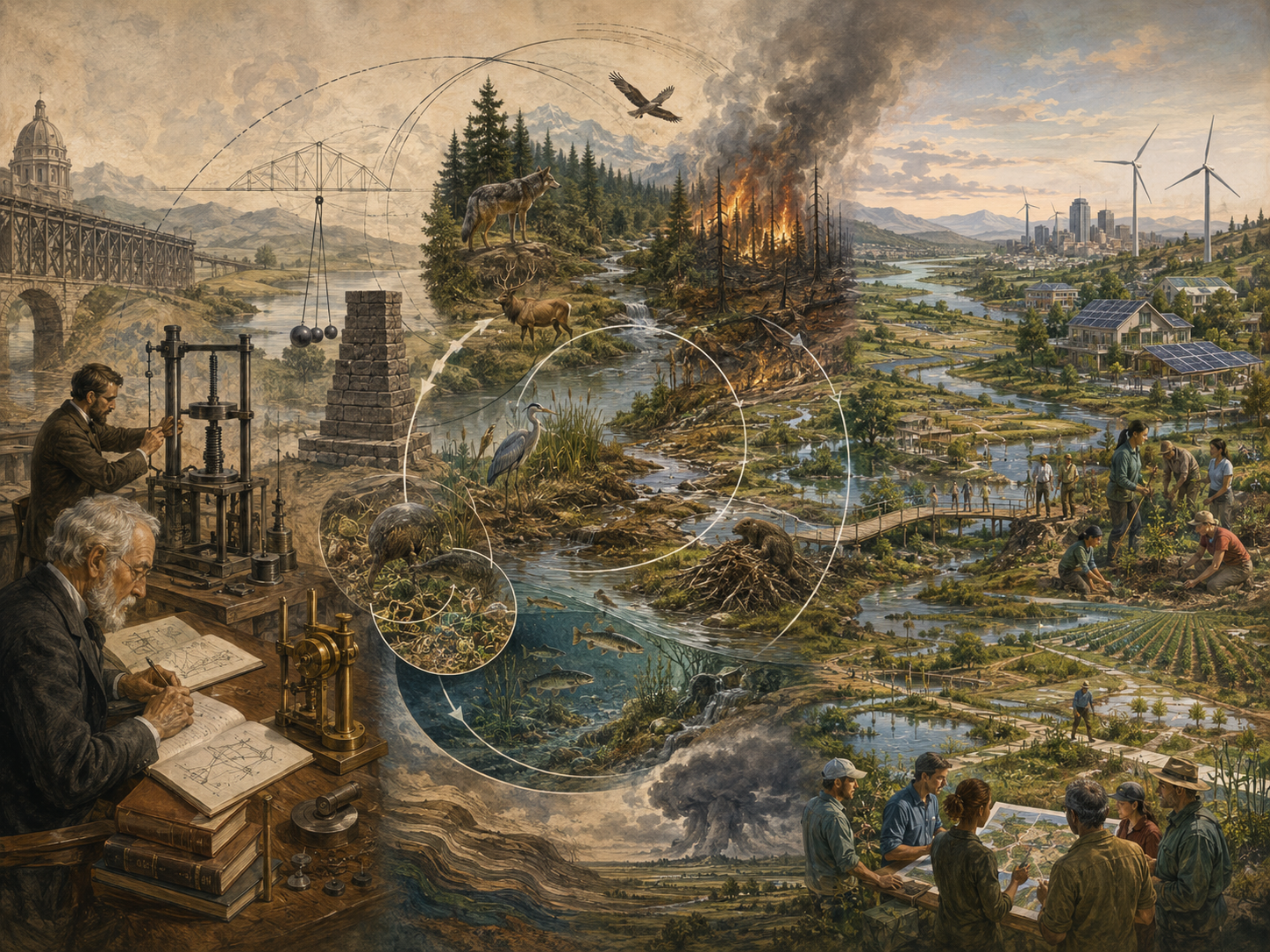
Before Resilience: The Dominance of Equilibrium Thinking
Before resilience theory took shape, much of ecological and systems analysis was dominated by equilibrium assumptions. Systems were often modeled as if they tended toward a stable balance point and returned to that balance when disturbed. In ecology, this tendency appeared in ideas about succession, climax communities, carrying capacity, predator-prey balance, and stable natural order. In economics and engineering, equilibrium and optimization frameworks likewise played central roles.
These models were not useless. Equilibrium analysis remains powerful in many controlled settings. It can clarify local dynamics, identify stable operating points, and support formal analysis of feedback and return behavior. In engineering, equilibrium and stability analysis remain indispensable for designing control systems, structures, circuits, and machines that must operate safely within defined tolerances. In ecology, equilibrium ideas helped structure early debates about population dynamics, community organization, and ecosystem function.
But equilibrium thinking imposed limits on how researchers understood disturbance. If the primary question was whether a system returned to equilibrium, then disruption was interpreted as a temporary deviation from the norm. This made disturbance seem external, exceptional, and secondary. It also encouraged analysts to look for average behavior, stable states, and smooth recovery rather than thresholds, regime shifts, discontinuities, and transformation.
What equilibrium-centered models struggled to explain was why some systems crossed thresholds, reorganized into new states, or fluctuated substantially without losing their broader functional integrity. A lake might absorb nutrient inputs for years and then abruptly shift into a turbid eutrophic state. A forest might require fire disturbance to sustain renewal. A fishery might appear productive until exploitation and ecological feedbacks pushed it into collapse. A rangeland might retain vegetation under moderate pressure and then shift toward desertification.
The seeds of resilience theory lay in dissatisfaction with that narrow frame. Real ecosystems did not always behave as if they were smoothly self-correcting. Disturbance was often integral to their structure. Fire regimes, predator-prey interactions, drought cycles, nutrient pulses, flood dynamics, invasive species, land-use change, and habitat fragmentation all revealed that variability was not simply noise around equilibrium. In many systems, variability was part of the system itself.
Intellectual Preconditions: Systems, Cybernetics, and Ecology
Resilience theory did not appear from nowhere in 1973. It emerged from a wider intellectual environment in which scholars were already questioning simple linear models. Systems theory, cybernetics, operations research, ecology, and early complexity thinking all contributed to a broader interest in feedback, control, adaptation, and self-organization.
Cybernetics brought attention to feedback loops, regulation, communication, and control. Systems theory encouraged researchers to examine wholes, relationships, and interdependencies rather than isolated components. Ecology increasingly revealed that populations and ecosystems behaved through nonlinear interactions rather than simple mechanical balance. Resource management exposed the limits of command-and-control approaches. These intellectual currents created the conditions under which resilience could become a distinctive concept.
Key preconditions for resilience theory
Feedback thinking
Cybernetics and systems theory helped show that system behavior depends on feedback loops, delays, amplification, and regulation. Resilience theory later extended this logic into ecological and social-ecological systems.
Nonlinear ecology
Ecological research increasingly revealed that ecosystems do not always respond proportionally to disturbance. Small changes can produce large effects when thresholds or reinforcing feedbacks are involved.
Resource-management failure
Command-and-control management often simplified ecosystems in ways that produced short-term stability but long-term fragility. Resilience theory helped explain why suppressing disturbance could increase vulnerability.
Multiple regimes
Research on alternative stable states showed that systems may not have one natural equilibrium. A system can reorganize into a different regime and become difficult to restore.
These preconditions matter because they show that resilience theory was not only a new ecological concept. It was part of a broader move away from linear causality, static optimization, and single-equilibrium models toward a richer understanding of dynamic systems.
Holling 1973: The Founding Moment
The foundational turning point came with C.S. Holling’s 1973 article, Resilience and Stability of Ecological Systems. In that paper, Holling drew a crucial distinction between stability and resilience. Stability referred to the speed with which a system returned to equilibrium after disturbance. Resilience referred to the amount of disturbance a system could absorb before shifting into a different regime with different structures, relationships, and processes.
This was a major intellectual break. Holling argued that ecosystems could be highly resilient without being highly stable in the narrow equilibrium sense. A system might fluctuate dramatically yet still persist. Conversely, a system might appear stable under small perturbations while remaining vulnerable to larger shocks that push it across a threshold. The distinction made it possible to see that rapid return to equilibrium and deep capacity to absorb change are not the same property.
Holling’s intervention mattered not only because he introduced a durable term into ecological discourse, but because he reframed the core analytical problem. The question was no longer merely whether systems returned to equilibrium. It was whether they could absorb shock without losing their organizing relationships. That shift would reverberate across decades of ecological and systems research.
| Concept | Equilibrium-centered interpretation | Holling’s resilience-theory shift |
|---|---|---|
| Disturbance | A temporary deviation from normal conditions | A normal feature of system behavior that can reveal or reshape structure |
| Stability | Return speed after perturbation | Useful but insufficient for understanding persistence under larger shocks |
| Resilience | Often conflated with recovery | Capacity to absorb disturbance before shifting into another regime |
| System state | Often assumed to center on one equilibrium | May involve multiple basins of attraction and alternative regimes |
| Management goal | Restore or maintain equilibrium | Maintain adaptive capacity, threshold distance, and functional integrity |
The 1973 paper remains central because it established the conceptual difference that still animates resilience thinking today: a system may be stable but not resilient, and resilient without being stable in the ordinary sense. That distinction is explored in more detail in Resilience vs Stability vs Robustness.
From Ecological Resilience to Nonlinear Systems
After Holling’s early contribution, resilience theory increasingly became associated with nonlinear systems behavior. Researchers began to focus on the existence of multiple stable states, the importance of slow variables, the possibility of abrupt regime shifts, and the role of feedback loops in maintaining or transforming system structure. Ecological systems were no longer understood as merely oscillating around a single optimum. Instead, they were seen as capable of reorganizing into qualitatively different configurations when pressures crossed critical thresholds.
This perspective changed how disturbance was interpreted. Disturbance was not simply an external shock imposed on a passive system. It was part of the dynamic context within which systems developed. Some disturbances even contributed to system renewal. Fire, grazing, flood pulses, seasonal variability, predator-prey fluctuations, and nutrient cycling could sustain ecological processes rather than merely threaten them.
By the late twentieth century, resilience had become associated with a broader family of concepts: thresholds, alternative stable states, slow variables, ecological memory, adaptive management, cross-scale dynamics, and regime shifts. These ideas gradually moved resilience theory beyond descriptive ecology toward a more general framework for complex adaptive systems.
Concepts that deepened ecological resilience theory
Alternative stable states
Systems may have more than one persistent configuration. Once a system shifts into another regime, simply removing the original disturbance may not restore the prior state.
Slow variables
Some variables change gradually but control system behavior over long periods. Soil fertility, groundwater, biodiversity, trust, and institutional capacity may erode before visible collapse appears.
Threshold effects
Systems can absorb pressure for a long time before abrupt reorganization. Thresholds made resilience theory fundamentally different from simple recovery logic.
Ecological memory
Seed banks, surviving organisms, landscape patterns, genetic diversity, and species traits can help ecosystems reorganize after disturbance.
The historical importance of this stage is that resilience became less a descriptive term and more a theory of nonlinear persistence. It gave researchers a language for studying why systems do not always respond gradually, why recovery can be difficult, and why maintaining adaptive capacity may matter more than maintaining surface stability.
The Rise of Adaptive Management
Another important stage in the history of resilience theory was the development of adaptive management. Adaptive management emerged from the recognition that uncertainty is not a temporary inconvenience but a permanent condition of managing complex systems. Rather than pretending that ecosystems, watersheds, fisheries, forests, or institutions can be fully controlled through fixed plans, adaptive management treats policy and management interventions as opportunities for structured learning.
This was historically significant because it linked resilience theory to practice. It translated ecological insights into a way of governing under uncertainty. The key idea was that resilient systems are not merely shock-resistant; they are capable of learning, adjustment, and reorganization. Management therefore becomes not only intervention, but also inquiry.
Adaptive management also changed the role of monitoring. In a command-and-control model, monitoring may function mainly as compliance verification. In adaptive management, monitoring becomes part of a learning cycle. Managers test assumptions, observe outcomes, revise models, and adjust action. This makes governance more experimental, but also more demanding. It requires institutions capable of admitting uncertainty, learning from failure, and changing course.
Adaptive management helped shift resilience theory from a focus on ecological persistence alone toward a broader concern with institutional flexibility, feedback monitoring, stakeholder participation, and long-term governance capacity. This made resilience increasingly relevant to public policy, resource governance, and organizational design.
The Adaptive Cycle and Panarchy
During the 1990s and early 2000s, resilience theory gained additional conceptual depth through the development of the adaptive cycle and panarchy. These ideas were central to Lance Gunderson, C.S. Holling, and related scholars working on transformations in human and natural systems.
The adaptive cycle describes a recurring pattern of growth, conservation, release, and reorganization. Systems often begin by expanding and accumulating resources. Over time, those gains can become tightly locked in, creating efficiency but also rigidity. Disturbance may then trigger a release phase in which stored structures break down, followed by reorganization in which novelty, experimentation, and renewal become possible.
| Adaptive-cycle phase | Typical pattern | Historical importance for resilience theory |
|---|---|---|
| Growth | Expansion, experimentation, resource accumulation | Shows how systems build capacity, diversity, and opportunity. |
| Conservation | Efficiency, connectedness, institutionalization | Shows how success can create rigidity, lock-in, and hidden vulnerability. |
| Release | Disturbance, breakdown, rapid change | Shows that disruption can expose accumulated fragility and open space for reorganization. |
| Reorganization | Learning, recombination, renewal, transformation | Shows how novelty and adaptive capacity can shape the next regime. |
This model was influential because it challenged linear narratives of progress or decline. It suggested that disturbance and reorganization are not always signs of failure. They can also create the conditions for renewal. Panarchy extended this insight across scales by describing a nested structure of interacting adaptive cycles operating at different temporal and spatial levels. Smaller, faster systems may generate experimentation and change; larger, slower systems may provide memory, resources, and constraint.
This cross-scale framing was historically decisive because it made resilience theory more suitable for understanding complex systems embedded in one another rather than isolated in a single domain. A forest exists inside a watershed. A watershed exists inside a region. A region is shaped by climate systems, land-use institutions, markets, infrastructure, and governance. Panarchy offered a way to analyze these nested dynamics without reducing everything to one level of explanation.
Social-Ecological Systems and the Broadening of the Field
A major expansion in the history of resilience theory came when scholars moved from ecosystems alone to social-ecological systems. This shift recognized that ecological systems are inseparable from the human institutions, practices, technologies, economies, and governance arrangements that shape them. Resilience could no longer be treated as purely biophysical. It had to include adaptation, learning, power, knowledge, transformability, and decision-making in linked human-natural systems.
The 2004 article by Brian Walker, C.S. Holling, Stephen Carpenter, and Ann Kinzig on resilience, adaptability, and transformability in social-ecological systems was especially important in this transition. It helped formalize the distinction between resilience, adaptability, and transformability and located resilience more clearly within sustainability-related questions.
This move widened the scope of resilience theory enormously. It brought governance, institutions, livelihoods, knowledge systems, technology, and social learning into the picture. It also increased the framework’s relevance for sustainability science, because long-term ecological viability could not be separated from social coordination, political decision-making, economic incentives, and cultural values.
What social-ecological systems added to resilience theory
Institutions
Rules, norms, property systems, agencies, and governance arrangements shape how societies respond to disturbance and whether adaptation is possible.
Livelihoods
Resilience became linked to how people sustain well-being under ecological, economic, and climate stress, not only to how ecosystems persist.
Knowledge systems
Scientific knowledge, local knowledge, Indigenous knowledge, and institutional memory became central to adaptation and transformation.
Transformability
When existing regimes become untenable, resilience thinking must ask whether systems can move into new configurations rather than merely persist.
The social-ecological turn made resilience more powerful, but also more contested. Once resilience was applied to human systems, analysts had to ask difficult questions: whose resilience, whose vulnerability, whose knowledge, whose authority, and whose costs?
The Stockholm School and Sustainability Science
As resilience theory moved into the twenty-first century, it became deeply connected to sustainability science. The Stockholm Resilience Centre played a major role in this stage by integrating resilience thinking with governance of social-ecological systems, biosphere stewardship, climate adaptation, planetary boundaries, transformation, and global sustainability challenges.
This was a historically important transition because resilience was no longer confined to ecosystem management or resource theory. It became part of a broader attempt to understand how human societies can remain viable within environmental limits while navigating uncertainty, thresholds, and global change. Resilience thinking became tied to questions of transformation, sustainability pathways, and planetary-scale risk.
This institutional and intellectual phase also helped communicate resilience beyond specialized academic circles and into public discourse around sustainability, governance, and development. Resilience increasingly became not just a descriptive scientific concept, but a framework for thinking about viable futures under accelerating planetary pressure.
The Stockholm school also helped connect resilience to the concept of the Anthropocene: a period in which human activity has become a dominant force shaping Earth systems. In that context, resilience theory became a way to think about how societies can avoid dangerous thresholds, preserve biosphere functions, and transform institutions that are no longer compatible with ecological limits.
Resilience Theory and Disaster Risk Reduction
Another important historical development was the movement of resilience concepts into disaster risk reduction and public policy. Here, resilience was reframed in more operational terms. Rather than focusing only on ecological persistence, policy institutions increasingly defined resilience as the ability of communities, societies, infrastructure systems, and institutions to resist, absorb, adapt to, transform, and recover from hazards while preserving essential functions.
This broadened resilience theory into applied governance domains such as urban resilience, infrastructure resilience, community resilience, public-health resilience, and climate-resilient development. The framework became useful not only for explaining system behavior but also for guiding planning under conditions of hazard and uncertainty.
Historically, this phase mattered because it translated resilience theory from an ecological and scholarly discourse into global governance language. It also increased the concept’s visibility, though sometimes at the cost of simplification. In many policy contexts, resilience became shorthand for recovery, preparedness, or risk reduction. That broader use made the concept influential, but it also created the danger of losing the deeper theoretical focus on thresholds, regimes, adaptation, and transformation.
Disaster risk reduction also made the social dimension of resilience impossible to ignore. A hazard becomes a disaster through exposure, vulnerability, infrastructure quality, governance capacity, social inequality, and historical patterns of land use and investment. This pushed resilience theory toward questions of justice, power, planning, and public responsibility.
The IPCC and Climate-Resilient Development
Climate science gave resilience theory another major arena of relevance. As climate change intensified the need to think about thresholds, adaptation, vulnerability, exposure, and long-duration risk, resilience became central to climate discourse. The Intergovernmental Panel on Climate Change integrated resilience language into its treatment of climate impacts, adaptation, vulnerability, and sustainable development.
This was not merely terminological adoption. Climate change forced resilience theory to engage with coupled human-natural systems at multiple scales, from local vulnerability to global tipping processes. It strengthened the relationship between resilience, adaptation, and transformability, and it placed resilience in direct conversation with justice, exposure, development pathways, and long-horizon governance.
In this phase, resilience became part of an analytical language for climate-resilient development: not simply the ability to bounce back after disaster, but the capacity to navigate systemic change under conditions of intensifying environmental stress. It also made clear that resilience cannot be separated from mitigation, adaptation, infrastructure, finance, social protection, ecological restoration, and institutional capacity.
| Historical phase | Primary domain | Main contribution to resilience thinking |
|---|---|---|
| Ecological resilience | Ecosystems | Distinguished resilience from stability and introduced threshold persistence. |
| Adaptive management | Resource governance | Linked resilience to learning, monitoring, experimentation, and uncertainty. |
| Panarchy | Cross-scale systems | Explained nested adaptive cycles and interactions across scales. |
| Social-ecological systems | Human-natural systems | Integrated governance, livelihoods, institutions, knowledge, and transformability. |
| Sustainability science | Planetary change | Connected resilience to ecological limits, development pathways, and transformation. |
| Climate and disaster governance | Policy and planning | Operationalized resilience in relation to hazards, vulnerability, adaptation, and recovery. |
Critical Resilience: Power, Justice, and the Politics of Adaptation
As resilience theory entered public policy, development, climate adaptation, urban planning, and institutional governance, critics began asking whether resilience language could be used to shift responsibility onto vulnerable communities. This critical turn is now essential to the history of the concept.
The problem is not resilience theory itself. The problem is how resilience can be used politically. Communities can be praised for resilience while being denied infrastructure investment. Workers can be told to become resilient while institutions preserve exploitative conditions. Public agencies can demand community resilience while withdrawing support. Climate adaptation can be framed as local resilience while historical emitters and powerful institutions avoid responsibility.
This critique changed the field by making clear that resilience is never only technical. It is also normative. Analysts must ask what is being made resilient, for whom, against what disturbance, and at whose cost. A harmful system can be resilient. An unjust institution can adapt and persist. A polluting regime can reorganize to protect itself. A community can survive repeated shocks while still being abandoned by the systems that should protect it.
Critical questions that reshaped resilience debates
Resilience of what?
The system boundary must be explicit. Is analysis protecting an ecosystem, community, institution, supply chain, market, infrastructure network, or political regime?
Resilience for whom?
The beneficiaries must be named. Resilience for powerful actors may coexist with increased exposure for marginalized communities, workers, ecosystems, or future generations.
Resilience against what?
The disturbance must be specified. Resilience against familiar hazards does not guarantee resilience against compound, slow-moving, or structural threats.
Resilience at what cost?
Persistence can be harmful if it depends on exploitation, ecological degradation, austerity, exclusion, or abandonment of vulnerable populations.
The critical turn did not make resilience theory weaker. It made it more rigorous. It forced resilience scholars and practitioners to distinguish descriptive persistence from ethical desirability. It also connected resilience to justice, public responsibility, democratic accountability, and the politics of transformation.
Why the History Matters
The historical development of resilience theory matters because it explains why the concept is often misunderstood today. In popular discourse, resilience is frequently reduced to “bouncing back.” But historically, the field developed in explicit opposition to narrow recovery logic. From Holling onward, resilience theory has been about regime change, thresholds, adaptive capacity, and the capacity to absorb disturbance without losing essential system function.
The history also helps explain why resilience is now used across so many domains. The concept traveled because it addressed a widespread analytical failure: the inability of static, equilibrium-centered models to explain how complex systems behave under real-world conditions of uncertainty and change. Resilience theory offered a richer vocabulary for persistence, collapse, adaptation, and transformation.
Finally, this history matters for strategy. A historically informed understanding of resilience reveals that resilience is not simply a trait to be maximized. It is a way of thinking about system behavior that raises deeper questions about what should persist, what must adapt, and when transformation becomes necessary.
Intellectual Turning Points in Summary
Pre-1970s equilibrium thinking
Ecological and systems analysis often emphasized balance, stable states, return behavior, and equilibrium-centered models.
Holling 1973
Holling distinguished resilience from stability and reframed disturbance analysis around persistence, thresholds, and regime shifts.
Nonlinear systems and thresholds
Resilience became associated with alternative stable states, slow variables, feedbacks, and abrupt transitions.
Adaptive management
Resilience theory entered practice through structured learning, monitoring, experimentation, and governance under uncertainty.
Adaptive cycle and panarchy
Growth, conservation, release, and reorganization were linked across nested scales of change.
Social-ecological systems
Resilience expanded beyond ecology into governance, livelihoods, institutions, knowledge systems, and transformability.
Sustainability science
Resilience became central to ecological limits, planetary change, stewardship, and transformation pathways.
Disaster and climate governance
Resilience entered policy language around hazards, vulnerability, adaptation, recovery, and climate-resilient development.
Mathematical Lens: From Equilibrium Return to Threshold Persistence
The historical shift in resilience theory can be expressed through a contrast between two stylized models. A classical equilibrium-centered model emphasizes return toward a reference state:
\frac{dx}{dt} = -a(x – x^{*})
\]
Interpretation: \(x^{*}\) is an equilibrium and \(a > 0\) determines return speed. This captures the logic behind stability analysis: the key question is how quickly the system returns after perturbation.
Resilience theory broadened the problem by focusing on threshold persistence rather than only local return. A stylized nonlinear form is:
\frac{dx}{dt} = rx – x^3 + p
\]
Interpretation: \(x\) is the system state, \(r\) structures internal dynamics, and \(p\) is accumulating external pressure. This form allows for multiple regimes and abrupt transition when the existing basin of attraction disappears.
A simple resilience-capacity abstraction can then be written as:
R_t = B_t – D_t + A_t
\]
Interpretation: \(R_t\) is resilience margin, \(B_t\) is basin width or tolerance, \(D_t\) is accumulated disturbance, and \(A_t\) is adaptive capacity. The exact quantities vary by system, but the formal contrast shows why resilience theory moved beyond equilibrium return toward disturbance absorption, learning, and transformation.
The mathematical lesson is historical as well as technical. Early stability logic focused on return behavior near a reference point. Resilience theory made it necessary to analyze thresholds, basins, adaptive capacity, and the possibility that the system’s future trajectory may not resemble its past equilibrium.
Python Workflow: Modeling the Shift from Stability Logic to Resilience Logic
The Python workflow below compares a simple equilibrium-return system with a nonlinear threshold system. It is useful for making the intellectual transition visible: the first model captures stability logic, while the second better reflects why resilience theory became necessary for complex adaptive systems.
# Install packages if needed:
# pip install pandas numpy matplotlib

import numpy as np
import pandas as pd
import matplotlib.pyplot as plt

# ------------------------------------------------------------
# Python Workflow: Stability Logic vs Resilience Logic
# Purpose:
#   Compare an equilibrium-return model with a nonlinear
#   threshold model to illustrate the historical shift
#   from stability-centered thinking to resilience theory.
# ------------------------------------------------------------

time_steps = np.arange(1, 161)

# ------------------------------------------------------------
# 1. Equilibrium-return model
# x[t+1] = x[t] - a * (x[t] - x_star)
# ------------------------------------------------------------
x_star = 0.0
a = 0.10

equilibrium_state = np.zeros(len(time_steps))
equilibrium_state[0] = 1.0

for t in range(1, len(time_steps)):
    equilibrium_state[t] = (
        equilibrium_state[t - 1]
        - a * (equilibrium_state[t - 1] - x_star)
    )

# ------------------------------------------------------------
# 2. Nonlinear threshold model
# x[t+1] = x[t] + dt * (r*x - x^3 + p)
# ------------------------------------------------------------
threshold_state = np.zeros(len(time_steps))
threshold_state[0] = -0.9

pressure = np.linspace(-0.45, 0.85, len(time_steps))
r = 1.1
dt = 0.05

for t in range(1, len(time_steps)):
    threshold_state[t] = threshold_state[t - 1] + dt * (
        r * threshold_state[t - 1]
        - threshold_state[t - 1]**3
        + pressure[t]
    )

# ------------------------------------------------------------
# 3. Resilience margin abstraction
# ------------------------------------------------------------
basin_width = np.linspace(0.85, 0.45, len(time_steps))
disturbance_load = np.linspace(0.10, 0.70, len(time_steps))
adaptive_capacity = 0.35 + 0.20 * np.sin(time_steps / 18)

resilience_margin = basin_width - disturbance_load + adaptive_capacity

history_df = pd.DataFrame({
    "time": time_steps,
    "equilibrium_state": equilibrium_state,
    "threshold_state": threshold_state,
    "pressure": pressure,
    "basin_width": basin_width,
    "disturbance_load": disturbance_load,
    "adaptive_capacity": adaptive_capacity,
    "resilience_margin": resilience_margin
})

print(history_df.head())

# ------------------------------------------------------------
# Plot equilibrium return vs threshold dynamics
# ------------------------------------------------------------
plt.figure(figsize=(10, 6))
plt.plot(history_df["time"], history_df["equilibrium_state"], label="Equilibrium Return")
plt.plot(history_df["time"], history_df["threshold_state"], label="Threshold Dynamics")
plt.xlabel("Time Step")
plt.ylabel("System State")
plt.title("From Stability Logic to Resilience Logic")
plt.legend()
plt.tight_layout()
plt.show()

# ------------------------------------------------------------
# Plot threshold state against pressure
# ------------------------------------------------------------
plt.figure(figsize=(10, 6))
plt.plot(history_df["pressure"], history_df["threshold_state"])
plt.xlabel("Accumulating Pressure")
plt.ylabel("Threshold System State")
plt.title("Nonlinear Threshold Behavior Under Gradual Pressure")
plt.tight_layout()
plt.show()

# ------------------------------------------------------------
# Plot resilience margin
# ------------------------------------------------------------
plt.figure(figsize=(10, 6))
plt.plot(history_df["time"], history_df["resilience_margin"])
plt.axhline(0, linestyle="--", linewidth=1)
plt.xlabel("Time Step")
plt.ylabel("Resilience Margin")
plt.title("Stylized Resilience Margin Over Time")
plt.tight_layout()
plt.show()

# ------------------------------------------------------------
# Export results
# ------------------------------------------------------------
history_df.to_csv("resilience_theory_models.csv", index=False)
The workflow shows why resilience theory was historically necessary. A system can look comprehensible under equilibrium-return logic while a different kind of system requires attention to accumulating pressure, threshold behavior, and adaptive capacity. The shift is not only mathematical; it is conceptual.
R Workflow: Tracing the Historical Expansion of Resilience Theory
The R workflow below builds a stylized historical timeline of resilience theory and assigns weights to major conceptual shifts. It is not a bibliometric study. It is an evergreen analytical workflow for visualizing how the field expanded from ecology into governance, sustainability, disaster risk reduction, and climate discourse.
# Install packages if needed.
# install.packages(c("tidyverse"))

library(tidyverse)

# ------------------------------------------------------------
# R Workflow: Tracing the Historical Expansion of Resilience Theory
# Purpose:
#   Build a stylized timeline of major conceptual expansions
#   in resilience theory.
# ------------------------------------------------------------

resilience_history <- tibble(
  period = c(
    "Pre-1970s Equilibrium Thinking",
    "Holling 1973",
    "Nonlinear Systems and Thresholds",
    "Adaptive Management",
    "Adaptive Cycle and Panarchy",
    "Social-Ecological Systems",
    "Sustainability Science",
    "Disaster Risk Reduction",
    "Climate-Resilient Development",
    "Critical Resilience and Justice"
  ),
  start_year = c(1950, 1973, 1985, 1990, 2002, 2004, 2008, 2010, 2014, 2015),
  conceptual_scope = c(0.20, 0.35, 0.48, 0.55, 0.68, 0.78, 0.88, 0.91, 0.94, 0.96),
  governance_relevance = c(0.10, 0.18, 0.24, 0.45, 0.52, 0.70, 0.86, 0.90, 0.94, 0.96),
  system_complexity = c(0.25, 0.42, 0.60, 0.66, 0.78, 0.86, 0.92, 0.93, 0.95, 0.96),
  justice_relevance = c(0.05, 0.08, 0.12, 0.20, 0.28, 0.42, 0.58, 0.70, 0.80, 0.94)
)

print(resilience_history)

# ------------------------------------------------------------
# Long format for plotting
# ------------------------------------------------------------
history_long <- resilience_history %>%
  pivot_longer(
    cols = c(
      conceptual_scope,
      governance_relevance,
      system_complexity,
      justice_relevance
    ),
    names_to = "dimension",
    values_to = "value"
  )

ggplot(history_long, aes(x = start_year, y = value, color = dimension)) +
  geom_line(linewidth = 1.1) +
  geom_point(size = 2.5) +
  labs(
    title = "Stylized Historical Expansion of Resilience Theory",
    x = "Year",
    y = "Relative Emphasis",
    color = "Dimension"
  ) +
  theme_minimal(base_size = 12)

# ------------------------------------------------------------
# Weighted historical influence score
# ------------------------------------------------------------
resilience_history <- resilience_history %>%
  mutate(
    influence_score =
      0.35 * conceptual_scope +
      0.25 * governance_relevance +
      0.25 * system_complexity +
      0.15 * justice_relevance
  )

print(resilience_history)

ggplot(resilience_history, aes(x = reorder(period, influence_score), y = influence_score)) +
  geom_col() +
  coord_flip() +
  labs(
    title = "Stylized Influence Score Across Historical Phases",
    x = "Historical Phase",
    y = "Influence Score"
  ) +
  theme_minimal(base_size = 12)

# ------------------------------------------------------------
# Export results
# ------------------------------------------------------------
write_csv(resilience_history, "history_of_resilience_theory.csv")
write_csv(history_long, "history_of_resilience_theory_long.csv")
The purpose of the workflow is to make the expansion of the field visible. Resilience theory began with ecological disturbance and stability debates, but its conceptual scope widened as the framework entered governance, sustainability, disaster risk, climate adaptation, and justice-centered critique.
GitHub Repository
The companion GitHub repository for this article is designed as a historical modeling and knowledge-architecture scaffold for resilience theory. It translates the article’s intellectual history into reproducible workflows for timeline analysis, conceptual expansion mapping, historical phase comparison, and simple models that contrast equilibrium-return logic with threshold-based resilience logic.
Complete Code Repository
Companion code for tracing the history of resilience theory, including historical timeline datasets, conceptual expansion analysis, equilibrium-versus-threshold modeling, resilience-theory mapping workflows, and multi-language computational examples.
The companion article directory is articles/history-of-resilience-theory/. It is structured to support a professional analytical workflow: Python for timeline modeling and nonlinear systems comparison; R for historical expansion profiles and visualization; SQL for historical phase, concept, source, and model-run schemas; Julia for threshold and regime-transition examples; and Rust, Go, C, C++, and Fortran for lightweight diagnostic and simulation utilities.
The modeling objective is to make the historical shift from equilibrium-centered thinking to resilience-centered thinking analytically visible. The scaffold includes synthetic historical datasets, conceptual-weighting models, timeline visualizations, nonlinear threshold examples, documentation, validation notes, and generated outputs. It is not a substitute for historiography or bibliometric research, but it gives readers a reproducible foundation for exploring how resilience theory expanded across ecology, governance, sustainability science, climate adaptation, and critical resilience debates.
This repository extends the article from narrative history into applied knowledge modeling. It allows readers to explore how ideas such as stability, disturbance, thresholds, adaptive management, panarchy, social-ecological systems, transformability, climate resilience, and justice entered the field over time.
Conclusion
The history of resilience theory is the history of a profound conceptual transition. It began as a critique of equilibrium-centered ecological thinking and became a wider framework for understanding how systems absorb disturbance, adapt under uncertainty, cross thresholds, reorganize across scales, and sometimes transform. In that sense, resilience theory did not merely add one more concept to systems thought. It changed the underlying questions.
That historical trajectory also explains why resilience now appears across ecology, governance, sustainability, disaster policy, infrastructure planning, climate adaptation, organizational analysis, and social vulnerability research. The framework traveled because it addressed a general problem: how to think clearly about systems that do not remain stable, do not respond linearly, and cannot be governed through fixed assumptions alone.
In the broader architecture of this knowledge series, the history of resilience theory matters because it shows that resilience is not a slogan or a motivational ideal. It is an intellectual tradition with specific origins, arguments, and turning points. To understand that history is to understand why resilience thinking remains powerful for analyzing systems under pressure.
The most important historical lesson is that resilience theory has always been more than recovery. It is a way of analyzing persistence, adaptation, thresholds, learning, and transformation in systems whose futures cannot be reduced to equilibrium return.
Related Articles
- What Is Resilience Thinking?
- Resilience vs Stability vs Robustness
- Adaptive Cycles and Panarchy
- Social-Ecological Systems
- Adaptive Capacity in Complex Systems
- System Thresholds and Tipping Points
- Systems Modeling
Further Reading
- Berkes, F., Colding, J. and Folke, C. (eds.) (2003) Navigating Social-Ecological Systems: Building Resilience for Complexity and Change. Cambridge: Cambridge University Press. Available at: https://www.cambridge.org/core/books/navigating-socialecological-systems/78B6F14EF6AB9F1C9F8BDB67A7B22363.
- Biggs, R., Schlüter, M. and Schoon, M.L. (eds.) (2015) Principles for Building Resilience: Sustaining Ecosystem Services in Social-Ecological Systems. Cambridge: Cambridge University Press. Available at: https://www.cambridge.org/core/books/principles-for-building-resilience/557CAECDFDFA305625E100D99B193718.
- Folke, C. (2016) ‘Resilience’, Oxford Research Encyclopedia of Environmental Science. Oxford: Oxford University Press. Available at: https://doi.org/10.1093/acrefore/9780199389414.013.8.
- Gunderson, L.H. and Holling, C.S. (eds.) (2002) Panarchy: Understanding Transformations in Human and Natural Systems. Washington, DC: Island Press. Available at: https://islandpress.org/books/panarchy.
- Scheffer, M. (2009) Critical Transitions in Nature and Society. Princeton: Princeton University Press. Available at: https://press.princeton.edu/books/paperback/9780691122045/critical-transitions-in-nature-and-society.
- Walker, B. and Salt, D. (2006) Resilience Thinking: Sustaining Ecosystems and People in a Changing World. Washington, DC: Island Press. Available at: https://islandpress.org/books/resilience-thinking.
- Walker, B. and Salt, D. (2012) Resilience Practice: Building Capacity to Absorb Disturbance and Maintain Function. Washington, DC: Island Press. Available at: https://islandpress.org/books/resilience-practice.
References
- Béné, C., Wood, R.G., Newsham, A. and Davies, M. (2012) ‘Resilience: New utopia or new tyranny? Reflection about the potentials and limits of the concept of resilience in relation to vulnerability reduction programmes’, IDS Working Papers, 2012(405), pp. 1–61. Available at: https://doi.org/10.1111/j.2040-0209.2012.00405.x.
- Biggs, R., Schlüter, M. and Schoon, M.L. (eds.) (2015) Principles for Building Resilience: Sustaining Ecosystem Services in Social-Ecological Systems. Cambridge: Cambridge University Press. Available at: https://www.cambridge.org/core/books/principles-for-building-resilience/557CAECDFDFA305625E100D99B193718.
- Folke, C. (2006) ‘Resilience: The emergence of a perspective for social-ecological systems analyses’, Global Environmental Change, 16(3), pp. 253–267. Available at: https://doi.org/10.1016/j.gloenvcha.2006.04.002.
- Folke, C., Carpenter, S.R., Walker, B., Scheffer, M., Chapin, T. and Rockström, J. (2010) ‘Resilience thinking: Integrating resilience, adaptability and transformability’, Ecology and Society, 15(4), 20. Available at: https://ecologyandsociety.org/vol15/iss4/art20/.
- Gunderson, L.H. (2000) ‘Ecological resilience—in theory and application’, Annual Review of Ecology and Systematics, 31, pp. 425–439. Available at: https://doi.org/10.1146/annurev.ecolsys.31.1.425.
- Gunderson, L.H. and Holling, C.S. (eds.) (2002) Panarchy: Understanding Transformations in Human and Natural Systems. Washington, DC: Island Press. Available at: https://islandpress.org/books/panarchy.
- Holling, C.S. (1973) ‘Resilience and stability of ecological systems’, Annual Review of Ecology and Systematics, 4, pp. 1–23. Available at: https://www.annualreviews.org/content/journals/10.1146/annurev.es.04.110173.000245.
- Intergovernmental Panel on Climate Change (IPCC) (2023) AR6 Synthesis Report: Climate Change 2023. Available at: https://www.ipcc.ch/report/ar6/syr/.
- Manyena, S.B. (2006) ‘The concept of resilience revisited’, Disasters, 30(4), pp. 434–450. Available at: https://doi.org/10.1111/j.0361-3666.2006.00331.x.
- Resilience Alliance (no date) Adaptive Cycle. Available at: https://www.resalliance.org/adaptive-cycle.
- Resilience Alliance (no date) Adaptive Management. Available at: https://www.resalliance.org/adaptive-mgmt.
- Resilience Alliance (no date) Key Concepts. Available at: https://www.resalliance.org/key-concepts.
- Resilience Alliance (no date) Panarchy. Available at: https://www.resalliance.org/panarchy.
- Rockström, J. et al. (2009) ‘A safe operating space for humanity’, Nature, 461, pp. 472–475. Available at: https://doi.org/10.1038/461472a.
- Scheffer, M. (2009) Critical Transitions in Nature and Society. Princeton: Princeton University Press. Available at: https://press.princeton.edu/books/paperback/9780691122045/critical-transitions-in-nature-and-society.
- United Nations Office for Disaster Risk Reduction (UNDRR) (no date) Definition: Resilience. Available at: https://www.undrr.org/terminology/resilience.
- Walker, B., Holling, C.S., Carpenter, S.R. and Kinzig, A. (2004) ‘Resilience, adaptability and transformability in social-ecological systems’, Ecology and Society, 9(2), 5. Available at: https://ecologyandsociety.org/vol9/iss2/art5/.