
Last Updated June 2, 2026
Resilience in food and water systems is the capacity of interconnected agricultural, hydrological, ecological, infrastructural, economic, and social systems to maintain safe, sufficient, affordable, and reliable access to food and water under disturbance, uncertainty, and long-term change. It is not simply the ability to produce more food or store more water. It is the broader ability to sustain availability, access, quality, stability, ecological function, public health, institutional trust, and adaptive capacity when systems face drought, flood, heat, conflict, market volatility, infrastructure failure, contamination, ecosystem degradation, and shifting climate baselines.
Food and water systems are among the clearest examples of resilience thinking in practice because they are both essential to life and deeply interconnected. Agriculture depends on rainfall, groundwater, rivers, reservoirs, soil moisture, irrigation infrastructure, energy, labor, biodiversity, markets, logistics, and governance. Water systems are shaped by agricultural demand, land use, urban growth, industrial use, watersheds, treatment systems, pollution, legal rights, ecosystems, and climate conditions. A disruption in one domain can propagate into the other, producing food insecurity, water scarcity, public-health risk, economic instability, displacement, ecological stress, and political conflict.
This article examines resilience in food and water systems as a systems problem rather than a narrow resource-management problem. It explains why food and water cannot be understood as separate sectors, how availability differs from access, why stability and quality matter as much as aggregate supply, how climate change alters both hydrological and agricultural baselines, why ecosystems are part of resource resilience, how markets and governance can buffer or amplify risk, and why justice is central to food-and-water security. It also extends the conceptual discussion into applied modeling workflows for comparing food-and-water resilience strategies under uncertainty.
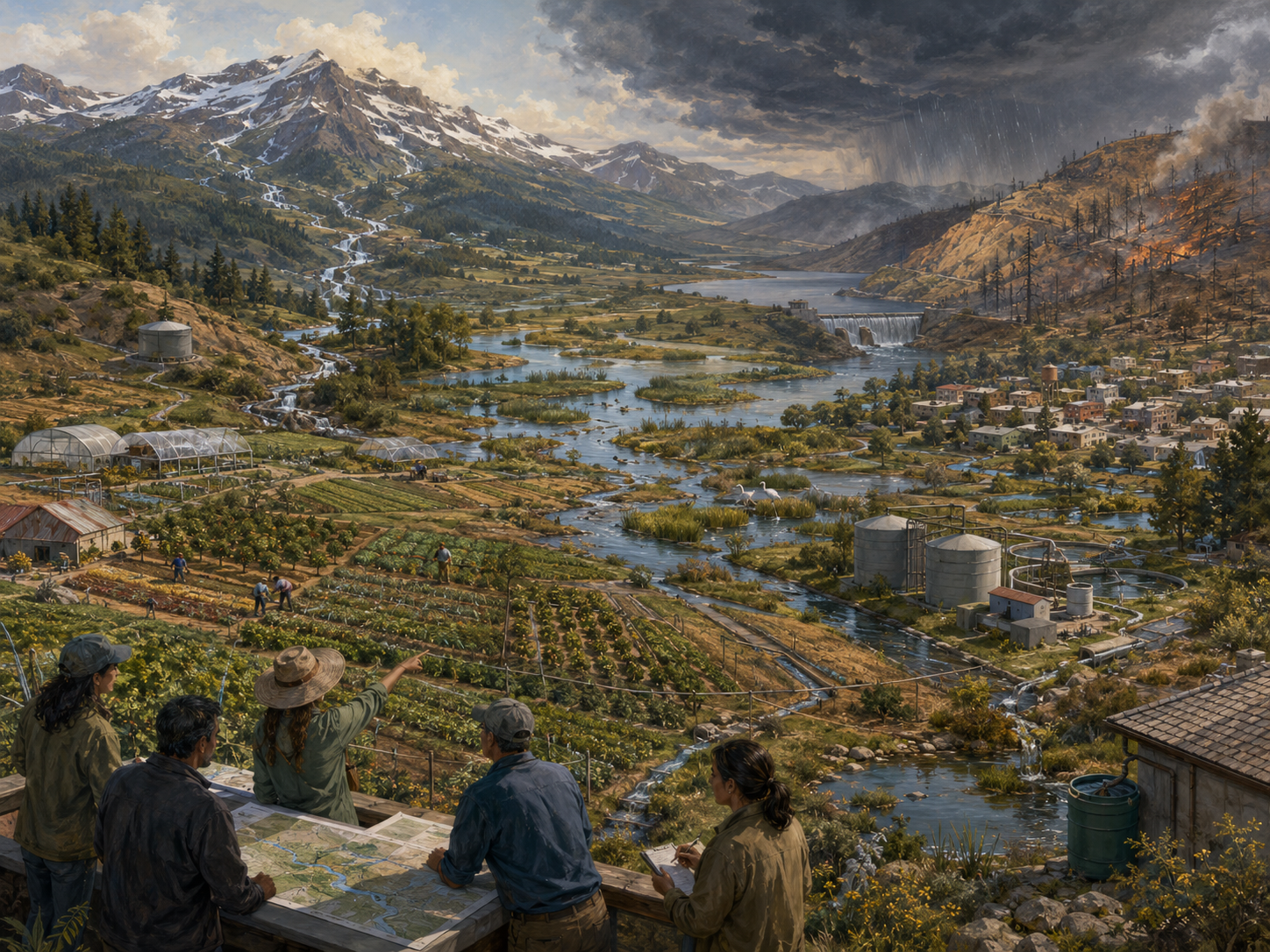
What Resilience in Food and Water Systems Means
Resilience in food and water systems refers to the ability to maintain supply, access, safety, quality, affordability, ecological viability, and continuity under conditions of stress and uncertainty. This includes the capacity to withstand shocks such as droughts, floods, heatwaves, pests, disease outbreaks, infrastructure failure, contamination events, supply-chain disruption, conflict, and price volatility. It also includes the capacity to adapt to longer-term pressures such as climate change, groundwater depletion, soil degradation, demographic change, urbanization, ecosystem decline, changing diets, shifting trade patterns, and competing demands for land, water, and energy.
This perspective emphasizes both stability and adaptability. Food and water systems must provide reliable outputs under ordinary conditions, but they must also remain flexible enough to adjust when those conditions change. A system that maximizes production in the short term while depleting groundwater, degrading soils, narrowing crop diversity, weakening local livelihoods, or excluding poor households from access is not resilient in a serious sense. It may be productive, but brittle. A resilient system preserves basic human need while retaining the ability to learn, reorganize, and adapt under pressure.
Food-and-water resilience is also broader than food production or water supply. Food resilience includes nutrition, affordability, distribution, storage, safety, crop diversity, labor, soil health, logistics, household access, and market stability. Water resilience includes availability, treatment, sanitation, quality, allocation, ecosystem flow, infrastructure continuity, groundwater sustainability, and protection from contamination. The two are inseparable because food systems are water-dependent and water systems are shaped by food production.
| Concept | Primary question | Resilience implication |
|---|---|---|
| Food availability | Is sufficient food physically produced, stored, imported, or distributed? | High production does not guarantee access, nutrition, affordability, or stability. |
| Food access | Can people actually obtain adequate, safe, nutritious food? | Income, prices, transport, conflict, social protection, and inequality shape resilience. |
| Water availability | Is sufficient water physically available across seasons and uses? | Surface water, groundwater, rainfall, storage, ecosystems, and demand all matter. |
| Water access | Can households, farms, ecosystems, and institutions obtain safe water reliably? | Infrastructure, governance, affordability, sanitation, rights, and power determine outcomes. |
| System resilience | Can food and water functions continue under disturbance and long-term change? | Requires ecological, infrastructural, economic, institutional, and community capacity. |
Resilience in food and water systems is therefore a question of function, access, justice, adaptation, and long-term viability—not merely total output.
Why Food and Water Resilience Matters
Food and water systems matter because they support the most basic conditions of life. When they function well, they sustain nutrition, public health, livelihoods, education, economic activity, ecological stability, and social trust. When they fail, the effects can cascade quickly into malnutrition, disease, displacement, economic loss, social unrest, public-health emergency, conflict over allocation, and institutional crisis. Few systems reveal the link between ecological condition and human security more directly.
Food-and-water resilience is especially important because these systems are exposed to multiple stressors at once. Climate variability affects rainfall, river flows, snowpack, soil moisture, heat stress, crop yields, pest dynamics, livestock health, aquifer recharge, water quality, and hydropower. Market shocks affect fertilizer, fuel, feed, food prices, import dependency, and household purchasing power. Infrastructure failures affect irrigation, cold chains, water treatment, sanitation, storage, transport, and emergency distribution. Governance failures affect allocation, environmental protection, food safety, emergency response, and long-term planning.
The stakes are not evenly distributed. Poor households, smallholder farmers, informal workers, rural communities, Indigenous communities, pastoralists, fisher communities, people living in informal settlements, children, older adults, displaced populations, and people already facing health burdens often experience food-and-water disruptions more severely. Resilience must therefore be measured not only by aggregate production or total withdrawals, but by who remains protected when systems are stressed.
Why food-and-water resilience is a systems priority
Basic human need
Food and water are foundational to survival, health, dignity, learning, labor, and social stability.
Climate sensitivity
Temperature, precipitation, drought, flood, heat, and ecosystem stress affect both food and water systems.
Infrastructure dependence
Irrigation, storage, treatment, refrigeration, transport, sanitation, and energy shape resource continuity.
Market volatility
Prices, trade, fuel costs, input shortages, and household purchasing power determine access under stress.
Ecological foundations
Soils, watersheds, aquifers, wetlands, biodiversity, and pollination support durable resource security.
Unequal vulnerability
Aggregate supply can hide exclusion, hunger, unsafe water, and delayed recovery for vulnerable groups.
Food-and-water resilience matters because it determines whether environmental and economic shocks remain manageable or become threats to life, health, social order, and long-term development.
Food and Water Systems as Social-Ecological Systems
Food and water systems are social-ecological systems: ecological processes and human systems shape one another continuously. Soil fertility, rainfall, river flow, groundwater recharge, pollination, wetlands, forests, biodiversity, and climate interact with land tenure, agricultural policy, markets, irrigation infrastructure, labor systems, water rights, trade, culture, technology, and household behavior. Neither the ecological nor the social side can be treated as a background variable.
This matters because system failure often emerges from the coupling between ecological stress and social decisions. A drought is not only a rainfall deficit. It becomes crisis through groundwater dependence, crop choice, irrigation efficiency, water allocation, poverty, market access, public support, ecosystem condition, and institutional trust. A food-price shock is not only a market event. It becomes hunger through income insecurity, import dependence, storage, logistics, conflict, policy response, and social protection. A contamination event is not only a water-quality problem. It becomes public-health crisis through treatment capacity, monitoring, governance, communication, and household alternatives.
Social-ecological framing also helps explain why resilience cannot be separated from feedback and thresholds. Degraded soils reduce yields, which can encourage more input use or land expansion, which can worsen ecological stress. Groundwater depletion can sustain production temporarily while reducing future water availability. Deforestation can alter watersheds and local climate, affecting both agriculture and water supply. These feedbacks make food-and-water resilience a central topic in resilience thinking.
| Social-ecological component | Food-and-water role | Resilience concern |
|---|---|---|
| Soils | Support crop growth, water retention, nutrient cycling, and carbon storage | Degradation reduces productivity and drought resilience. |
| Watersheds | Regulate flow, filtration, storage, recharge, and flood buffering | Land-use change can increase flood, sediment, contamination, and scarcity risk. |
| Institutions | Allocate water, regulate land, support farmers, protect safety, and manage emergencies | Weak governance can produce overuse, inequity, conflict, and delayed adaptation. |
| Markets | Move food, inputs, finance, labor, and risk across regions | Markets can buffer shortage or amplify volatility and exclusion. |
| Communities | Hold local knowledge, practices, networks, and adaptive capacity | Top-down planning can fail if it ignores lived vulnerability and local stewardship. |
Food-and-water resilience is strongest when ecological processes, infrastructure, governance, markets, and communities are studied together rather than treated as separate systems.
Interdependence of Food and Water Systems
Food and water systems are tightly coupled. Agriculture depends on water availability, while water security is shaped by agriculture. Irrigation can stabilize production under rainfall variability, but it can also increase groundwater depletion, reduce river flows, alter ecosystems, concentrate salts, and create long-term dependence on unsustainable withdrawals. Livestock systems require water for animals, feed crops, processing, and sanitation. Fisheries and aquaculture depend on water quality, flow, temperature, and ecosystem function. Food processing, refrigeration, and transport require water and energy, while water systems require energy for pumping, treatment, storage, and distribution.
This interdependence creates feedback loops. Water scarcity can reduce yields, which raises prices, which increases household vulnerability and political pressure. Higher food demand can increase irrigation, which reduces groundwater, which increases future water scarcity. Floods can damage crops and contaminate water supplies simultaneously. Heat can reduce crop productivity while increasing water demand. Energy shortages can interrupt irrigation and water treatment while also affecting food storage and transport.
These dynamics highlight the importance of Feedback Loops in Resilient Systems. Food-and-water resilience cannot be built by optimizing each sector separately. A water strategy that ignores food production may undermine livelihoods. A food strategy that ignores water limits may destroy future resource security. A market strategy that ignores household access may preserve aggregate supply while increasing hunger. A climate strategy that ignores ecosystems may reduce short-term risk while weakening long-term resilience.
| Interdependency | Risk pathway | Resilience implication |
|---|---|---|
| Irrigation and groundwater | Irrigation stabilizes yields while depleting aquifers if withdrawals exceed recharge | Requires water accounting, recharge protection, crop choices, allocation rules, and demand management. |
| Food logistics and energy | Power or fuel disruption affects cold chains, transport, processing, and storage | Requires energy resilience, distributed storage, backup systems, and local contingency planning. |
| Water treatment and public health | Flood, power loss, or contamination disrupts safe water and sanitation | Requires treatment redundancy, monitoring, emergency distribution, and sanitation planning. |
| Markets and household access | Price spikes or trade disruption reduce access even when food exists in aggregate | Requires social protection, reserves, diversified supply, and affordability safeguards. |
| Watersheds and agriculture | Land-use change affects runoff, erosion, recharge, water quality, and flood risk | Requires integrated land-water planning and ecosystem stewardship. |
The interdependence of food and water systems makes resilience a coordination problem: ecological, infrastructural, economic, and institutional decisions must be aligned over time.
Core Dimensions of Resilience in Food and Water Systems
Several dimensions are central to resilience in food and water systems. These dimensions are not interchangeable. A system can have high availability but weak access, strong production but poor nutrition, stable supply but declining water quality, strong infrastructure but weak governance, or strong short-term output but low adaptive capacity. Serious food-and-water resilience requires examining these dimensions together.
Availability
Availability concerns the physical presence of sufficient food and water resources. In food systems, it includes production, imports, storage, reserves, fisheries, livestock, processing, and distribution capacity. In water systems, it includes rainfall, rivers, reservoirs, aquifers, soil moisture, reuse, treatment, storage, and environmental flows. Availability is necessary, but it is not enough: resources can exist in aggregate while households, farms, or ecosystems remain excluded.
Access
Access concerns whether people, communities, farms, institutions, and ecosystems can actually obtain food and water. It depends on affordability, infrastructure, land and water rights, transport, income, social protection, disability access, conflict conditions, public distribution, sanitation systems, and political inclusion. Access is often where aggregate abundance fails to translate into resilience.
Stability
Stability concerns consistency of supply and access over time, especially under stress. Food and water systems must handle seasonal variability, drought, flood, market volatility, pest outbreaks, infrastructure outage, conflict, and changing demand. Stability depends on storage, diversification, reserves, soil health, groundwater management, supply-chain redundancy, public finance, and institutional coordination.
Quality
Quality concerns whether food and water are safe and usable for human, ecological, and productive needs. Food quality includes nutrition, food safety, contamination control, dietary diversity, and storage integrity. Water quality includes treatment, sanitation, salinity, pathogen control, chemical contamination, ecosystem health, and suitability for agriculture, drinking, industry, and environmental flows.
Adaptive Capacity
Adaptive capacity is the ability to adjust production, consumption, allocation, infrastructure, governance, markets, and ecological management as conditions change. It includes monitoring, learning, flexible rules, diversified livelihoods, local knowledge, seed systems, crop switching, water-saving practices, scenario planning, institutional memory, and the ability to revise assumptions before crisis becomes unavoidable.
Equity and Legitimacy
Equity and legitimacy determine whether food-and-water resilience is publicly meaningful rather than merely technical. These systems must be governed in ways that protect vulnerable groups, include affected communities, respect local and Indigenous knowledge, distribute costs fairly, and prevent adaptation from becoming dispossession, exclusion, or privatized security for the already protected.
| Dimension | Primary focus | Failure if neglected |
|---|---|---|
| Availability | Physical supply of food and water | Scarcity emerges because resources are insufficient, depleted, disrupted, or poorly stored. |
| Access | Ability to obtain food and water reliably | Aggregate supply hides hunger, unsafe water, affordability barriers, or exclusion. |
| Stability | Consistency across time and disturbance | Seasonal, market, climate, or infrastructure shocks create recurring crisis. |
| Quality | Safety, nutrition, sanitation, and usability | Food or water exists but becomes unsafe, unhealthy, contaminated, or unsuitable. |
| Adaptive capacity | Learning and adjustment under changing conditions | Systems remain productive in the short run while becoming fragile under future stress. |
| Equity and legitimacy | Fair access, participation, and accountable governance | Resilience benefits some users while shifting insecurity onto others. |
Food-and-water resilience is strongest when availability, access, stability, quality, adaptive capacity, and equity reinforce one another rather than competing as separate goals.
Climate Change and Resource Systems
Climate change is one of the most significant drivers of stress in food and water systems. Changes in temperature, precipitation, seasonality, snowpack, evapotranspiration, storm intensity, drought frequency, flood risk, ocean conditions, pests, disease pressure, and extreme heat affect both agricultural production and water security. Climate change also alters the baselines against which infrastructure and institutions were designed. A reservoir built around historical flow assumptions may become less reliable. A crop calendar may no longer match rainfall timing. Irrigation demand may rise as water availability declines. Flood protection may be overwhelmed by more intense rainfall.
The challenge is not only more severe individual events. It is the destabilization of the patterns that food and water systems depend on. Farmers rely on seasonal expectations. Utilities rely on flow records, demand projections, treatment assumptions, and storage planning. Markets rely on predictable supply. Public-health systems rely on safe water, sanitation, and food availability. Climate change weakens these assumptions and increases the need for adaptive governance.
Climate change also creates nonlinear risk. Gradual warming, soil moisture decline, aquifer depletion, salinization, ecosystem degradation, or repeated crop stress can eventually push systems across thresholds. This connects directly to System Thresholds and Tipping Points. A food-and-water system may appear stable until a threshold is crossed: groundwater becomes too deep or saline, heat stress reduces labor and yield, pollinator loss reduces productivity, water treatment is overwhelmed, or repeated shocks exhaust household coping capacity.
Climate pressures on food and water systems
Heat stress
Reduces crop productivity, livestock health, labor safety, water availability, and food storage reliability.
Drought
Reduces surface water, groundwater recharge, soil moisture, hydropower, crop yields, and ecosystem flow.
Flooding
Damages crops, infrastructure, roads, storage, sanitation systems, water quality, and public health.
Seasonal disruption
Shifts planting, harvest, rainfall, snowmelt, irrigation, pest pressure, and storage planning.
Sea-level rise
Threatens deltas, coastal aquifers, salinity, fisheries, ports, agricultural land, and freshwater access.
Compound events
Heat, drought, flood, market stress, power outage, and disease can interact in the same season.
Food-and-water resilience under climate change requires planning for shifting baselines, not simply preparing for isolated extreme events.
Drought, Flood, and Hydrological Variability
Drought and flood are often treated as opposite hazards, but in food and water systems they are linked through hydrological variability. The same watershed may face drought in one season and extreme rainfall in another. Dry soils can reduce infiltration and increase runoff when heavy rain arrives. Floods can damage storage, contaminate wells, erode soils, and interrupt planting. Droughts can reduce river flows, concentrate pollutants, increase groundwater pumping, reduce yields, and deepen conflict over allocation.
Resilience therefore requires more than drought response or flood control in isolation. It requires watershed thinking, soil restoration, groundwater management, water storage, demand management, floodplain protection, infrastructure redundancy, early warning, ecological buffers, and governance that can handle variability. In many places, the central problem is not simply too little or too much water; it is water arriving at the wrong time, in the wrong form, with the wrong infrastructure and governance capacity.
| Hydrological stress | Food-and-water pathway | Resilience strategy |
|---|---|---|
| Drought | Soil moisture decline, crop stress, livestock stress, groundwater pumping, food-price pressure | Demand management, crop diversity, soil health, water accounting, drought planning, social protection. |
| Extreme rainfall | Flooded fields, erosion, contaminated water, damaged transport, disrupted planting | Floodplain restoration, drainage design, storage protection, watershed management, early warning. |
| Groundwater decline | Short-term irrigation stability becomes long-term water insecurity | Recharge protection, pumping limits, crop switching, monitoring, allocation reform. |
| Salinization | Soils and freshwater sources become less usable for crops and households | Drainage, crop adaptation, coastal protection, aquifer management, land-use change. |
| Water-quality degradation | Water exists physically but becomes unsafe or unusable | Treatment, pollution control, sanitation, watershed protection, monitoring, emergency distribution. |
Hydrological resilience requires managing variability, not merely maximizing withdrawals or building storage without attention to ecological limits.
Food Security, Nutrition, and Public Health
Food-system resilience must be evaluated through food security and nutrition, not only production volume. A system can produce or import sufficient calories while still producing hunger, micronutrient deficiency, diet-related disease, food deserts, unsafe food, unaffordable diets, or unstable access. Resilience therefore requires attention to availability, access, utilization, stability, quality, and the social conditions that determine whether households can obtain adequate food consistently.
Food disruptions can become public-health crises quickly. Crop failure, food-price spikes, conflict, transport disruption, supply-chain bottlenecks, and income loss can reduce dietary quality and increase malnutrition. Food safety failures can produce disease outbreaks. Heat and power outages can disrupt refrigeration. Floods can contaminate crops and storage facilities. Drought can reduce dietary diversity and increase dependence on emergency food. Children, pregnant people, older adults, displaced communities, people with chronic illness, and low-income households may be especially vulnerable.
Food resilience beyond production volume
Nutrition
Resilience requires dietary quality, micronutrients, and food safety, not only calories.
Affordability
Food may exist in markets while households cannot afford adequate diets.
Storage and cold chains
Power, refrigeration, transport, and storage affect spoilage, safety, and access.
Local and regional capacity
Regional production, storage, processing, and distribution can buffer distant shocks.
Public distribution
Emergency food, school meals, reserves, and social protection support access during disruption.
Livelihood security
Food access depends on income, labor, land, credit, and social support, not only supply.
A resilient food system protects nourishment, dignity, safety, and access under stress—not merely total output in good years.
Water Security, Quality, and Sanitation
Water resilience includes water security, quality, and sanitation. Physical water availability does not guarantee usable water. Water can be present but polluted, saline, unaffordable, inaccessible, intermittent, unsafe, or captured by more powerful users. Water security therefore requires reliable quantity, acceptable quality, functioning infrastructure, equitable allocation, sanitation, ecosystem protection, and institutional capacity.
Water quality is especially important because contamination can turn water abundance into public-health risk. Flooding can overwhelm sewage systems, spread pathogens, mobilize chemicals, and contaminate wells. Drought can concentrate pollutants and increase salinity. Agricultural runoff can affect rivers, lakes, groundwater, and coastal systems. Industrial pollution, mining, poor sanitation, and aging infrastructure can degrade water long before visible scarcity appears. A resilience framework must therefore measure both water quantity and water usability.
Sanitation is inseparable from water resilience. When sanitation systems fail, disease risk increases, water bodies are contaminated, and public trust declines. In emergencies, water supply, sanitation, hygiene, and public health must be managed together. This is why water resilience cannot be treated only as storage or supply engineering. It is also a public-health, ecosystem, governance, and equity problem.
| Water resilience dimension | Resilience concern | Example intervention |
|---|---|---|
| Quantity | Enough water across seasons, uses, and drought conditions | Demand management, storage, reuse, leakage control, groundwater governance. |
| Quality | Water safe enough for drinking, irrigation, ecosystems, and public health | Treatment, monitoring, pollution control, watershed protection, emergency testing. |
| Access | People and essential users can obtain water reliably and affordably | Public infrastructure, affordability protections, rural access, inclusive service design. |
| Sanitation | Wastewater and hygiene systems prevent disease and contamination | Sewer resilience, decentralized sanitation, floodproofing, emergency WASH support. |
| Environmental flows | Ecosystems receive enough water to sustain function | River-basin planning, wetland protection, allocation rules, habitat restoration. |
Water resilience is not only about finding more water. It is about protecting safe, usable, equitable, and ecologically sustainable water over time.
Infrastructure and Resource Resilience
Infrastructure plays a major role in food and water resilience. Irrigation systems, reservoirs, canals, wells, pumps, treatment plants, sewer networks, stormwater systems, storage facilities, roads, ports, refrigeration, warehouses, energy systems, digital monitoring platforms, and emergency distribution networks determine whether food and water can be produced, stored, treated, transported, and delivered under stress. Resource resilience therefore depends partly on Infrastructure Resilience.
Infrastructure failures can quickly cascade across food and water systems. Power outages can interrupt irrigation, water treatment, refrigeration, fuel pumps, communications, and distribution. Flooded roads can delay food deliveries and emergency water distribution. Damaged storage facilities can increase spoilage. Treatment failures can create drinking-water crises. Digital system failures can disrupt monitoring, forecasting, logistics, and payment systems. A food-and-water resilience strategy must therefore map the infrastructure dependencies that support resource access.
Infrastructure resilience also includes maintenance and adaptation. Aging pipes, leaky canals, undermaintained treatment systems, weak rural roads, insufficient cold storage, poor drainage, and unreliable power can create chronic fragility before a shock occurs. Climate change can then expose and intensify that fragility. Building resilient food and water systems requires investing before disruption becomes emergency.
| Infrastructure system | Food-and-water function | Resilience concern |
|---|---|---|
| Irrigation and pumping | Stabilizes crop production under rainfall variability | Can depend on energy, groundwater, maintenance, allocation, and long-term water availability. |
| Water treatment and sanitation | Protects public health and usable water quality | Can fail under flood, power outage, contamination, aging infrastructure, or underinvestment. |
| Storage and cold chains | Reduces spoilage and stabilizes food availability | Depends on power, transport, refrigeration, monitoring, and market coordination. |
| Transport and logistics | Moves food, water, inputs, labor, and emergency supplies | Can fail under flood, conflict, fuel shortage, infrastructure damage, or supply-chain disruption. |
| Digital monitoring | Supports forecasting, allocation, early warning, quality control, and logistics | Depends on data quality, connectivity, governance, cybersecurity, and institutional capacity. |
Infrastructure resilience in food and water systems must be evaluated by service continuity: whether people and ecosystems can still access safe food and water when infrastructure is stressed.
Economic and Market Dynamics
Economic systems shape food and water resilience through pricing, trade, labor, credit, input markets, insurance, public finance, subsidies, storage, procurement, and distribution. Markets can buffer local shortages by moving food across regions, but they can also transmit volatility and expose households to price shocks. Trade can diversify supply, but import dependence can increase vulnerability to distant disruptions. Fertilizer, fuel, feed, seed, and transport costs can affect both production and affordability. Water pricing can encourage conservation, but it can also exclude poor households or small farmers if designed without justice safeguards.
This connects directly to Economic Resilience. A food-and-water system is economically resilient when it can absorb shocks without collapsing access, livelihoods, or production capacity. That requires diversified supply chains, fair markets, local and regional buffers, household income support, public reserves where appropriate, risk finance, smallholder support, and safeguards against volatility. It also requires attention to labor: farmworkers, food processors, transport workers, water utility workers, informal vendors, and care workers all support resource continuity.
Aggregate market efficiency is not the same as resilience. A highly efficient food supply chain with low inventory, long-distance dependence, concentrated suppliers, and just-in-time logistics may reduce costs under routine conditions but become fragile under disruption. A water allocation system that maximizes short-term economic value may undermine long-term equity, ecosystem function, or public health. Resilience requires evaluating economic arrangements under stress, not only in normal times.
Economic pathways shaping food-and-water resilience
Price volatility
Food and input price spikes can reduce household access and producer viability.
Trade dependence
Imports can buffer local shortage but create exposure to distant disruption and export controls.
Input markets
Fertilizer, seed, fuel, feed, equipment, and energy costs affect production and affordability.
Labor conditions
Heat, migration, wages, safety, and labor rights shape the people who keep systems operating.
Public finance
Infrastructure, reserves, social protection, monitoring, and extension require sustained investment.
Market concentration
Concentrated suppliers, processors, or logistics systems can create systemic bottlenecks.
Economic resilience in food and water systems is measured by whether markets, public institutions, and households can maintain access under stress—not only by whether production or trade continues in aggregate.
Governance and Institutional Factors
Governance systems determine how food and water resources are managed, allocated, protected, monitored, financed, and adapted. Policies, laws, rights, agencies, utilities, extension services, public-health systems, emergency managers, market regulators, land-use planners, watershed authorities, farmer organizations, and community institutions all shape resilience. Strong institutions can reduce vulnerability and support long-term stewardship. Weak institutions can encourage overuse, inequitable allocation, delayed adaptation, corruption, conflict, pollution, and systemic risk.
Food-and-water governance is difficult because it must balance competing needs: farms, households, ecosystems, cities, industry, energy, sanitation, cultural practices, emergency use, and future generations. Governance must also operate across scales. A household water crisis may be shaped by neighborhood infrastructure, city policy, regional watershed management, national agricultural incentives, global commodity prices, and climate change. Local, regional, national, and international systems interact.
This connects directly to Institutional Resilience. A resilient governance system can coordinate across sectors, revise allocation rules when conditions change, enforce environmental protections, protect vulnerable groups, invest before crisis, manage conflict, incorporate local knowledge, and learn from failure. Governance failure can turn environmental stress into social crisis even when technical solutions exist.
| Governance function | Food-and-water role | Failure mode |
|---|---|---|
| Allocation | Determines who receives water, land, food aid, infrastructure, and emergency support | Powerful users capture resources while vulnerable users face scarcity. |
| Regulation | Protects water quality, food safety, land use, ecosystems, labor, and public health | Pollution, unsafe food, overuse, and environmental degradation accumulate. |
| Monitoring | Tracks rainfall, aquifers, water quality, crop conditions, prices, nutrition, and risk | Slow variables remain invisible until crisis occurs. |
| Coordination | Connects agriculture, water, health, infrastructure, environment, finance, and emergency response | Sectoral silos miss feedback loops and cascading risks. |
| Learning | Updates rules and investments after shocks, near misses, and changing conditions | Systems repeat failures because lessons are documented but not implemented. |
Food-and-water resilience requires institutions capable of balancing immediate needs with long-term sustainability, equity, ecological limits, and adaptive governance.
Community-Level Dynamics
Communities play a central role in food and water resilience because local knowledge, social networks, cultural practices, mutual aid, farmer experience, watershed stewardship, seed systems, cooperative storage, informal markets, and household coping strategies strongly influence how systems respond to change. Community-level resilience is not merely a supplement to formal infrastructure or policy. It is a core source of practical knowledge and adaptive capacity.
Local communities often understand everyday vulnerability more clearly than distant institutions. They may know which wells fail first, which roads become impassable, which crops tolerate local stress, which households are food insecure, which distribution systems are trusted, which water sources are contaminated seasonally, which farmers are overextended, and which official plans do not work under real conditions. Such knowledge is essential for accurate diagnosis.
At the same time, community resilience should not be romanticized or used as a substitute for public responsibility. Communities should not be expected to compensate for underinvestment, weak infrastructure, unsafe water, food insecurity, exploitative labor, failed governance, or climate impacts they did not create. The strongest food-and-water resilience combines local knowledge and participation with public investment, accountable institutions, and material support.
Community capacities in food-and-water resilience
Local water knowledge
Communities often know seasonal sources, contamination patterns, access barriers, and informal coping strategies.
Seed and crop diversity
Local seed systems, crop knowledge, and agroecological practices can support adaptation under changing conditions.
Mutual aid and distribution
Community networks can support food access, emergency water, transport, care, and information.
Cooperative storage
Shared storage, processing, and local logistics can buffer market and climate shocks.
Participatory monitoring
Local reporting can identify crop stress, water failure, contamination, and access gaps early.
Legitimacy and trust
Adaptation is more durable when communities help define risk, priorities, and acceptable trade-offs.
Community-level resilience is strongest when local knowledge is treated as a decision-making resource and paired with real authority, investment, and institutional accountability.
Ecosystems and Resource Resilience
Ecosystems support food and water systems through soil formation, nutrient cycling, water regulation, infiltration, groundwater recharge, pollination, pest control, flood buffering, sediment control, biodiversity, climate moderation, and watershed function. When ecosystems degrade, food-and-water resilience declines. Eroded soils reduce yields and water retention. Depleted aquifers reduce future irrigation and drinking-water security. Damaged wetlands reduce flood buffering and water filtration. Biodiversity loss can reduce pollination, pest regulation, and ecological redundancy. Deforestation can alter runoff, local climate, and river systems.
This connects directly to Ecological Resilience and Ecosystem Stability. Maintaining ecosystem function is not an environmental add-on to food and water strategy. It is part of what makes long-term food and water security possible. Food-and-water resilience is weakened when soil, water, biodiversity, and ecosystem services are treated as expendable inputs rather than as living foundations.
Nature-based and agroecological strategies can strengthen resilience when they are designed carefully. Soil restoration, agroforestry, wetland protection, watershed restoration, diversified cropping, riparian buffers, floodplain reconnection, regenerative practices, integrated pest management, and biodiversity protection can reduce vulnerability while improving ecological function. But they require monitoring, local fit, governance, and justice safeguards. Conservation or restoration that displaces people, ignores livelihoods, or excludes local knowledge can create new vulnerabilities.
| Ecosystem function | Food-and-water benefit | Risk if degraded |
|---|---|---|
| Soil health | Supports yields, water retention, infiltration, nutrient cycling, and drought buffering | Erosion, compaction, nutrient depletion, runoff, and crop vulnerability increase. |
| Watersheds | Regulate flows, recharge, water quality, flood risk, and sediment | Flooding, contamination, scarcity, and infrastructure stress intensify. |
| Wetlands | Filter water, store floodwater, support biodiversity, and sustain fisheries | Flood peaks, water pollution, and ecological vulnerability increase. |
| Biodiversity | Supports pollination, pest control, genetic diversity, and ecological redundancy | Systems become more vulnerable to pests, disease, climate stress, and productivity shocks. |
| Environmental flows | Maintain rivers, wetlands, fisheries, habitats, and water quality | Human withdrawals undermine the ecological systems that sustain future water security. |
Food-and-water resilience depends on living systems. The resilience of farms, aquifers, rivers, wetlands, markets, and households cannot be separated from the resilience of ecosystems.
Trade-Offs and Sustainability
Resilience in food and water systems often involves difficult trade-offs. Increasing production may strain water resources. Expanding irrigation may stabilize yields while depleting aquifers. Protecting rivers may reduce short-term water withdrawals while supporting long-term ecosystem function. Conservation measures may reduce immediate output while preserving future capacity. Food reserves may improve stability but require finance, storage, and governance. Trade may buffer local shortages but increase exposure to global volatility. Water pricing may encourage efficiency but harm poor households if not designed with protection.
These trade-offs reveal that resilience cannot be reduced to maximizing a single variable. A narrow production goal can weaken water resilience. A narrow water-efficiency goal can harm livelihoods. A narrow market-efficiency goal can reduce reserves and local capacity. A narrow conservation goal can ignore food security and community rights. A narrow infrastructure goal can create lock-in or ecological harm. This is why food-and-water resilience must be evaluated through systems thinking.
Balancing trade-offs connects directly to Resilience and Sustainable Development. Sustainable systems must meet present needs without undermining future availability, ecological function, or equitable access. Resilience adds a disturbance lens: can those systems keep functioning under stress? Together, sustainability and resilience ask whether food and water systems are viable not only in average years, but through shocks, surprises, and long-term change.
| Trade-off | Short-term benefit | Long-term resilience concern |
|---|---|---|
| Irrigation expansion | Stabilizes yields under rainfall variability | Can deplete aquifers, increase salinity, and create unsustainable dependence. |
| High-yield monoculture | Improves output and market efficiency | Can reduce biodiversity, soil health, crop diversity, and pest resilience. |
| Long-distance trade dependence | Buffers local scarcity and lowers costs | Can increase vulnerability to distant shocks, export restrictions, and logistics failure. |
| Strict conservation | Protects ecosystems and water sources | Can become unjust if local food needs, land rights, and livelihoods are ignored. |
| Low inventory supply chains | Reduces storage costs under normal conditions | Can increase fragility during transport disruption, conflict, pandemics, or extreme weather. |
Food-and-water resilience requires disciplined trade-off analysis: what improves present performance, what protects future capacity, who benefits, who pays, and what risks are shifted elsewhere?
Justice, Equity, and Resource Access
Food-and-water resilience is inseparable from justice because resource insecurity is shaped by inequality. Some people face scarcity because resources are physically limited. Others face scarcity because they are excluded by poverty, weak infrastructure, discrimination, land tenure, political marginalization, conflict, disability, geography, or unaffordable prices. A food-and-water system can appear resilient at the national or regional level while leaving specific communities hungry, thirsty, exposed to unsafe water, or dependent on emergency support.
Justice matters at several levels. Distributive justice asks who receives food, water, infrastructure, protection, subsidies, recovery assistance, and adaptation investment. Procedural justice asks who participates in decisions about allocation, land use, water rights, food policy, adaptation, and relocation. Recognitional justice asks whose knowledge, culture, practices, and rights are respected. Intergenerational justice asks whether present systems deplete aquifers, soils, ecosystems, and climate stability at the expense of future communities.
Food-and-water resilience can also be undermined by maladaptation. Adaptation projects can protect powerful users while shifting scarcity onto poorer communities. Water infrastructure can expand supply for export agriculture while local households face shortages. Conservation projects can restrict local access without providing alternatives. Market reforms can improve efficiency while raising prices beyond what low-income households can afford. Resilience must therefore be evaluated through power and access, not only technical performance.
| Justice dimension | Food-and-water question | Example |
|---|---|---|
| Distributive justice | Who receives safe water, nutritious food, infrastructure, and support? | Water access, food assistance, irrigation benefits, recovery funding, storage investments. |
| Procedural justice | Who participates in allocation, planning, adaptation, and governance? | Community water boards, farmer participation, Indigenous governance, public hearings with authority. |
| Recognitional justice | Whose knowledge, livelihoods, rights, and cultural practices are respected? | Local seed systems, pastoral mobility, fishing rights, Indigenous water knowledge, traditional foods. |
| Restorative justice | How are past harms and underinvestment addressed? | Infrastructure repair, pollution cleanup, land and water rights, investment in underserved places. |
| Intergenerational justice | What resource risks are shifted to future generations? | Aquifer depletion, soil degradation, biodiversity loss, climate stress, unsafe infrastructure lock-in. |
Food-and-water resilience without justice can become resource security for some and insecurity for others. Serious resilience must protect access, dignity, and ecological viability together.
Measuring Resilience in Food and Water Systems
Resilience in food and water systems is difficult to measure because these systems are multidimensional, dynamic, and context-specific. A useful measurement system must include availability, access, stability, quality, adaptive capacity, ecosystem condition, infrastructure performance, governance capacity, market volatility, and justice. No single indicator captures the whole system. Crop yield may rise while water security declines. Water availability may be adequate while access remains unequal. Food prices may stabilize while nutrition quality falls. A system may recover quickly after one shock while becoming more fragile over repeated disturbances.
This connects directly to Resilience Metrics and Measurement. Metrics should not merely count outputs. They should ask how systems behave under stress. Do households maintain food access during price shocks? Do water systems maintain safe service during drought or flood? Do ecosystems retain function? Do markets buffer or transmit volatility? Do institutions learn? Do vulnerable groups recover? Do slow variables show emerging risk?
Good measurement should combine quantitative and qualitative evidence: production data, water availability, water quality, nutrition indicators, price volatility, groundwater levels, soil health, storage capacity, infrastructure downtime, household surveys, local knowledge, institutional review, and scenario modeling. It should also be transparent about uncertainty and missing data.
| Measurement domain | Example indicator | Dashboard risk |
|---|---|---|
| Food availability | Production, storage, imports, reserves, crop diversity, supply-chain continuity | High aggregate supply can hide local hunger or poor nutrition. |
| Water availability | River flow, groundwater levels, reservoir storage, recharge, drought status | Short-term water supply can hide long-term depletion. |
| Access | Affordability, distance, service reliability, distribution, household food security | Average access can hide exclusion by income, geography, disability, or legal status. |
| Quality | Nutrition, food safety, water contamination, sanitation, salinity, pathogens | Resources may exist but be unsafe or unusable. |
| Adaptive capacity | Monitoring, governance flexibility, crop diversity, extension, local knowledge, contingency plans | Plans may be counted as capacity even when implementation is weak. |
| Ecosystem condition | Soil health, wetlands, watershed function, biodiversity, environmental flows | Ecological decline may be invisible until thresholds are crossed. |
| Justice | Disaggregated food insecurity, water access, recovery time, participation, rights | Aggregate resilience may conceal concentrated insecurity. |
Resilience measurement should support action: identify weak signals, reveal unequal vulnerability, trigger adaptation, and prevent short-term success from hiding long-term decline.
A Practical Framework for Food and Water Resilience Planning
A practical food-and-water resilience process should begin with system definition and move toward risk pathways, trade-offs, interventions, monitoring, and learning. It should not begin with generic calls for more production or more storage. The framework must identify the food and water functions that must continue, who depends on them, which ecological and infrastructure systems support them, how climate and market shocks propagate, where access is unequal, which slow variables are changing, and when adaptation must escalate.
| Step | Question | Output |
|---|---|---|
| Define the system | Which food and water systems are being assessed? | System boundary, essential functions, users, ecosystems, infrastructure, markets, institutions. |
| Map availability | What physical supplies exist across seasons and stress conditions? | Food production, imports, storage, reserves, water sources, groundwater, reservoirs, environmental flows. |
| Assess access | Who can obtain food and water, and who cannot? | Affordability, distance, distribution, rights, infrastructure, social protection, disaggregated vulnerability. |
| Evaluate quality | Are food and water safe, nutritious, usable, and reliable? | Food safety, nutrition, water quality, sanitation, salinity, contamination, public-health indicators. |
| Map dependencies | How do infrastructure, energy, markets, ecosystems, and governance support resource continuity? | Dependency maps, bottlenecks, supply-chain risks, infrastructure vulnerabilities, ecological foundations. |
| Identify slow variables | Which conditions are changing before crisis becomes visible? | Aquifer decline, soil degradation, price volatility, ecosystem stress, maintenance backlog, institutional trust. |
| Stress test scenarios | How does the system perform under drought, flood, heat, market shock, conflict, or infrastructure failure? | Scenario outputs, weak points, cascade pathways, household impacts, recovery capacity. |
| Design interventions | What portfolio strengthens availability, access, quality, stability, and adaptive capacity? | Watershed restoration, diversified crops, storage, social protection, infrastructure, governance reform. |
| Monitor and learn | How will indicators revise action over time? | Dashboards, community monitoring, decision triggers, after-action review, adaptive policy updates. |
This framework treats food-and-water resilience as an ongoing systems practice rather than a one-time resource plan.
Mathematical Lens: Modeling Availability, Access, Stability, and Adaptive Capacity
Food-and-water resilience is not reducible to a single number, but formal framing can clarify the dimensions that must be balanced. One useful abstraction is to treat the resilience value of a system \(i\) as a function of availability, access, stability, quality, adaptive capacity, and equity protection:
R_i = w_a A_i + w_x X_i + w_s S_i + w_q Q_i + w_c C_i + w_e E_i
\]
Interpretation: \(A_i\) represents availability, \(X_i\) access, \(S_i\) stability, \(Q_i\) quality, \(C_i\) adaptive capacity, and \(E_i\) equity protection. The weights reflect analytical priorities and value judgments.
The usefulness of this model lies not in reducing resilience to arithmetic, but in making explicit that a system can be strong in one dimension while weak in another. A system may have high food production but weak access. It may have adequate water supply but poor quality. It may have strong infrastructure but weak governance. It may perform well under present conditions but lack adaptive capacity under climate change.
Dynamic food-and-water performance can also be represented over time. Let system performance at time \(t\) be \(P_t\), climate and resource stress be \(K_t\), infrastructure support be \(I_t\), adaptive response be \(A_t\), and market volatility be \(M_t\):
P_{t+1} = P_t – \alpha K_t – \delta M_t + \beta I_t + \gamma A_t
\]
Interpretation: Food-and-water performance depends not only on climate or resource stress, but on infrastructure, adaptation, and whether markets amplify or buffer disruption.
A pathway framing is useful as well. If each resilience pathway \(j\) has probability \(p_j\) of sustaining food and water function under future stress, expected resilience can be written as:
E(P) = \sum_{j=1}^{n} p_j R_j
\]
Interpretation: Food-and-water resilience rarely comes from one intervention alone. It emerges from combined ecological stewardship, infrastructure, governance, market design, social protection, and community-level capacity.
A justice-adjusted resilience score can include a penalty for unequal access, unsafe water, hunger, or delayed recovery:
R_i^{*} = R_i – \lambda U_i
\]
Interpretation: \(U_i\) represents unequal resource insecurity, such as hunger, unaffordable food, unsafe water, exclusion from irrigation, or delayed service restoration for vulnerable groups.
These equations do not replace field evidence, hydrology, agronomy, public health, community knowledge, governance review, or ecological monitoring. They help make assumptions explicit so food-and-water resilience choices can be debated, tested, and improved.
Advanced R Workflow: Comparing Food and Water Resilience Strategies
The R workflow below compares food-and-water resilience strategies across availability, access, stability, quality, adaptive capacity, equity protection, and resource-depletion risk. It then shows how rankings shift under different strategic priorities.
# Install packages if needed.
# install.packages(c("tidyverse", "scales"))

library(tidyverse)
library(scales)

# -------------------------------------------------------------------
# Example food and water resilience strategies.
# Higher resource_depletion_risk is worse.
# Values are synthetic and for methodological demonstration only.
# -------------------------------------------------------------------

strategies <- tibble(
  strategy = c(
    "Climate-Smart Irrigation Upgrade",
    "Regional Food Storage and Distribution Network",
    "Watershed Restoration and Recharge Program",
    "Community Water Governance and Access Reform",
    "Diversified Agroecological Production Program",
    "Safe Water Treatment and Sanitation Resilience Plan"
  ),
  availability = c(8.4, 8.1, 8.3, 7.6, 8.0, 7.8),
  access = c(7.5, 8.2, 7.4, 8.8, 8.1, 8.5),
  stability = c(8.1, 8.5, 7.9, 7.7, 8.2, 8.1),
  quality = c(7.8, 7.5, 8.6, 8.1, 8.4, 8.9),
  adaptive_capacity = c(8.3, 7.9, 8.5, 8.7, 8.6, 8.0),
  equity_protection = c(7.4, 8.0, 7.7, 8.9, 8.2, 8.6),
  resource_depletion_risk = c(3.7, 3.1, 2.7, 2.8, 2.9, 3.0)
)

# -------------------------------------------------------------------
# Weighted resilience value function.
# -------------------------------------------------------------------

score_strategies <- function(data, wa, wx, ws, wq, wc, we, wd) {
  data %>%
    mutate(
      resilience_value =
        wa * availability +
        wx * access +
        ws * stability +
        wq * quality +
        wc * adaptive_capacity +
        we * equity_protection -
        wd * resource_depletion_risk
    ) %>%
    arrange(desc(resilience_value))
}

# -------------------------------------------------------------------
# Scenario weights for different priorities.
# -------------------------------------------------------------------

scenarios <- tribble(
  ~scenario,              ~wa,  ~wx,  ~ws,  ~wq,  ~wc,  ~we,  ~wd,
  "Balanced",             0.17, 0.17, 0.16, 0.14, 0.16, 0.14, 0.06,
  "Availability-first",   0.40, 0.12, 0.12, 0.10, 0.12, 0.10, 0.04,
  "Access-first",         0.12, 0.40, 0.12, 0.10, 0.12, 0.10, 0.04,
  "Stability-first",      0.12, 0.12, 0.40, 0.10, 0.12, 0.10, 0.04,
  "Quality-first",        0.12, 0.12, 0.12, 0.36, 0.12, 0.12, 0.04,
  "Adaptation-first",     0.12, 0.12, 0.12, 0.10, 0.38, 0.12, 0.04,
  "Equity-first",         0.10, 0.14, 0.12, 0.10, 0.12, 0.38, 0.04,
  "Depletion-sensitive",  0.13, 0.13, 0.13, 0.12, 0.13, 0.12, 0.24
)

# -------------------------------------------------------------------
# Evaluate strategies across scenarios.
# -------------------------------------------------------------------

scenario_results <- scenarios %>%
  rowwise() %>%
  do(
    score_strategies(
      strategies,
      wa = .$wa,
      wx = .$wx,
      ws = .$ws,
      wq = .$wq,
      wc = .$wc,
      we = .$we,
      wd = .$wd
    ) %>%
      mutate(scenario = .$scenario)
  ) %>%
  ungroup()

ranked_results <- scenario_results %>%
  group_by(scenario) %>%
  arrange(desc(resilience_value), .by_group = TRUE) %>%
  mutate(rank = row_number()) %>%
  ungroup()

print(ranked_results)

# -------------------------------------------------------------------
# Visualize ranking shifts across priorities.
# -------------------------------------------------------------------

ggplot(ranked_results, aes(x = strategy, y = resilience_value, group = scenario)) +
  geom_point(size = 3) +
  geom_line(aes(color = scenario), linewidth = 1) +
  coord_flip() +
  labs(
    title = "Food and Water Resilience Strategy Value Across Priority Scenarios",
    x = "Strategy",
    y = "Weighted Resilience Value",
    color = "Scenario"
  ) +
  theme_minimal(base_size = 12)

# -------------------------------------------------------------------
# Summarize which strategies rank first most often.
# -------------------------------------------------------------------

top_rank_summary <- ranked_results %>%
  filter(rank == 1) %>%
  count(strategy, name = "times_ranked_first") %>%
  arrange(desc(times_ranked_first))

print(top_rank_summary)

# -------------------------------------------------------------------
# Export results for review.
# -------------------------------------------------------------------

write_csv(ranked_results, "food_water_resilience_strategy_rankings.csv")
write_csv(top_rank_summary, "food_water_resilience_top_rank_summary.csv")
This workflow shows why food-and-water strategy rankings depend on values and assumptions. An availability-first strategy, access-first strategy, quality-first strategy, equity-first strategy, and depletion-sensitive strategy may rank differently. A responsible planning process should make those trade-offs explicit rather than hiding them inside one score.
Advanced Python Workflow: Uncertainty Analysis for Food and Water System Choices
The Python workflow below extends the same logic with Monte Carlo simulation. Instead of assuming fixed values, it models uncertainty across availability, access, stability, quality, adaptive capacity, equity protection, and resource-depletion risk.
# Install packages if needed:
# pip install pandas numpy matplotlib

import numpy as np
import pandas as pd
import matplotlib.pyplot as plt

# ---------------------------------------------------------------------
# Example food and water resilience strategies.
# Values are synthetic and for methodological demonstration only.
# Higher resource_depletion_risk is worse.
# ---------------------------------------------------------------------

strategies = pd.DataFrame({
    "strategy": [
        "Climate-Smart Irrigation Upgrade",
        "Regional Food Storage and Distribution Network",
        "Watershed Restoration and Recharge Program",
        "Community Water Governance and Access Reform",
        "Diversified Agroecological Production Program",
        "Safe Water Treatment and Sanitation Resilience Plan"
    ],
    "availability": [8.4, 8.1, 8.3, 7.6, 8.0, 7.8],
    "access": [7.5, 8.2, 7.4, 8.8, 8.1, 8.5],
    "stability": [8.1, 8.5, 7.9, 7.7, 8.2, 8.1],
    "quality": [7.8, 7.5, 8.6, 8.1, 8.4, 8.9],
    "adaptive_capacity": [8.3, 7.9, 8.5, 8.7, 8.6, 8.0],
    "equity_protection": [7.4, 8.0, 7.7, 8.9, 8.2, 8.6],
    "resource_depletion_risk": [3.7, 3.1, 2.7, 2.8, 2.9, 3.0]
})

# ---------------------------------------------------------------------
# Baseline weights.
# ---------------------------------------------------------------------

weights = {
    "availability": 0.17,
    "access": 0.17,
    "stability": 0.16,
    "quality": 0.14,
    "adaptive_capacity": 0.16,
    "equity_protection": 0.14,
    "resource_depletion_risk": 0.06
}

# ---------------------------------------------------------------------
# Weighted resilience value function.
# ---------------------------------------------------------------------

def compute_resilience_value(df, weights_dict):
    result = df.copy()
    result["resilience_value"] = (
        weights_dict["availability"] * result["availability"]
        + weights_dict["access"] * result["access"]
        + weights_dict["stability"] * result["stability"]
        + weights_dict["quality"] * result["quality"]
        + weights_dict["adaptive_capacity"] * result["adaptive_capacity"]
        + weights_dict["equity_protection"] * result["equity_protection"]
        - weights_dict["resource_depletion_risk"] * result["resource_depletion_risk"]
    )

    result["diagnostic"] = np.select(
        [
            result["resource_depletion_risk"] >= 3.5,
            result["access"] < 7.8,
            result["quality"] < 7.8,
            result["equity_protection"] < 7.8
        ],
        [
            "resource depletion review needed",
            "access protection needs strengthening",
            "quality and safety review needed",
            "equity protection needs strengthening"
        ],
        default="promising but requires food-water scenario validation"
    )

    return result.sort_values("resilience_value", ascending=False)

baseline_results = compute_resilience_value(strategies, weights)
print("Baseline food and water resilience ranking:")
print(baseline_results[["strategy", "resilience_value", "diagnostic"]])

# ---------------------------------------------------------------------
# Monte Carlo simulation.
# Allow values to vary around current estimates.
# ---------------------------------------------------------------------

np.random.seed(42)
n_simulations = 5000
simulation_rows = []

for simulation_id in range(n_simulations):
    simulated = strategies.copy()

    for col in [
        "availability",
        "access",
        "stability",
        "quality",
        "adaptive_capacity",
        "equity_protection",
        "resource_depletion_risk"
    ]:
        simulated[col] = np.random.normal(
            loc=strategies[col],
            scale=0.6
        )
        simulated[col] = simulated[col].clip(1, 10)

    simulated_results = compute_resilience_value(simulated, weights)

    for rank, (_, row) in enumerate(simulated_results.iterrows(), start=1):
        simulation_rows.append({
            "simulation_id": simulation_id,
            "strategy": row["strategy"],
            "rank": rank,
            "resilience_value": row["resilience_value"],
            "diagnostic": row["diagnostic"],
            "winner": simulated_results.iloc[0]["strategy"]
        })

simulation = pd.DataFrame(simulation_rows)

summary = (
    simulation
    .groupby("strategy")
    .agg(
        mean_resilience_value=("resilience_value", "mean"),
        median_resilience_value=("resilience_value", "median"),
        probability_ranked_first=("rank", lambda x: (x == 1).mean() * 100),
        probability_top_two=("rank", lambda x: (x <= 2).mean() * 100),
        probability_bottom_two=("rank", lambda x: (x >= 5).mean() * 100),
        depletion_review_rate=("diagnostic", lambda x: (x == "resource depletion review needed").mean() * 100)
    )
    .reset_index()
    .sort_values("probability_ranked_first", ascending=False)
)

print("\nStrategy robustness under uncertainty:")
print(summary)

# ---------------------------------------------------------------------
# Plot robustness under uncertainty.
# ---------------------------------------------------------------------

plt.figure(figsize=(10, 6))
plt.bar(summary["strategy"], summary["probability_ranked_first"])
plt.xticks(rotation=20, ha="right")
plt.ylabel("Probability of Ranking First (%)")
plt.title("Robustness of Food and Water System Choices Under Uncertainty")
plt.tight_layout()
plt.show()

# ---------------------------------------------------------------------
# Plot depletion-review rate.
# ---------------------------------------------------------------------

plt.figure(figsize=(10, 6))
plt.bar(summary["strategy"], summary["depletion_review_rate"])
plt.xticks(rotation=20, ha="right")
plt.ylabel("Resource Depletion Review Rate (%)")
plt.title("How Often Food and Water Strategies Trigger Depletion Review")
plt.tight_layout()
plt.show()

# ---------------------------------------------------------------------
# Export summary for reporting.
# ---------------------------------------------------------------------

baseline_results.to_csv("food_water_resilience_baseline_results.csv", index=False)
simulation.to_csv("food_water_resilience_uncertainty_simulation.csv", index=False)
summary.to_csv("food_water_resilience_uncertainty_summary.csv", index=False)
This workflow shows why food-and-water resilience decisions should be evaluated under uncertainty. A strategy that appears strongest under fixed assumptions may not remain robust when availability, access, stability, quality, adaptive capacity, equity protection, and depletion-risk estimates vary. A strategy may also score well while still requiring resource-depletion review or equity review.
GitHub Repository
The companion GitHub repository for this article is designed as an advanced food-and-water resilience modeling scaffold. It translates availability, access, stability, quality, adaptive capacity, equity protection, resource-depletion risk, climate stress, market volatility, infrastructure support, and uncertainty into reproducible workflows for resilience analysis.
Complete Code Repository
Companion code for food and water resilience modeling, including availability-access-stability-quality scoring, adaptive-capacity diagnostics, equity-adjusted resilience value, resource-depletion review, Monte Carlo uncertainty analysis, responsible-use notes, and multi-language computational examples.
The companion article directory is articles/resilience-in-food-and-water-systems/. It is structured to support a professional modeling workflow: Python for uncertainty analysis and scenario simulation; R for strategy comparison and ranking sensitivity; SQL for food-water systems, indicators, scenarios, model runs, and outputs; Julia for resilience-pathway examples; and Rust, Go, C, C++, and Fortran for lightweight diagnostic and simulation utilities.
The modeling objective is to explore how availability, access, stability, quality, adaptive capacity, equity protection, and resource-depletion risk shape food-and-water resilience choices under uncertainty. The scaffold includes synthetic data, validation notes, responsible-use documentation, generated outputs, and notebook placeholders.
This repository extends the article from conceptual food-and-water resilience into applied resilience modeling. It gives readers a reproducible foundation for examining when food and water strategies strengthen long-term viability, when they risk resource depletion, and how priorities shift under different uncertainty assumptions.
Conclusion
Resilience in food and water systems matters because these systems sustain the most basic conditions of life. When they remain functional under stress, communities retain the capacity to preserve health, nutrition, livelihoods, public trust, ecological stability, and social order. When they fail, disruptions propagate quickly across public health, markets, migration, infrastructure, governance, and political stability.
Seen clearly, food-and-water resilience is not merely a question of producing more output or storing more water. It is a question of maintaining availability, access, stability, quality, adaptive capacity, equity, and ecological viability under growing environmental and socio-economic pressure. It requires attention to ecosystems, infrastructure, governance, markets, local knowledge, public health, and community capacity at the same time.
The field is weakened when food and water are treated as separate technical sectors or when resilience is reduced to narrow efficiency measures. It is strongest when these systems are understood as deeply interconnected social-ecological systems and when resilience is approached as a long-term challenge shaped by climate, inequality, institutions, infrastructure, markets, and ecological limits.
In the broader Resilience Thinking series, food-and-water resilience connects climate resilience, infrastructure resilience, ecological resilience, community resilience, economic resilience, adaptive capacity, feedback loops, thresholds, and sustainable development. The central lesson is simple but demanding: food and water systems are resilient only when they preserve life, access, quality, ecological function, and adaptive capacity under disturbance—not only when they perform well in average conditions.
Related Articles
- Infrastructure Resilience
- Climate Resilience
- Ecological Resilience and Ecosystem Stability
- Economic Resilience
- Community Resilience
- Adaptive Capacity in Complex Systems
- Feedback Loops in Resilient Systems
- Resilience and Sustainable Development
Further Reading
- Food and Agriculture Organization of the United Nations (FAO) (2017) The Future of Food and Agriculture: Trends and Challenges. Rome: FAO. Available at: https://www.fao.org/3/i6583e/i6583e.pdf.
- Food and Agriculture Organization of the United Nations (FAO) (2021) The State of the World’s Land and Water Resources for Food and Agriculture: Systems at Breaking Point. Rome: FAO. Available at: https://www.fao.org/land-water/solaw2021/en/.
- High Level Panel of Experts on Food Security and Nutrition (HLPE) (2015) Water for Food Security and Nutrition. Rome: Committee on World Food Security. Available at: https://www.fao.org/3/av045e/av045e.pdf.
- Intergovernmental Panel on Climate Change (IPCC) (2022) Climate Change 2022: Impacts, Adaptation and Vulnerability. Cambridge: Cambridge University Press. Available at: https://www.ipcc.ch/report/ar6/wg2/.
- Intergovernmental Panel on Climate Change (IPCC) (2019) Climate Change and Land. Geneva: IPCC. Available at: https://www.ipcc.ch/srccl/.
- Rockström, J., Falkenmark, M., Karlberg, L., Hoff, H., Rost, S. and Gerten, D. (2009) ‘Future water availability for global food production: The potential of green water for increasing resilience to global change’, Water Resources Research, 45(7). Available at: https://doi.org/10.1029/2007WR006767.
- UN-Water (no date) Water and Climate Change. Available at: https://www.unwater.org/water-facts/water-and-climate-change.
- UN-Water (no date) Water Scarcity. Available at: https://www.unwater.org/water-facts/water-scarcity.
- World Bank (no date) Food Security Update. Available at: https://www.worldbank.org/en/topic/agriculture/brief/food-security-update.
References
- Food and Agriculture Organization of the United Nations (FAO) (2017) The Future of Food and Agriculture: Trends and Challenges. Rome: FAO. Available at: https://www.fao.org/3/i6583e/i6583e.pdf.
- Food and Agriculture Organization of the United Nations (FAO) (2021) The State of the World’s Land and Water Resources for Food and Agriculture: Systems at Breaking Point. Rome: FAO. Available at: https://www.fao.org/land-water/solaw2021/en/.
- High Level Panel of Experts on Food Security and Nutrition (HLPE) (2015) Water for Food Security and Nutrition. Rome: Committee on World Food Security. Available at: https://www.fao.org/3/av045e/av045e.pdf.
- Intergovernmental Panel on Climate Change (IPCC) (2019) Climate Change and Land. Geneva: IPCC. Available at: https://www.ipcc.ch/srccl/.
- Intergovernmental Panel on Climate Change (IPCC) (2022) Climate Change 2022: Impacts, Adaptation and Vulnerability. Cambridge: Cambridge University Press. Available at: https://www.ipcc.ch/report/ar6/wg2/.
- Rockström, J., Falkenmark, M., Karlberg, L., Hoff, H., Rost, S. and Gerten, D. (2009) ‘Future water availability for global food production: The potential of green water for increasing resilience to global change’, Water Resources Research, 45(7). Available at: https://doi.org/10.1029/2007WR006767.
- UN-Water (no date) Water and Climate Change. Available at: https://www.unwater.org/water-facts/water-and-climate-change.
- UN-Water (no date) Water Scarcity. Available at: https://www.unwater.org/water-facts/water-scarcity.
- World Bank (no date) Food Security Update. Available at: https://www.worldbank.org/en/topic/agriculture/brief/food-security-update.
- World Health Organization (WHO) and United Nations Children’s Fund (UNICEF) (no date) Joint Monitoring Programme for Water Supply, Sanitation and Hygiene. Available at: https://washdata.org/.