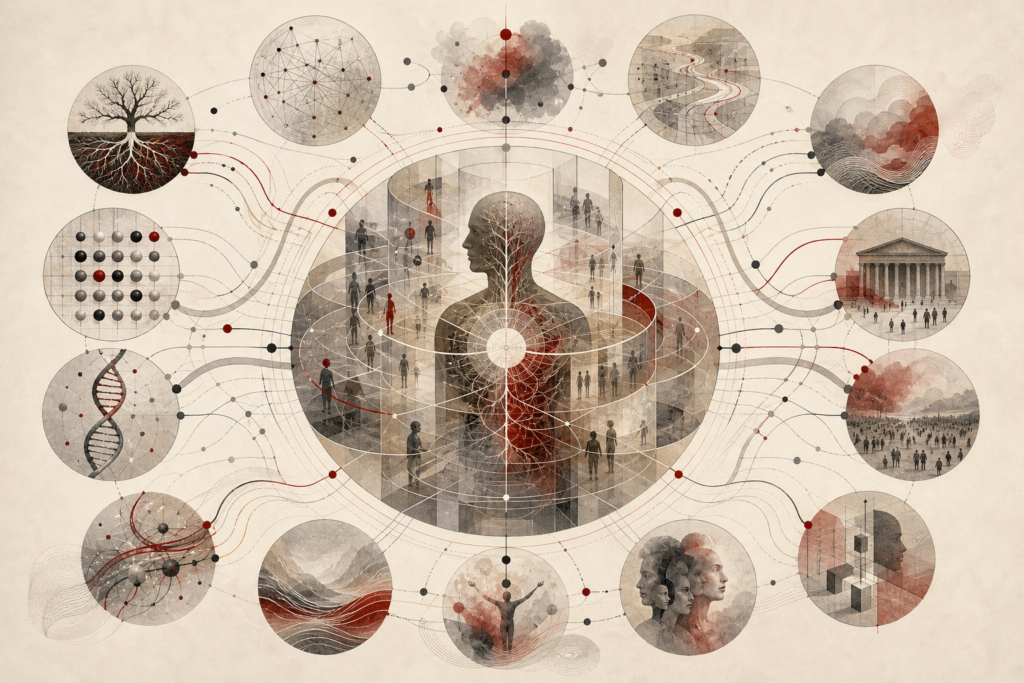
Editorial scientific illustration of personality psychology as a structured model of personhood, showing trait architecture, temperament, identity, self-concept, psychometrics, motivation, development, pathology, and personality change.

Personality Psychology: Traits, Character, Identity, and the Structure of the Person

Personality psychology examines the enduring patterns through which human beings think, feel, desire, interpret, and act. This strongest-sense expansion upgrades the pillar from a solid trait-centered overview into a fuller map of the field by integrating motivation, selfhood, narrative identity, personality dynamics, biology and behavior genetics, maladaptive personality, morality and dark traits, health, institutions, culture, and advanced psychometrics. It also adds a mathematical lens, a semi-formal conceptual model, and substantial R and Python sections for readers interested in modeling personality organization, adaptation, pathology, and long-run life outcomes. The result is a broader and more research-driven account of personality as patterned personhood rather than trait description alone.
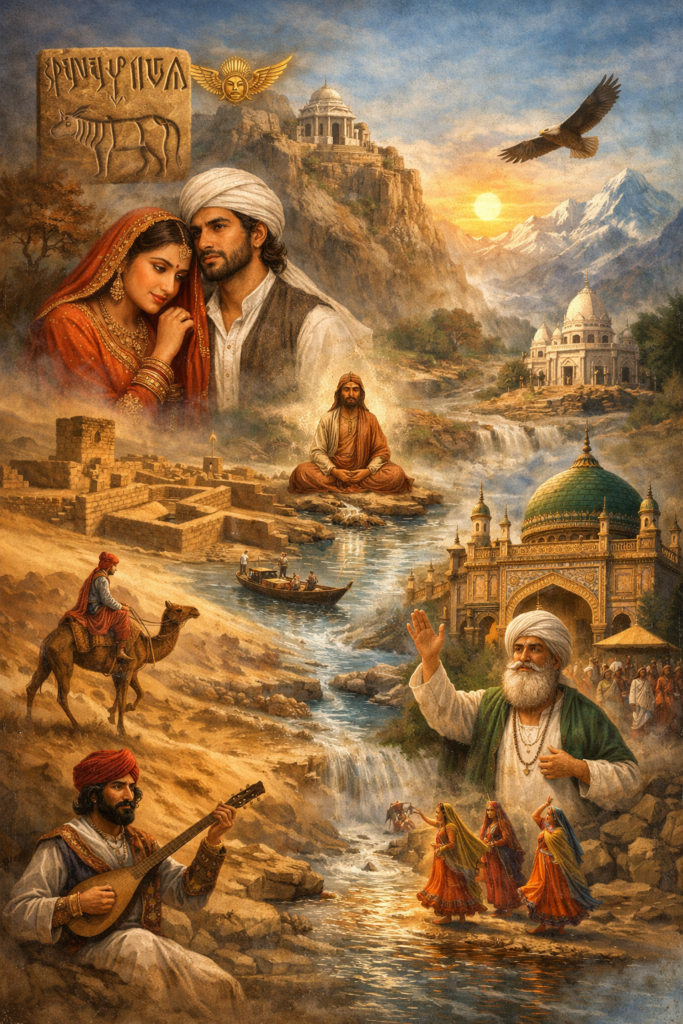

Editorial conceptual illustration for “Indus Region Myth, Folklore & Sacred Narrative” showing the civilizational story world of the Indus through river, desert, mountain, shrine, and oral tradition imagery, including lovers, a mystic figure, a musician, ancient ruins, sacred architecture, and a flowing river linking the landscape.

Indus Region Myth, Folklore & Sacred Narrative: River Civilizations, Oral Memory, and the Sacred Imagination of the Region

Indus Region Myth, Folklore & Sacred Narrative examines the layered story worlds that emerged across the Indus basin and its adjoining landscapes, where river civilizations, oral tradition, shrine culture, love epics, heroic memory, and sacred geography helped shape enduring forms of cultural imagination. This pillar explores the symbolic legacy of the ancient Indus world, the vernacular narrative traditions of Punjab, Sindh, Balochistan, Kashmir, and the frontier, and the ways folklore, devotion, and local memory preserve ideas of longing, sanctity, homeland, moral duty, and belonging across time.

Editorial landscape illustration for The Land Ethic and the Expansion of Moral Community showing mountains, river, waterfall, wildlife, books, a balance scale contrasting conqueror and member, and symbolic elements of ecological membership, integrity, stability, and beauty.

The Land Ethic and the Expansion of Moral Community

The land ethic matters for sustainable systems because it redefines the scope of moral concern by asking whether human beings stand above the natural world as managers and owners, or within it as members of a wider biotic community. This article examines Aldo Leopold’s expansion of ethics beyond the human, the shift from conqueror to member, the significance of integrity, stability, and beauty, and the lasting relevance of the land ethic for conservation, stewardship, and sustainable systems. It argues that sustainability depends not only on better management of land, but on a deeper ethical transformation in how human beings understand their place within the community of life.

Editorial illustration for environmental ethics and the moral status of nature showing a mountain landscape, river and waterfall, wildlife, books, a balance scale with Earth and forest, a hand holding a young plant, and symbolic objects of ethical judgment and ecological care.

Environmental Ethics and the Moral Status of Nature

Environmental ethics matters for sustainable systems because it asks whether nature matters only as a means to human ends or whether the more-than-human world possesses moral significance that should constrain what human beings are permitted to do. This article examines the moral status of nature through the distinction between instrumental and intrinsic value, the debate between anthropocentric, sentientist, biocentric, and ecocentric ethics, the significance of Aldo Leopold’s land ethic, and the problem of plural values in environmental judgment. It argues that sustainable systems depend not only on better management of natural resources, but on a deeper ethical understanding of what in nature has value, what moral limits follow from that value, and how human societies should position themselves within a more-than-human world.

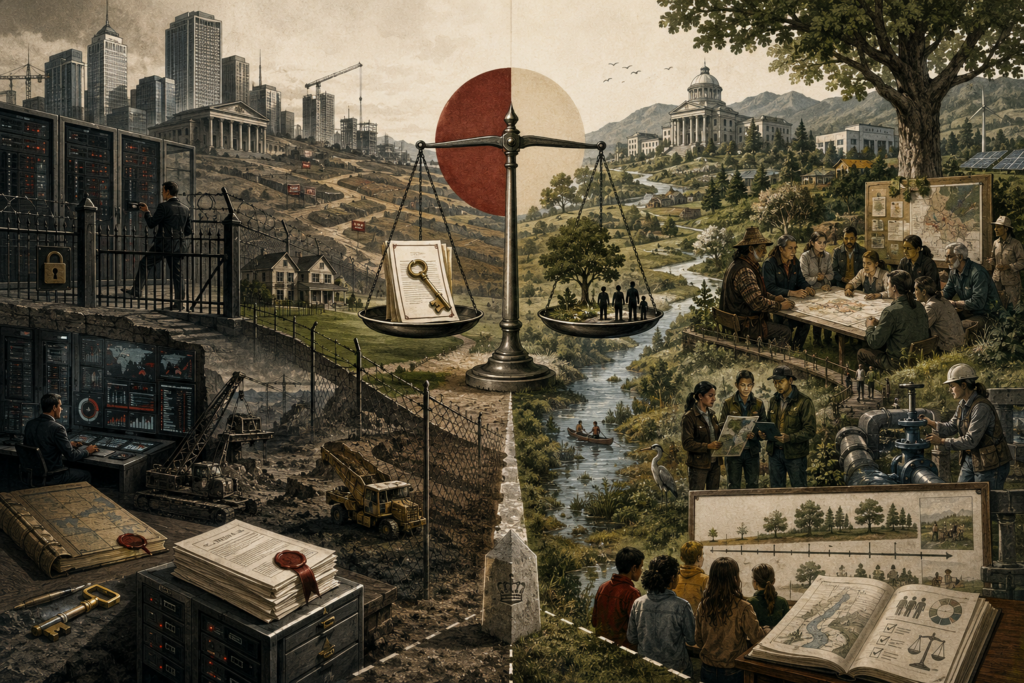
Editorial sustainability illustration showing a balance scale between ownership and stewardship, with fences, contracts, data systems, extraction equipment, public institutions, restored landscapes, community deliberation, water systems, and future generations symbolizing the moral limits of authority.

Stewardship Versus Ownership, Use, and Control

Stewardship is not the same as ownership, use, or control. Ownership grants claims, use enables benefit, and control directs systems, but stewardship asks whether those forms of authority are exercised with responsibility, restraint, and accountability. This article examines why legal entitlement does not automatically create moral legitimacy, especially when land, infrastructure, finance, data, ecosystems, and public institutions affect others beyond the immediate owner or manager. It contrasts dominion with trusteeship, explores commons governance and fiduciary responsibility, and argues that sustainable systems require authority to be judged by what it preserves, what it endangers, and whose future it shapes. Stewardship becomes the higher ethical standard for power in a shared world: not merely whether someone has the right to act, but whether that action protects ecological integrity, public trust, vulnerable communities, and future generations.

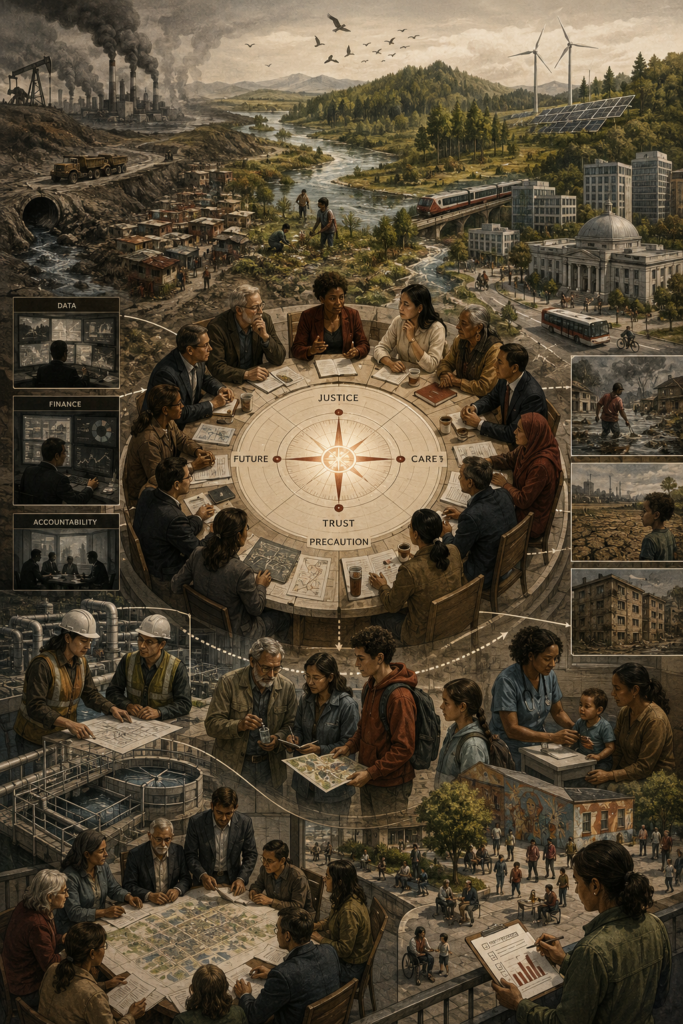
Editorial sustainability illustration showing a civic forum centered on an ethical compass, with community members, public officials, engineers, scientists, caregivers, young people, polluted landscapes, renewable energy, public institutions, infrastructure, and ecological restoration representing stewardship, justice, care, trust, precaution, and responsibility to future generations.

What Is Stewardship & Ethics? Responsibility, Justice, and Sustainable Systems

Stewardship and ethics give sustainable systems their moral architecture. Stewardship asks how power should be held when institutions shape land, infrastructure, finance, technology, ecosystems, public trust, and future possibilities. Ethics asks by what standards that power should be judged: justice, dignity, care, accountability, truthfulness, precaution, and responsibility across generations. This article explains why sustainability cannot be reduced to technical management, efficiency, resilience, or greener growth. Systems may function well while still distributing burdens unjustly, degrading ecological foundations, concealing risk, or shifting harm onto vulnerable communities and future generations. Stewardship and ethics make those hidden judgments visible, asking not only whether systems work, but what they protect, what they sacrifice, who they serve, and whether they are worthy of continuation.

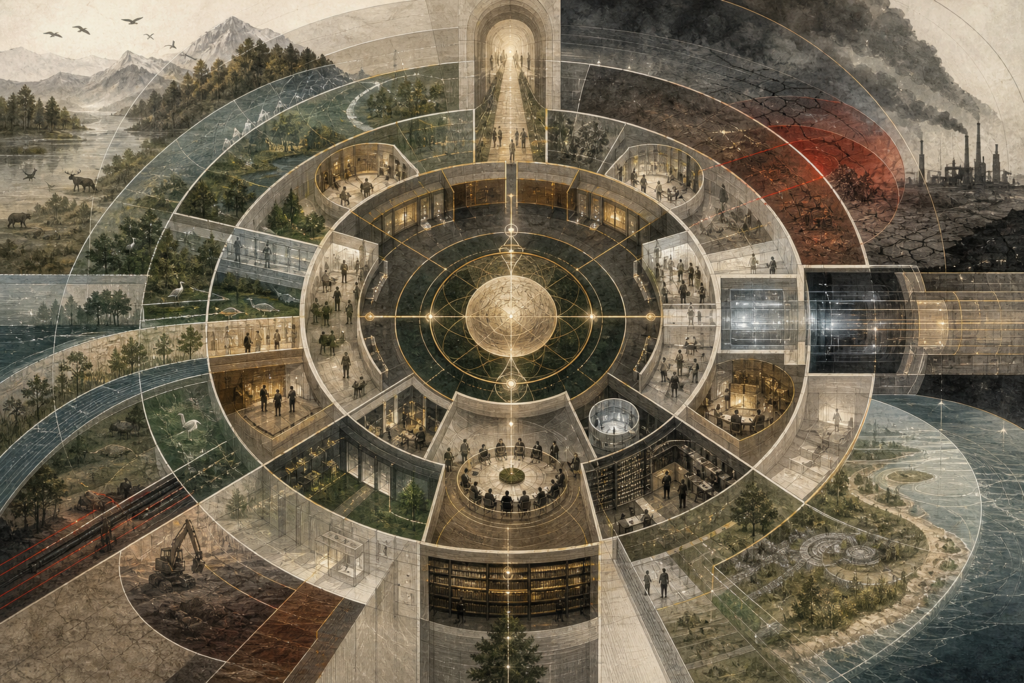
Editorial illustration of stewardship and ethics shown as a layered moral and ecological systems architecture, with a central stewardship core surrounded by institutional chambers, environmental landscapes, knowledge spaces, industrial pressure zones, and interconnected pathways of responsibility, justice, care, and long-term obligation.

Stewardship & Ethics: Responsibility, Justice, and the Moral Architecture of Sustainable Systems

Stewardship & Ethics examines the moral principles, civic obligations, institutional responsibilities, and long-horizon judgments that shape how human beings inhabit, govern, and transform the world. As a pillar within sustainable systems thinking, it explores environmental ethics, justice, intergenerational obligation, precaution, public trust, and the ethical limits of extraction, optimization, and technological power. This series considers how responsibility moves from philosophy into governance, asking what societies, institutions, and leaders owe to vulnerable populations, future generations, and the living systems on which human flourishing depends.

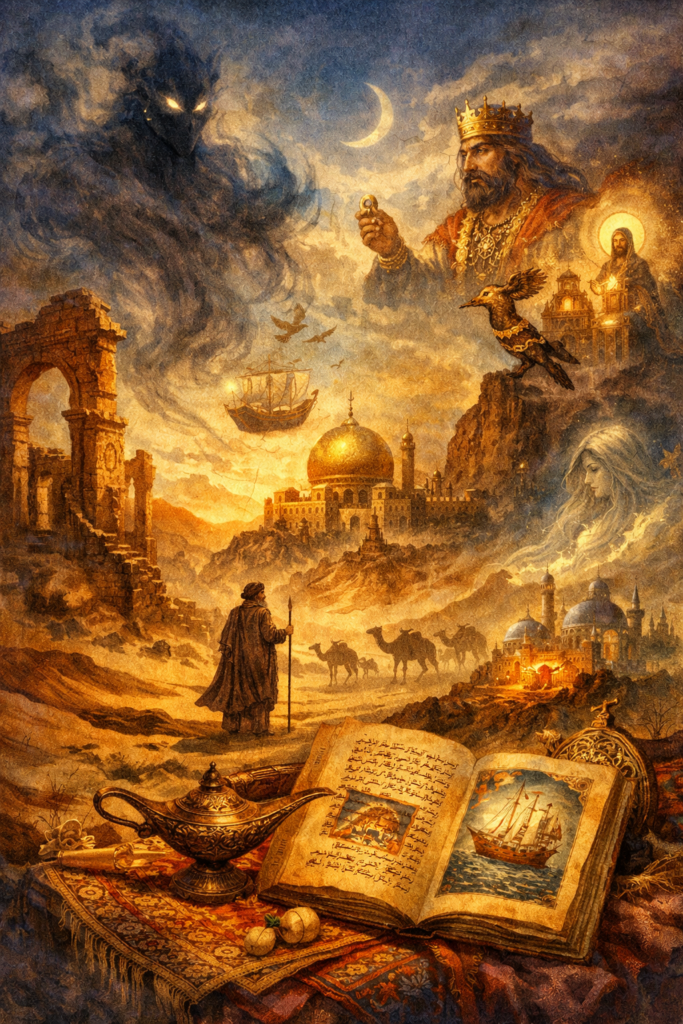
Editorial illustration inspired by Arabian and Levantine narrative traditions featuring desert ruins, sacred architecture, a jinn-like presence, legendary figures, manuscript imagery, caravans, and a charged mythic landscape.

Arabian & Levantine Myth, Folklore & Sacred Narrative: Sacred Worlds, Oral Tradition, and the Narrative Imagination of the Region

Arabian and Levantine myth, folklore, and sacred narrative preserve one of the most intricate story worlds of the premodern imagination: a world shaped by deserts and ruins, prophets and saints, jinn and miracles, shrines and cities, exile and hospitality, judgment and wonder. These traditions do not belong to a single canon. They survive instead across pre-Islamic poetry, Qurʾanic and post-Qurʾanic sacred narrative, Christian and Jewish storytelling, saint legends, pilgrimage memory, oral folklore, marvel literature, heroic romance, and local tales tied to sacred landscapes and everyday life. Arabian and Levantine storytelling returns again and again to holy places, haunted terrains, ruined peoples, prophetic warning, blessed persons, moral testing, and the enduring power of story to preserve meaning across conquest, displacement, and cultural change.

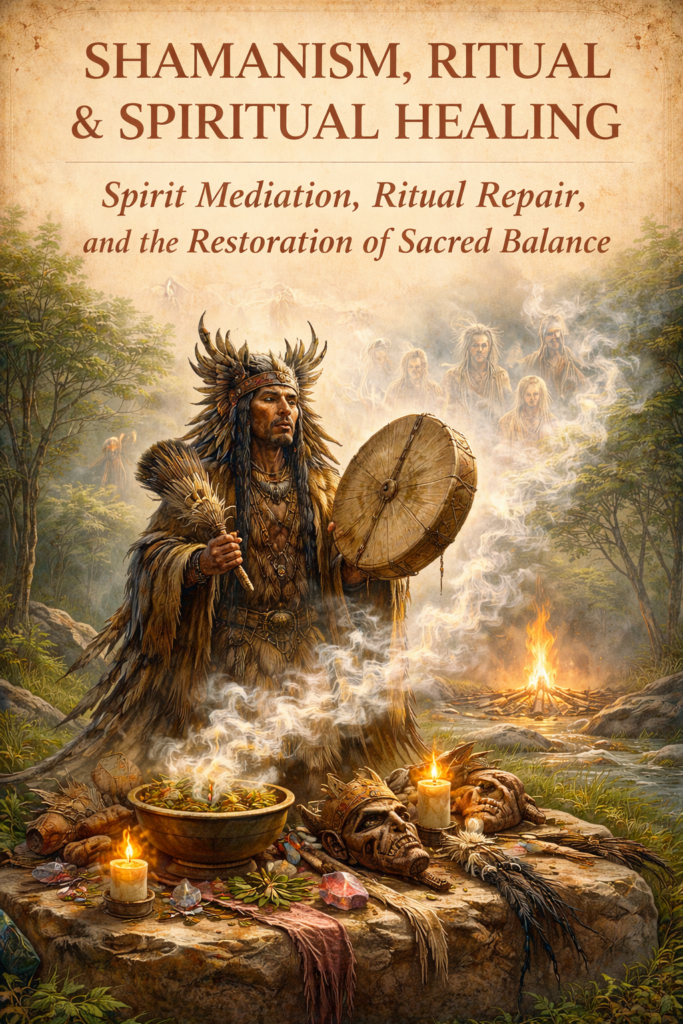
Editorial illustration inspired by ritual and spiritual healing traditions featuring a ritual specialist with drum and feather bundle, smoke, sacred objects, ancestral figures, and a forest ceremonial setting.

Shamanism, Ritual & Spiritual Healing: Spirit Mediation, Ritual Repair, and the Restoration of Sacred Balance

Shamanism, Ritual & Spiritual Healing: Spirit Mediation, Ritual Repair, and the Restoration of Sacred Balance explores a complex field of healing traditions in which illness, disturbance, and restoration are understood through relationships among body, spirit, community, ancestry, ecology, and unseen worlds. From trance, chant, and ritual specialists to purification, soul retrieval, initiation, and communal restoration, this category examines how healing has been practiced as a work of mediation, ceremonial repair, and the reordering of sacred balance.

Scroll to Top