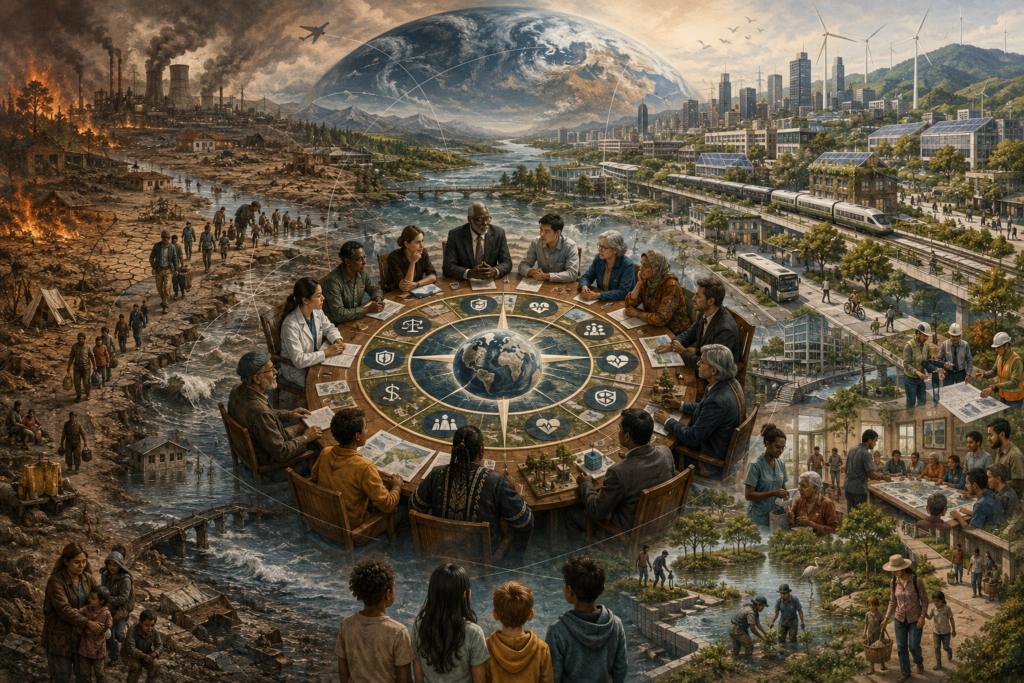
Editorial climate ethics illustration showing a central stewardship forum gathered around a planetary compass, with one side depicting wildfire, fossil industry, flooding, drought, displacement, and damaged infrastructure, and the other showing renewable energy, resilient cities, restoration, public transit, healthcare, community planning, and protection of future generations.

Stewardship and the Ethics of Climate Change

Stewardship matters for climate ethics because climate change is not only a scientific or policy problem. It is a moral question about how power should be exercised over conditions of life that are shared, vulnerable, and not fully replaceable. This article examines stewardship in relation to responsibility, restraint, unequal contribution, vulnerable populations, future generations, mitigation, adaptation, and institutional obligation under planetary risk. It argues that climate ethics requires more than technical management of emissions and impacts. It requires a deeper ethic of care, justice, and long-horizon responsibility for the atmospheric and ecological conditions on which collective life depends.
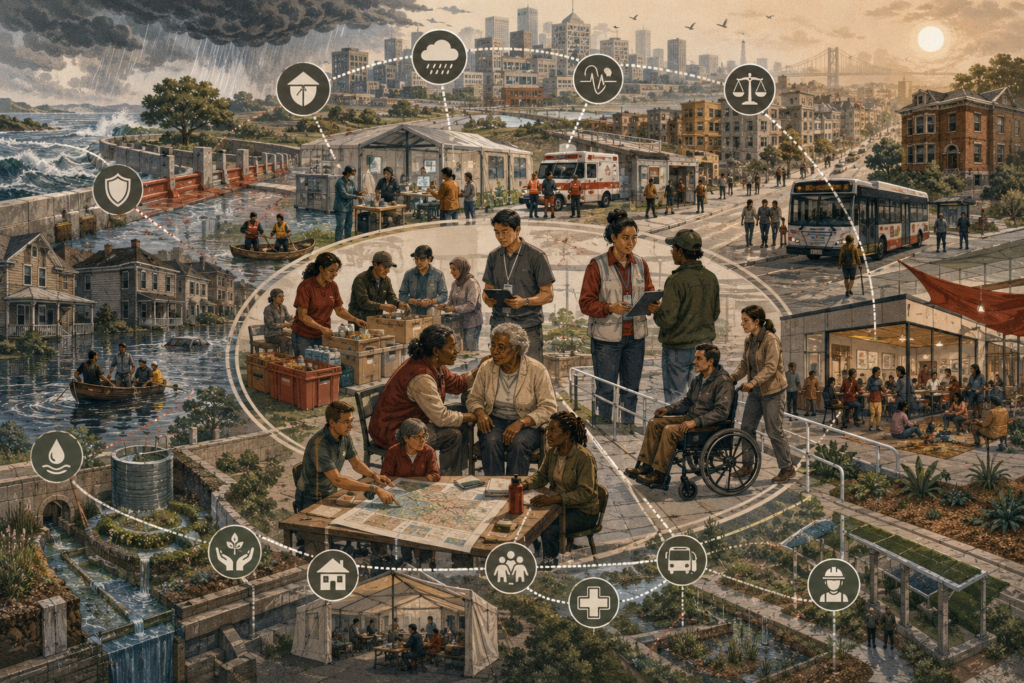

Editorial illustration showing a community responding together to flood, heat, and infrastructure stress through mutual aid, public health support, accessible care, and protective public systems.

Solidarity, Vulnerability, and the Ethics of Protection

Solidarity matters for sustainable systems because vulnerability is never only an individual condition. This article examines how exposure to harm is shaped by inequality, institutional design, public responsibility, and uneven protection, and argues that solidarity is a practical ethic of standing with and protecting those most at risk. It shows that sustainable systems require more than abstract resilience. They require organized forms of care, reciprocity, justice, and protection for people and communities facing patterned and foreseeable harm.

Editorial illustration for justice, equity, and the distribution of environmental burdens showing polluted industrial and healthy green communities separated by a central scale of justice, with families facing unequal environmental conditions.

Justice, Equity, and the Distribution of Environmental Burdens

Justice and equity matter for sustainable systems because environmental harm is rarely distributed evenly. This article examines how pollution, climate risk, ecological degradation, extraction, and infrastructural neglect are patterned through inequality, exclusion, cumulative impacts, and unequal political power. It argues that sustainable systems require more than aggregate environmental improvement. They require fairer distributions of protection, voice, risk, and repair for communities disproportionately burdened by environmental harm.

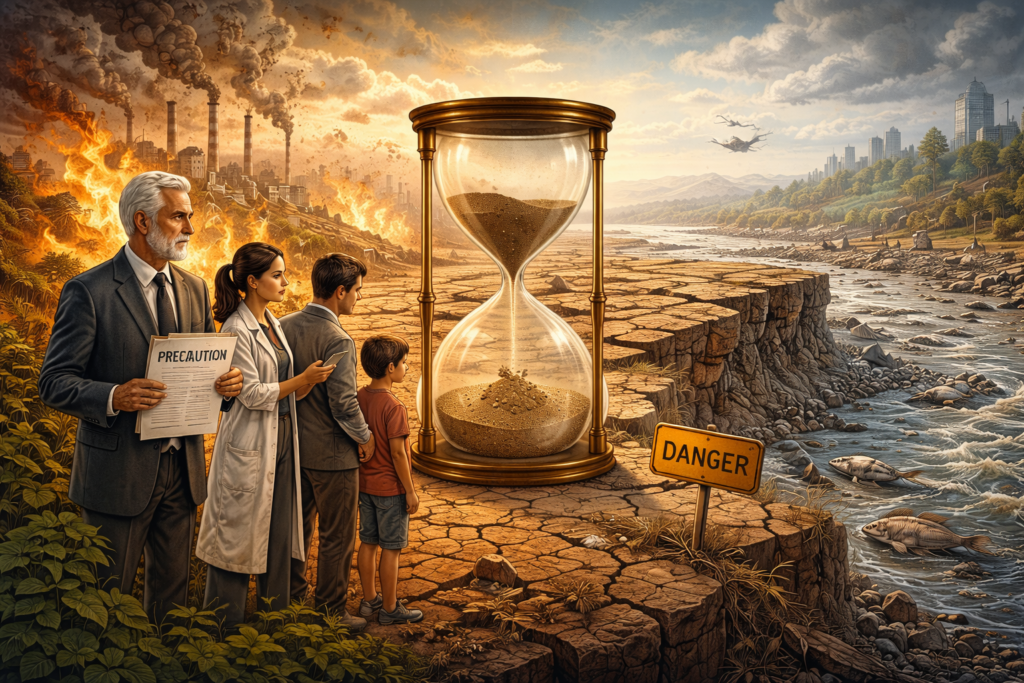
Editorial illustration for precaution, prudence, and irreversible harm showing an hourglass between a burning industrial landscape and a damaged river system, with observers, warning signs, and symbols of delayed environmental risk.

Precaution, Prudence, and Irreversible Harm

Precaution matters for sustainable systems because it asks how responsible judgment should proceed when the stakes are high, the harms may be severe or irreversible, and full scientific certainty is unavailable. This article examines precaution as an ethical and governance principle shaped by prudence, uncertainty, thresholds, delayed harm, and the moral weight of irreversible loss. It argues that sustainable systems require more than waiting for perfect evidence. They require institutions capable of acting responsibly before avoidable damage becomes entrenched, unjustly distributed, or impossible to reverse.

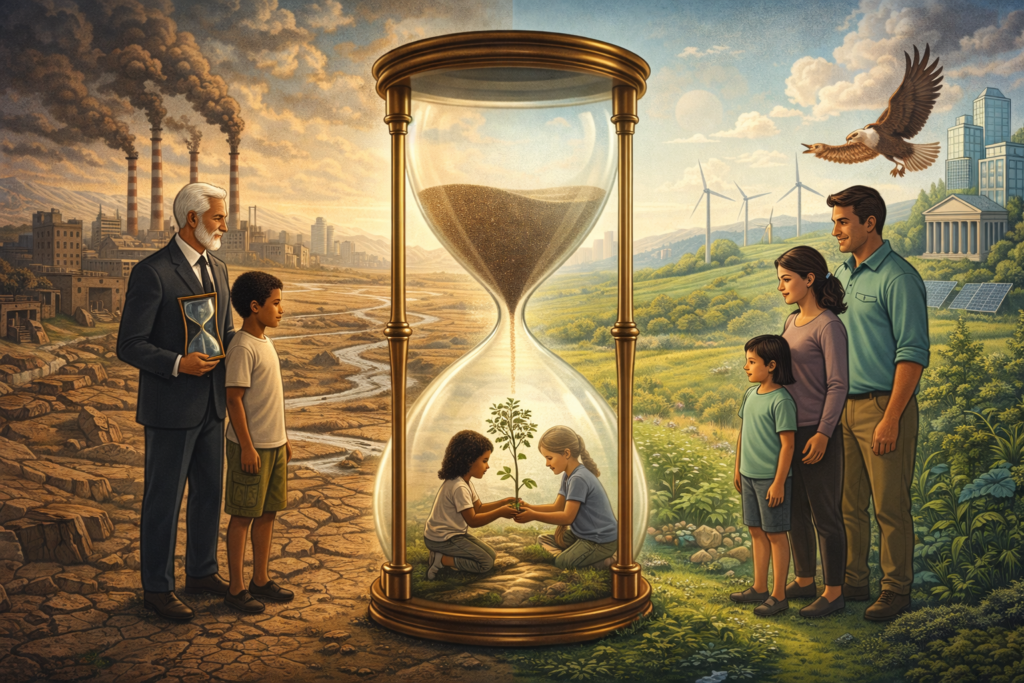
Editorial illustration contrasting environmental degradation and ecological renewal through a central hourglass, with a child and elder on a barren industrial side and a family on a green renewable-energy side, symbolizing intergenerational justice and long-term obligation.

Intergenerational Justice and Long-Term Obligation

Intergenerational justice matters for sustainable systems because it asks what the present owes to those who do not yet exist but who will nonetheless inherit the consequences of present action. This article examines fairness across time through the moral standing of future persons, the nonidentity problem, savings and depletion, discounting and short-termism, climate burden, irreversible harm, and the institutional challenge of representing absent generations. It argues that sustainable systems require more than present stability or short-run gain. They require forms of governance capable of acting justly toward those who cannot yet speak, vote, or bargain, but whose lives will be shaped by the decisions made today.

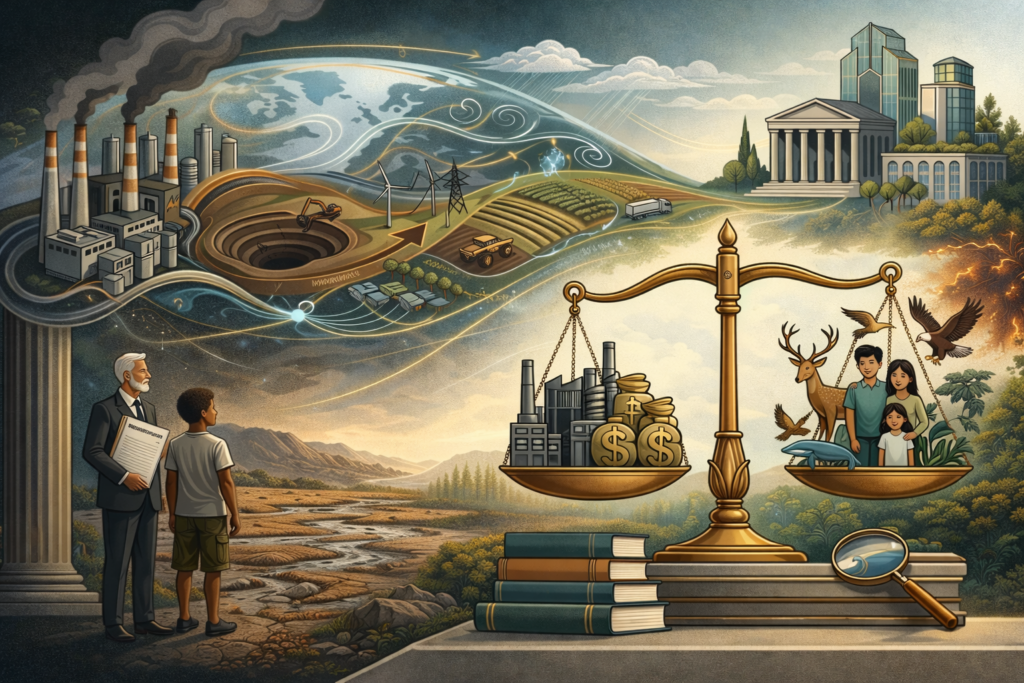
Editorial illustration for responsibility in the Anthropocene showing factories, mining, farmland, governance buildings, a child and elder observer, and a balance scale weighing industrial wealth against a family, wildlife, and ecological life across a damaged landscape.

Responsibility in the Anthropocene: Ethics, Justice, and Planetary Obligation

Responsibility in the Anthropocene matters for sustainable systems because it asks what obligations arise when human activity becomes a force capable of altering climate, biodiversity, landscapes, and the long-term conditions of life at planetary scale. This article examines Anthropocene responsibility as a problem of cumulative causation, unequal agency, historical emissions, benefit, capacity, future generations, more-than-human worlds, and institutional power. It argues that sustainable systems require a deeper ethic of responsibility in which planetary consequence does not dissolve obligation, but enlarges it.

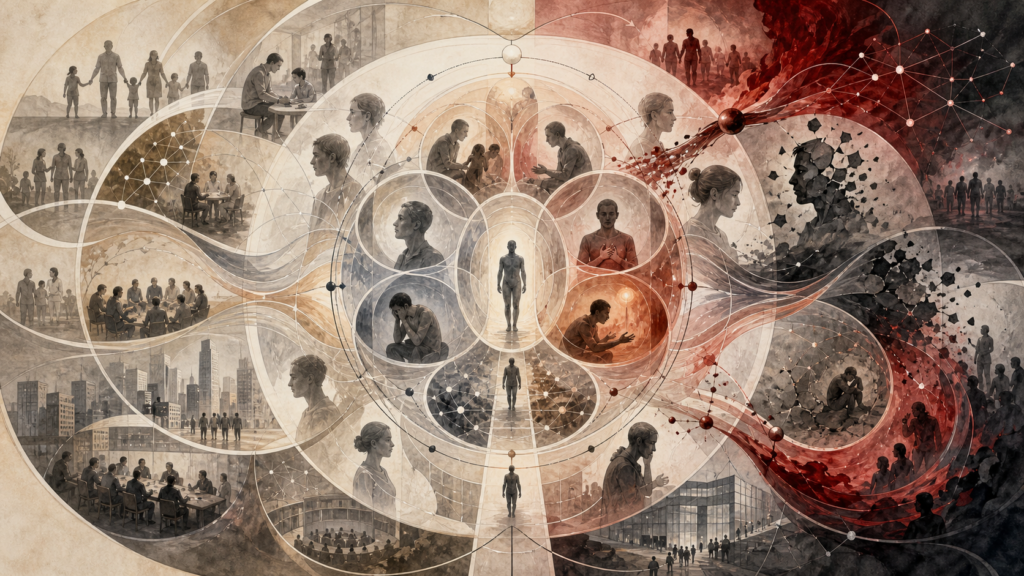
Editorial scientific illustration of moral psychology as an ethical agency systems architecture, showing moral judgment, empathy, conscience, justice, blame, forgiveness, moral repair, group identity, institutional pressure, polarization, and moral development.

Moral Psychology: Judgment, Character, Moral Emotion, and the Formation of Moral Agency

Moral psychology examines how human beings perceive, interpret, judge, feel, and act in morally significant contexts. This upgraded pillar expands the field beyond moral reasoning alone by integrating moral perception, motivation, conscience, self-regulation, relational care, blame and repair, moral failure, institutional life, cultural pluralism, and political conflict into a single map of moral agency. It also adds a mathematical lens, a semi-formal conceptual model, and substantial R and Python sections for readers interested in modeling identity, prosociality, disengagement, and ethical action over time. The result is a broader and more publication-ready account of moral psychology as a field concerned not only with what people think is right, but with how moral life becomes possible, fragile, and consequential in real human worlds.

Editorial scientific illustration of analytical psychology as a depth psychology systems architecture, showing psyche, ego, persona, shadow, complexes, dream imagery, archetypal patterns, symbolic transformation, fragmentation, and psychic integration.

Analytical Psychology, Symbolism & the Depth Mind: Archetype, Individuation, and the Inner Life of Meaning

Analytical psychology examines the psyche at the level of symbol, conflict, image, and transformation. This pillar presents the field as a major depth-psychological tradition concerned not only with archetypes and the collective unconscious, but also with complexes, dream life, active imagination, psychic suffering, individuation, symbolic development, and the difficult relation between ego and self. It expands the tradition in a stronger and more publication-ready form by foregrounding analytic practice, post-Jungian differentiation, alchemy, spirituality, epistemology, and non-Western cultural critique. The result is a broader map of analytical psychology as a living, interpretive, and internally contested framework for understanding the symbolic life of the mind.

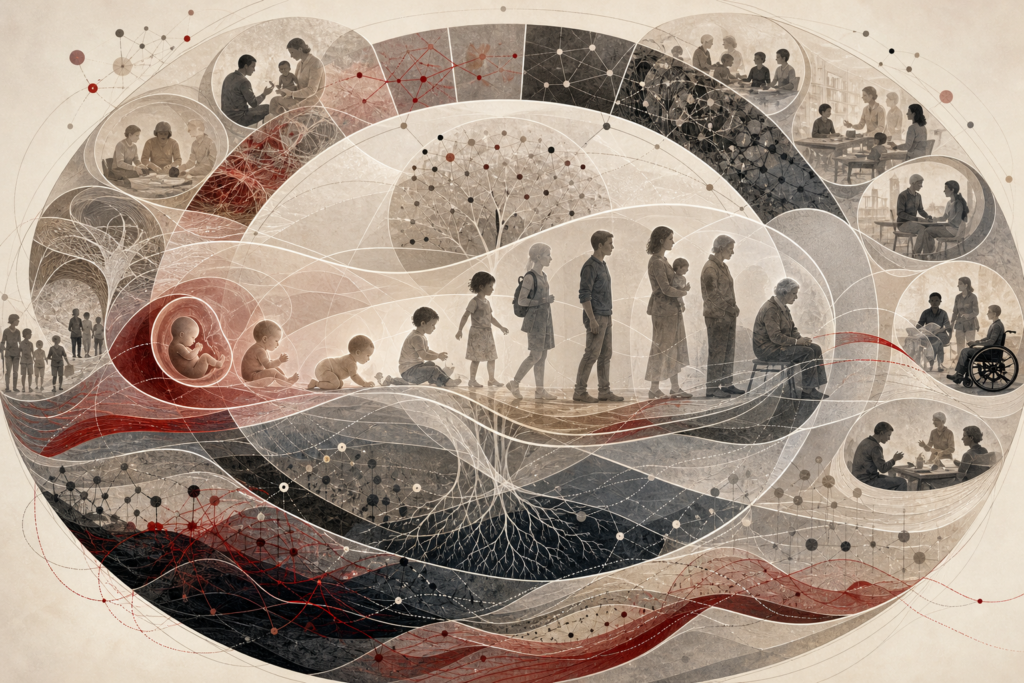
Editorial scientific illustration of developmental psychology as a lifespan systems architecture, showing prenatal life, infancy, childhood, adolescence, adulthood, aging, caregiving, education, disability inclusion, family systems, resilience pathways, and life-course development.

Developmental Psychology: Growth, Change, and Human Development Across the Lifespan

Developmental psychology examines how human beings grow, change, adapt, and age across the lifespan. This expanded pillar strengthens the field in the strongest sense by integrating prenatal development, temperament, brain development, attachment, schooling, psychopathology, culture, inequality, disability, neurodivergence, adulthood, aging, and developmental methods into a single lifespan framework. It also upgrades the page with a mathematical lens, a semi-formal conceptual model, and substantial R and Python sections for readers interested in modeling developmental context, cumulative risk, adaptation, and life-course divergence. The result is a broader, more research-driven map of development as the socially and historically situated formation of human capacities across time.

Scroll to Top