Thinking

Thinking refers to the frameworks through which complexity is interpreted, uncertainty is framed, and change is understood across time. Contemporary thought increasingly recognizes that many real-world conditions are dynamic, adaptive, and interconnected, requiring approaches that move beyond linear analysis toward more relational and systems-oriented ways of understanding.

Modern approaches to thinking draw from multiple disciplines, including systems theory, design research, ecology, futures studies, and organizational learning. These frameworks help individuals and institutions make sense of patterns, feedback, resilience, emergence, and long-term change, while providing more structured ways to engage with uncertainty.

Effective thinking is central to research, governance, innovation, and strategy. In rapidly changing environments, organizations increasingly rely on interdisciplinary thinking frameworks to strengthen sense-making, support adaptive learning, and improve the quality of judgment in complex settings.

Panoramic illustration of intelligent infrastructure with bridges, water systems, transit, renewable energy, sensors, monitoring stations, field engineers, storm clouds, wildfire damage, and adaptive repair work.

Intelligent Infrastructure and Resilience: Designing Smart Systems That Can Fail Safely

Intelligent Infrastructure and Resilience examines how digitally instrumented, data-enabled, cyber-physical, and institutionally governed infrastructure systems can detect stress, continue essential functions, degrade safely, recover from disruption, and adapt under changing conditions. The article argues that smart infrastructure is not automatically resilient. Sensors, dashboards, digital twins, automation, and AI can improve monitoring, maintenance, early warning, climate adaptation, and emergency coordination, but they can also create cyber-physical fragility, vendor lock-in, surveillance, brittle optimization, and false confidence. By connecting resilience thinking with energy, water, transportation, communications, public health, environmental monitoring, predictive maintenance, digital twins, cybersecurity, and environmental justice, the article shows why intelligent infrastructure must be designed around safe failure, public accountability, ecological responsibility, human oversight, equitable service restoration, and the practical repair capacity needed to protect communities when disruption arrives across physical, digital, social, institutional, and ecological layers of modern life.

Panoramic illustration of AI-assisted resilience planning across a river valley with wetlands, farms, infrastructure, sensors, satellite monitoring, storm risk, wildfire, damaged bridges, and planners reviewing maps.

AI and Resilience Thinking: Using Artificial Intelligence Without Creating Fragile Systems

AI and Resilience Thinking examines how artificial intelligence can support early warning, monitoring, scenario analysis, infrastructure maintenance, climate adaptation, disaster response, public health, supply-chain visibility, and institutional learning while also creating new forms of fragility. The article argues that AI should be treated as one layer within broader social, ecological, technological, and institutional resilience systems, not as an autonomous solution. It explains how AI can strengthen adaptive capacity by detecting weak signals, modeling uncertainty, identifying dependencies, supporting decisions, and improving feedback loops. It also examines model drift, bias, automation fragility, surveillance, data justice, cyber risk, environmental cost, and institutional overreliance. By connecting AI governance with resilience thinking, the article shows how artificial intelligence can support resilient systems only when it remains accountable to human judgment, local knowledge, equity, participation, and public purpose under uncertainty.

Community-centered illustration of local technology resilience with residents using solar power, radios, laptops, network equipment, repair crews, and communication infrastructure after disruption.

Technology System Resilience: Designing Digital Systems That Can Fail Safely

Technology System Resilience examines how digital, software, data, cloud, cyber-physical, platform, AI, and communication systems can continue essential functions, fail safely, recover from disruption, and adapt as risks change. The article argues that resilience is not only uptime, cybersecurity, or technical reliability, but a socio-technical capacity shaped by architecture, redundancy, observability, data integrity, maintainability, governance, human safeguards, vendor dependence, and ethical accountability. It explains why technology failures can cascade across healthcare, finance, public benefits, utilities, logistics, education, small businesses, and civic life when systems are tightly coupled or poorly governed. By connecting resilience thinking with software engineering, cybersecurity, data governance, AI risk, platform dependence, technical debt, and public-interest technology, the article shows how resilient systems are designed to degrade gracefully, recover honestly, protect users and workers, and learn from failure.

Panoramic illustration of a small town economy recovering after disruption, with local shops, repair crews, transit, community gardens, deliveries, planners, storm clouds, and burned hillsides.

Resilience in Small Business and Local Economies: Building Community Capacity Before Crisis

Resilience in small business and local economies examines how locally rooted firms, workers, households, neighborhoods, public institutions, and civic networks absorb disruption without losing the economic and social fabric that makes communities livable. The article argues that small business resilience is not only entrepreneurial grit, but a systems capacity shaped by liquidity, workforce stability, local supply chains, digital readiness, public support, community wealth, fair capital access, and anti-displacement protections. It explains why local economies can appear active while remaining fragile through thin cash reserves, rent pressure, owner burnout, supplier concentration, infrastructure gaps, and unequal access to recovery finance. By connecting resilience thinking with community development, procurement, CDFIs, workforce systems, climate risk, and equitable recovery, the article shows how local economies become stronger when small firms are supported as civic and economic infrastructure before, during, and after serious disruption together.

Multi-panel illustration of organizations preparing for disruption through emergency planning, backup supplies, infrastructure repair, reserves, coordination rooms, and field response.

Resilience and Strategic Slack: Why Systems Need Room to Adapt

Resilience and strategic slack examines why systems need spare capacity, optionality, time, financial reserves, workforce depth, redundancy, institutional memory, and decision space to absorb disruption without collapsing. Rather than treating all unused capacity as waste, the article shows how carefully designed slack protects essential functions, reduces cascading failure, supports adaptation, and prevents resilience from being built on burnout or shifted risk. It explains the difference between purposeful slack and genuine inefficiency across organizations, supply chains, infrastructure, public institutions, small businesses, financial systems, and communities. The article also foregrounds the ethics of slack: who has reserves, who lacks them, who absorbs volatility, and who benefits when buffers are activated. Strategic slack becomes a practical resilience capability when it is governed, measured, tested, rebuilt, and distributed fairly across the systems that depend on it before the next shock arrives safely again.

Panoramic illustration of organizational teams coordinating recovery, infrastructure repair, field operations, planning meetings, documentation, and learning after flood, storm, and wildfire disruption.

Organizational Resilience and Learning: How Institutions Adapt, Remember, and Recover

Organizational resilience and learning refer to the capacity of organizations to anticipate disruption, absorb shocks, sustain essential functions, adapt behavior, preserve institutional memory, and transform when existing structures no longer fit the environment. This article examines resilience not as heroic endurance or short-term continuity, but as a disciplined organizational capability built through learning systems, psychological safety, workforce protection, knowledge management, ethical governance, and operational preparedness. It explains why resilient organizations do more than survive crisis: they detect weak signals, protect people from burnout, preserve critical knowledge, coordinate across boundaries, and revise routines when evidence shows that old assumptions are failing. By connecting resilience thinking with organizational learning, institutional memory, crisis management, and systems governance, the article shows how organizations become stronger learning systems under pressure rather than brittle institutions repeating the same failures.

Panoramic illustration of community members, elders, field workers, and local stewards using maps, ecological knowledge, restoration work, and place-based observation in a river valley under storm and wildfire pressure.

Local Knowledge and Resilience Practice

Local knowledge is the place-based, practice-based, historically situated understanding that people develop through living, working, caring, governing, monitoring, and adapting within particular environments over time. This article examines local knowledge as a core element of resilience practice, showing why communities closest to risk often recognize hazards, vulnerabilities, infrastructure failures, ecological shifts, and recovery barriers before formal systems do. It explains how local knowledge strengthens disaster risk reduction, climate adaptation, public health resilience, infrastructure planning, environmental monitoring, adaptive governance, and community resilience. The article distinguishes meaningful knowledge co-production from symbolic consultation, emphasizes Indigenous knowledge sovereignty and consent, and examines participatory mapping, community science, community memory, trusted messengers, data governance, privacy, and knowledge justice. It argues that resilience practice becomes stronger when local knowledge changes decisions, resources, accountability, and institutional learning.

Panoramic illustration of an urban river valley where residents, responders, planners, and community groups support vulnerable neighborhoods facing flood, storm, wildfire, and infrastructure stress.

Social Vulnerability and Resilience: Why Risk Is Unequal

Social vulnerability is the unequal capacity of people, households, communities, and institutions to anticipate, withstand, respond to, recover from, and adapt to disturbance because risk is distributed through housing, health, income, infrastructure, geography, institutional access, political power, and historical injustice. This article examines social vulnerability as a central concept in resilience thinking, showing why disasters, climate impacts, public-health crises, power outages, and economic shocks do not harm everyone equally. It explains the difference between hazard, exposure, vulnerability, and capacity; examines poverty, housing, disability, race, Indigeneity, gender, language access, legal status, environmental justice, trust, mutual aid, and administrative burden; and evaluates social vulnerability indices as useful but limited tools. The article argues that resilience is not real unless it reduces unequal risk, strengthens institutional access, protects vulnerable groups, and changes the systems that produce vulnerability.

Panoramic illustration of community members, public officials, planners, restoration workers, and field teams coordinating landscape recovery across a river valley affected by wildfire, storm risk, infrastructure pressure, and ecological change.

Adaptive Governance and Resilience

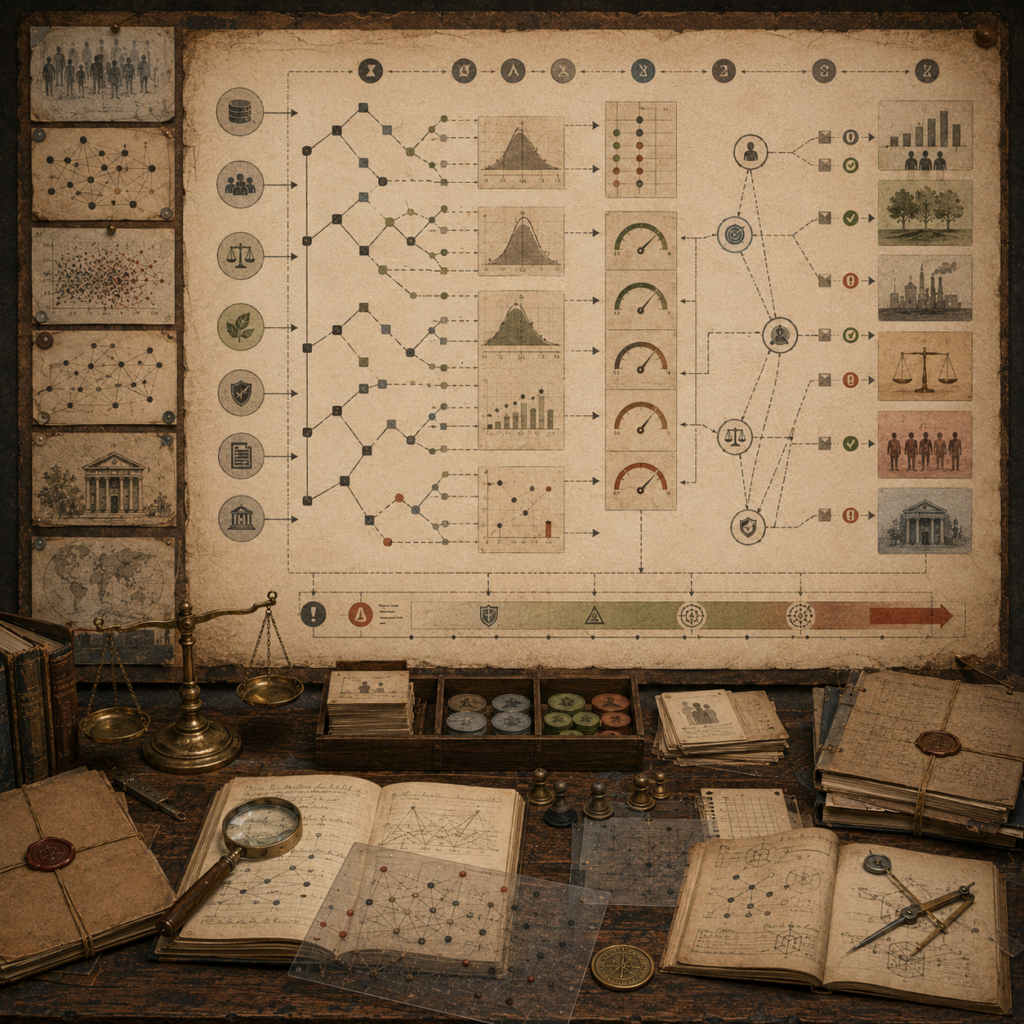
Adaptive governance is the institutional capacity to learn, coordinate, revise rules, share authority, and remain accountable as social, ecological, technological, and economic conditions change. This article examines adaptive governance as a central concept in resilience thinking, showing why fixed rules and single-agency authority often fail when systems face climate disruption, disaster risk, ecological thresholds, infrastructure fragility, public-health stress, and institutional distrust. It explains how learning systems, feedback loops, polycentric coordination, knowledge co-production, adaptive management, local knowledge, legitimacy, accountability, and equity shape resilient decision-making. The article also distinguishes adaptive governance from deregulation, emergency overreach, and symbolic participation, emphasizing that flexibility must be constrained by rights, transparency, and democratic control. Through practical frameworks and modeling workflows, it shows how governance systems can adapt without abandoning justice, public purpose, or long-term resilience.

Scroll to Top