Algorithms & Computational Reasoning

Algorithms & Computational Reasoning examines how problems are formalized, decomposed, sequenced, optimized, automated, and evaluated through procedural logic. It studies the intellectual foundations behind algorithms, computational models, decision rules, symbolic representation, abstraction, classification, search, recursion, simulation, and complexity. Rather than treating computation as only a matter of programming, this category approaches algorithms as a way of thinking: a disciplined method for translating messy problems into structured processes that can be analyzed, tested, repeated, and improved.

This category also explores the limits and consequences of computational reasoning. Algorithms can clarify patterns, coordinate action, support modeling, and extend human judgment, but they can also simplify context, encode assumptions, amplify bias, obscure responsibility, or mistake procedural efficiency for understanding. For that reason, Algorithms & Computational Reasoning connects technical reasoning with systems thinking, mathematical modeling, decision science, artificial intelligence, governance, and ethics.

As part of the broader Thinking library, this category investigates how human and machine reasoning interact in complex environments. It asks not only how algorithms work, but when computational approaches are appropriate, what they leave out, how they should be interpreted, and how they can be designed responsibly in scientific, institutional, technological, and social contexts.

A restrained scholarly illustration of a vintage research study with proof trees, verification diagrams, checked logical pathways, truth-table-like grids, punched cards, notebooks, and archival papers representing formal methods and machine-checked reasoning.

Formal Methods and Machine-Checked Reasoning: How Computation Can Be Verified

Formal methods bring mathematical rigor into the design, analysis, verification, and governance of computational systems. They ask whether programs, protocols, algorithms, models, and workflows can be specified precisely enough that their properties can be checked by formal proof, automated search, model exploration, type discipline, or machine-checked reasoning. Machine-checked reasoning uses software tools to verify formal claims. A proof assistant can check whether a proof follows from definitions and rules. A model checker can search a state space for violations. A solver can test whether constraints are satisfiable. A type checker can reject invalid programs before they run. This article explains specifications, preconditions, postconditions, invariants, proof obligations, model checking, proof assistants, theorem proving, SAT and SMT solving, type systems, contracts, refinement, static analysis, counterexamples, limits, assumptions, and governance for responsible computational reasoning.
A restrained scholarly illustration of a vintage logician’s study covered with tree-like symbolic diagrams, lambda-marked tiles, notebooks, reduction sequences, flow structures, and archival papers representing lambda calculus, functions, and formal computation.

Lambda Calculus, Functions, and Formal Computation: How Functions Define Computation

Lambda calculus is one of the foundational languages of formal computation. It shows that computation can be understood through functions, variables, abstraction, application, and substitution. A function can be defined, applied to an argument, and reduced by substituting that argument into the function body. From this small set of ideas, lambda calculus helps explain programming languages, recursion, higher-order functions, evaluation strategies, type systems, logic, proof, and the relationship between functions and formal reasoning. This article introduces variables, abstraction, application, free and bound variables, substitution, alpha conversion, beta reduction, eta conversion, normal forms, evaluation strategies, recursion, fixed points, Church encodings, typed lambda calculus, functional programming, proof systems, type theory, and formal verification. It shows why lambda calculus remains a living foundation for programming-language design, symbolic computation, proof assistants, and computational reasoning across modern software, logic, education, and verified systems today.

A restrained scholarly illustration of a vintage academic workspace with proof trees, logic diagrams, truth-table-like grids, punched cards, flowcharts, state diagrams, notebooks, and archival files representing automated reasoning and mechanical inference.

Automated Reasoning and Mechanical Inference: How Machines Follow Formal Rules

Automated reasoning asks whether parts of reasoning can be represented so precisely that a machine can carry them out. Mechanical inference asks how formal rules can move from premises to conclusions without relying on intuition, persuasion, or hidden judgment during execution. Automated reasoning works by formalizing a problem into symbols, rules, constraints, proofs, models, or logical structures, then applying procedures that search, derive, check, refute, satisfy, or verify claims within that formal system. Its power comes from precision, and its limits come from the same source: only what has been formalized can be mechanically inferred. This article explains premises, conclusions, inference rules, proof search, theorem proving, satisfiability solving, constraint solving, model checking, logic programming, symbolic reasoning, type systems, proof assistants, rule engines, knowledge representation, verification, artificial intelligence, and governance.

A restrained scholarly illustration of a vintage computational study with state diagrams, looping pathways, terminal nodes, punched tape, notebooks, drafting tools, and archival materials representing the halting problem and the limits of automation.

The Halting Problem and the Limits of Automation: Why No Tool Can Predict Every Program

The halting problem is one of the clearest demonstrations that computation has limits. It asks whether a general algorithm can take any program and any input, then determine whether that program will eventually stop or run forever. The answer is no. This result is not a weakness of one programming language, one machine, one operating system, or one era of computing. It is a mathematical limit on algorithmic procedure itself. This article explains the halting problem as a foundation for understanding the limits of automation. It introduces program behavior, halting, nontermination, self-reference, diagonal reasoning, undecidability, recognizability, program analysis, Rice’s theorem, static analysis limits, verification limits, AI automation limits, bounded methods, practical safeguards, and responsible computational governance. The central lesson is not that automation is weak. Automation must be scoped honestly.

A restrained scholarly illustration of an archival research desk and wall board showing orderly procedural diagrams giving way to tangled, looping, and indeterminate structures, representing computability and the limits of procedure.

Computability and the Limits of Procedure: What Algorithms Can and Cannot Solve

Computability studies the boundary between what can and cannot be solved by algorithmic procedure. It asks which problems are computable in principle, regardless of speed, hardware, programming language, or implementation skill. This question is deeper than efficiency. A problem may be slow but computable, while another may be impossible for any general procedure. Computability and the limits of procedure matter because modern systems often assume that enough data, automation, modeling, or artificial intelligence can eventually resolve any formalized question. Computability theory shows why that assumption is false. This article explains effective procedures, algorithms, decision problems, decidability, recognizability, Turing machines, the Church-Turing thesis, computable functions, undecidable problems, semidecidability, reduction, the halting problem, automation limits, and the difference between computability and complexity in responsible computational reasoning. It frames procedural limits as essential knowledge for verification, artificial intelligence, modeling, governance, and trust.
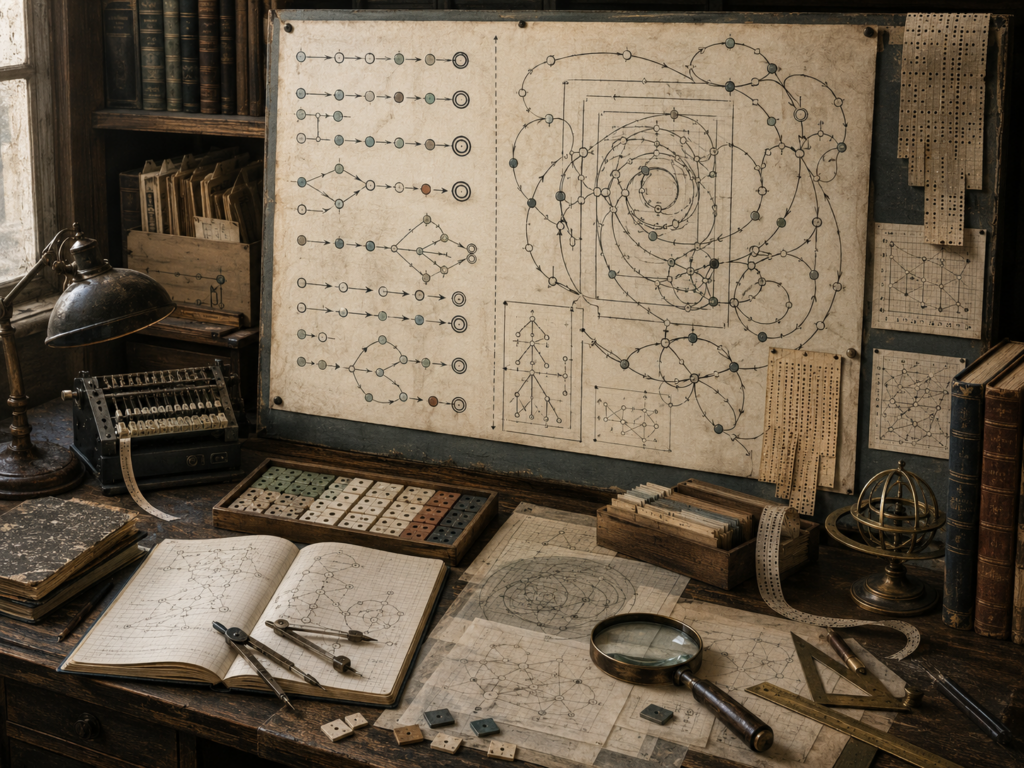
A restrained scholarly illustration of a cluttered research desk covered with state diagrams, repeated structures, verification grids, marked terminal nodes, edge-case sketches, notebooks, rulers, and drafting tools representing termination, invariants, and edge cases.

Termination, Invariants, and Edge Cases: How Algorithms Stop and Stay Reliable

Algorithms do not only need to produce the right answer. They also need to stop, preserve what must remain true, and behave responsibly near boundaries. Termination asks whether an algorithm eventually halts. Invariants ask what remains true while the algorithm runs. Edge cases ask what happens near boundaries: empty inputs, extreme values, invalid states, missing data, repeated values, zero divisions, impossible combinations, timeouts, overflow, concurrency conflicts, and unusual but plausible conditions. Together, these ideas turn algorithmic reasoning from a general belief that a procedure works into a disciplined question: under what assumptions does it stop, what properties does it preserve, and where might it fail? This article connects termination, invariants, and edge cases to proof, testing, debugging, verification, software engineering, data validation, simulation, and responsible automation. It frames boundary reasoning as a core discipline for reliable computational systems today.

A restrained scholarly illustration of a mathematician’s research desk covered with proof diagrams, algorithmic flowcharts, verification tables, marked pathways, graph structures, notebooks, rulers, and archival papers representing correctness and algorithmic verification.

Proof, Correctness, and Algorithmic Verification: How Algorithms Are Shown to Work

Proof, correctness, and algorithmic verification ask how we know that an algorithm does what it is supposed to do. A program may run, produce output, and pass several tests while still failing for untested inputs, edge cases, invalid states, or unstated assumptions. Correctness is not simply whether code works. It is a relationship among problem, specification, procedure, implementation, and intended use. This article explains specifications, preconditions, postconditions, invariants, partial correctness, total correctness, termination, tests, proof sketches, counterexamples, static analysis, type systems, model checking, formal verification, and machine-checked reasoning. It also emphasizes that verification depends on context. A procedure can be correct under stated assumptions and still be inappropriate, incomplete, misleading, or unsafe if its specification, data, goals, or deployment context are wrong in real technical, scientific, civic, and institutional systems.

A restrained scholarly illustration of an antique academic desk covered with symbolic tokens, parsing trees, grammar-like diagrams, state-transition maps, notebooks, rulers, and archival papers representing formal languages and symbolic representation.

Formal Languages and Symbolic Representation: How Symbols Become Computable

Formal languages give computation a way to represent structure precisely. A computer cannot work directly with vague intention. It works with symbols, strings, tokens, rules, expressions, encodings, grammars, syntax trees, schemas, instructions, and formally interpretable patterns. Formal languages make those structures explicit. This matters because computation is not only about numbers. It is also about representation. Programs, mathematical expressions, database queries, markup, regular expressions, logic formulas, type declarations, configuration files, data schemas, proofs, protocols, and machine instructions all depend on symbolic forms that can be parsed, checked, transformed, interpreted, or executed. This article explains alphabets, symbols, strings, languages, grammars, syntax, semantics, tokens, parsing, regular languages, context-free languages, schemas, compilers, interpreters, validators, symbolic reasoning, and responsible representation design across technical, scientific, educational, institutional, and public computational systems.

A restrained scholarly illustration of a vintage research desk covered with logic-gate diagrams, truth tables, symbolic proofs, decision trees, flowcharts, graph networks, notebooks, and drafting tools representing the relationship between logic and computation.

Logic and Computation: How Formal Reasoning Shapes Algorithms

Logic gives computation one of its deepest foundations. Before a program can calculate, search, sort, verify, infer, classify, or decide, it must distinguish conditions, rules, cases, states, claims, and consequences. Logic provides formal tools for doing that. It helps computation represent what is true or false, what follows from what, when a condition holds, when a rule applies, when a proof is valid, and when a procedure has satisfied its requirements. This article explains how logic supports computational reasoning through propositions, predicates, truth values, conditionals, rules, inference, proof, satisfiability, Boolean algebra, specifications, type systems, verification, logic programming, databases, and artificial intelligence. It emphasizes that logic is not merely abstract symbolism. In computation, logic becomes operational: directing control flow, validating states, constraining search, supporting correctness, and governing rule-based systems across technical and institutional environments.

Scroll to Top