Grit

Grit examines the psychological capacities involved in sustained effort, long-term commitment, perseverance through difficulty, and the pursuit of demanding goals over time. In the study of human development, grit has emerged as an important concept for understanding how individuals persist beyond talent alone, drawing attention to the roles of discipline, purpose, self-regulation, and endurance in achievement, growth, and personal formation.

This category explores grit in relation to motivation, deliberate practice, resilience, character, and the conditions under which effort can be maintained across setbacks, uncertainty, and slow progress. It considers how perseverance is shaped by meaning, habit, aspiration, and environment, while also examining the tensions between persistence and exhaustion, commitment and rigidity, and individual striving and structural constraint.

Grit plays an important role in positive psychology and related fields because it helps illuminate how people sustain purposeful action over time and how enduring forms of effort contribute to mastery, character, and human flourishing. By engaging this topic seriously, this category deepens understanding of perseverance as both a psychological process and a broader question about achievement, development, and the disciplined pursuit of meaningful ends.

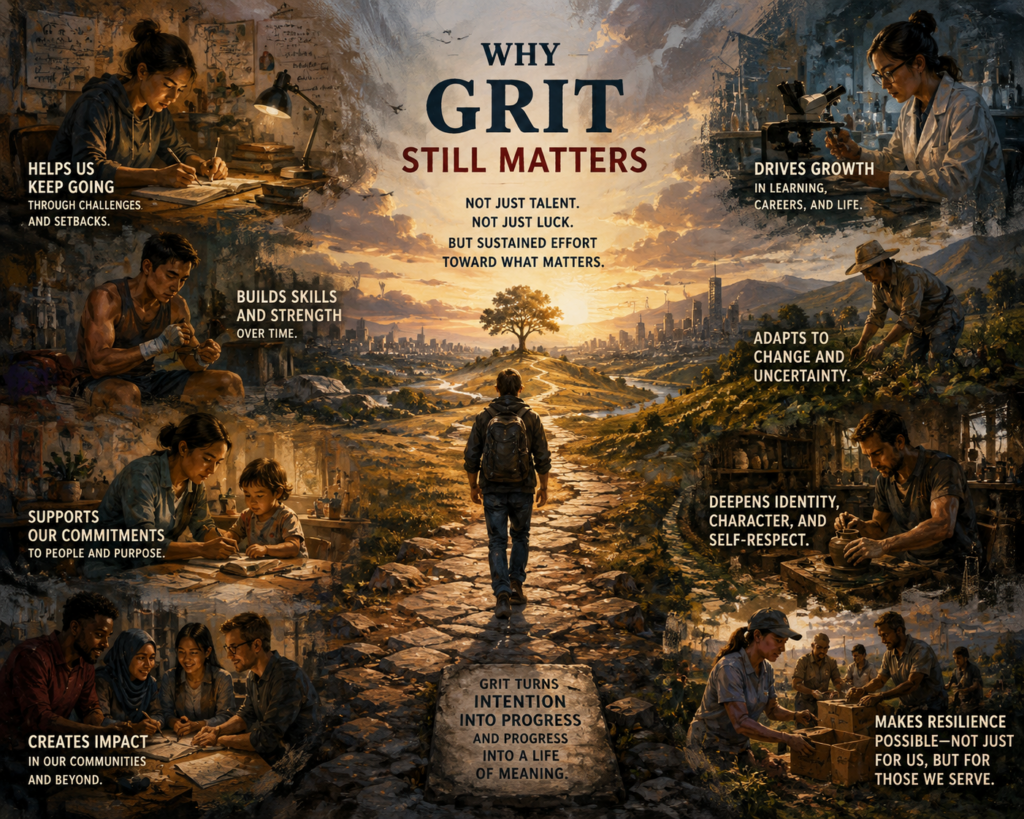
Painterly editorial illustration of a person walking a rugged path toward a glowing horizon, surrounded by scenes of study, science, caregiving, craft, farming, collaboration, and sustained effort.

Why Grit Still Matters

Grit still matters because many meaningful goals cannot be achieved quickly. Education, science, art, caregiving, justice, leadership, recovery, scholarship, and craft all require sustained effort across difficulty, delay, feedback, boredom, and setback. This article offers a balanced capstone account of grit after the major criticisms, measurement debates, meta-analytic cautions, and ethical concerns are taken seriously. It argues that grit should not be treated as a magic trait, moral ranking system, or substitute for opportunity. Instead, grit matters most as adaptive persistence: long-term effort toward meaningful goals, guided by feedback, supported by relationships, protected by recovery, shaped by context, and open to revision. The result is a humane, professional positive-psychology account of why persistence still matters without romanticizing burnout, overpersistence, or institutional failure.


Painterly editorial illustration of grit across different social and cultural contexts, showing people studying, training, caregiving, farming, crafting, learning, mentoring, and walking intersecting paths.

Grit in Comparative Perspective

Grit becomes more useful when studied in comparative perspective. This article places grit alongside self-control, conscientiousness, resilience, deliberate practice, motivation, purpose, growth mindset, narrative identity, environmental support, and institutional context. It argues that grit matters, but should not be treated as a standalone explanation for achievement or human flourishing. Grit emphasizes long-term perseverance and sustained commitment, while neighboring constructs explain impulse regulation, personality structure, recovery from adversity, skill development, meaning, identity, and the conditions that make effort possible. A professional positive-psychology approach asks what grit uniquely contributes, where it overlaps with other constructs, and when persistence becomes adaptive, rigid, coerced, or harmful. The result is a more precise, humble, and context-sensitive account of sustained effort.

Painterly editorial illustration of a person walking a rugged path surrounded by supportive learning, mentoring, rest, food, accessibility, collaboration, transportation, and focused work environments.

Designing Environments That Support Grit

Designing environments that support grit means moving beyond slogans about toughness and building conditions where sustained effort can become meaningful, informed, recoverable, and connected to real progress. This article examines how schools, workplaces, teams, programs, families, and institutions can intentionally support adaptive persistence through autonomy, feedback, belonging, mentoring, psychological safety, recovery, fair expectations, material resources, and credible pathways forward. It argues that grit-supportive environments do not simply demand more effort; they make effort more intelligent, sustainable, dignified, and worthwhile. The article also addresses adaptive quitting, burnout prevention, equity, measurement, environmental design, and responsible positive psychology, showing why persistence depends on both individual agency and the environments that shape human development.

Painterly editorial illustration of sustained effort supported by mentoring, study, rest, caregiving, accessible transportation, stable home life, food, emotional support, and a long path toward growth.

Situational Supports for Sustained Effort

Sustained effort is never only an individual trait. This article examines the situational supports that help people persist adaptively over time, including autonomy, feedback, belonging, mentoring, psychological safety, recovery, material resources, fairness, and credible pathways forward. It argues that grit becomes more scientifically and ethically credible when understood as a person-environment process rather than isolated toughness. People are more likely to sustain meaningful effort when goals are self-endorsed, progress is visible, failure can be revised, and support is available. They are more likely to disengage or burn out when effort meets humiliation, blocked opportunity, overload, or chronic stress. A professional positive-psychology approach studies both individual agency and the environments that cultivate, drain, or distort persistence.

Painterly editorial illustration of grit education, showing a young person walking a difficult stone path surrounded by scenes of mentoring, study, coaching, emotional support, practice, and reflection.

Can Grit Be Taught?

Grit can be supported, cultivated, and strengthened, but it cannot be installed through slogans or pressure. This article examines whether grit can be taught through a professional positive-psychology lens, arguing that adaptive persistence develops when people have meaningful goals, credible pathways, supportive relationships, feedback, recovery, autonomy, and environments where effort can lead somewhere. It distinguishes serious grit development from simplistic “try harder” messaging, showing why interventions must include goal clarity, self-regulation, deliberate practice, setback interpretation, recovery planning, adaptive quitting, and ethical safeguards. The article also addresses schools, workplaces, clinical-adjacent caution, intervention design, evaluation methods, equity, psychometrics, and burnout-risk monitoring. A responsible approach teaches sustainable persistence, not blind endurance, and pairs individual growth with institutional responsibility.

Painterly editorial illustration of grit developing across the life course, showing adolescents and adults studying, practicing, reflecting, receiving support, mentoring, caregiving, and walking along a long path.

The Development of Grit Across Adolescence and Adulthood

Grit develops across the life course rather than appearing as a fixed character trait. This article examines how perseverance of effort and consistency of interests emerge through adolescence, emerging adulthood, adulthood, and later life. It explains how future orientation, identity formation, school feedback, family expectations, peer belonging, work, caregiving, vocation, setbacks, recovery, opportunity, and chronic stress shape long-term persistence. Adolescents may need exploration before stable interests form; young adults often revise goals through education and work; adults may deepen grit through responsibility, craft, and purpose; later adults may show mature grit through selectivity, wisdom, and legacy. A developmental account treats grit as context-sensitive, teachable only through sustained conditions, and inseparable from support, feedback, recovery, opportunity, and adaptive revision.

Editorial illustration of a multi-level digital knowledge platform with archives, research rooms, semantic networks, data infrastructure, public institutions, and interconnected analytical spaces.

When Quitting Is Adaptive

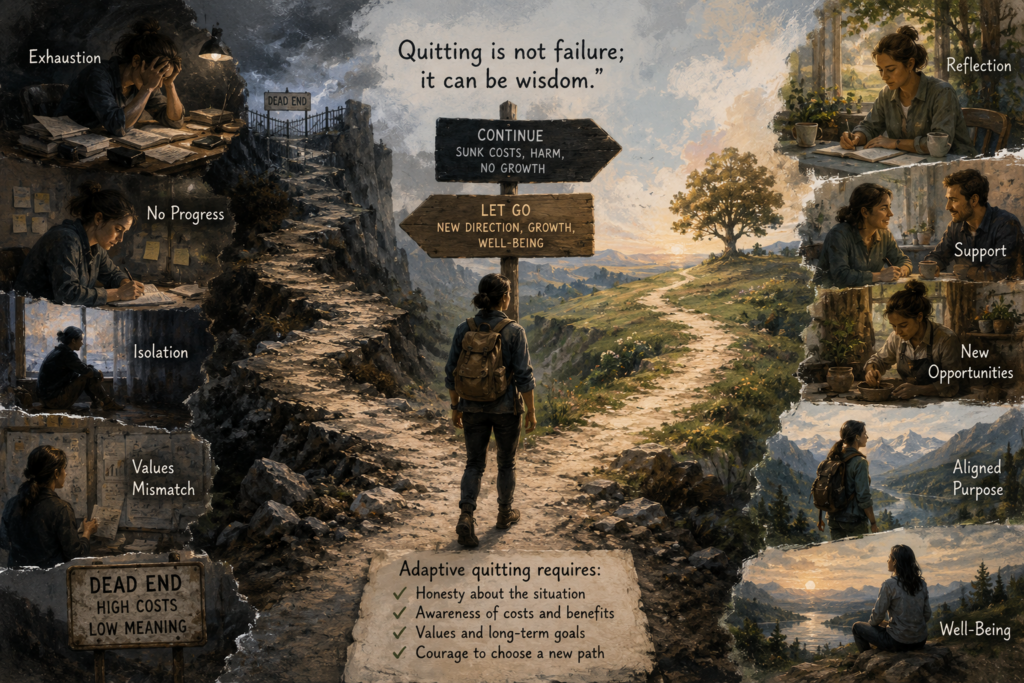
Quitting is often treated as the opposite of grit, but mature persistence requires judgment. This article examines when quitting becomes adaptive: not as impulsive avoidance, but as thoughtful disengagement from a goal, strategy, role, institution, or path that no longer serves health, dignity, learning, ethics, or purpose. It explains the difference between avoidant quitting and evidence-based redirection, drawing on goal disengagement, goal reengagement, sunk cost, identity pressure, burnout, feedback, and goal hierarchy. The article also addresses education, work, relationships, institutions, unequal freedom to quit, decision frameworks, and responsible interpretation. A serious account treats adaptive quitting as part of sustainable grit: effort should remain loyal to goals worth sustaining, not trapped by pride, shame, sunk cost, or every past decision.

Painterly editorial illustration of a weary figure continuing across a broken stone path, surrounded by scenes of exhaustion, overwork, isolation, rest, support, and recovery.

Grit, Burnout, and the Risks of Overpersistence

Grit is valuable, but persistence is not always wise. This article examines how sustained effort can become harmful when it loses contact with recovery, feedback, health, autonomy, values, and changing evidence. It explains the risks of overpersistence, including burnout, sunk cost, identity pressure, perfectionism, goal rigidity, moral overcommitment, and institutional misuse of grit language. The article distinguishes adaptive persistence from compulsive endurance, showing why “never quit” is not a responsible rule for human development. It also addresses education, work, vocation, caregiving, service, organizational culture, unequal burnout risk, measurement limits, adaptive quitting, and strategic disengagement. A mature account treats grit as strongest when persistence remains sustainable, supported, purpose-aligned, feedback-guided, and open to revision when continued effort becomes harmful.

Painterly editorial illustration of grit and recovery, showing a person continuing along a broken stone path after falling, surrounded by scenes of study, practice, injury, reflection, support, and renewed effort.

Grit, Setbacks, and Recovery

Grit is tested most clearly when long-term goals are interrupted. This article examines how setbacks, failure, rejection, fatigue, stalled progress, injury, burnout, and changing circumstances shape perseverance over time. It explains why grit should not mean blind endurance, and why recovery is essential for adaptive persistence. Emotional recovery protects dignity after failure; cognitive recovery turns feedback into learning; behavioral recovery restores action; social recovery rebuilds support and belonging; purpose recovery reconnects effort to meaning. The article also addresses resilience, overpersistence, adaptive quitting, strategic revision, educational recovery systems, workplace setbacks, unequal recovery conditions, and responsible interpretation. A mature account treats grit as strongest when people can recover, learn, revise, rest, seek support, and return to goals worth sustaining without romanticizing harm or ignoring structural barriers.

Scroll to Top