Problem Solving

Problem solving refers to the cognitive and strategic processes used to identify challenges, analyze underlying causes, and develop effective solutions. In complex environments, problem solving requires more than analytical reasoning; it involves integrating creative thinking, structured analysis, and systems-level understanding.

Traditional models of problem solving emphasized linear processes such as defining the problem, generating alternatives, and selecting optimal solutions. Contemporary research recognizes that many real-world problems are complex, dynamic, and interconnected, requiring iterative approaches that incorporate experimentation, feedback, and adaptive learning.

Modern problem-solving frameworks often draw from multiple disciplines, including cognitive psychology, systems thinking, design research, and decision science. These approaches help individuals and organizations understand how problems emerge within broader systems and how interventions may produce both intended and unintended consequences.

Effective problem solving is central to innovation, policy development, and strategic planning. In rapidly changing environments, organizations increasingly rely on interdisciplinary problem-solving methods that combine analytical rigor with creative exploration.

Research-table landscape model with several translucent model variants above it, each showing different network pathways, assumptions, spatial patterns, and a combined ensemble layer.

Model Comparison and Ensemble Reasoning: Testing Models Against Uncertainty

Model comparison and ensemble reasoning examine how systems modelers evaluate multiple plausible representations instead of relying on one model as the answer. The article explains why complex systems often require structural comparison, predictive validation, scenario ensembles, benchmark models, weighting logic, model-dependence checks, and robustness metrics. It shows how disagreement between models can reveal uncertainty, hidden assumptions, scale effects, boundary choices, or missing mechanisms rather than merely creating confusion. The discussion connects ensemble reasoning to calibration, validation, sensitivity analysis, uncertainty interpretation, policy comparison, regret, and decision support under complex conditions. It also warns against naïve ensemble averaging, false consensus, and overconfidence when models share data, theory, code, or institutional assumptions. With technical workflows in R and Python, the article frames model comparison as a discipline of transparent, uncertainty-aware systems reasoning for research, policy, infrastructure, sustainability, complex governance, and organizational decision-making.


Painterly editorial illustration of future directions in decision science with branching decision networks, public deliberation, systems models, uncertainty maps, tradeoff scales, infrastructure, ecosystems, and long-term pathways.

Future Directions in Decision Science: AI, Uncertainty, and Accountable Judgment

Future Directions in Decision Science examines how the field is evolving as institutions face deeper uncertainty, artificial intelligence, democratic legitimacy challenges, complex systems, climate risk, infrastructure fragility, algorithmic governance, geopolitical instability, organizational accountability, and long-term public consequences. This article explains why future decision science must move beyond narrow optimization toward accountable decision systems that integrate human judgment, AI-assisted evidence, uncertainty analysis, ethical reasoning, public legitimacy, systems thinking, adaptive governance, reproducible workflows, participatory methods, and institutional learning. It shows how decision science is shifting from individual choice models to decision architectures that preserve accountability across framing, evidence, modeling, implementation, monitoring, correction, and review. The article frames future decision quality as robust across plausible futures, transparent about uncertainty, reproducible enough to inspect, adaptive enough to revise, and accountable enough to defend in public, organizational, technological, and ecological decision environments over time.

Painterly editorial illustration of democratic public reasoning with diverse citizens, deliberative forums, civic institutions, shared evidence, decision networks, public values, and long-term social consequences

Decision Science and Democratic Public Reasoning: Evidence, Values, and Public Trust

Decision Science and Democratic Public Reasoning examines how structured decision methods can strengthen democratic legitimacy, public deliberation, civic trust, transparent trade-offs, accountable evidence use, and collective judgment without reducing public decisions to expert optimization or technocratic control. Democratic institutions make choices under uncertainty about infrastructure, climate adaptation, public health, artificial intelligence, budgets, energy, housing, education, and crisis response. This article explains how decision science can clarify alternatives, surface assumptions, compare consequences, communicate uncertainty, document decisions, and make disagreement more structured. It also shows why public decisions require more than technical analysis: evidence must be understandable, values must be visible, participation must be meaningful, and contestability must be real. The article frames democratic decision science as public reasoning infrastructure that connects evidence, values, authority, dissent, accountability, monitoring, and institutional learning across the full decision lifecycle in democratic institutions over time.

Painterly editorial illustration of AI-assisted decision support with human decision-makers studying maps, analytical networks, model outputs, evidence layers, and judgment pathways.

AI-Assisted Decision Support and Human Judgment: AI, Oversight, and Accountability

AI-Assisted Decision Support and Human Judgment examines how artificial intelligence can help people gather evidence, compare options, detect patterns, forecast outcomes, summarize uncertainty, and monitor decisions while also introducing risks of automation bias, opacity, overreliance, deskilling, accountability gaps, and institutional misuse. This article explains why AI decision support is not the same as automated decision-making. AI can improve decision quality when it expands evidence, clarifies uncertainty, identifies weak signals, supports monitoring, and helps humans manage complexity. But it can also distort judgment when outputs appear more certain than they are, narrow human attention, hide values, or shift responsibility away from institutions. The article frames responsible AI-assisted decision support as a human-machine governance system requiring clear use cases, meaningful oversight, contestability, monitoring, decision records, and accountable human judgment.

Painterly editorial illustration of decision governance with institutional deliberation, accountability systems, public records, review processes, civic structures, stakeholder groups, and decision networks.

Decision Governance and Institutional Accountability: Authority, Review, and Learning

Decision Governance and Institutional Accountability examines how institutions design decision systems that make authority visible, responsibility traceable, judgment reviewable, and learning possible. Decisions inside organizations, agencies, boards, committees, and public institutions rarely belong to one person alone. They move through analysts, managers, legal counsel, technical experts, executives, auditors, vendors, regulators, and affected stakeholders. This article explains how decision governance strengthens institutional judgment through decision rights, evidence standards, accountability chains, review processes, escalation rules, decision records, internal controls, monitoring, corrective action, and learning loops. It shows why accountable decisions require more than approval: institutions must clarify who decides, who reviews, who implements, who monitors outcomes, who can challenge assumptions, and who has authority to revise or stop harmful action. The article frames governance as the architecture that makes decision science durable, inspectable, and responsible across the full decision lifecycle responsibly.

Painterly editorial illustration of ethics in decision science with deliberating decision-makers, justice scales, public institutions, affected communities, environmental risk, AI systems, and accountability symbols.

Ethics of Decision Science: Values, Fairness, and Accountability

Ethics of Decision Science examines how structured decision-making can clarify choices, reduce bias, improve accountability, and support public value while also creating risks of false precision, hidden value judgments, exclusion, procedural injustice, and institutional misuse. Decision science uses evidence, models, probabilities, decision trees, utility, trade-off analysis, stakeholder values, and decision records to improve judgment under uncertainty. But every method carries ethical assumptions about what matters, whose interests count, which harms are acceptable, and who has authority to decide. This article explains how ethical decision science requires explicit attention to values, distribution, legitimacy, consent, transparency, contestability, power, uncertainty, accountability, and lived consequences. It shows why good decision-making is not only technically rigorous, but also inspectable, challengeable, equitable, humble, and responsible to the people and systems it affects.

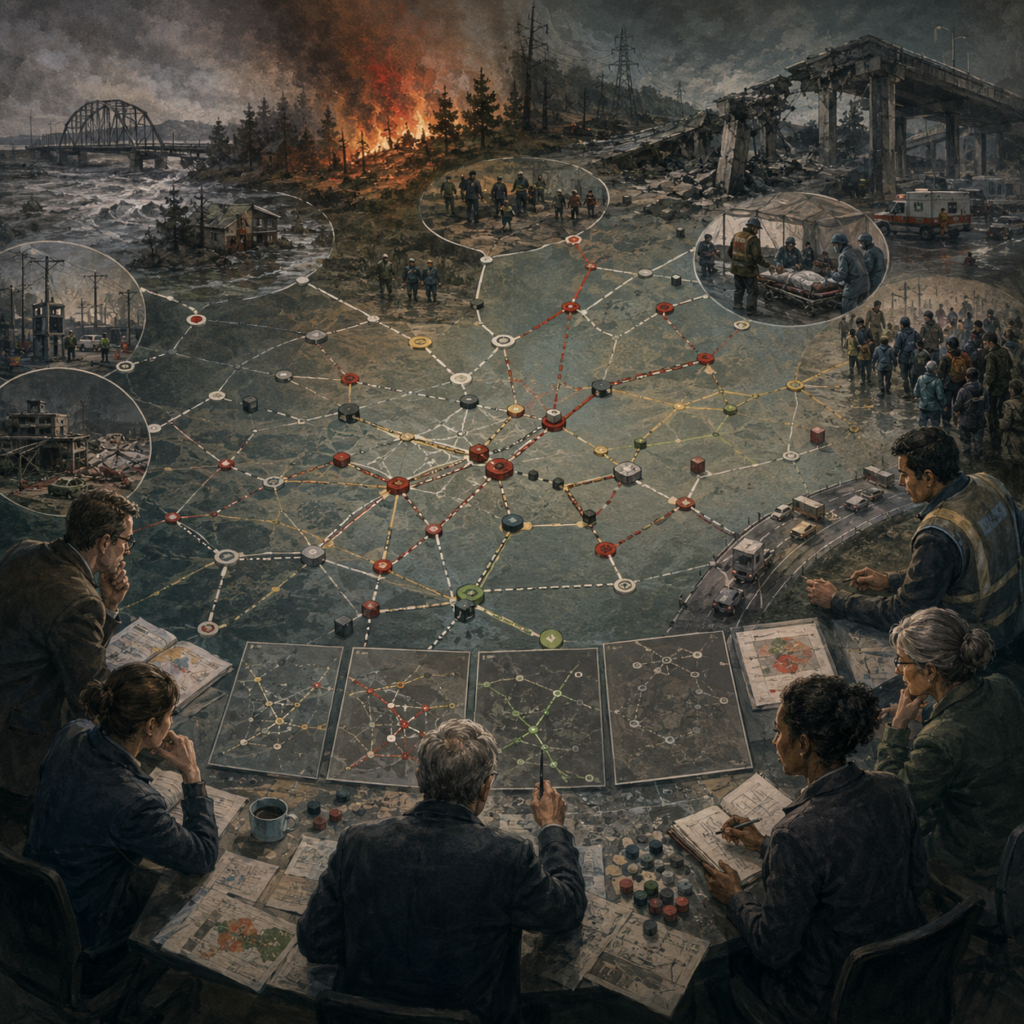
Painterly editorial illustration of crisis management with response teams studying emergency networks, damaged infrastructure, wildfire, flooding, medical response, evacuation routes, and cascading risk.

Decision Science in Crisis Management: Risk, Urgency, and Public Trust

Decision Science in Crisis Management examines how institutions make urgent, high-stakes decisions under uncertainty, time pressure, incomplete information, operational stress, public scrutiny, and cascading risk. Crises compress time, disrupt routines, expose weak assumptions, and force action before evidence is complete. This article explains how decision science strengthens crisis management through sensemaking, risk triage, escalation thresholds, incident coordination, situational awareness, public communication, ethical prioritization, continuity planning, adaptive response, and after-action learning. It shows why effective crisis leadership requires more than speed, authority, or confidence. Strong crisis decisions depend on clear priorities, accountable authority, uncertainty communication, public trust, resource coordination, decision records, and the capacity to revise as conditions change. The article frames crisis management as structured judgment under pressure, designed to reduce harm, protect critical services, support vulnerable populations, and improve institutional learning.

Painterly editorial illustration of AI governance with decision-makers, civic institutions, data systems, infrastructure, public values, tradeoff scales, and interconnected accountability networks.

Decision Science in AI Governance: Risk, Oversight, and Accountability

Decision Science in AI Governance examines how institutions decide which AI systems to build, buy, deploy, restrict, monitor, audit, scale, or reject when evidence is incomplete and risks evolve after deployment. AI governance is not only a compliance, ethics, or technical risk problem. It is structured judgment about use context, accountability, human oversight, fairness, privacy, security, transparency, vendor dependence, public legitimacy, and revision under uncertainty. This article explains how decision science improves AI governance by classifying use-case risk, setting evidence thresholds, evaluating model and sociotechnical harms, designing meaningful oversight, testing distributional impact, governing data and vendors, monitoring drift, and preserving decision records. It shows why responsible AI adoption requires more than strong model performance: institutions must decide when AI is appropriate, under what safeguards, for whose benefit, with what evidence, and with what authority over time in practice responsibly.

Painterly editorial illustration of infrastructure planning with analysts studying transportation, energy, water systems, civic institutions, layered maps, tradeoff scales, and environmental risk.

Decision Science in Infrastructure Planning: Risk, Resilience, and Public Value

Decision Science in Infrastructure Planning examines how public agencies, utilities, cities, regions, engineers, planners, investors, and communities make long-lived infrastructure choices under uncertainty, constraint, risk, public accountability, and system interdependence. Infrastructure decisions are not only engineering or financing problems. They commit societies to physical pathways that shape mobility, water, energy, housing, safety, climate exposure, public health, economic opportunity, and environmental quality for decades. This article explains how decision science improves infrastructure planning by clarifying needs, comparing alternatives, testing scenarios, evaluating lifecycle value, assessing resilience, incorporating equity, managing fiscal risk, and designing adaptive pathways. It shows why strong infrastructure judgment must account for future demand, climate stress, maintenance obligations, public legitimacy, service continuity, and institutional capacity before major commitments become difficult to reverse.

Scroll to Top