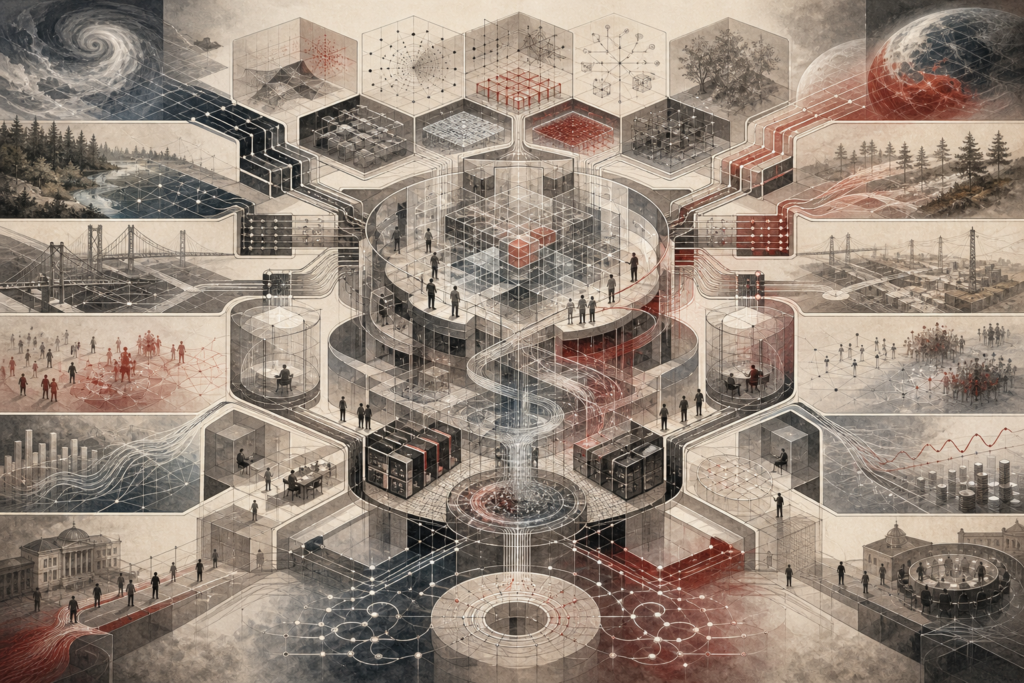
Scientific Computing for Systems Modeling
Scientific Computing for Systems Modeling examines how computational methods make it possible to represent, simulate, analyze, and visualize the behavior of complex systems. In systems work, scientific computing provides the practical bridge between formal models and applied analysis, allowing mathematical structure to be translated into executable workflows capable of handling scale, iteration, interdependence, and dynamic change.
This category explores numerical methods, algorithmic modeling, simulation, computational experiments, data workflows, reproducibility, and performance-aware analytical practice as tools for studying complex systems. It considers how computational techniques make it possible to solve equations that cannot be handled analytically, simulate nonlinear behavior, test scenarios, and work across domains such as environmental systems, economics, infrastructure, engineering, public policy, and sustainability. Particular attention is given to approximation, stability, discretization, sensitivity, reproducibility, and the interpretive discipline required to ensure that computational outputs remain analytically meaningful.
The category also considers the relationship between programming, mathematical reasoning, and systems inquiry. Scientific computing is treated not merely as a technical support function, but as a core methodological domain through which models are implemented, evidence is generated, and complex behavior becomes tractable to investigation. Where appropriate, articles may connect scientific computing to Python, numerical libraries, simulation frameworks, visualization tools, and reproducible analytical workflows used in applied systems research.
By linking computation to systems thinking, this category positions scientific computing as an essential method for turning formal models into operational analysis and for studying complexity at scales that exceed purely theoretical treatment.
Scientific Computing for Systems Modeling examines how computational methods make it possible to implement, simulate, analyze, and evaluate complex systems across economics, infrastructure, ecology, climate, engineering, epidemiology, governance, and public policy. Moving from numerical methods and data structures to simulation, optimization, performance, calibration, and reproducible workflows, this pillar treats scientific computing as both a practical computational discipline and a core modeling framework. It also connects scientific computing to implementation in R and Python, showing how mathematical models can be approximated, visualized, stress-tested, and explored in applied settings.