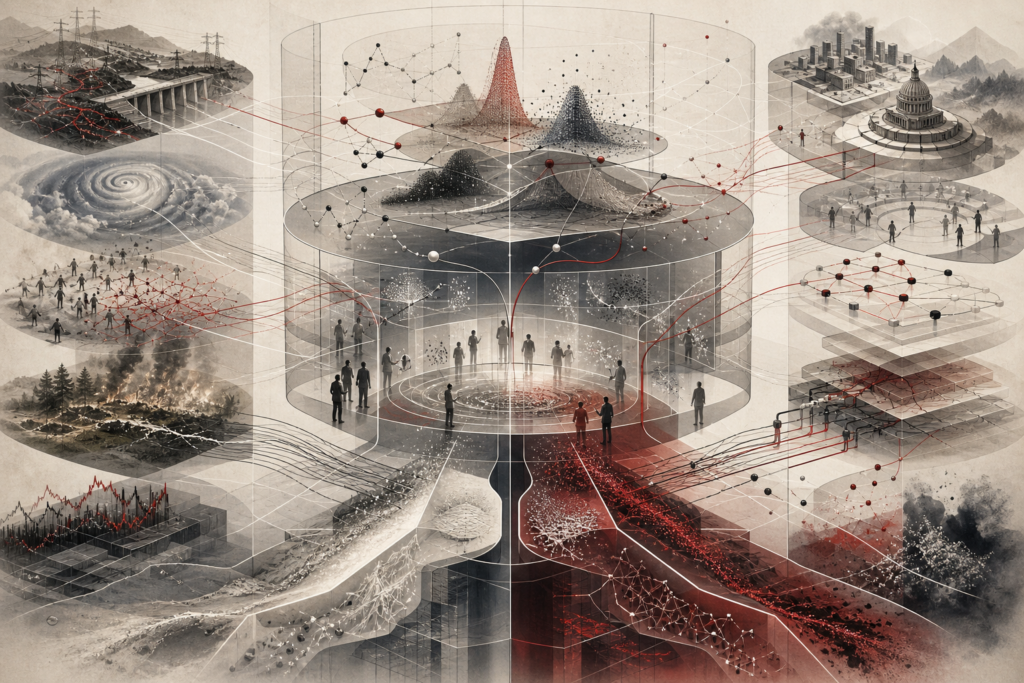
Probability for Systems Modeling
Probability for Systems Modeling examines how uncertainty, randomness, risk, and variation can be formally represented in the analysis of complex systems. In systems work, probability provides a foundational framework for reasoning about events that cannot be predicted with certainty, but whose patterns, distributions, dependencies, and likelihoods can still be modeled, interpreted, and used to guide analysis.
This category explores random variables, probability distributions, conditional probability, stochastic processes, Bayesian reasoning, Markov dynamics, and probabilistic dependence as tools for understanding systems shaped by uncertainty. It considers how probabilistic structure helps clarify exposure, volatility, contingency, and the range of outcomes that may emerge across social, economic, environmental, technological, and engineered systems. Particular attention is given to risk, uncertainty propagation, event likelihood, path dependence, and the ways in which random variation can alter or constrain system behavior through time.
The category also considers the relationship between formal probability theory and computational implementation. Probability is treated not merely as an abstract branch of mathematics, but as a practical language for simulation, risk analysis, forecasting, scenario design, and decision-making under uncertainty. Where appropriate, articles may connect probabilistic reasoning to computational workflows, Monte Carlo methods, stochastic simulation, and reproducible analytical practice.
By linking uncertainty to systems thinking, this category positions probability as an essential method for understanding contingency, variation, and the structured unpredictability of complex systems.