

Mathematical Modeling

Mathematical modeling examines how formal mathematical structures can be used to represent relationships, dynamics, constraints, and change within complex systems. In fields such as economics, engineering, environmental analysis, operations research, and decision science, models provide a disciplined way to translate real-world problems into structured forms that can be analyzed, tested, and compared.

The practice of mathematical modeling involves defining variables, specifying assumptions, identifying functional relationships, and constructing equations or computational representations that capture important features of a system. These models can be used to clarify mechanisms, simulate scenarios, estimate outcomes, evaluate trade-offs, and support reasoning under uncertainty. In this way, mathematical modeling serves as a bridge between abstract reasoning and applied problem-solving.

Mathematical modeling plays a central role in forecasting, optimization, systems analysis, and strategic planning. By formalizing complex relationships into analyzable structures, it enables researchers, institutions, and practitioners to examine possible interventions, compare alternative pathways, and make more rigorous judgments about systems that would otherwise remain too complex to understand clearly.

If you want, I can also do the same-format descriptions for the full updated Thinking and Problem Solving pillar pages.

Editorial scientific illustration of probability for systems modeling as an uncertainty-and-risk architecture, showing probability fields, distribution-like structures, stochastic pathways, transition states, Monte Carlo simulation streams, rare-event zones, tail-risk shadows, reliability networks, climate uncertainty, epidemiological pathways, infrastructure risk, ecological disturbance, public-policy systems, and responsible uncertainty interpretation.

Probability for Systems Modeling: Uncertainty, Risk, Stochastic Processes, R, and Python

Probability for Systems Modeling examines how uncertainty, randomness, risk, and variation can be formally represented in the analysis of complex systems across economics, infrastructure, ecology, climate, epidemiology, engineering, finance, and public policy. Moving from random variables and probability distributions to conditional probability, stochastic processes, Bayesian reasoning, reliability, and Monte Carlo simulation, this pillar treats probability as both a formal mathematical language and a practical modeling framework. It also connects probability to computational implementation in R and Python, showing how uncertain systems can be simulated, estimated, visualized, and interpreted in applied settings.

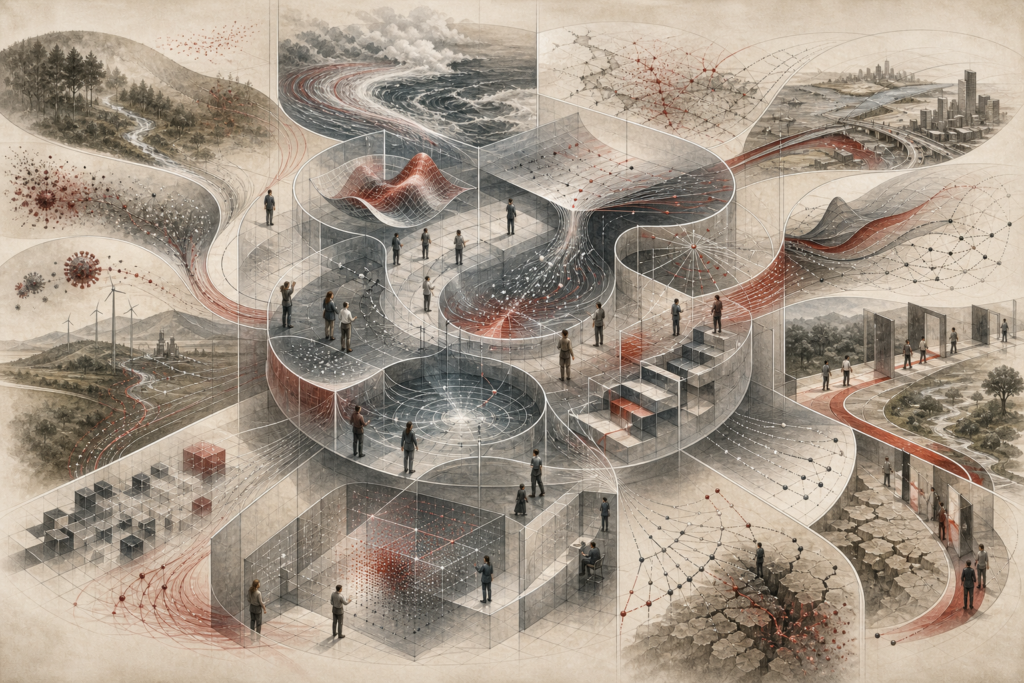
Editorial scientific illustration of linear algebra for systems modeling as a structural-systems architecture, showing vector pathways, matrix grids, coordinate spaces, transformation surfaces, eigenstructure axes, network adjacency structures, graph flows, decomposition layers, dimensionality-reduction funnels, infrastructure networks, ecological systems, economic input-output structures, machine-learning representation spaces, governance systems, and responsible structural interpretation.

Linear Algebra for Systems Modeling: Matrices, Networks, Dynamics, and Structural Reasoning

Linear Algebra for Systems Modeling introduces matrices, vectors, transformations, networks, and eigensystems as tools for understanding structure in complex systems. The map connects foundational ideas—linear equations, matrix operations, rank, span, bases, projections, determinants, eigenvalues, singular value decomposition, and least-squares reasoning—to applied questions in engineering, data analysis, infrastructure, control, optimization, and scientific modeling. Rather than treating linear algebra as isolated computation, it presents the subject as a language for describing flows, constraints, dependence, stability, approximation, feedback, and system behavior. Readers move from basic matrix representation to network models, dynamical systems, dimensional reduction, numerical reliability, and interpretive judgment. The series emphasizes both mathematical clarity and practical modeling discipline: how linear structures reveal hidden relationships, where linear assumptions fail, and how computational methods translate abstract algebra into usable insight.

Editorial scientific illustration of calculus for systems modeling as a continuous-change architecture, showing dynamic pathways, accumulation basins, derivative-like curves, feedback loops, gradient fields, spatial flows, simulation tracks, sensitivity branches, ecological systems, climate feedback, infrastructure networks, epidemiological spread, sustainability transitions, and responsible model interpretation.

Calculus for Systems Modeling: Change, Accumulation, and Dynamics

Calculus for Systems Modeling examines how mathematical representations of continuous change make it possible to analyze dynamic systems across ecology, economics, infrastructure, climate, engineering, public policy, and sustainability. Moving from limits and derivatives to integration, multivariable analysis, vector calculus, differential equations, and numerical methods, this pillar treats calculus as both a formal mathematical language and a practical modeling framework. It also connects calculus to computational implementation in R and Python, showing how continuous models can be simulated, visualized, approximated, and interpreted in applied settings.

Scroll to Top