Mathematical Modeling

Mathematical modeling examines how formal mathematical structures can be used to represent relationships, dynamics, constraints, and change within complex systems. In fields such as economics, engineering, environmental analysis, operations research, and decision science, models provide a disciplined way to translate real-world problems into structured forms that can be analyzed, tested, and compared.

The practice of mathematical modeling involves defining variables, specifying assumptions, identifying functional relationships, and constructing equations or computational representations that capture important features of a system. These models can be used to clarify mechanisms, simulate scenarios, estimate outcomes, evaluate trade-offs, and support reasoning under uncertainty. In this way, mathematical modeling serves as a bridge between abstract reasoning and applied problem-solving.

Mathematical modeling plays a central role in forecasting, optimization, systems analysis, and strategic planning. By formalizing complex relationships into analyzable structures, it enables researchers, institutions, and practitioners to examine possible interventions, compare alternative pathways, and make more rigorous judgments about systems that would otherwise remain too complex to understand clearly.

If you want, I can also do the same-format descriptions for the full updated Thinking and Problem Solving pillar pages.

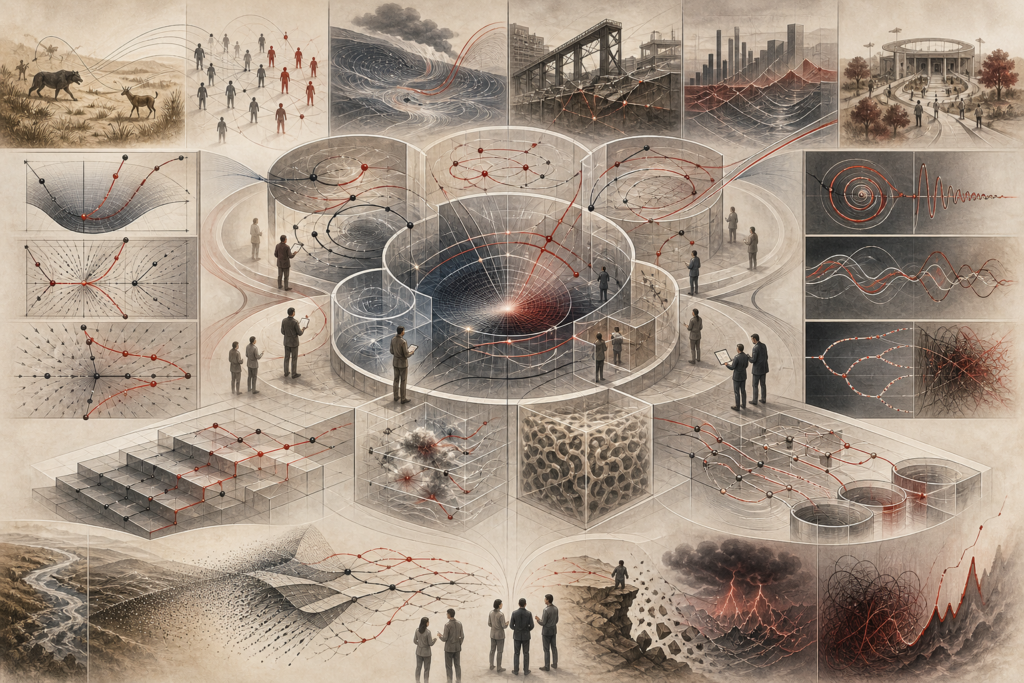
Editorial illustration of a scholarly modeling workspace where terrain, settlements, and systems are framed through transparent overlays, nested boundaries, scale windows, and formal diagrams.

Model Boundaries, Scale, and Scope: How to Define What a Mathematical Model Can Explain

Model boundaries, scale, and scope determine what a mathematical model includes, excludes, resolves, aggregates, and claims to explain. Before equations, parameters, simulations, or forecasts can be interpreted, modelers must decide where the modeled system begins and ends, what level of detail matters, what time and spatial scales are relevant, and which uses the model can responsibly support. This article explains how boundary choices shape model meaning, how scale affects visibility and distortion, and how scope defines the legitimate reach of conclusions. It examines system boundaries, temporal horizons, spatial resolution, population inclusion, mechanism selection, external drivers, feedback, aggregation, and decision context. By treating boundaries, scale, and scope as explicit design decisions rather than background assumptions, the article helps readers evaluate when mathematical models clarify a problem, when they overreach, and how boundary revision improves modeling practice across science and policy.


Editorial illustration of a scholarly modeling workspace where complex real-world patterns are simplified through assumptions, overlays, boundaries, and formal model diagrams.

Assumptions, Simplification, and Model Design

Assumptions, simplification, and model design shape every mathematical model before computation begins. A model does not become useful by including everything; it becomes useful by selecting structure, simplifying detail, and making assumptions explicit enough to inspect, test, revise, and communicate. This article explains how assumptions function as load-bearing parts of model architecture, why simplification can clarify rather than weaken a model, and how design choices determine what a model can explain, predict, simulate, optimize, or support. It distinguishes helpful assumptions from hidden distortions, examines idealization, aggregation, linearization, boundary choice, parameterization, and scale, and shows how sensitivity analysis and validation reveal whether assumptions matter. By treating model design as a disciplined process of judgment rather than mere equation selection, the article prepares readers to build, evaluate, and revise mathematical models responsibly across science, engineering, policy, statistics, and complex systems today.

Editorial illustration of a scholarly desk where natural forms, mechanical objects, and observed patterns transition into abstract networks, geometric diagrams, and mathematical representations.

Abstraction and Representation in Mathematical Models: How Models Select, Simplify, and Explain

Abstraction and representation are the central acts of mathematical modeling. A model cannot reproduce the world in full; it selects, simplifies, encodes, and organizes features of a situation so that they can be reasoned about mathematically. This article explains how abstraction removes detail while preserving structure, and how representation gives that structure a formal form through variables, parameters, equations, diagrams, simulations, networks, probability models, or algorithms. It distinguishes useful simplification from distortion, examines how modelers choose boundaries and scales, and shows why every representation hides as well as reveals. The article also connects abstraction to validation, uncertainty, computation, communication, and ethical responsibility. By treating models as selective representations rather than miniature realities, it prepares readers to evaluate when mathematical models clarify systems, when they mislead, and how better representations can be revised through evidence and judgment in practice today.

Editorial illustration of a scholarly worktable showing the modeling process as real-world landscapes, populations, and mechanisms are transformed into formal diagrams, networks, and geometric representations.

The Modeling Process: From World to Formal Representation

The modeling process translates a real-world situation into a formal representation that can be analyzed, tested, revised, and interpreted. This article explains how modeling moves from problem framing to abstraction, boundary selection, variable design, assumptions, formulation, computation, assessment, and revision. A model does not begin with an equation; it begins with a question about the world and a disciplined judgment about what must be represented. The article shows how modelers identify purpose, choose scale, define variables and parameters, construct relationships, check units and constraints, compare results with evidence, and communicate uncertainty. It also explains why modeling is iterative: weak assumptions, poor boundaries, unstable parameters, numerical error, or failed validation can force revision. By connecting conceptual framing, formal structure, computation, validation, and accountability, the article provides a practical foundation for modeling across science, engineering, statistics, policy, and complex systems today.

Editorial illustration of a scholarly worktable where messy real-world systems are translated into abstract mathematical models through maps, graphs, networks, curves, and geometric diagrams.

What Is Mathematical Modeling? How Formal Models Translate Reality Into Structure

Mathematical modeling translates real-world questions into formal representations that can be analyzed, tested, revised, and used with judgment. This opening article defines mathematical modeling as more than equations or computation. It explains how models frame problems, select boundaries, identify variables and parameters, state assumptions, formulate relationships, analyze behavior, compare results with evidence, and communicate uncertainty. Mathematical models can support explanation, prediction, simulation, optimization, control, and decision-making, but they are never complete copies of reality. They are selective tools shaped by purpose, scale, assumptions, data, and interpretation. By connecting abstraction, formal structure, computation, validation, uncertainty, and responsibility, the article establishes the foundation for the Mathematical Modeling series and prepares readers for later articles on equations, differential models, stochastic systems, optimization, simulation, calibration, sensitivity, model governance, and modeling practice across science, engineering, policy, and complex systems in modern analytical work today.

Editorial scientific illustration of differential equations for systems modeling as a dynamic-systems architecture, showing trajectory pathways, coupled feedback loops, equilibrium basins, stability fields, oscillation patterns, diffusion structures, ecological interaction, climate feedback, infrastructure stress, epidemiological pathways, public-policy systems, and responsible model interpretation.

Differential Equations for Systems Modeling: Dynamics, Stability, R, and Python

Differential Equations for Systems Modeling examines how relationships of change can be formally represented when the behavior of a system depends on rates of change, feedback, interaction, forcing, and time-dependent adjustment across economics, infrastructure, ecology, climate, engineering, epidemiology, governance, and public policy. Moving from first-order and higher-order equations to coupled systems, stability analysis, phase behavior, nonlinearity, diffusion, and numerical methods, this pillar treats differential equations as both a formal mathematical language and a practical modeling framework. It also connects differential equations to computational implementation in R and Python, showing how dynamic systems can be solved, simulated, visualized, and interpreted in applied settings.

Editorial scientific illustration of statistics for systems modeling as an evidence-and-uncertainty architecture, showing data fields, measurement systems, sampling pathways, distribution clouds, uncertainty bands, regression surfaces, model diagnostics, resampling loops, forecasting structures, ecological monitoring, infrastructure sensors, climate data streams, public-policy evaluation, and responsible statistical interpretation.

Statistics for Systems Modeling: Inference, Evidence, Forecasting, R, and Python

Statistics for Systems Modeling examines how data, measurement, variation, uncertainty, and inference support the study of complex systems. This article explains statistics as a modeling language for evidence rather than a set of isolated formulas, connecting descriptive statistics, sampling, estimation, confidence intervals, hypothesis testing, regression, model diagnostics, causal inference, bias, missing data, resampling, simulation, time series, forecasting, prediction error, and responsible interpretation. It also shows why statistical reasoning matters for ecology, climate, infrastructure, epidemiology, economics, public policy, governance, and scientific computing. By combining formal statistical concepts with R and Python workflows, the article frames statistics as a disciplined way to reason from imperfect observations toward credible, transparent, and revisable claims about real-world systems.

Editorial scientific illustration of mathematical modeling as a formal representation systems architecture, showing abstraction, assumptions, variables, parameters, constraints, simulation, calibration, validation, sensitivity analysis, uncertainty, robustness, scientific computing, systems modeling, decision support, infrastructure, sustainability, AI systems, and responsible model governance.

Mathematical Modeling: Abstraction, Uncertainty, and the Structure of Reality

Mathematical modeling translates real-world systems into formal structures that can be analyzed, simulated, tested, and revised. This article explains modeling as a disciplined practice of abstraction, assumption-making, variable selection, mathematical formulation, calibration, validation, sensitivity analysis, uncertainty assessment, and interpretation. It shows why models are not reality itself, but purposeful representations that help clarify mechanisms, compare scenarios, expose trade-offs, and support judgment under incomplete knowledge. The article also connects mathematical modeling to systems modeling, decision science, scientific computing, engineering, public policy, sustainability, infrastructure, public health, ecology, artificial intelligence, and reproducible research workflows, emphasizing both the power and limits of formal representation.

Editorial scientific illustration of scientific computing for systems modeling as a computational architecture, showing data-flow pathways, numerical grids, algorithmic chambers, simulation loops, parameter sweeps, uncertainty envelopes, calibration bridges, validation checkpoints, structured output vaults, climate simulation fields, ecological monitoring, infrastructure networks, epidemiological pathways, governance systems, and responsible computational interpretation.

Scientific Computing with Python for Systems Modeling

Scientific Computing for Systems Modeling examines how computational methods make it possible to implement, simulate, analyze, and evaluate complex systems across economics, infrastructure, ecology, climate, engineering, epidemiology, governance, and public policy. Moving from numerical methods and data structures to simulation, optimization, performance, calibration, and reproducible workflows, this pillar treats scientific computing as both a practical computational discipline and a core modeling framework. It also connects scientific computing to implementation in R and Python, showing how mathematical models can be approximated, visualized, stress-tested, and explored in applied settings.

Scroll to Top