Mathematical Modeling

Mathematical modeling examines how formal mathematical structures can be used to represent relationships, dynamics, constraints, and change within complex systems. In fields such as economics, engineering, environmental analysis, operations research, and decision science, models provide a disciplined way to translate real-world problems into structured forms that can be analyzed, tested, and compared.

The practice of mathematical modeling involves defining variables, specifying assumptions, identifying functional relationships, and constructing equations or computational representations that capture important features of a system. These models can be used to clarify mechanisms, simulate scenarios, estimate outcomes, evaluate trade-offs, and support reasoning under uncertainty. In this way, mathematical modeling serves as a bridge between abstract reasoning and applied problem-solving.

Mathematical modeling plays a central role in forecasting, optimization, systems analysis, and strategic planning. By formalizing complex relationships into analyzable structures, it enables researchers, institutions, and practitioners to examine possible interventions, compare alternative pathways, and make more rigorous judgments about systems that would otherwise remain too complex to understand clearly.

If you want, I can also do the same-format descriptions for the full updated Thinking and Problem Solving pillar pages.

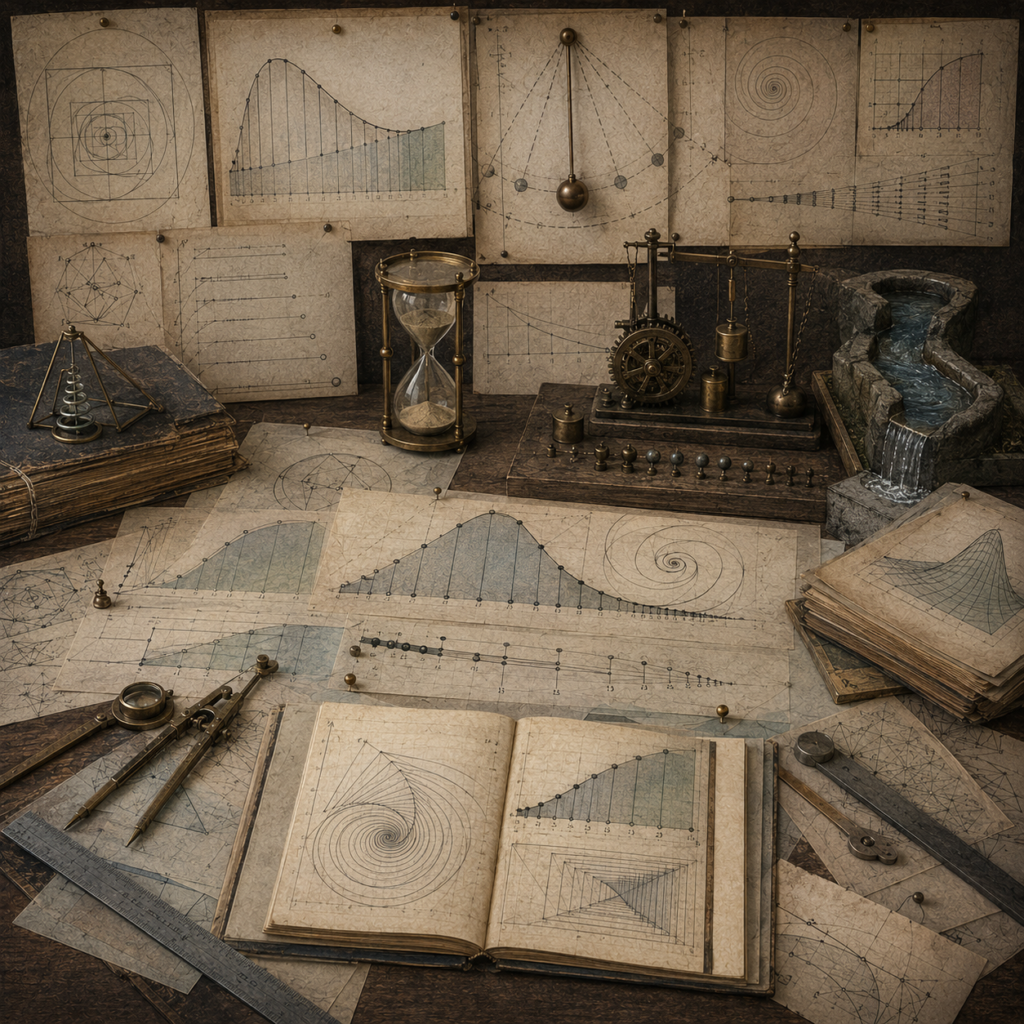
Antique scholarly workspace with spiral diagrams, infinitesimal partitions, pendulum traces, area approximations, flowing water, gears, notebooks, and drafting instruments representing infinity, infinitesimals, and the historical study of change.

Infinity, Infinitesimals, and the Historical Problem of Change: How Calculus Made Motion Mathematically Precise

Infinity, infinitesimals, and the historical problem of change explain why calculus became the central mathematical language of continuous systems. Long before modern limits, mathematicians and philosophers struggled to understand motion, accumulation, curvature, and local change across infinitely divisible intervals. This article connects ancient paradoxes, geometric exhaustion, infinitesimal reasoning, Newtonian fluxions, Leibnizian differentials, and later limit formalization to systems modeling practice. It shows why models of population growth, climate accumulation, infrastructure stress, resource depletion, epidemiological transmission, and economic change still depend on ideas of small intervals, limiting behavior, local rates, and cumulative effects. The article also introduces reproducible workflows in Python, R, SQL, and Haskell for difference quotients, approximation records, convergence checks, typed step sizes, concept registries, and responsible interpretation of continuous change in computational modeling.
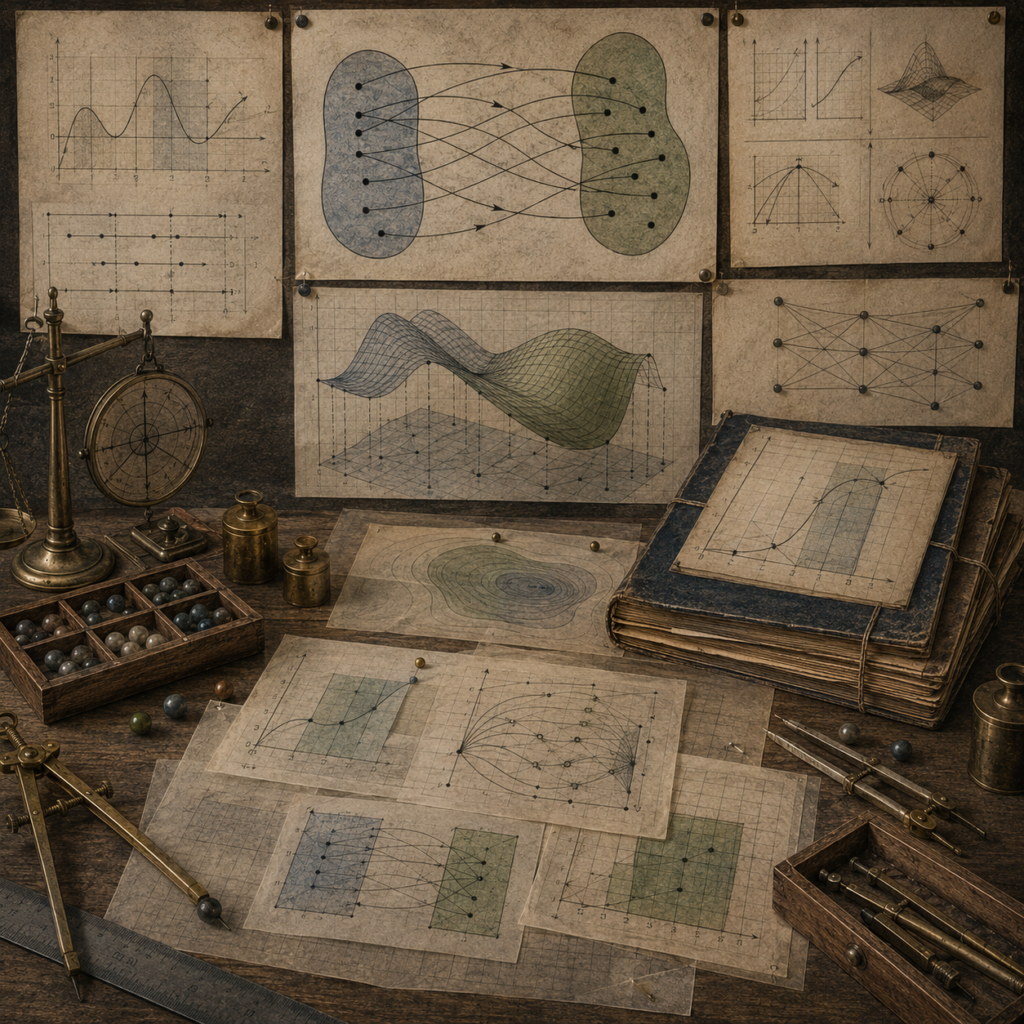
Archival-style mathematical study with mapping diagrams, plotted curves, surface graphs, network structures, and drafting tools arranged across a scholarly worktable to represent domains, ranges, and functional relationships.

Domains, Ranges, and the Structure of Functional Models: How Calculus Defines Valid System Behavior

Domains, ranges, and functional model structure determine what a systems model is allowed to say. A function does not operate on every possible input, and its outputs are not automatically meaningful in every context. In calculus for systems modeling, the domain defines valid inputs, states, parameters, scenarios, and conditions, while the range defines possible or interpretable outputs. This article explains how input spaces, output spaces, constraints, feasible regions, parameter ranges, state spaces, and boundary conditions shape model validity before derivatives, integrals, optimization, or simulation are applied. It connects domain and range reasoning to population dynamics, infrastructure modeling, epidemiology, climate systems, economics, and resource systems. It also introduces reproducible workflows in Python, R, SQL, and Haskell for validating inputs, checking outputs, documenting assumptions, and flagging scenarios that require review before drawing conclusions about model behavior, validity, or responsible use later.

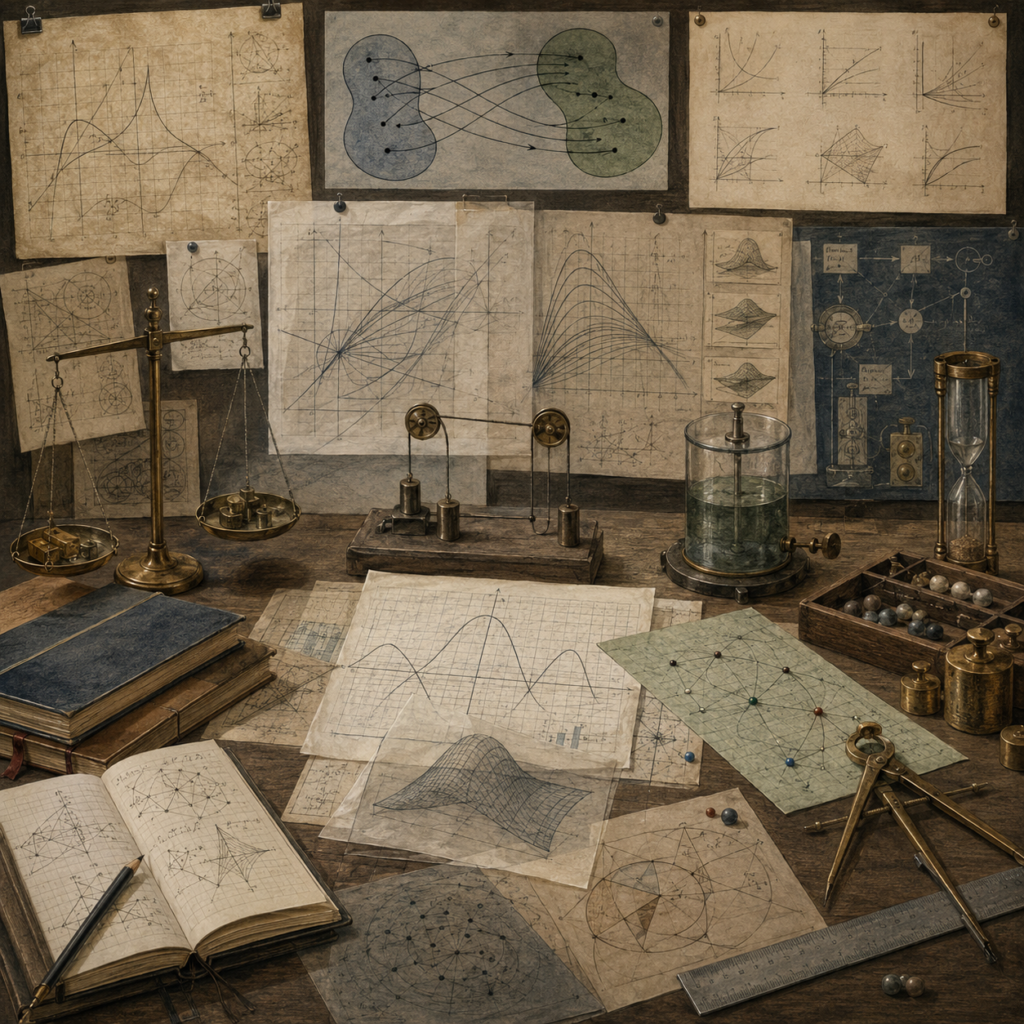
Archival-style scholarly workspace covered with graphs, plotted curves, geometric diagrams, mapping sketches, notebooks, measuring tools, weights, and model components that symbolize functions, variables, and mathematical representation.

Functions, Variables, and Mathematical Representation: How Calculus Builds Models of System Behavior

Functions, variables, and mathematical representation form the foundation of calculus for systems modeling. Before a model can describe rates of change, accumulation, feedback, optimization, or dynamic behavior, it must define what quantities matter, how those quantities are related, what inputs are valid, what outputs are meaningful, and what assumptions connect formal structure to the system being studied. This article explains functions as modeled relationships, variables as interpreted quantities, parameters as structural assumptions, and functional forms as choices that shape system behavior. It connects representation to examples from ecology, infrastructure, epidemiology, climate, economics, urban systems, and sustainability. It also introduces reproducible computational workflows in Python, R, SQL, and Haskell, showing how code can make variables, parameters, model registries, and functional assumptions inspectable, auditable, and easier to revise.

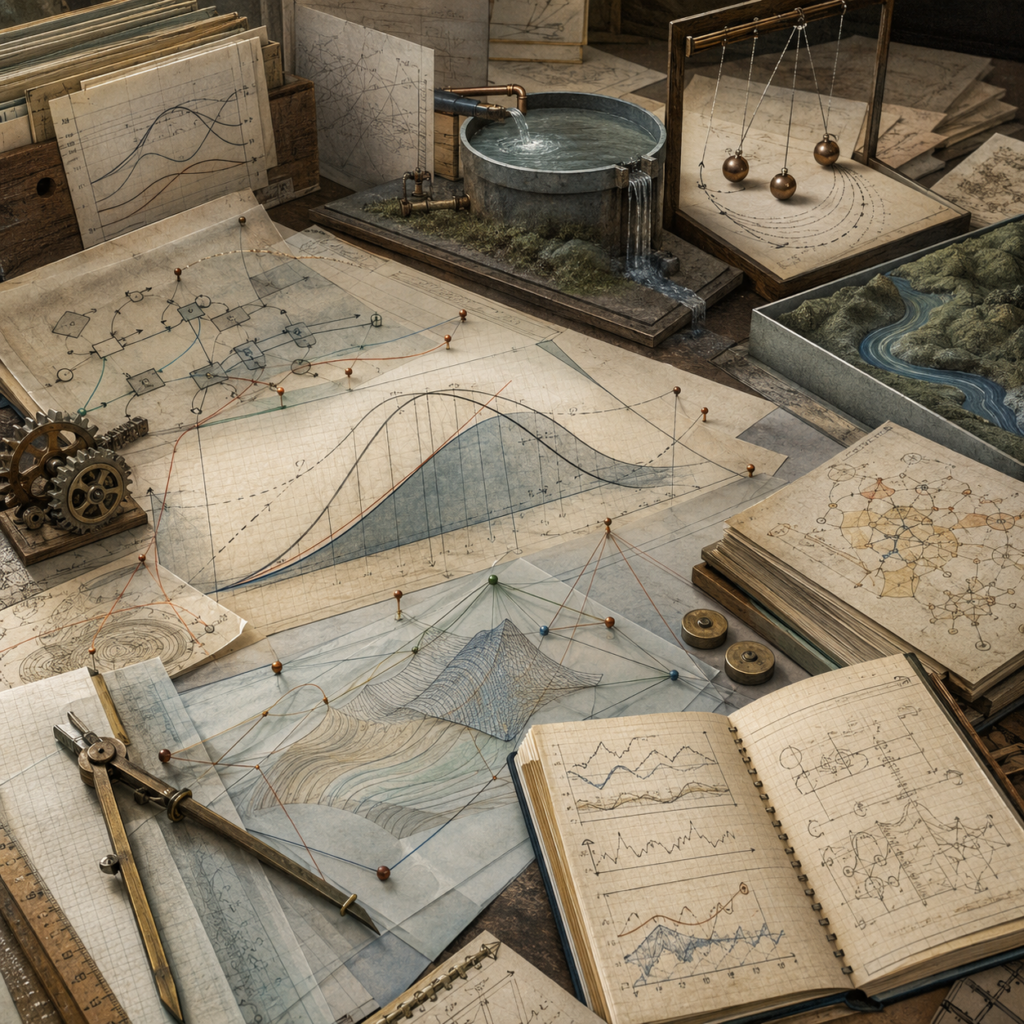
Scholarly worktable with layered diagrams, curves, flow models, gears, a water reservoir, pendulum traces, and notebooks representing calculus as a tool for understanding system change over time.

What Is Calculus for Systems Modeling? Rates, Accumulation, and Dynamic Change

Calculus for systems modeling explains how derivatives, integrals, limits, approximation, optimization, multivariable analysis, vector fields, and differential equations help represent systems that change through time and space. This article introduces calculus as a modeling language for rates, accumulation, feedback, sensitivity, spatial flow, and dynamic behavior across ecology, infrastructure, economics, epidemiology, climate, engineering, public policy, and sustainability. It shows how derivatives describe local change, how integrals describe cumulative effects, how differential equations represent evolving states, and how numerical methods make complex models executable. The article also connects calculus to reproducible computational workflows in Python, R, Julia, SQL, Haskell, C, C++, Fortran, Rust, Go, and notebooks. Throughout, it emphasizes that calculus supports interpretation and disciplined judgment; it does not replace assumptions, evidence, uncertainty analysis, validation, or responsible systems thinking in applied modeling practice.

Editorial illustration of a scholarly governance workspace with model diagrams, review materials, balance scales, audit objects, archival folders, small human figures, and oversight tools.

Model Governance and Accountability: How Mathematical Models Should Be Reviewed, Monitored, Documented, and Used Responsibly

Model governance and accountability examines how mathematical models should be documented, reviewed, approved, monitored, revised, and retired when they influence consequential decisions. Models can clarify evidence, test assumptions, compare scenarios, estimate uncertainty, and support planning, but they can also mislead when ownership, validation, use limits, monitoring, and decision responsibility are weak. This article explains why models require governance across their full lifecycle: purpose definition, data review, assumption documentation, validation, uncertainty communication, approval, deployment, monitoring, incident review, revision, and retirement. It also distinguishes model ownership from decision ownership, showing why accountability cannot be delegated to equations, software, dashboards, or artificial intelligence. Responsible governance keeps models useful without allowing them to become unchallengeable authorities. Models support judgment, but institutions remain responsible for how model-based claims are interpreted and used.

Editorial illustration of a collaborative scholarly modeling atelier with complex system maps, network diagrams, transparent overlays, uncertainty clouds, surface models, and research tools.

Future Directions in Mathematical Modeling: Complexity, AI Assistance, Digital Twins, Uncertainty, Governance, and Human Judgment

Future directions in mathematical modeling examines how modeling practice is changing as science, policy, engineering, public systems, sustainability, and artificial intelligence confront more complex, uncertain, and interconnected problems. The future of modeling will not be defined by one technique alone. It will involve hybrid models, model ensembles, digital twins, causal reasoning, machine learning, simulation platforms, uncertainty-aware workflows, participatory interpretation, reproducible research, and stronger governance. This article explains why future modeling must become more transparent, adaptive, plural, computationally reproducible, ethically accountable, and connected to human judgment. It explores emerging directions in AI-assisted modeling, complexity science, scenario analysis, model repositories, decision support, stakeholder review, and institutional accountability. Mathematical models will remain essential, but their future depends on using them as disciplined instruments for learning, not as substitutes for judgment.

Editorial illustration of a scholarly collaborative workspace where people review model diagrams, uncertainty surfaces, network maps, and analytical materials with balance scales and research tools.

AI-Assisted Modeling and Human Judgment: How Mathematical Models, Artificial Intelligence, and Human Oversight Should Work Together

AI-assisted modeling and human judgment examines how artificial intelligence can support mathematical modeling without replacing responsible interpretation, domain expertise, ethical review, and decision ownership. AI systems can help generate hypotheses, organize data, propose model structures, write code, compare scenarios, detect anomalies, summarize results, and accelerate documentation. But AI assistance also creates risks: hallucinated assumptions, hidden bias, weak provenance, automation bias, overconfident outputs, untested model logic, and blurred accountability. This article explains how AI should be used as a modeling assistant rather than a final authority. It emphasizes human review, transparent assumptions, reproducible workflows, uncertainty communication, validation, escalation rules, model governance, and accountable decision-making. In responsible modeling, AI belongs in the toolkit, but human judgment remains responsible for purpose, evidence, interpretation, values, consequences, and use.

Editorial illustration of a scholarly modeling workspace with layered system maps, network diagrams, surface models, ecological and urban patterns, transparent overlays, and scientific instruments.

Mathematical Modeling in an Age of Complexity: How Models Help Us Reason About Nonlinearity, Emergence, Uncertainty, and Interdependence

Mathematical modeling in an age of complexity examines how models help people reason about systems that are nonlinear, adaptive, uncertain, interconnected, and difficult to predict. Climate systems, economies, ecosystems, cities, infrastructure, health systems, supply chains, artificial intelligence, public institutions, and global risks do not behave like simple machines. They involve feedback loops, thresholds, path dependence, emergence, cascading effects, strategic behavior, uncertainty, and competing values. This article explains why complex conditions require model pluralism, scenario thinking, robustness analysis, uncertainty communication, participatory interpretation, and governance. It shows how mathematical modeling can clarify structure, test assumptions, compare futures, reveal fragility, and support decisions without pretending that complexity can be fully controlled. In an age of complexity, models are not final answers; they are disciplined tools for learning, judgment, and accountability.

Editorial illustration of a scholarly modeling desk with fragile model structures, uncertainty patterns, comparison maps, damaged surfaces, human figures, and balance scales representing ethical judgment.

Limits, Failure, and the Ethics of Modeling: How Mathematical Models Mislead, Distort, and Require Accountability

Limits, failure, and the ethics of modeling examines why mathematical models can clarify reality while also distorting it when assumptions, boundaries, data, uncertainty, validation, incentives, or communication are mishandled. Models fail when they are used outside their domain, treated as neutral authorities, optimized for narrow objectives, detached from context, or allowed to conceal judgment behind technical form. This article explains structural limits, data limits, validation limits, uncertainty, false precision, bias, misuse, governance failure, accountability gaps, and ethical responsibility in modeling practice. It shows why responsible modeling requires transparent assumptions, use limits, stakeholder awareness, uncertainty communication, bias review, documentation, independent challenge, monitoring, and human decision ownership. Models are powerful tools, but they must remain accountable representations rather than substitutes for judgment, evidence, and responsibility.

Scroll to Top