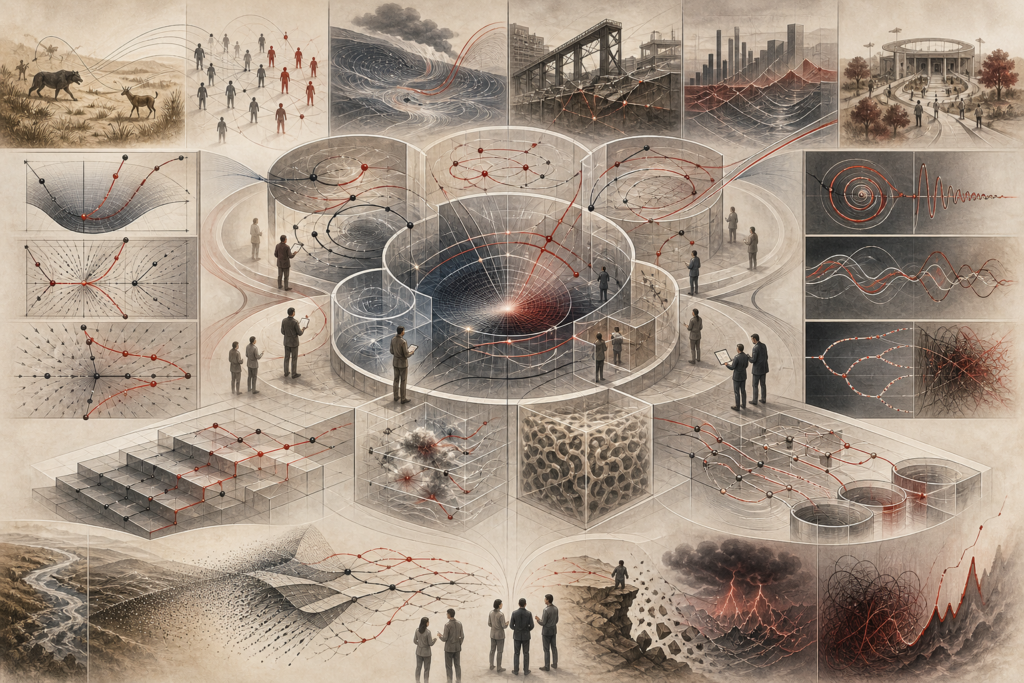
Differential Equations for Systems Modeling
Differential Equations for Systems Modeling examines how relationships of change can be formally represented when the behavior of a system depends on rates of change, feedback, interaction, and time-dependent adjustment. In systems work, differential equations provide a foundational framework for modeling dynamic processes whose present state is shaped by ongoing motion, accumulation, coupling, and response.
This category explores ordinary differential equations, systems of differential equations, initial value problems, equilibrium conditions, stability analysis, oscillation, nonlinear dynamics, and related numerical methods as tools for understanding how complex systems evolve through time. It considers how differential equations make it possible to represent growth, decay, diffusion, interaction, forcing, delay, and feedback across social, economic, environmental, technological, and engineered systems. Particular attention is given to dynamic trajectories, coupled behavior, thresholds, path dependence, and the conditions under which systems stabilize, destabilize, or shift into new regimes.
The category also considers the relationship between formal dynamic models and computational implementation. Differential equations are treated not merely as symbolic mathematical objects, but as practical tools for simulation, forecasting, scenario analysis, and mechanistic explanation in applied settings. Where appropriate, articles may connect differential equations to Python, R, numerical solvers, phase diagrams, dynamical systems analysis, and reproducible modeling workflows.
By linking dynamic mathematics to systems thinking, this category positions differential equations as an essential method for explaining how systems move, interact, adapt, and transform through time.