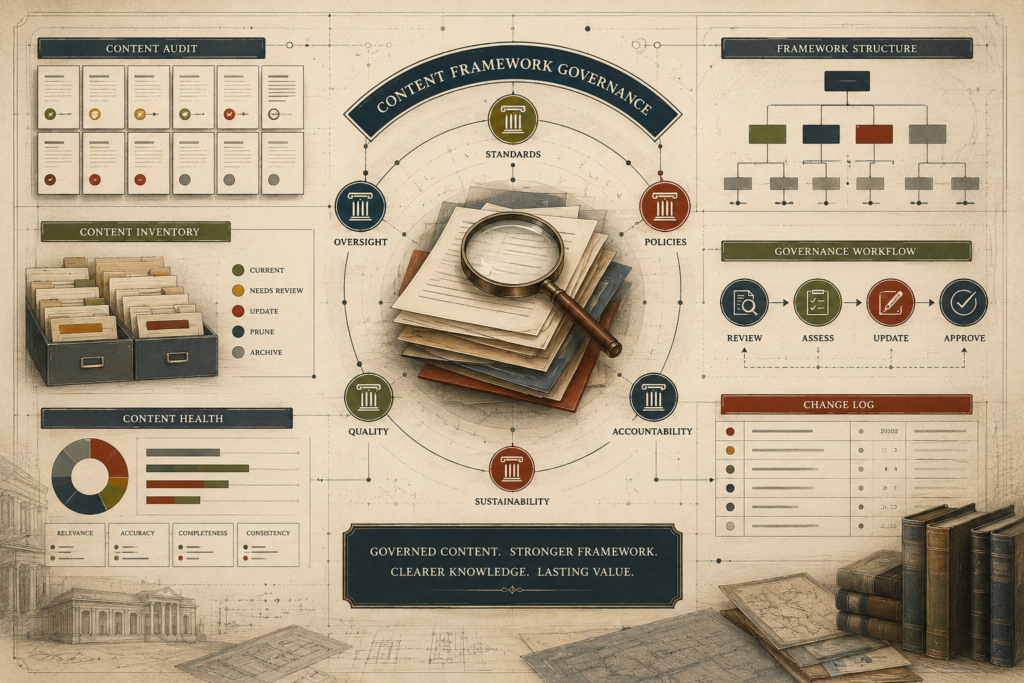
Content Frameworks

Content frameworks are structured models used to organize, communicate, and scale complex ideas across research, education, and strategic communication. Rather than presenting information as isolated articles or reports, content frameworks provide repeatable structures that help audiences understand how concepts relate to one another within a broader system of thought.

Effective content frameworks translate complex knowledge into navigable intellectual pathways. They may take the form of pillar pages, topic clusters, narrative models, educational sequences, or conceptual maps that guide readers through layered explanations of a subject. By structuring information in this way, content frameworks support deeper comprehension while maintaining coherence across large knowledge platforms.

Within research and policy contexts, content frameworks also help institutions communicate interdisciplinary insights to diverse audiences. They make it possible to connect specialized research, strategic analysis, and public-facing communication within a unified intellectual structure. As knowledge systems grow in scale and complexity, well-designed content frameworks become essential tools for maintaining clarity, accessibility, and long-term strategic alignment.

Abstract institutional illustration of connected content pages, document cards, network lines, nodes, and layered knowledge maps representing internal linking as framework infrastructure.

Internal Linking as Framework Infrastructure: How Links Build Knowledge Systems

Internal linking is more than a technical SEO practice. It is a form of framework infrastructure that shapes how knowledge is organized, discovered, interpreted, and extended across a site. This article examines how links connect concepts, articles, pillar pages, methods, examples, and supporting resources into coherent knowledge systems. Strong internal linking helps readers move from general ideas to deeper explanations, related frameworks, applied cases, and broader intellectual contexts. It also supports editorial governance by revealing gaps, redundancies, weak pathways, and underdeveloped clusters. The article explains why links should not be added mechanically, but designed as meaningful relationships that clarify hierarchy, sequence, comparison, and conceptual dependency. When used responsibly, internal links strengthen learning, research navigation, strategic communication, and institutional memory. They turn isolated pages into structured pathways through evolving bodies of knowledge and help readers find meaning with less friction.

Abstract institutional illustration showing the evolution of framework thinking through historical manuscripts, diagrams, classification trees, modular grids, network maps, and contemporary strategic structures.

The History of Framework Thinking in Communication and Strategy

Framework thinking has a long history in communication and strategy. This article traces how structured ways of organizing thought developed across rhetoric, logic, classification, education, scientific modeling, military and organizational strategy, management theory, advertising, information architecture, content strategy, knowledge management, digital publishing, and AI-assisted systems. It shows that modern content frameworks did not appear from nowhere. They inherit older practices for arranging speech, sequencing learning, classifying knowledge, representing systems, guiding decisions, persuading audiences, structuring digital environments, and maintaining institutional memory. The article explains why historical awareness matters for responsible framework use: every framework carries assumptions from the tradition that produced it. By understanding those lineages, editors, educators, researchers, strategists, and platform builders can reuse frameworks with judgment, adapt them carefully, and govern them responsibly as content systems scale without turning inherited structures into rigid formulas or ahistorical strategic shortcuts.

Abstract institutional illustration of layered documents, templates, grids, hierarchy diagrams, model structures, and connecting lines representing the relationship between frameworks, templates, and models.

Frameworks, Templates, and Models: How to Choose the Right Content Structure

Frameworks, templates, and models are often treated as interchangeable, but each performs different intellectual work. This article explains how frameworks organize reasoning, templates standardize repeatable outputs, and models represent relationships, systems, or simplified versions of reality. It shows why the distinction matters for research communication, education, strategic communication, knowledge architecture, AI-assisted workflows, and editorial governance. A template can improve consistency, but it cannot replace strategy. A model can clarify relationships, but it must disclose assumptions and limits. A framework can guide understanding, but it should not become a rigid formula. The article also explains how methods and workflows fit into content systems, how structural confusion creates weak decisions, and how professional platforms such as Catalyst Canvas can classify, audit, govern, and scale reusable structures without sacrificing judgment, evidence, context, or ethical responsibility across complex digital publishing environments and teams.

Abstract institutional illustration of layered archival sheets, modular grids, hierarchy diagrams, and networked knowledge maps representing framework literacy and the organization of usable knowledge.

Framework Literacy and the Structure of Usable Knowledge

Framework literacy is the ability to use frameworks without being used by them. This article explains how structured models clarify knowledge while also shaping what readers notice, remember, question, and ignore. It examines how frameworks support usable knowledge through categories, sequences, relationships, evidence layers, use conditions, and governance systems, while showing why every framework carries assumptions, boundaries, and blind spots. The article helps readers evaluate whether a framework fits its purpose, audience, evidence, domain, and ethical context, and when it risks oversimplification, false universality, category forcing, stereotype reinforcement, or manipulation. It also explores framework literacy in research communication, education, strategic communication, digital publishing, knowledge architecture, and public reasoning. The goal is not to reject frameworks, but to use them with judgment, adapting, combining, or rejecting structures when they no longer support responsible understanding across changing institutional and public contexts.

Scroll to Top