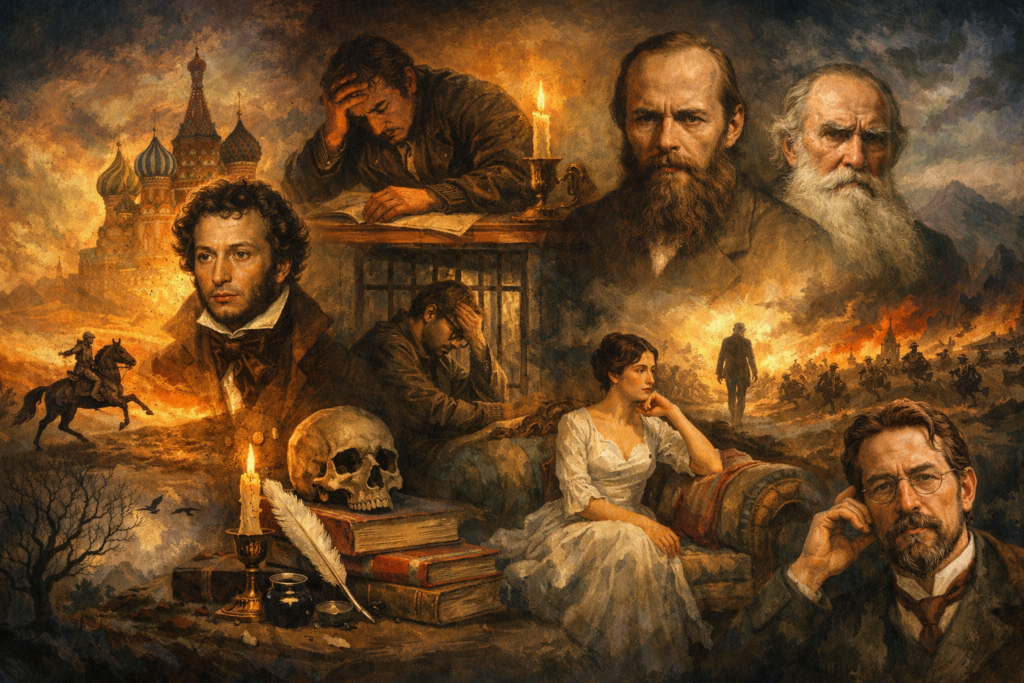
Russian Thought
Russian thought explores the moral, spiritual, literary, and philosophical traditions through which Russian writers and thinkers grappled with freedom, conscience, suffering, faith, history, and the meaning of human life. It examines a tradition in which literature, ethics, spirituality, and civilizational reflection are often inseparable, giving sustained attention to inner struggle, social disorder, moral responsibility, and the search for transcendence under modern conditions.
This category considers how Russian thinkers and writers engaged questions of nihilism, redemption, guilt, justice, personhood, and historical destiny. It includes the philosophical depth of literary figures alongside explicitly religious and intellectual traditions, recognizing that Russian thought often moves through novels, poetry, and moral reflection rather than through abstract system-building alone.
Russian thought plays an important role in a broader philosophy architecture because it brings spiritual seriousness, existential intensity, and civilizational depth to questions of ethics, freedom, suffering, and human becoming. By engaging this tradition, the site gains a powerful lens on the moral and psychological crises of modern life.
Russian thought examines the literary, moral, psychological, and civilizational traditions through which Russian writers and thinkers explored freedom, conscience, suffering, history, social order, and the meaning of human life. This pillar follows the arc from Pushkin to Chekhov, showing how Russian literature became one of the world’s most powerful mediums for philosophical inquiry, spiritual conflict, psychological depth, and the drama of human becoming.