
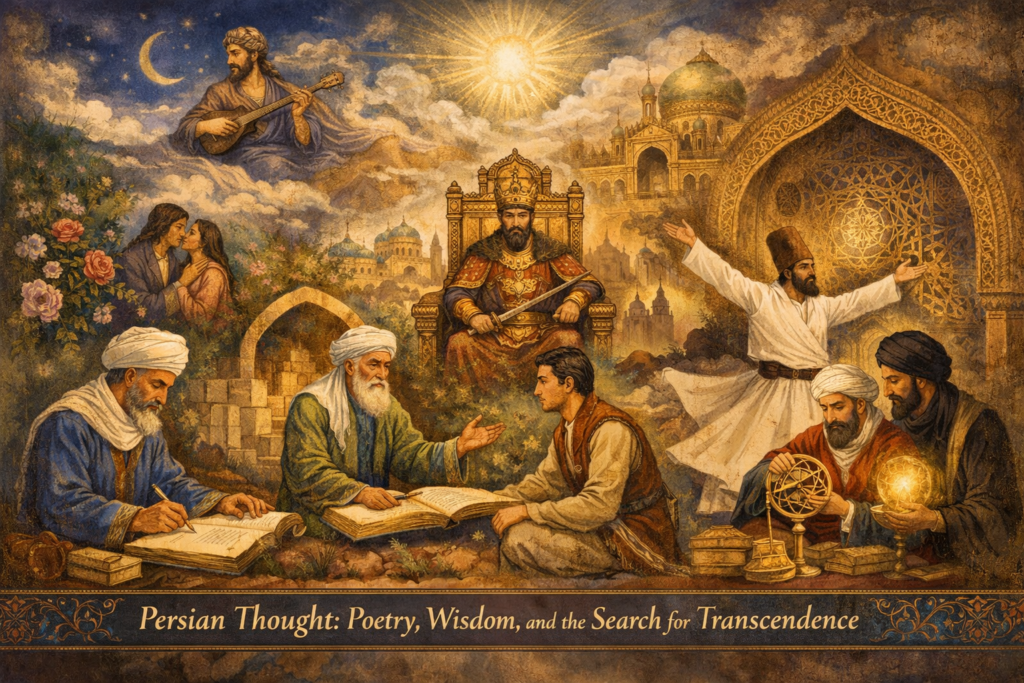
Persian Thought: Poetry, Wisdom, and the Search for Transcendence
Persian thought examines the philosophical, poetic, ethical, mystical, political, historical, and civilizational traditions through which Persian writers and thinkers reflected on wisdom, beauty, justice, kingship, love, transcendence, and the meaning of human life. This field is not a narrow literary inheritance or a single doctrinal school, but a vast civilizational tradition in which epic memory, ethical prose, lyric poetry, metaphysical philosophy, Sufi longing, historiography, and political reflection continually inform one another. At its core lies a defining philosophical question: how should human beings seek truth, cultivate the soul, remember civilization, and live under the demands of beauty, justice, mortality, and transcendence? This content pillar explores pre-Islamic Iranian memory, Zoroastrian moral order, Ferdowsi, Saadi, Nizami, Attar, Nasir Khusraw, Omar Khayyam, Hafez, Rumi, Jami, Avicenna, Suhrawardi, Mulla Sadra, Shi‘i philosophy, mirrors-for-princes traditions, Persian historiography, and the wider Persianate world, showing why Persian thought remains one of the world’s most luminous traditions of integrated wisdom, poetic intelligence, and metaphysical depth.