
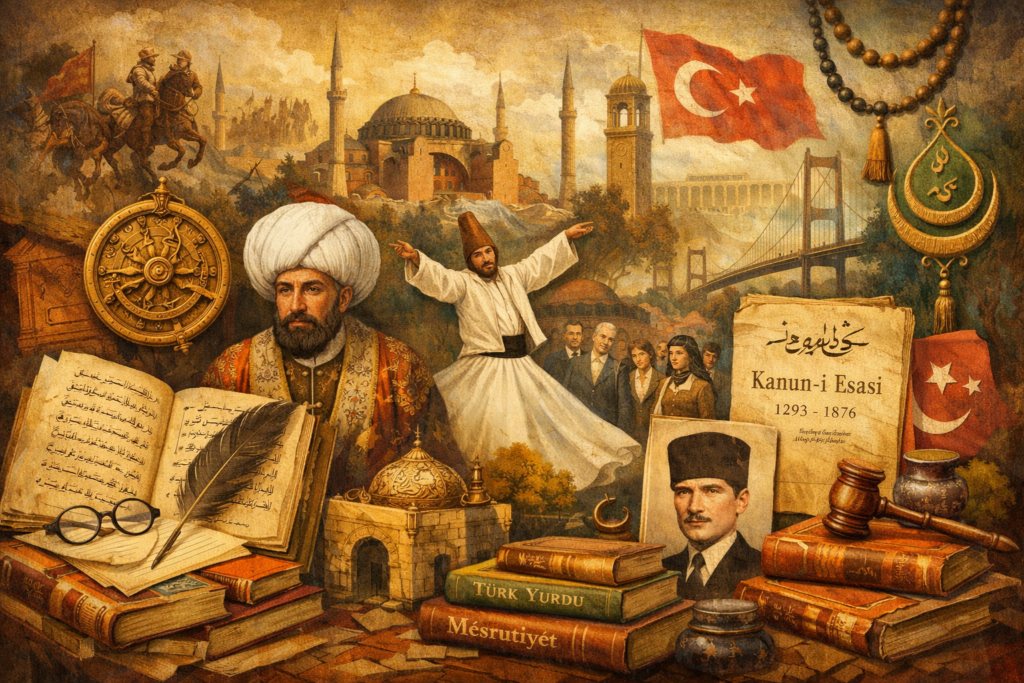
Ottoman and Turkish Thought: Law, Memory, and the Search for Order
Ottoman and Turkish thought preserves one of the great intellectual archives for understanding how civilizations negotiate sovereignty, law, religion, literature, reform, and historical transformation across long stretches of time. Shaped by Turkic, Islamic, Persianate, Byzantine, Mediterranean, and Balkan inheritances, this tradition developed across Anatolia and the wider Ottoman world through dynastic legitimacy, jurisprudence, theology, Sufi devotion, poetic culture, historical writing, administrative reason, educational institutions, and later struggles over constitutionalism, nationalism, secularism, and republican identity. It is not a narrow national canon or a simple imperial ideology, but a layered and contested field in which legal order, spiritual authority, political memory, and civilizational self-understanding were repeatedly reworked under conditions of expansion, crisis, reform, and rupture.