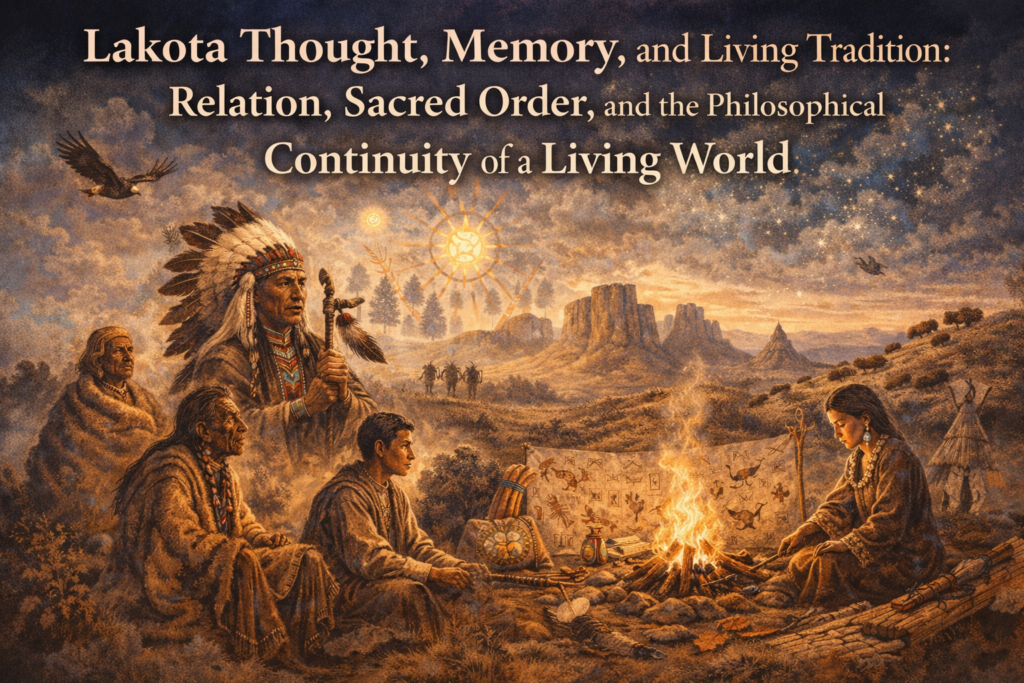
Lakota Thought, Memory, and Living Tradition
Lakota Thought, Memory, and Living Tradition examines the intellectual, moral, spiritual, and historical worlds through which Lakota communities have understood existence, sacred order, land, kinship, and collective continuity across generations. In the history of ideas, Lakota tradition is not adequately approached as folklore, legend, or anthropological residue. It is a living and internally coherent field of thought carried through language, oral teaching, ceremonial life, ecological relation, political memory, visual recordkeeping, and intergenerational systems of transmission. Its categories of meaning emerge not from the abstract divisions of modern Western scholarship alone, but from a civilizational inheritance in which story, place, law, spirituality, memory, and communal responsibility remain inseparable.
This category explores Lakota oral tradition, narrative memory, winter counts, language and translation, cosmology, sacred geography, kinship systems, ceremonial life, ethical formation, governance, treaty history, sovereignty, education, historical trauma, resilience, and cultural renewal. It considers how collective memory is preserved not only in written archives but through oral narration, seasonal knowledge, naming practices, ritual continuity, sacred landscapes, and inherited forms of responsibility. It also examines how Lakota language carries philosophical, relational, and cosmological meanings that resist reduction to outside categories, and how social life is shaped by obligations to family, community, ancestors, the more-than-human world, and future generations.
The category also addresses the immense pressures that sought to fracture Lakota continuity, including dispossession, forced assimilation, missionary intervention, boarding schools, administrative control, and the attempted suppression of language and ceremony. Yet it approaches these histories not as a story of disappearance, but as part of a longer history of endurance, adaptation, and renewal. Rather than treating Lakota tradition as an object of observation, this category approaches it as a serious and enduring domain of thought in which memory is a mode of governance, land is a bearer of relation and obligation, spirituality is inseparable from communal order, and survival itself becomes an archive of knowledge.