
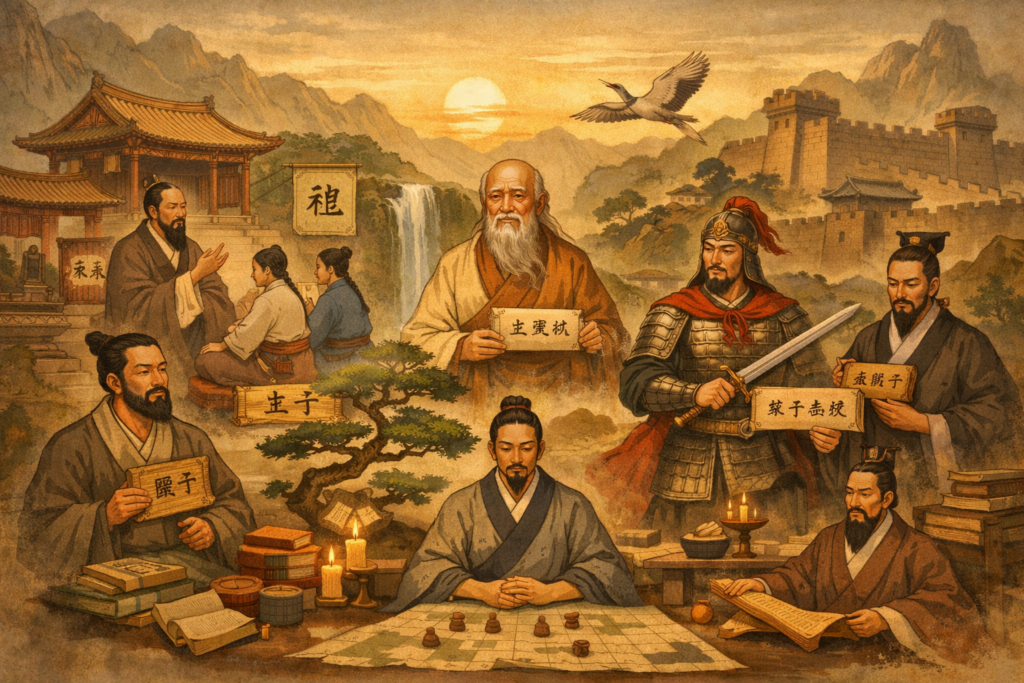
Chinese Thought: Harmony, Cultivation, and the Order of Human Life
Chinese thought examines the major philosophical traditions that shaped conceptions of self-cultivation, harmony, governance, ritual order, moral formation, and the relationship between human life and the larger cosmos. This field is not merely a study of Confucianism, Daoism, Mohism, and Legalism in isolation, but a broad civilizational inquiry into how persons, families, states, and the world itself should be brought into fitting relation. At its core lies a defining philosophical question: how should human life be cultivated and ordered under heaven? This content pillar explores Confucius, Mencius, Xunzi, Laozi, Zhuangzi, Mozi, Han Feizi, Sunzi, the Yijing, Chinese Buddhism, Neo-Confucianism, qi, li, yin-yang, the Five Phases, ritual, law, empire, moral psychology, and the metaphysics of change, showing why Chinese thought remains one of the world’s deepest traditions for understanding ethics, governance, cosmology, and the disciplined art of living well.