
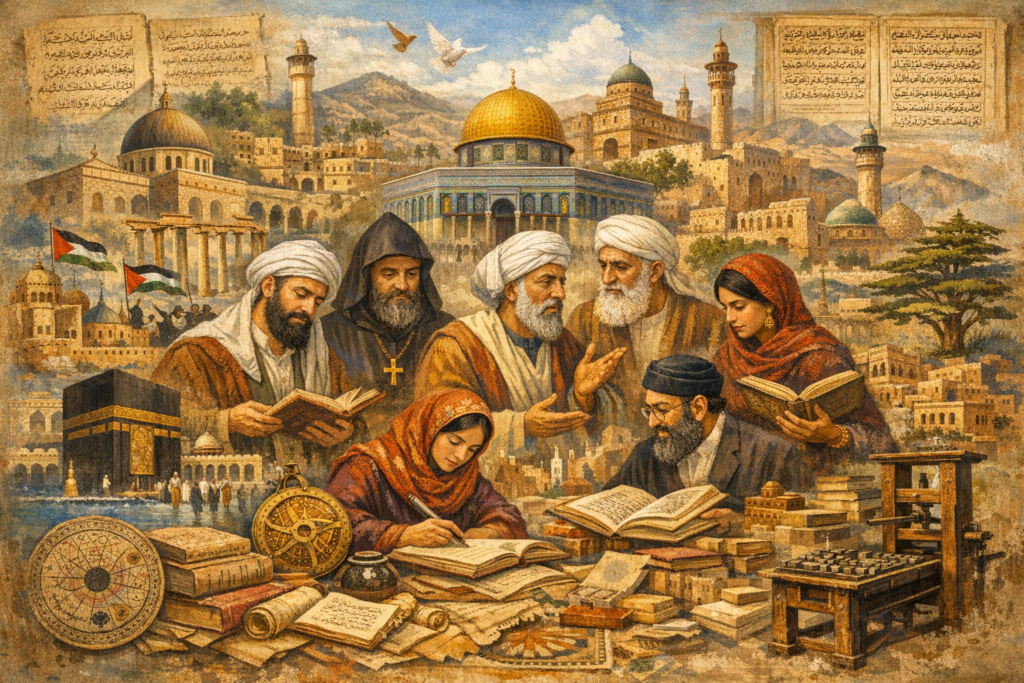
Arabian and Levantine Thought: Revelation, Language, Memory, and Renewal
Arabian and Levantine thought preserves one of the world’s great intellectual traditions: a vast and internally diverse field in which revelation, grammar, law, theology, poetry, philosophy, reform, memory, and exile have shaped reflection across the Arabian Peninsula, the Levant, and Iraq. From pre-Islamic poetry and Qur’anic revelation to Arabic grammar, jurisprudence, kalām, adab, Christian and Jewish Arabic thought, Nahda reformism, Palestinian intellectual life, Lebanese and Syrian public culture, Iraqi philosophical and literary worlds, Yemeni scholarship, and Omani Ibāḍī traditions, this article explores how language, faith, historical vulnerability, and the struggle for dignity formed a dense and enduring civilizational web. By treating Palestine, Lebanon, Syria, Iraq, Yemen, Oman, the Hijaz, and Najd as constitutive rather than peripheral, it presents the Arab East as a polycentric zone of thought in which scripture, literary form, political conflict, and cultural renewal remain inseparably linked.