Natural Science

Natural Science examines the physical and living world through the systematic study of matter, energy, life, Earth systems, and the broader universe. It seeks to explain the structures, processes, laws, and transformations that govern the natural order, from the smallest physical interactions to the largest planetary and cosmic systems.

This field brings together disciplines that investigate how nature is organized, how change occurs, and how physical and biological systems develop across time and scale. It includes the study of material composition, chemical transformation, living organisms, planetary processes, celestial phenomena, and the environmental conditions that sustain or constrain life.

Natural Science plays a foundational role in human knowledge because it provides disciplined methods for understanding reality beyond opinion, intuition, or custom. By clarifying how the natural world functions, it shapes scientific reasoning, technological development, environmental awareness, and humanity’s broader understanding of life, matter, and the universe.

Editorial illustration of quantum fields, particles, and the Standard Model featuring abstract field excitations, particle-collision imagery, detector geometry, symmetry-inspired structures, and computational analysis displays.

Quantum Fields, Particles, and the Standard Model

Quantum field theory redefines the particle world by treating electrons, quarks, photons, gluons, W and Z bosons, and the Higgs boson not as isolated miniature objects moving through empty space, but as excitations of underlying quantum fields structured by symmetry, relativity, and interaction. This article explains why quantum field theory became necessary once particle creation, annihilation, and relativistic dynamics had to be described consistently, and shows how the Standard Model organizes matter fields, gauge bosons, and electroweak symmetry breaking into the most successful framework in modern high-energy physics. It also explores gauge invariance, quark and lepton generations, the role of the Higgs field in mass generation, the importance of renormalization and running couplings, and the extraordinary experimental success of collider-based Standard Model tests, while also clarifying the major open questions the theory still leaves unresolved.
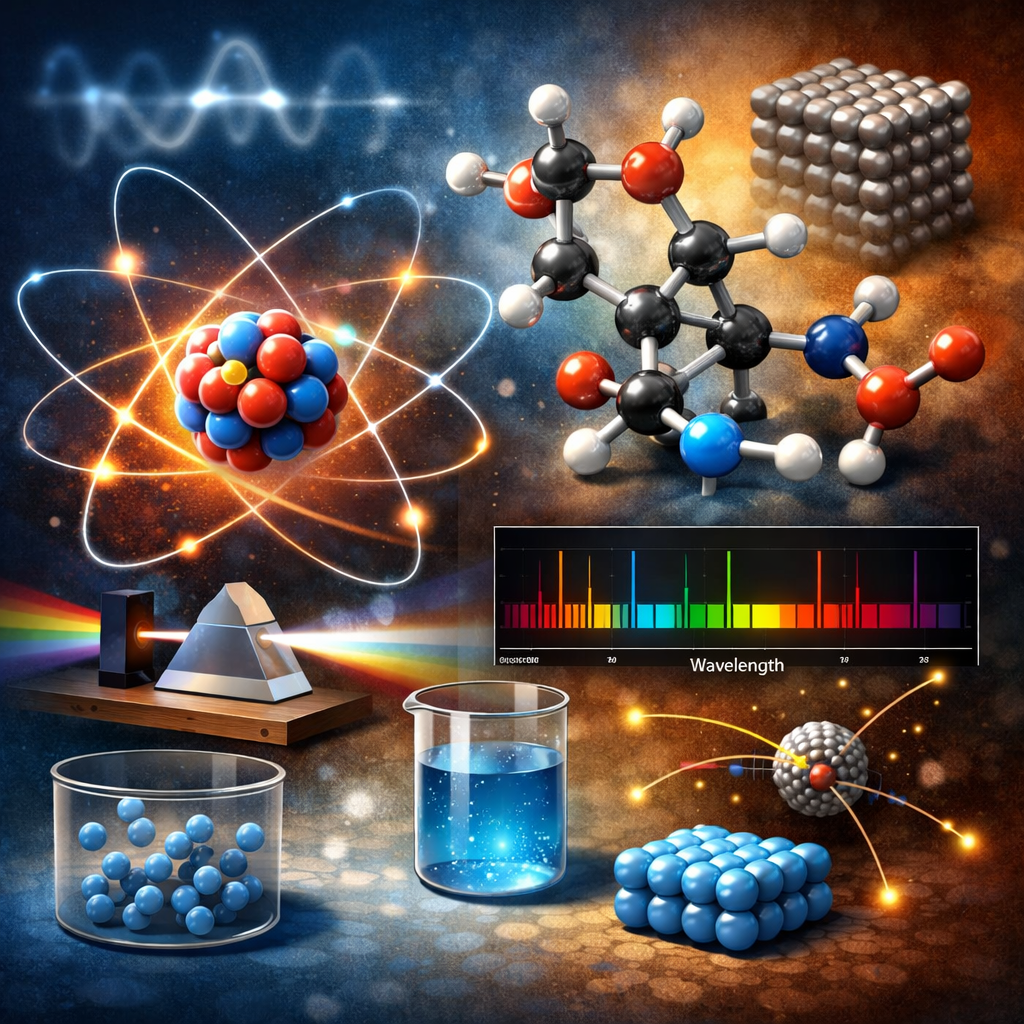

Editorial illustration of atoms, molecules, and the structure of matter featuring an atomic nucleus, molecular models, a crystal lattice, spectral analysis, light dispersion, and laboratory vessels.

Atoms, Molecules, and the Structure of Matter

Atoms, molecules, and the structure of matter explain how the visible diversity of the material world emerges from discrete microscopic organization. This article traces the development of atomic and molecular theory from Dalton, Avogadro, Rutherford, Bohr, and Schrödinger to the modern quantum view of matter. It shows how atoms are structured through nuclei and electron states, how molecules form through energy-lowering bonds, and how spectra, geometry, polarity, and collective organization reveal the architecture of physical substance. The article also connects atomic and molecular structure to measurement, spectroscopy, quantum mechanics, materials science, and computational modeling, showing how equations such as E=hν, E=hc/λ, and
H
^
ψ=Eψ help translate microscopic structure into observable physical behavior.

Editorial illustration of quantum mechanics featuring probability-wave structures, atomic-scale abstraction, interference patterns, and computational modeling

Quantum Mechanics and the Limits of Classical Intuition

Quantum Mechanics and the Limits of Classical Intuition examines one of the decisive conceptual ruptures in physics: the breakdown of classical assumptions about trajectory, determinism, simultaneity of observable properties, and measurement-independent description at microscopic scale. This article explores Planck’s radiation law, Einstein’s light quanta, de Broglie’s matter waves, Heisenberg’s matrix-mechanical break with classical visualization, Schrödinger’s wave mechanics, and Born’s probabilistic interpretation through a research-grade treatment grounded in primary and authoritative sources. It also develops the mathematics of wavefunctions, operators, superposition, uncertainty, and eigenvalue structure, while presenting R and Python as complementary tools for visualizing probability densities, computing quantum states, and exploring the formal logic of microscopic physics.

Editorial illustration of curved spacetime featuring a black hole, orbiting body, gravitational-wave-like ripples, and computational modeling with no internal text

Gravity, Curvature, and the Structure of Spacetime

Gravity, Curvature, and the Structure of Spacetime examines one of the deepest reconstructions in physics: the replacement of Newtonian gravity as a force with a geometric theory in which matter and energy shape the curvature of spacetime itself. This article explores Einstein’s 1916 foundation of general relativity, the equivalence principle, metric structure, geodesic motion, Einstein’s field equations, Schwarzschild geometry, gravitational time dilation, black holes, and gravitational waves through a research-grade treatment grounded in primary and official sources. It also presents R and Python as complementary tools for modern inquiry, with R supporting comparative visualization and parameter-based analysis, and Python supporting spacetime modeling, relativistic simulation, and computational exploration of gravitational geometry.

Editorial illustration of relativity featuring spacetime geometry, light paths, moving frames, and computational modeling with no internal text

Relativity and the Reconstruction of Space and Time

Relativity and the Reconstruction of Space and Time examines one of the decisive conceptual revolutions in physics: the replacement of absolute space and universal time with a frame-dependent but mathematically invariant spacetime structure. This article explores Einstein’s 1905 reconstruction of moving-body kinematics, Minkowski’s spacetime formulation, Lorentz transformation, the relativity of simultaneity, time dilation, length contraction, invariant interval, and relativistic energy-momentum relations through a research-grade treatment grounded in primary and official sources. It also presents R and Python as complementary tools for modern inquiry, with R supporting comparative visualization and measured-effect analysis, and Python supporting symbolic transformation, spacetime diagrams, and computational relativistic modeling.

Editorial illustration of light, waves, and radiation featuring a double-slit setup, spectral color spread, optical instruments, and computational modeling with no internal text

Light, Waves, and the Physics of Radiation

Light, waves, and radiation reveal one of the deepest unifying structures in physics by linking optical phenomena, wave propagation, electromagnetic fields, the spectrum, and thermal emission within a single research-grade framework. This article examines Huygens’s wave principle, Young’s interference argument, Maxwell’s electromagnetic unification, Hertz’s experimental confirmation of electromagnetic waves, and Planck’s blackbody radiation law, while developing the mathematics of wavelength, frequency, interference, diffraction, wave equations, and spectral distribution. It also presents R and Python as complementary tools for modern inquiry, with R supporting spectral visualization and comparative radiation analysis, and Python supporting interference simulation, symbolic wave relations, and computational radiation modeling.

Editorial illustration of electromagnetism featuring electric and magnetic field motion, induction, laboratory instrumentation, and computational modeling with no internal text

Electromagnetism and the Unification of Fields

Electromagnetism is one of physics’ great acts of unification, bringing electric charge, magnetic action, current, induction, radiation, and light into a single field-based theory. This article traces the development from Faraday’s experimental work on induction and lines of force to Maxwell’s mathematical synthesis of electric and magnetic fields. It explains how electromagnetism shifted physics away from isolated force interactions toward distributed fields capable of storing energy, transmitting momentum, and propagating as waves. The article also examines electric potential, Gauss’s law, the Lorentz force, Faraday induction, Maxwell’s equations, the Poynting vector, material response, electromagnetic units, and modern standards. Computational examples in R and Python show how field strength, potential, magnetic scaling, and field superposition can be modeled, while the linked GitHub repository extends the article with advanced reproducible electromagnetic workflows.

Editorial illustration of statistical physics featuring particle distributions, probability curves, emergent landscape forms, equilibrium balance, and computational modeling

Statistical Physics and the Emergence of Macroscopic Order

Statistical physics explains how macroscopic order emerges from microscopic complexity through probability, multiplicity, averaging, and typicality. This article examines the bridge between thermodynamics and many-particle behavior, showing how temperature, entropy, equilibrium, heat capacity, and phase behavior arise from large populations of microscopic states. It traces the foundational turn from Boltzmann’s statistical interpretation of entropy to Gibbs’s ensemble framework, then develops microstates, macrostates, partition functions, fluctuation-response relations, Brownian motion, phase transitions, order parameters, and the statistical arrow of time. Selected R and Python workflows model two-state systems, exact macrostate distributions, partition functions, Monte Carlo sampling, and fluctuation scaling, while the linked GitHub repository expands the article with advanced reproducible computational scaffolding for statistical-physics workflows.

Editorial illustration of thermodynamics featuring a heated piston-cylinder system, thermal instrumentation, process curves, and computational modeling with no internal text

Thermodynamics and the Physics of Heat

Thermodynamics explains how heat, temperature, energy transfer, entropy, and equilibrium govern macroscopic physical systems. This article traces the field from Carnot’s analysis of heat engines to Clausius’s formulation of entropy and Kelvin’s absolute temperature scale, showing how thermodynamics became both an engineering science and a foundational theory of physical transformation. It examines heat and work, state variables, equilibrium, the four laws of thermodynamics, irreversibility, enthalpy, Helmholtz and Gibbs free energy, response functions, equations of state, reversible cycles, and Carnot efficiency. Selected R and Python workflows model ideal-gas expansion, entropy accounting, process paths, work, heat, and internal energy, while the linked GitHub repository extends the article with advanced reproducible computational scaffolding for thermodynamics workflows.

Scroll to Top