
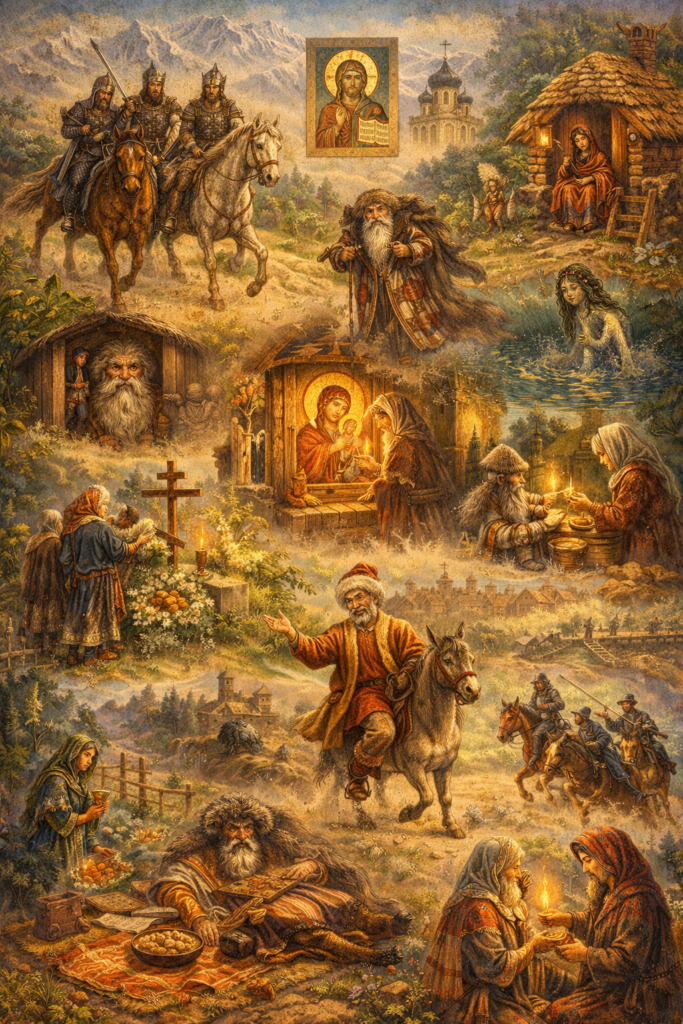
Russian Myth, Epic, and Folklore: Nature, Sanctity, Suffering, and Moral Imagination
Russian myth, epic, and folklore preserve one of Europe’s most layered narrative worlds: a world of forests, rivers, saints, spirits, heroes, witches, domestic rites, village memory, and the returning dead, all held within a shared symbolic order. Rather than surviving as a single canonical mythology, these traditions endure through pre-Christian East Slavic belief, heroic oral epic, fairy tale, vernacular demonology, folk Christianity, monastic legend, women’s ritual song, seasonal custom, and later literary and artistic reworkings of folkloric form. Here, nature is never inert, suffering is rarely meaningless, and the boundary between visible and invisible life remains morally charged. This article approaches Russian myth, epic, and folklore as a civilizational archive rather than a loose body of old tales. It traces the interplay of pagan inheritance and Christian transformation; the world of the bogatyrs and the byliny; the supernatural ecology of household and wilderness spirits; the symbolic force of Baba Yaga and other wonder-tale figures; the role of saints, icons, pilgrimage, and holy fools; and the ritual year of Maslenitsa and Ivan Kupala.