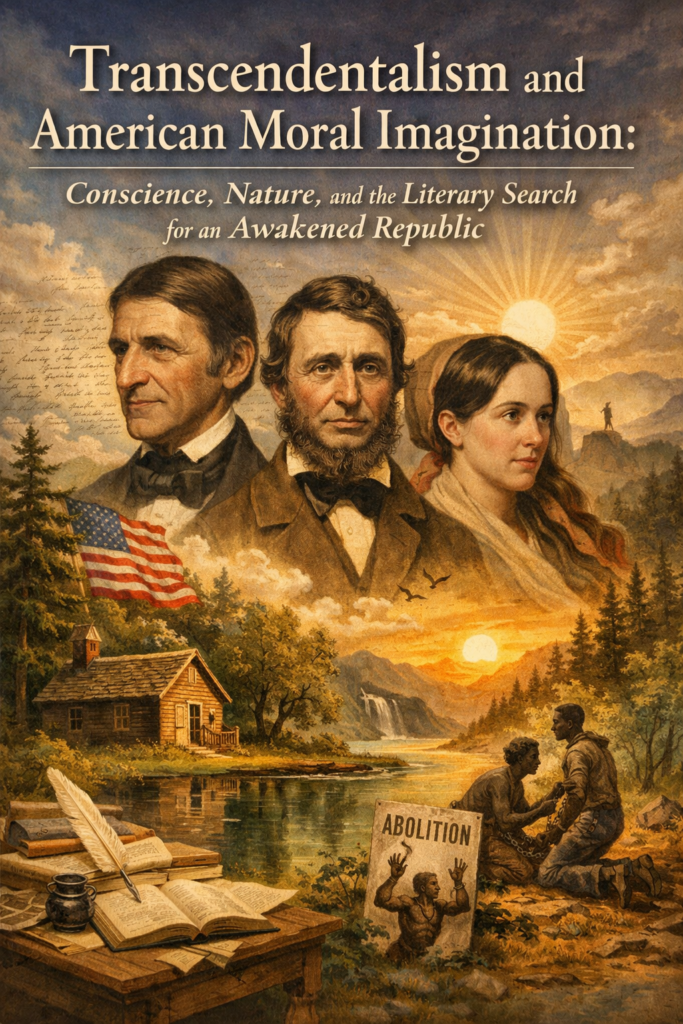
Transcendentalism and American Moral Imagination
Transcendentalism and American Moral Imagination explores the literary and philosophical movement through which nineteenth-century American writers reimagined selfhood, conscience, nature, spiritual authority, democratic possibility, and the ethical responsibilities of individual life. Emerging in response to inherited religious forms, social conformity, market expansion, and the unsettled moral energies of a rapidly changing republic, Transcendentalism treated literature not merely as expression, but as a means of awakening perception, enlarging moral vision, and recovering a deeper relation between the human person, the natural world, and the demands of truth. In this tradition, literary thought became inseparable from questions of inward freedom, civic responsibility, reform, and the search for a more just and spiritually serious society.
This category examines the writings, ideas, and cultural afterlives of Transcendentalism through essays, journals, lectures, poetry, and reflective prose, considering how figures associated with the movement helped shape an American language of moral striving, dissent, spiritual independence, and reverence for nature. It explores the movement’s engagement with self-culture, abolition, education, nonconformity, friendship, solitude, civil disobedience, and the relation between inner life and public obligation. It also considers how Transcendentalism drew from European Romanticism, Protestant inheritance, classical thought, and Asian religious and philosophical traditions while developing a distinctly American form of literary idealism.
Transcendentalism and American Moral Imagination is central to understanding one of the deepest currents in American intellectual and literary history. It studies how literature became a vehicle for ethical seriousness, democratic hope, critique of materialism, and the effort to align inward conviction with social life. By linking literary expression to spirituality, reform, ecology, selfhood, and the unfinished moral project of American culture, this category illuminates a tradition whose influence extends far beyond its moment into later environmental thought, civil resistance, educational ideals, and the enduring question of what a morally awakened society might require.