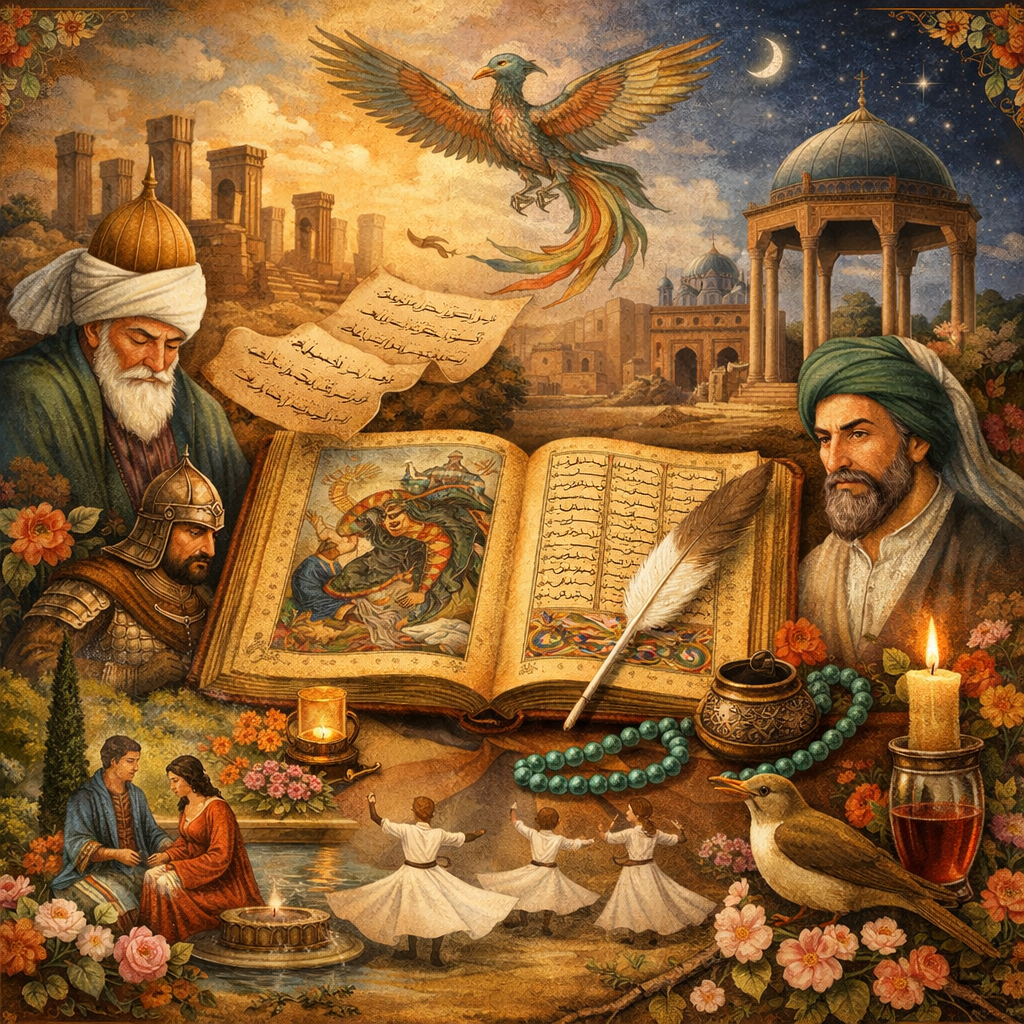
Persian Poetry and Cultural Memory
Persian Poetry and Cultural Memory explores one of the world’s great literary traditions as a long civilizational archive of love, kingship, wisdom, loss, spiritual longing, ethical reflection, and historical remembrance. Persian poetry has served for centuries as a medium through which communities across Iran, Central Asia, South Asia, and the wider Persianate world preserved cultural memory, shaped refined forms of expression, and articulated visions of moral and metaphysical order. From epic and panegyric to lyric, mystical, didactic, and courtly verse, Persian literature has carried forward an enduring world of symbols through which beauty, grief, transcendence, and historical consciousness have been imagined.
This category examines Persian poetry not only as literary achievement, but also as a carrier of memory across dynasties, empires, languages, and sacred traditions. It considers the role of epic in preserving political and mytho-historical identity, the ghazal as a vehicle of emotional and spiritual intensity, and the masnavi and didactic poem as forms for ethical instruction, reflection, and cosmological vision. It also explores the transmission of Persian literary culture through manuscript traditions, patronage, performance, education, translation, and the wider Persianate ecumene, where Persian became a language of refinement, governance, and cultural prestige.
Persian Poetry and Cultural Memory is therefore a study of literature as both inheritance and renewal. It traces how poetic language preserves the memory of courts, landscapes, saints, lovers, rulers, and vanished worlds, while also allowing each generation to reinterpret that inheritance under new historical conditions. By bringing Persian literary forms into relation with political order, Sufism, philosophy, historiography, and the afterlives of empire, this category helps illuminate how poetry becomes one of the deepest instruments of cultural continuity.