Literature & Cultural Memory

Literature & Cultural Memory examines how literary traditions preserve, transmit, reinterpret, and contest the memories through which cultures understand themselves across time. In the history of civilization, literature has never been only a matter of aesthetic expression. Epics, poems, dramas, chronicles, devotional writings, novels, memoirs, oral narratives, and reflective prose have served as vessels of memory through which communities have carried forward their stories of origin, loss, justice, belonging, exile, love, catastrophe, and renewal. Literature therefore belongs not only to the history of art, but also to the history of cultural continuity, moral imagination, and collective self-understanding.

This category explores the ways literary forms hold together worlds of memory that might otherwise be fractured by war, conquest, migration, colonization, religious change, political rupture, or linguistic decline. It considers how texts preserve the symbolic order of a civilization, how they encode ethical and emotional inheritance, and how they allow later generations to revisit unresolved questions of power, identity, sacred order, grief, historical trauma, and communal meaning. Literature may stabilize memory, but it may also resist official narratives, recover silenced voices, and expose the tensions between inherited tradition and lived experience.

Literature & Cultural Memory is therefore concerned with literary traditions as living archives of civilization. It treats literature as a medium through which societies remember themselves, reimagine their pasts, and struggle over the meanings that bind generations together. By bringing literary expression into relation with history, religion, language, law, ethics, myth, and social life, this category helps clarify how collective memory is formed, preserved, contested, and transformed through the written and spoken imagination.

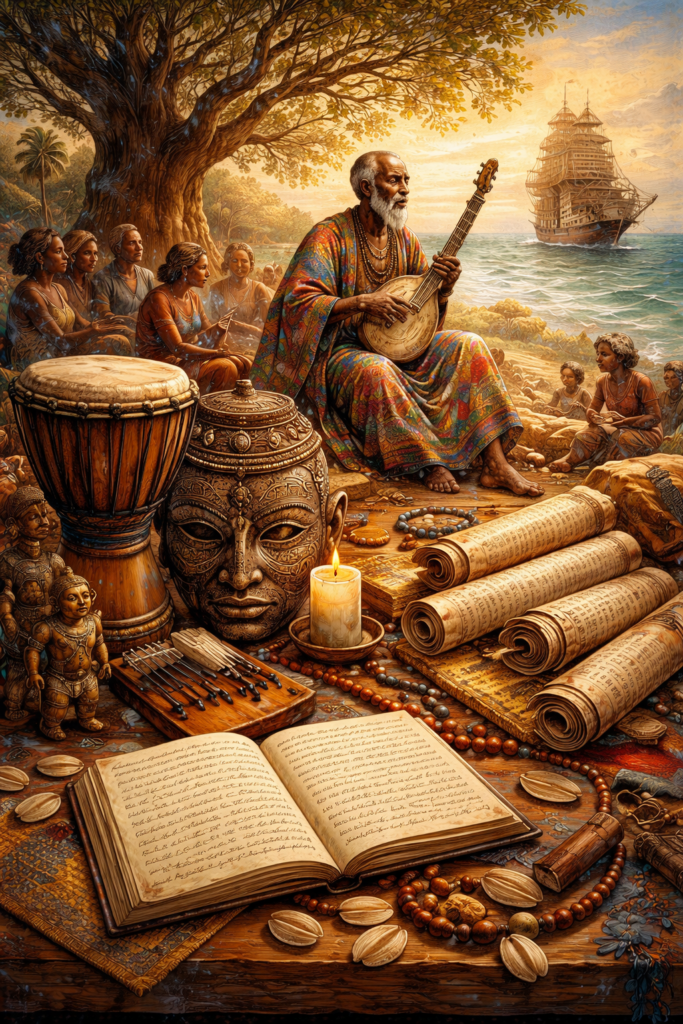
Editorial illustration of African and diasporic literature and cultural memory featuring oral performance, manuscripts, drums, ancestral objects, oceanic passage, and layered symbols of memory and survival

African and Diasporic Literature and Cultural Memory: Memory, Resistance, and Liberation

African and diasporic literature preserves one of the world’s most powerful archives of memory under conditions of rupture. Across oral traditions, praise poetry, epics, slave narratives, anti-colonial writing, postcolonial fiction, African American literature, Caribbean poetics, testimony, music-inflected forms, and spiritual expression, African societies and dispersed African-descended communities have carried forward ancestral relation, collective trauma, resistance, dignity, and the search for renewal across enslavement, colonial domination, racial violence, migration, and dispossession. From oral epic and sacred memory to Richard Wright, Ralph Ellison, James Baldwin, Toni Morrison, Black Atlantic thought, and liberation poetics, this article approaches literature as a transregional archive in which memory survives through voice, form, performance, witness, and the enduring struggle to narrate a people’s humanity against erasure.
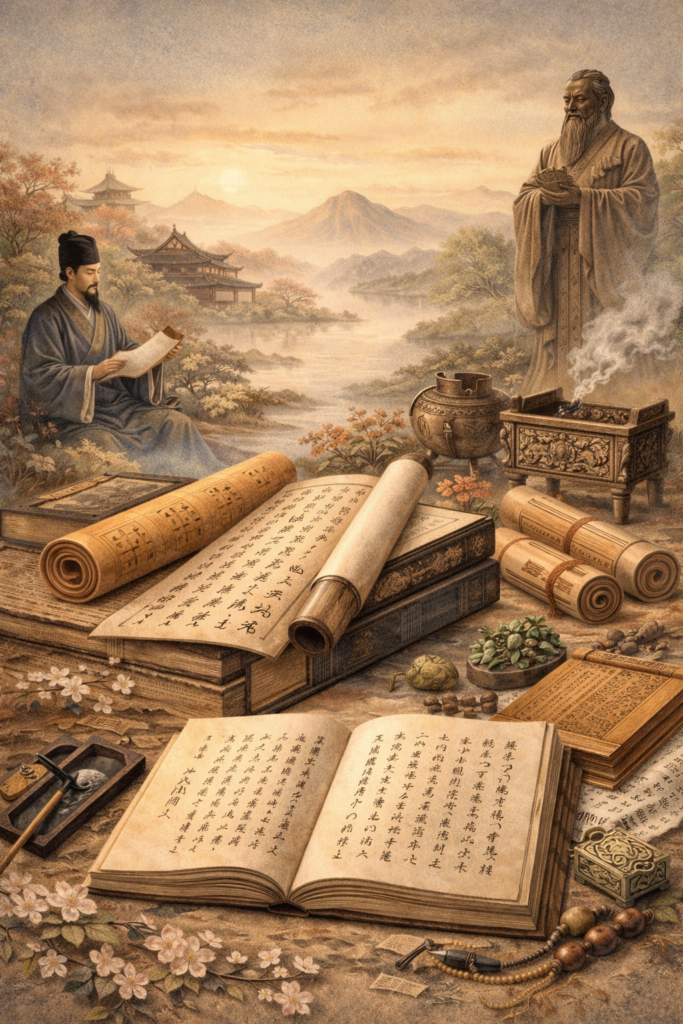
Editorial illustration of Chinese literature and classical memory featuring manuscripts, brush calligraphy, scholar’s objects, scrolls, landscape distance, and symbols of literati culture

Chinese Literature and Classical Memory: Poetry, History, Canon, and Civilizational Form

Chinese literature preserves one of the world’s deepest archives of classical memory. Across poetry, historiography, philosophical prose, regulated verse, ci lyric, literati essay, drama, fiction, women’s writing, and commentary traditions, Chinese literary culture has carried forward moral order, dynastic remembrance, cultivated feeling, political judgment, and the continuity of civilization across more than two millennia. From the Classic of Poetry, early philosophy, and historical prose to Tang poetry, Song literati culture, the great Ming–Qing novels, and the modern recasting of classical inheritance, this article approaches Chinese literature as a long civilizational archive in which memory survives through disciplined form, commentary, literary language, and renewal through return.

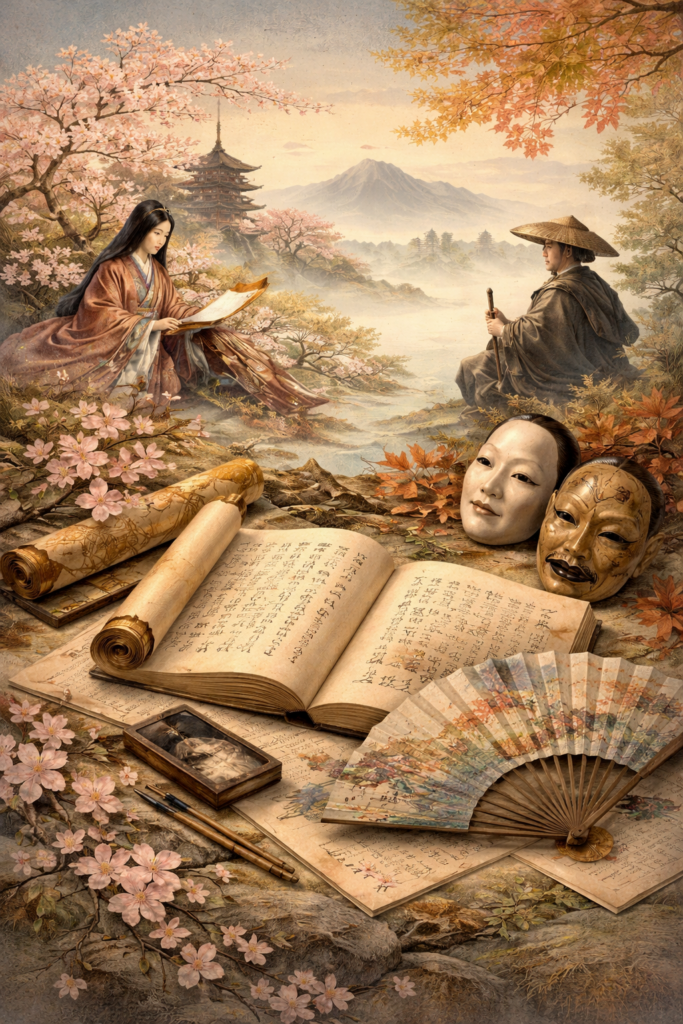
Editorial illustration of Japanese literature and poetic memory featuring manuscripts, seasonal landscapes, courtly and travel motifs, Noh masks, and layered literary symbols

Japanese Literature and Poetic Memory: Waka, Genji, Bashō, and Literary Memory

Japanese literature preserves one of the world’s most refined archives of poetic memory. Across waka, courtly narrative, diaries, war tales, travel writing, linked verse, Noh, urban prose, and modern fiction, Japanese literary culture has carried forward seasonal consciousness, impermanence, allusion, landscape memory, emotional restraint, and the subtle endurance of feeling through forms of extraordinary precision. From Heian poetry and The Tale of Genji to The Tale of the Heike, Bashō, Edo print culture, and the modern literary transformations of Sōseki, Tanizaki, Kawabata, Dazai, and Ōe, this article approaches Japanese literature as a civilizational archive in which memory survives through mood, rhythm, placement, and the quiet persistence of poetic form.

Editorial illustration of Russian literature and moral memory featuring candlelit books, manuscripts, winter cityscapes, and symbolic motifs of conscience, endurance, and historical reflection

Russian Literature and Philosophical Intensity: Freedom, Suffering, and the Human Soul

Russian literature preserves one of the world’s most morally serious literary traditions. Across novel, poetry, drama, memoir, religious prose, prison testimony, exile writing, and philosophical reflection, Russian authors have returned repeatedly to conscience, suffering, redemption, humiliation, spiritual crisis, censorship, and the historical burden of violence and upheaval. From Pushkin and Gogol to Tolstoy, Dostoevsky, Chekhov, Akhmatova, Pasternak, Shalamov, Solzhenitsyn, Grossman, and Brodsky, this article approaches Russian literature not simply as a national canon, but as a long civilizational archive of ethical memory in which inner life, moral responsibility, and historical pressure remain inseparable.

Editorial illustration of South Asian literature and sacred memory featuring manuscripts, temple and shrine architecture, sacred river landscapes, devotional objects, and layered literary traditions

South Asian Literature and Sacred Memory: Epic, Bhakti, Sufi, and Sacred Worlds

South Asian literature preserves one of the world’s richest archives of sacred memory. Across epic, devotional poetry, philosophical verse, classical drama, vernacular retelling, Sufi lyric, and modern writings shaped by empire and partition, the literary cultures of South Asia have carried forward gods, kingdoms, saints, teachers, pilgrims, lovers, and sacred landscapes across extraordinary spans of time. From the Ramayana and Mahabharata to Sanskrit kavya, Tamil devotional worlds, bhakti poetry, Persianate and Urdu literary culture, and the modern afterlives of colonialism and nationalism, this article approaches literature as a living medium of civilizational continuity, reinterpretation, and sacred inheritance.

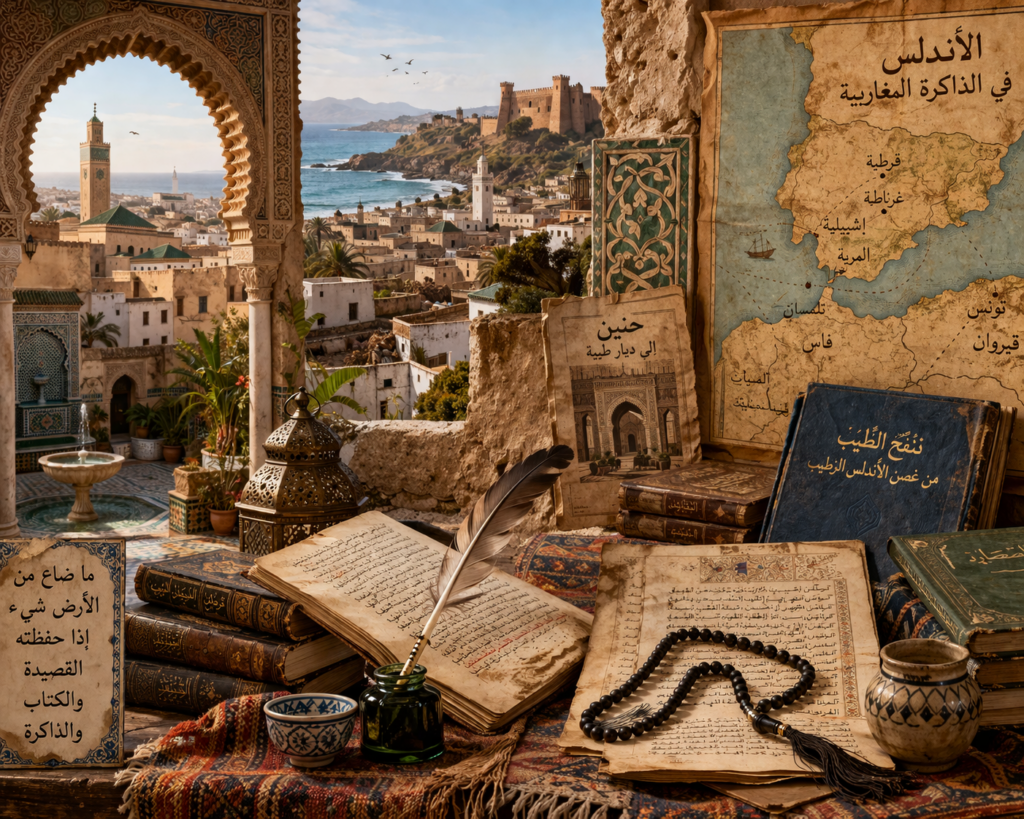
Editorial illustration of Maghrebi and Andalusi literature and cultural memory featuring coastal North African cityscapes, manuscripts, courtyards, Andalusi-Maghrebi architecture, and recollective Mediterranean motifs

Maghrebi and Andalusi Literature and Cultural Memory: Exile, Cities, and Literary Afterlife

Maghrebi and Andalusi literature preserves one of the most layered archives of place, devotion, refinement, exile, and historical remembrance in the wider Mediterranean world. Shaped by Amazigh, Arab, Islamic, Jewish, and Andalusi inheritances, these literary traditions carried forward memories of cities, courts, scholars, saints, gardens, songs, and homelands marked by both flourishing and rupture. From the lyric and courtly splendor of al-Andalus to the urban, devotional, and recollective traditions of North Africa, this article approaches literature as a home for worlds unsettled by conquest, migration, dynastic change, colonial violence, and post-imperial loss.

Editorial illustration of Arabic literature and adab featuring manuscripts, calligraphy, books, lamps, architectural forms, and cultivated literary motifs from the Arabic-speaking world

Arabic Literature and Adab: Poetry, Prose, Eloquence, and Cultivated Memory

Arabic literature preserves one of the world’s great traditions of eloquence, cultivated knowledge, ethical reflection, and literary memory. Through poetry, prose, belles-lettres, biography, travel writing, history, maqamat, and the expansive civilizational ideal of adab, Arabic-speaking societies shaped language into a medium of refinement, education, wit, moral intelligence, and public expression across centuries. From pre-Islamic qasida and Qur’anic rhetorical horizons to Abbasid prose, adab anthologies, court poetry, and the literary cultures of al-Andalus and the Maghrib, this article approaches Arabic literature not simply as a body of texts, but as a broader practice of forming persons, preserving memory, and organizing inherited knowledge through eloquence.

Editorial illustration of Persian poetry and cultural memory featuring illuminated manuscripts, calligraphy, garden imagery, courtly and mystical motifs, and Persianate architectural forms

Persian Poetry and Cultural Memory: Epic, Ghazal, Sufism, and the Persianate World

Persian poetry preserves one of the world’s great traditions of cultural memory. Across epic, court poetry, romance, mystical verse, ghazal, ethical writing, and elegy, Persian literary culture carried forward visions of kingship, justice, beauty, longing, exile, spiritual transformation, and historical endurance across centuries of upheaval and renewal. From the deep memory of ancient Iran to Ferdowsi’s Shahnameh, Nezami’s narrative romances, Attar’s spiritual allegories, Rumi’s metaphysics of love, Saadi’s ethical humanism, and Hafez’s lyric ambiguity, this article approaches Persian poetry as a vast archive through which a civilization remembered itself and transmitted its most enduring symbolic forms.

Editorial illustration of classical literature as civilizational memory, featuring ancient tablets, scrolls, books, and Greco-Roman architecture arranged across a luminous Mediterranean landscape

Classical Literature and Civilizational Memory: Epic, Tragedy, History, and Canon

Classical literature preserves the memory structures through which ancient civilizations narrated origins, war, law, grief, eros, empire, mortality, and the search for lasting name. From The Epic of Gilgamesh to Homer, Greek tragedy, Hellenistic scholarship, Roman epic, satire, historiography, and Suetonius’ The Twelve Caesars, the classical archive carried forward the symbolic forms by which societies understood power, virtue, catastrophe, and inheritance. This article approaches classical literature not simply as a canon of great works, but as a durable civilizational system of transmission shaped by performance, education, commentary, translation, and reinterpretation across centuries.

Scroll to Top