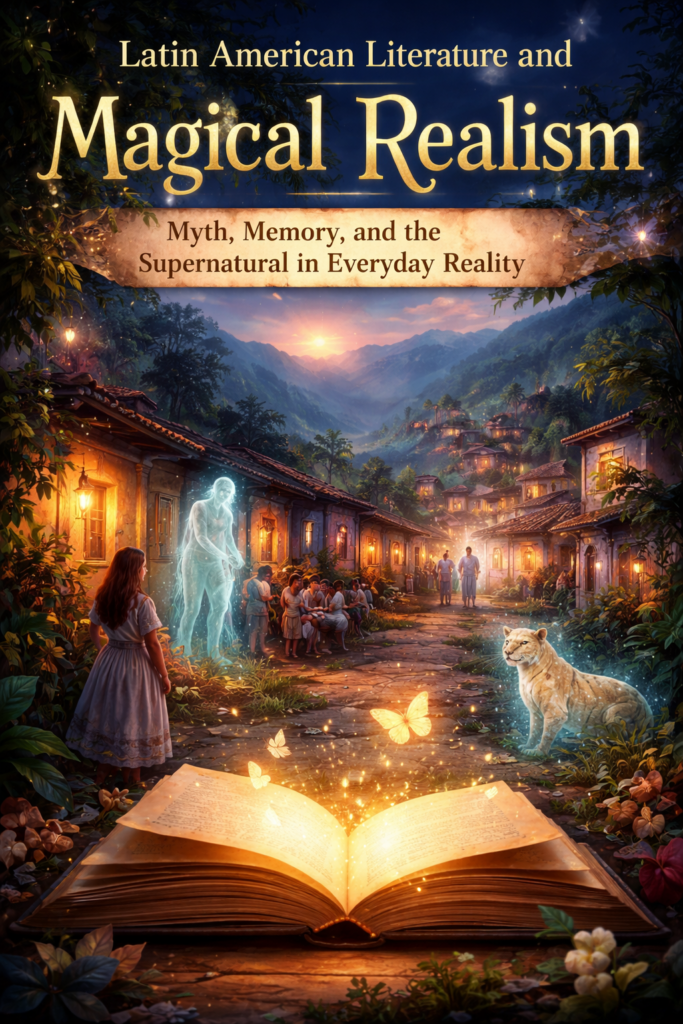
Latin American Literature and Magical Realism
Latin American Literature and Magical Realism explores the literary traditions through which the societies of Latin America have preserved conquest, empire, Indigenous survival, colonial hierarchy, slavery, revolution, dictatorship, memory, and cultural reinvention through forms in which the marvelous, the everyday, the ancestral, and the historical coexist. In this literary world, the extraordinary often does not appear as a rupture from reality, but as part of reality’s deeper structure: myth lives beside bureaucracy, ghosts inhabit family history, prophecy shadows politics, and landscapes carry memory older than the nation-state. Literature becomes a medium through which violence, wonder, syncretism, spiritual inheritance, and historical repetition can be narrated with unusual density and imaginative force.
This category examines Latin American literary forms across multiple regions, languages, and historical contexts, with particular attention to magical realism as one of the tradition’s most influential and recognizable modes. It includes the colonial and postcolonial archive, modernismo, regional and rural fiction, Indigenous and Afro-descendant literary traditions, the Boom and post-Boom, dictatorship novels, revolutionary writing, border literature, and works shaped by exile, disappearance, migration, and democratic recovery. It considers how magical realism and related narrative forms preserve layered historical consciousness; how they register conquest, racial mixture, land, memory, and political violence; and how writers have used myth, cyclical time, family saga, folklore, dream, and the supernatural not as escape from history, but as ways of revealing its buried structures. It also explores the relation between literary form and oral tradition, sacred worlds, ecological memory, state violence, and the unstable making of modern Latin American identity.
Latin American Literature and Magical Realism is essential for understanding literature as an archive of history, enchantment, survival, and political witness. It reveals how literary traditions can preserve the memory of conquest, dictatorship, revolution, and communal endurance while also refusing purely secular or documentary limits on reality. By linking literature to colonialism, slavery, Indigenous persistence, syncretism, mestizaje, authoritarianism, exile, liberation, and the marvelous as a mode of historical truth, this category helps illuminate how Latin American writing transformed the novel and reshaped global literary imagination through one of the most powerful narrative traditions of the modern world.