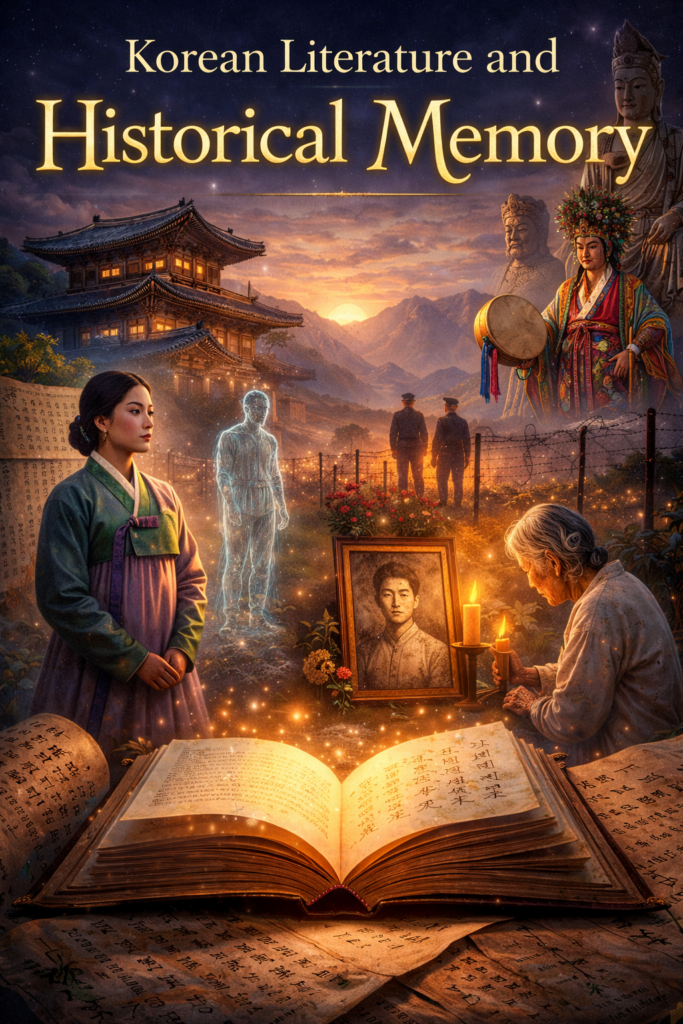
Korean Literature and Historical Memory
Korean Literature and Historical Memory explores the literary traditions through which Korea has preserved dynastic order, Confucian learning, Buddhist and shamanic worlds, invasion, colonization, war, division, collective grief, and the endurance of cultural form across repeated historical rupture. Across classical poetry, sijo, kasa, prose narrative, Buddhist writing, vernacular fiction, memoir, resistance literature, modern fiction, testimony, and diasporic writing, Korean literary culture has served as a powerful medium for preserving ethical reflection, social memory, historical sorrow, familial obligation, and visions of dignity under conditions of foreign domination, national division, authoritarian violence, and rapid transformation. These traditions carry memory not only of suffering, but also of refinement, intimacy, ritual continuity, resilience, and the persistent search for moral and communal renewal.
This category examines Korean literary forms across classical, modern, and contemporary periods, including courtly and vernacular poetry, Confucian and Buddhist writing, women’s literary voices, oral and pansori traditions, colonial-era literature, partition and war writing, dissident and democratic literature, diaspora, and works shaped by modernization, industrialization, migration, and the unresolved legacy of division. It considers how literature preserves cultural continuity across dynastic change, Japanese colonial rule, the Korean War, authoritarianism, and the fractured memory of North and South; how literary expression mediates between collective discipline and private feeling; and how writers have used form to register grief, endurance, longing, filial memory, national trauma, and the search for historical truth. It also explores the relation between literary language and script, oral performance and print, gender and family memory, and the continuing literary force of displacement, separation, and return.
Korean Literature and Historical Memory is essential for understanding literature as an instrument of endurance, moral witness, and historical recovery. It reveals how literary traditions can preserve civilizational inheritance while also bearing the weight of invasion, occupation, war, ideological fracture, and modern dislocation. By linking literature to Confucian order, Buddhist sensibility, colonial resistance, partition, dictatorship, democratization, diaspora, and intergenerational grief, this category helps illuminate how memory becomes both a burden and a source of strength in the making of Korean cultural identity.