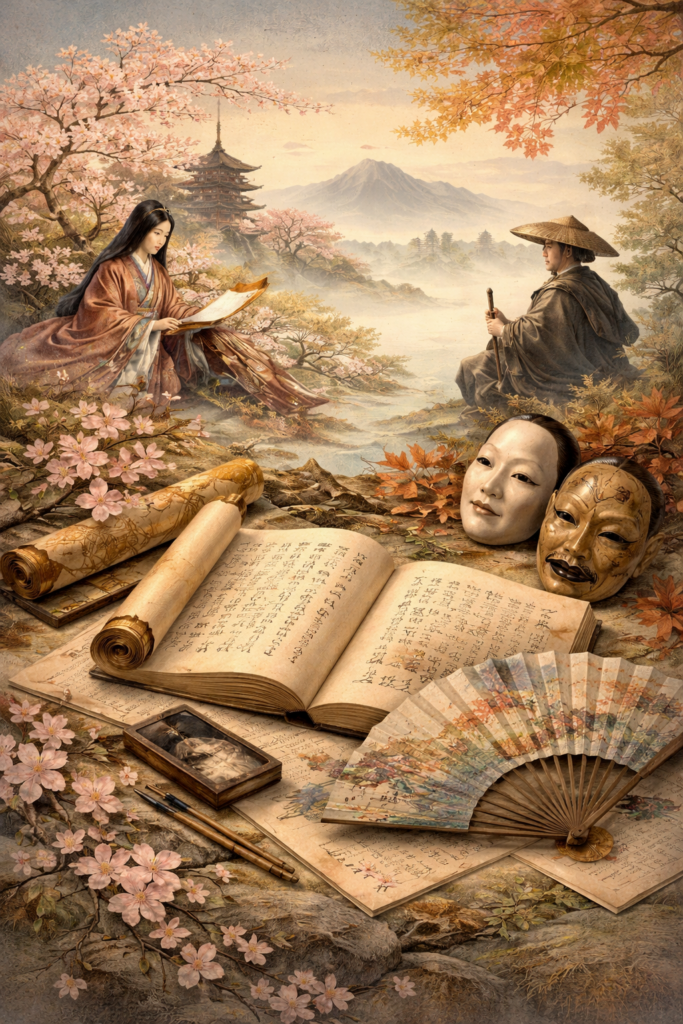
Japanese Literature and Poetic Memory
Japanese Literature and Poetic Memory explores the literary traditions through which Japan has preserved aesthetic sensitivity, seasonal consciousness, courtly refinement, impermanence, longing, and the memory of place, ritual, and social transformation. Japanese literature has often been marked by a distinctive interplay of emotional restraint and depth, formal precision and suggestive openness, where poetry, diaries, tale literature, theater, essays, and later fiction carry subtle forms of remembrance. Literary expression in this tradition frequently turns to transience, atmosphere, beauty, and the fragile endurance of human feeling as means of preserving cultural memory.
This category examines waka, haikai, prose narrative, court literature, war tales, Buddhist-inflected writing, travel diaries, theater, essay traditions, modern fiction, and literary responses to modernization, war, urban change, and historical rupture. It considers how Japanese literary forms preserve memory through image, seasonality, allusion, silence, and emotional compression, and how they mediate between aristocratic refinement, religious sensibility, vernacular life, and modern uncertainty. It also explores the role of literary tradition in preserving perceptions of nature, social relation, melancholy, loss, and the passage of time.
Japanese Literature and Poetic Memory is therefore concerned with literature as a subtle but enduring archive of feeling. It studies how language, form, and atmosphere carry forward cultural worlds that cannot be reduced to explicit doctrine or historical summary. By linking literary expression to court culture, Buddhism, performance, aesthetics, landscape, and modern transformation, this category illuminates how memory may be preserved not only through narrative continuity, but through rhythm, mood, and the quiet persistence of poetic form.