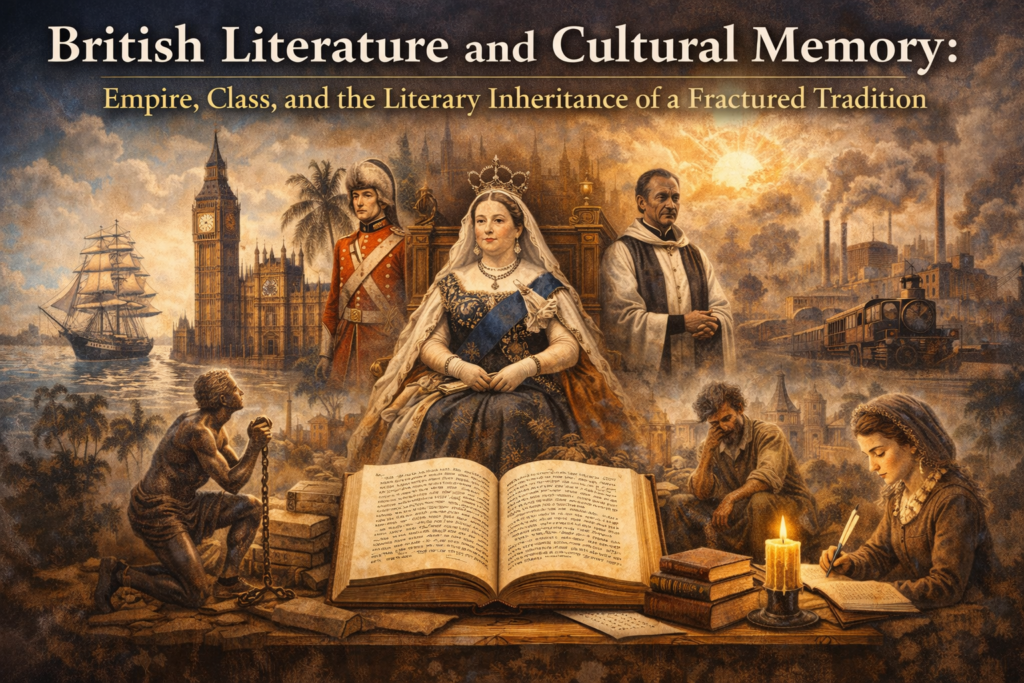
British Literature and Cultural Memory
British Literature and Cultural Memory explores the literary traditions through which Britain has remembered kingship, empire, class, faith, industrial transformation, domestic life, war, landscape, and the changing moral worlds of modernity. Across poetry, drama, the novel, essay, satire, life writing, and political prose, British literature has served as a major archive of cultural self-understanding, preserving both the continuity of inherited forms and the tensions produced by religious conflict, social inequality, imperial expansion, and historical change. It is a tradition in which literary form has often carried the memory of institutions, landscapes, customs, crises, and moral sensibilities that shaped British life across centuries.
This category examines British literary traditions from their early foundations through Romanticism, the Victorian period, modernism, and later transformations, considering how literature has mediated relations between nation and empire, metropolis and periphery, class order and social critique, public duty and private feeling. It explores how writers preserved and contested cultural memory through epic and ballad, lyric and essay, the realist novel and modernist experiment, and how literary works became sites for reflecting on industrialization, colonialism, gender, education, war, and the burdens of historical inheritance. It also considers the relationship between British literary culture and the institutions of canon formation, schooling, publishing, criticism, and public discourse.
British Literature and Cultural Memory is therefore concerned with literature as a record of both continuity and contradiction. It studies how British literary traditions have helped shape collective memory while also exposing the fractures within that memory: the silences of empire, the injuries of class, the ambiguities of moral authority, and the costs of national self-mythology. By linking literary expression to political history, religious life, social order, imperial power, and the evolution of cultural identity, this category illuminates one of the most globally consequential literary traditions in modern history.