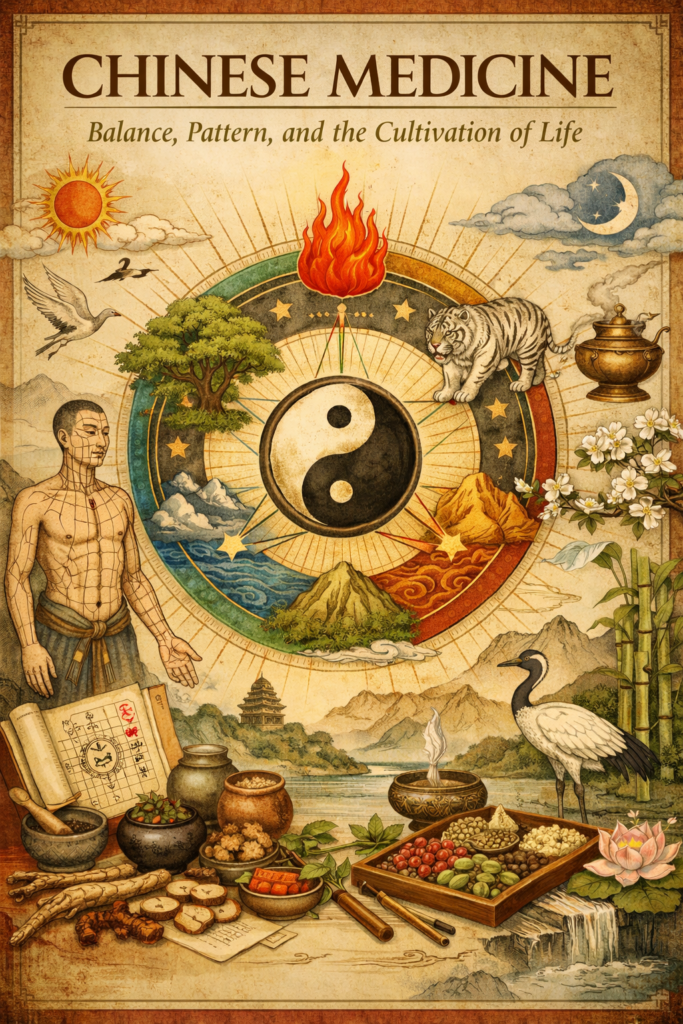
Chinese Medicine
Chinese Medicine examines a major healing tradition that developed through long historical reflection on balance, vitality, correspondence, and the relationship between human life and the larger patterns of nature. In the history of ideas, Chinese medicine offered an integrated approach to health grounded in theories of qi, yin and yang, the five phases, and the dynamic interdependence of bodily, emotional, environmental, and seasonal processes.
This category explores classical and later Chinese medical thought, including its approaches to diagnosis, prevention, circulation, nourishment, rhythm, and the maintenance of equilibrium within the body. It considers how health is understood as patterned harmony rather than isolated intervention, how disorder emerges through imbalance and disruption, and how healing involves attunement to process, relation, and change.
Chinese medicine plays an important role in comparative medical and philosophical inquiry because it presents a distinctive framework for understanding embodiment, health, and the ordering of life in relation to the cosmos. By engaging this tradition seriously, this category deepens understanding of balance, system, and cultivation, and broadens reflection on medicine as both practical art and civilizational worldview.
Chinese medicine examines a major healing tradition grounded in qi, yin and yang, the Five Phases, organ networks, seasonal change, and the patterned interpretation of health and disorder. From the Huangdi neijing and Nanjing to herbal formula traditions, acupuncture, moxibustion, pulse diagnosis, and preventive care, this category explores how Chinese medicine developed as an integrated medical-philosophical system of balance, regulation, correspondence, and cultivation.