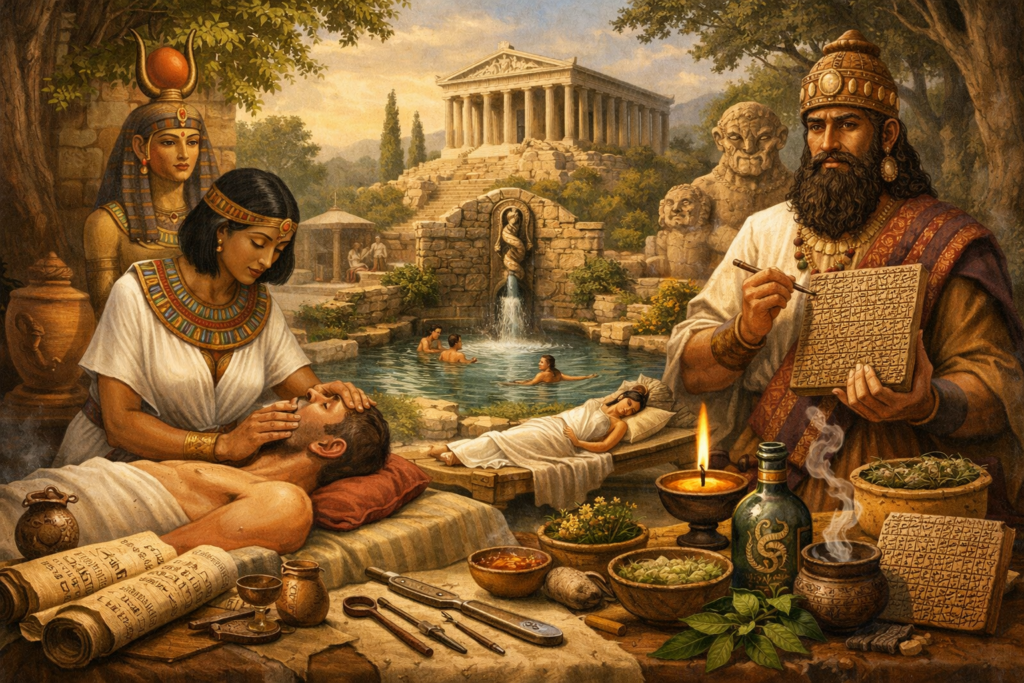
Ancient Near Eastern and Mediterranean Healing Traditions
Ancient Near Eastern and Mediterranean Healing Traditions examines the healing systems of the ancient Near East and Mediterranean through practices of diagnosis, ritual, remedy, bodily care, environmental awareness, and the interpretation of suffering within larger religious and natural orders. In the history of ideas, these traditions developed important approaches to illness, protection, restoration, and wellbeing through medical texts, temple healing, plant knowledge, incantation, surgery, and early empirical observation, often linking bodily disturbance to divine, cosmic, social, and ecological conditions.
This category explores Egyptian medicine, Mesopotamian healing, Levantine and eastern Mediterranean traditions, temple and sacred healing, early pharmacology, surgery, divination, protective ritual, and the relationship between medicine, religion, and civic life in the ancient world. It considers how ancient cultures understood the body as vulnerable to imbalance, injury, impurity, spiritual danger, and environmental stress, while also tracing the practical and intellectual traditions through which healers sought to restore order, relieve suffering, and preserve life.
Ancient Near Eastern and Mediterranean healing traditions play an important role in comparative inquiry because they reveal the deep civilizational background of medicine before and alongside Greek systematization. By engaging these traditions seriously, this category deepens understanding of ancient healing as a field of ritual, observation, remedy, and cosmological interpretation, while broadening reflection on the early human effort to care for the body within a larger order of nature, divinity, and communal life.