Author name: Tariq Ahmad

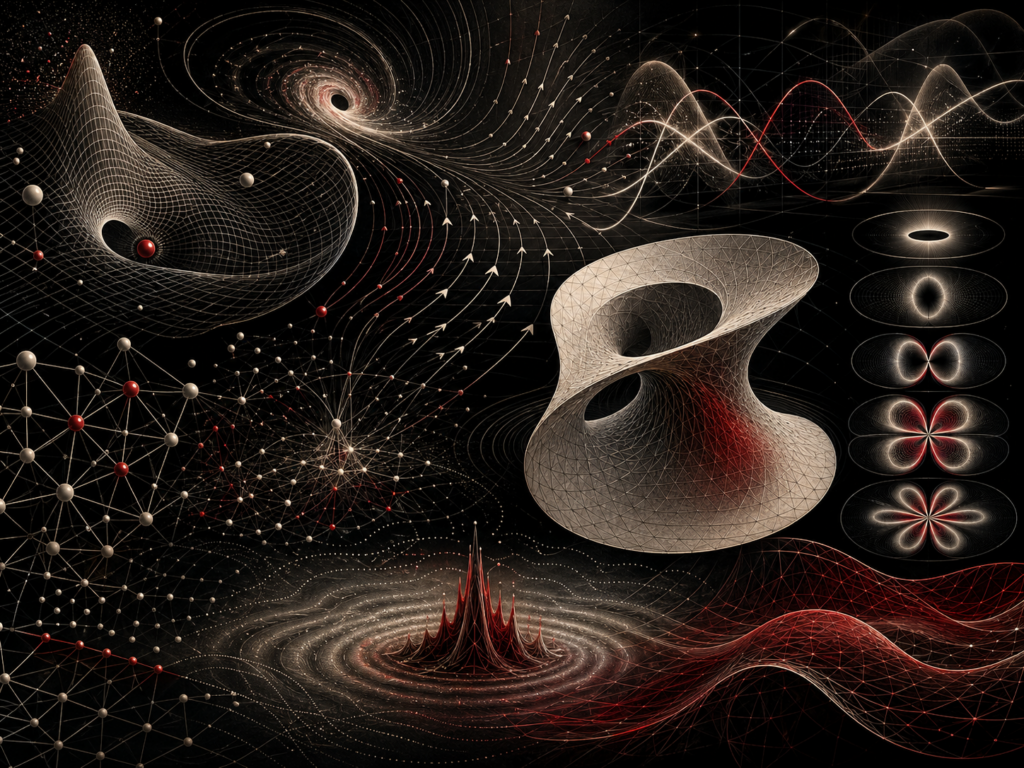
Editorial scientific illustration showing abstract mathematical structures, coordinate grids, vector-field arrows, waveforms, eigenmode patterns, tensor-like surfaces, and computational network forms.

Mathematical Methods in Physics

Mathematical methods in physics provide the language through which physical systems are described, modeled, solved, approximated, simulated, and interpreted. This article examines dimensional analysis, calculus, vector algebra, vector calculus, linear algebra, differential equations, boundary-value problems, Fourier analysis, complex numbers, tensors, probability, statistics, variational methods, numerical methods, computational workflows, and the role of mathematical modeling in physical reasoning. Selected R and Python workflows model uncertainty propagation, ODE integration, eigenvalue analysis, and Fourier spectra, while the linked GitHub repository expands the article with advanced computational scaffolding for reproducible mathematical-physics workflows.
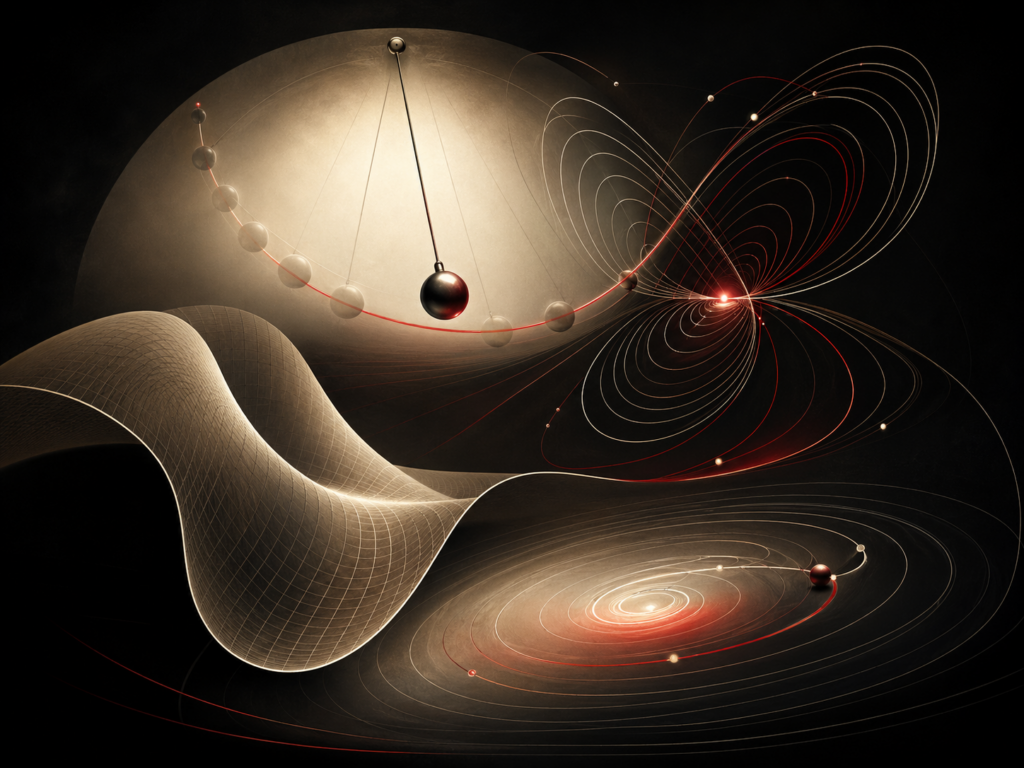
Editorial scientific illustration showing a pendulum trajectory, abstract phase-space curves, smooth geometric manifolds, orbit-like paths, and energy-surface contours.

Lagrangian and Hamiltonian Mechanics

Lagrangian and Hamiltonian mechanics reformulate classical physics around action, energy, constraints, symmetry, generalized coordinates, and phase space. This article examines generalized coordinates, degrees of freedom, constraints, the principle of stationary action, Euler–Lagrange equations, canonical momentum, cyclic coordinates, conservation laws, Hamiltonians, Hamilton’s equations, phase space, Poisson brackets, canonical transformations, symplectic structure, small oscillations, constrained systems, and computational integration. Selected R and Python workflows model pendulum phase-space energy, Hamiltonian dynamics, and symplectic Euler integration, while the linked GitHub repository expands the article with advanced computational scaffolding for reproducible analytical-mechanics workflows.

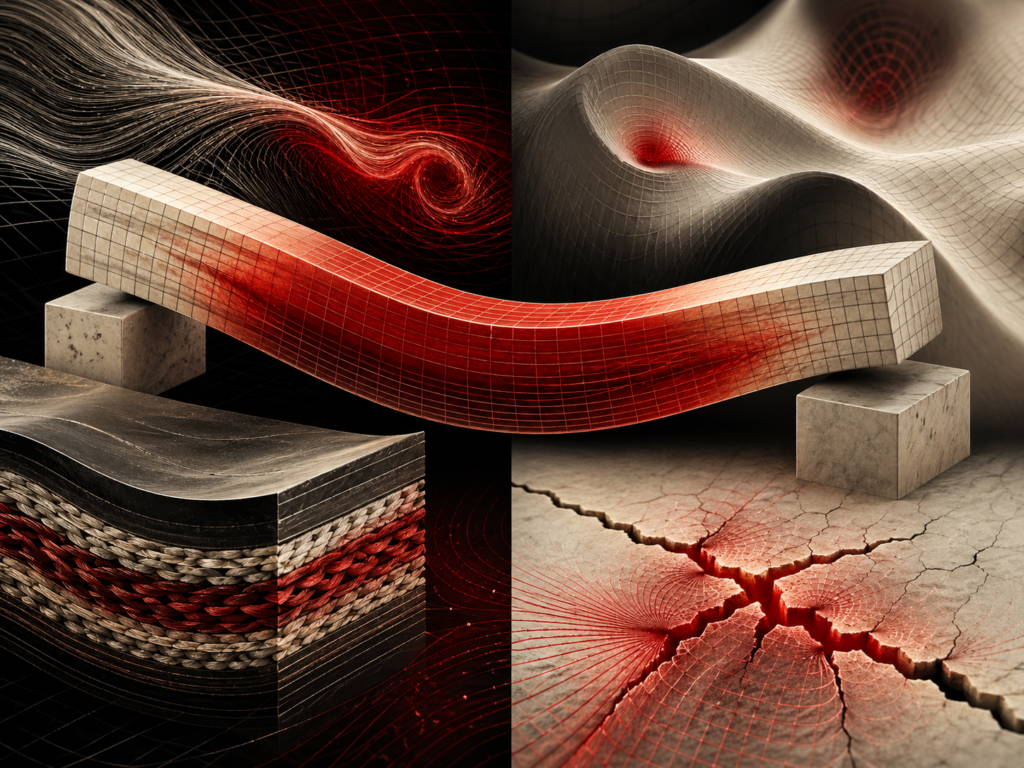
Editorial scientific illustration showing a bending beam under stress, layered composite material, abstract deforming surfaces, and a glowing crack pattern representing stress, strain, and material failure.

Continuum Physics and Material Behavior

Continuum physics and material behavior explain how extended matter deforms, carries load, stores elastic energy, flows slowly, yields, fractures, relaxes, and responds to force across space and time. This article examines the continuum hypothesis, displacement fields, deformation gradients, strain, stress, traction, equilibrium, momentum balance, constitutive laws, linear elasticity, isotropic material parameters, elastic energy, plastic deformation, yield criteria, viscoelasticity, fracture, fatigue, anisotropy, composites, multiphysics coupling, and computational material modeling. Selected R and Python workflows model stress–strain analysis, elastic modulus estimation, stress tensor diagnostics, principal stresses, and von Mises stress, while the linked GitHub repository expands the article with advanced computational scaffolding for reproducible continuum-mechanics workflows.

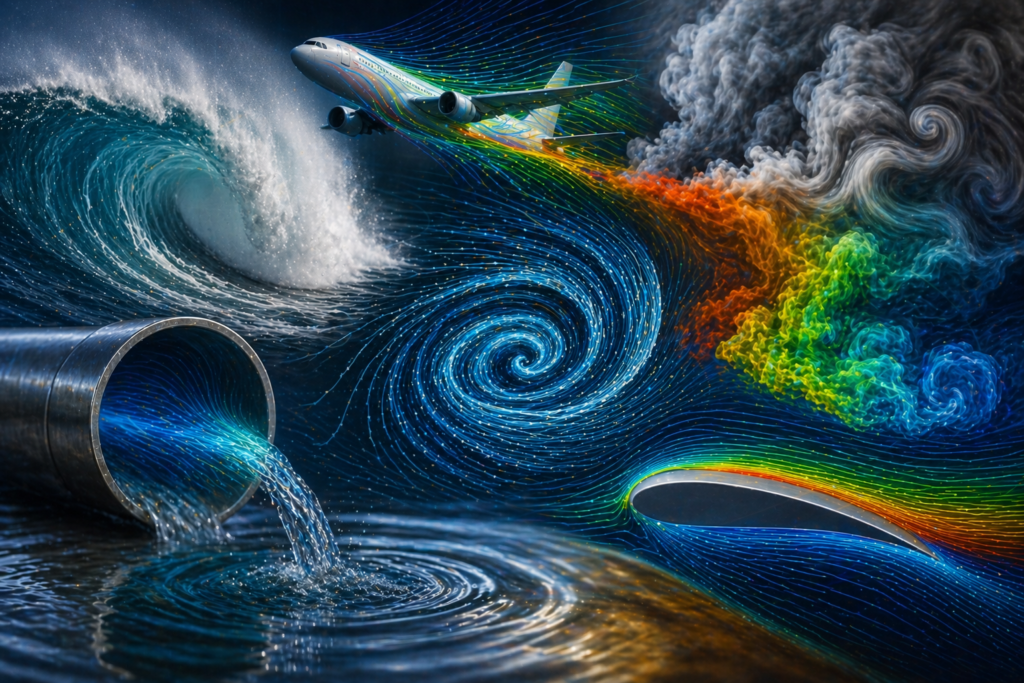
Cinematic scientific illustration showing ocean waves, pipe flow, aerodynamic streamlines, smoke vortices, and colorful flow-field patterns representing fluid dynamics and turbulence.

Fluid Dynamics and the Physics of Flow

Fluid dynamics studies how liquids and gases move, deform, transmit forces, transport momentum, generate pressure, form vortices, and transition to turbulence. This article examines fluids and continua, density, pressure, hydrostatics, velocity fields, the material derivative, conservation of mass, Bernoulli’s equation, viscosity, Newtonian fluids, momentum balance, Navier–Stokes equations, Reynolds number, laminar and turbulent flow, boundary layers, drag, lift, vorticity, circulation, dimensional analysis, environmental flow, biological flow, engineering flow, and computational fluid dynamics. Selected R and Python workflows model Reynolds-number classification and vorticity-field diagnostics, while the linked GitHub repository expands the article with advanced computational scaffolding for reproducible fluid-dynamics workflows.

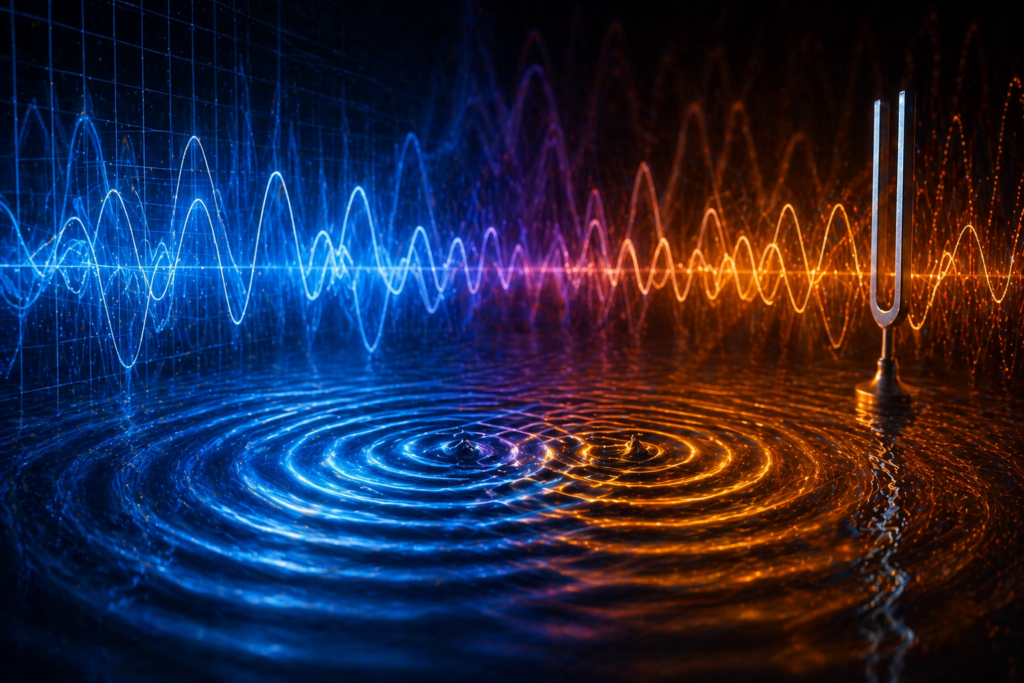
Abstract physics illustration showing glowing waveforms, circular water ripples, and a tuning fork to represent oscillations, resonance, interference, and wave propagation.

Waves, Oscillations, and Resonance

Waves, oscillations, and resonance form one of the great connective structures of physics because they show how systems repeat, transmit energy, respond to frequency, and form collective patterns across space and time. This article examines simple harmonic motion, damping, driven oscillators, resonance, phase, frequency, amplitude, coupled oscillators, normal modes, mechanical waves, the wave equation, standing waves, interference, beats, Fourier decomposition, dispersion, sound, light, and the broader role of wave reasoning across physics. Selected R and Python workflows model resonance curves and damped driven oscillator behavior, while the linked GitHub repository expands the article with advanced computational scaffolding for reproducible wave-physics workflows.

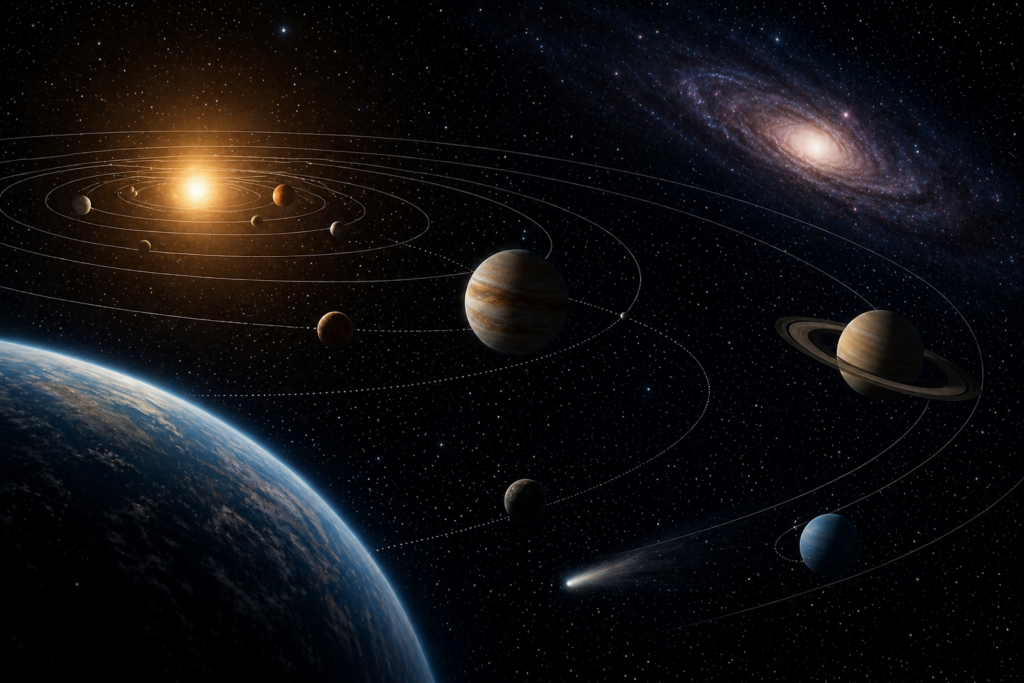
Cinematic space illustration showing planets, elliptical orbital paths, a glowing star, a comet, Earth, and a distant spiral galaxy to represent gravitation, orbital motion, and celestial mechanics.

Gravitation, Orbits, and Celestial Mechanics

Gravitation, orbits, and celestial mechanics show how classical physics extends from falling bodies on Earth to planets, moons, satellites, comets, stars, and spacecraft moving through space. This article examines Newtonian gravitation, Kepler’s laws, central-force motion, the two-body problem, orbital energy, angular momentum, circular orbits, escape speed, the vis-viva equation, orbital elements, perturbations, tides, resonances, many-body dynamics, and basic orbital-transfer reasoning. Selected R and Python workflows model circular orbits, escape speed, orbital period scaling, and two-body integration, while the linked GitHub repository expands the article with advanced computational scaffolding for reproducible celestial-mechanics workflows.

Editorial physics illustration showing a gyroscope, rolling wheel, inclined plane, rotating top, and torque arm to represent rotational dynamics, angular momentum, and rolling motion.

Rotational Dynamics, Torque, and Angular Momentum

Rotational dynamics extends classical mechanics beyond linear motion by explaining how bodies turn, spin, roll, precess, and conserve angular momentum. This article examines angular position, angular velocity, angular acceleration, torque, moment of inertia, rotational kinetic energy, rolling without slipping, angular impulse, gyroscopic behavior, and angular momentum conservation. It shows how rotational motion deepens the classical mechanics sequence by moving from point-particle models to extended bodies with shape, axes, constraints, and mass distribution. Selected R and Python workflows compare rolling objects, energy partition, torque-driven rotation, angular momentum, and rotational kinetic energy, while the linked GitHub repository expands the article with advanced computational scaffolding for reproducible rotational-dynamics workflows.

Editorial illustration of overlapping human silhouettes, civic institutions, social networks, ethical scales, and branching pathways representing moral judgment, empathy, justice, polarization, and collective responsibility.

Why Moral Psychology Matters Today

Moral psychology matters today because the moral pressures of contemporary life are no longer confined to private conscience or abstract ethical theory. Questions of harm, fairness, blame, trust, development, polarization, institutional responsibility, and moral injury now unfold inside technologically amplified, organizationally complex, and culturally plural environments. This article explains why the field has become so important across politics, education, organizations, digital life, and public accountability. Drawing on current review literature, it argues that moral psychology matters not because it replaces ethics or politics, but because it makes them more realistic by showing how people actually perceive, judge, learn, cooperate, condemn, and suffer under modern conditions.

Editorial illustration of moral psychology research methods, showing experimental observation, developmental stages, measurement forms, ethical scales, decision diagrams, and data analysis.

Methods in Moral Psychology: Experiment, Development, and Measurement

Methods in moral psychology determine what the field can legitimately claim about moral judgment, blame, norm learning, development, and ethical intuition. This article maps the field’s major methodological foundations by bringing experiment, developmental design, and measurement strategy into one framework. It argues that moral psychology is methodologically plural by necessity: experiments provide causal leverage, developmental research reveals emergence and change across the lifespan, and measurement work clarifies what constructs such as wrongness, blame, norm sensitivity, and moral identity actually mean in empirical practice. The central claim is that the field is strongest when researchers treat construct validity, developmental perspective, and experimental control as complementary rather than competing priorities.

Scroll to Top