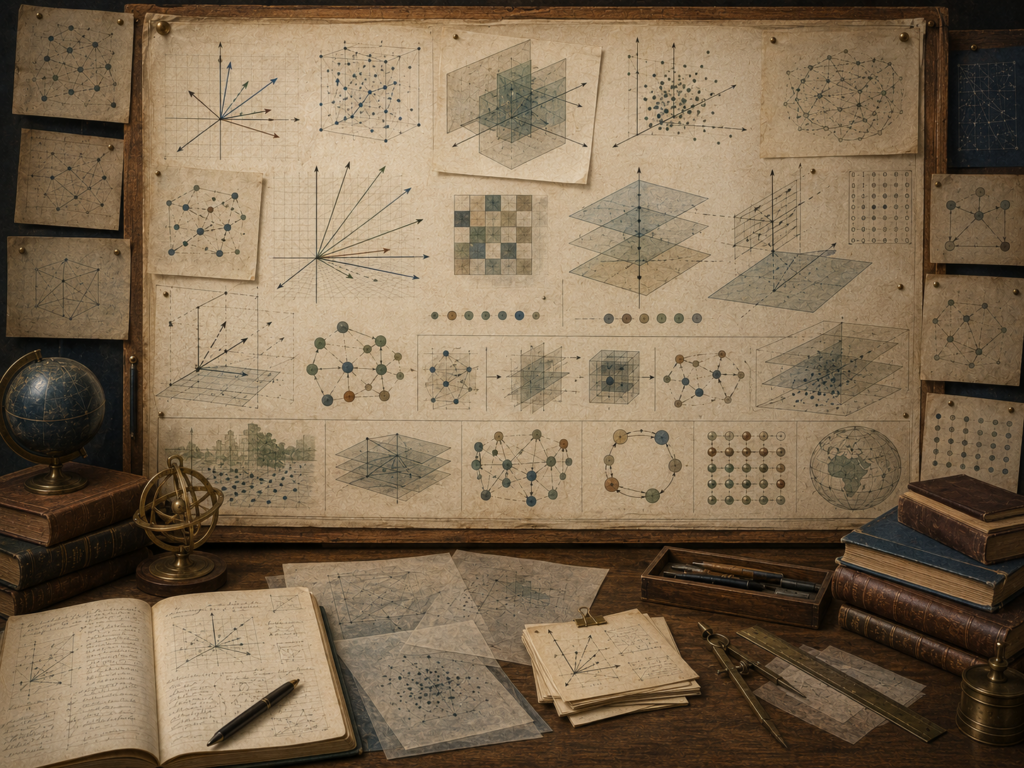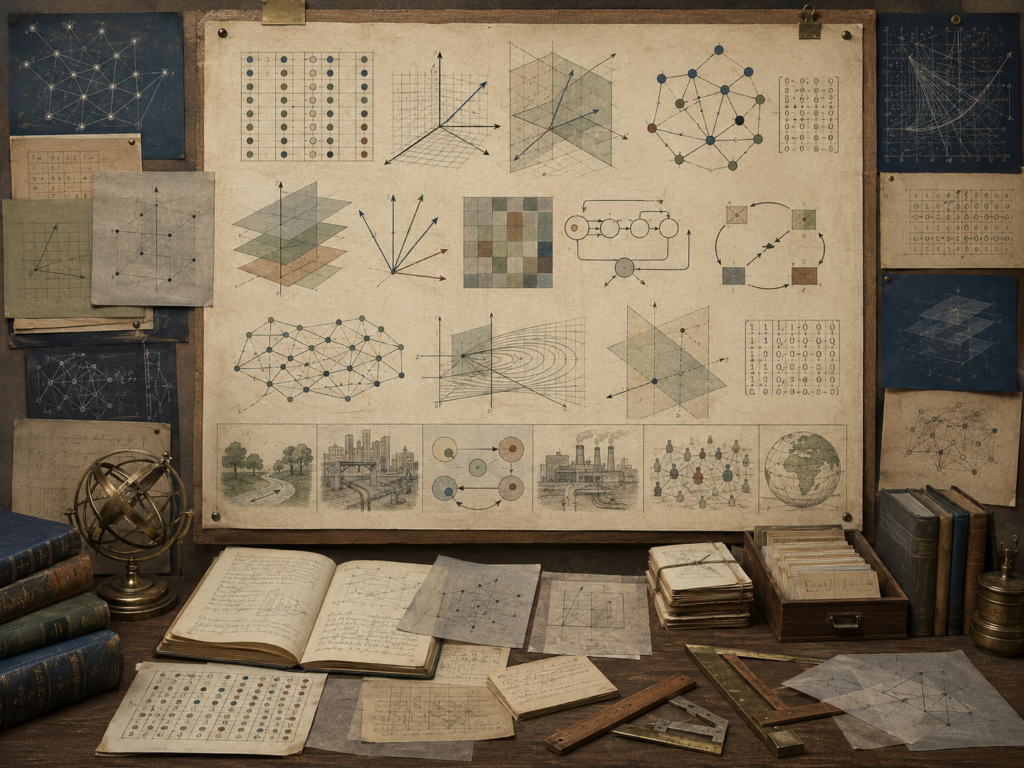
Span, Linear Independence, and Basis: How Linear Algebra Finds Essential System Directions
Span, linear independence, and basis explain what a system model can generate, what information is redundant, and which directions are essential. This article introduces span as the set of possible vectors produced by linear combinations, linear independence as the absence of redundant directions, and basis as a compact coordinate structure that spans a space without unnecessary vectors. It connects these ideas to systems modeling by examining reachable states, intervention coverage, scenario construction, feature redundancy, indicator design, rank diagnostics, model capacity, and representation governance. The article shows how dependence can reveal duplicated information, how independence can identify genuinely new system directions, and how basis choice shapes interpretation. It emphasizes responsible use by distinguishing mathematical span from real-world feasibility, rank from adequacy, and compact representation from complete understanding of complex systems across scientific, policy, infrastructure, ecological, and computational modeling workflow settings.