Author name: Tariq Ahmad

Editorial illustration of a public policy design team studying civic maps, community scenes, transit systems, institutional buildings, stakeholder diagrams, public service models, and feedback pathways.

Design Thinking in Public Policy

Design Thinking in Public Policy examines how human-centered design methods can improve the development, testing, and implementation of public programs, services, and regulatory systems. The article argues that policy failure often arises not only from political disagreement or weak analysis, but from poor problem framing, inaccessible service design, hidden administrative burdens, and insufficient attention to lived experience. It situates design thinking within the complexity of government, connects it to systems thinking, behavioral insights, democratic governance, and institutional learning, and addresses the ethical and political limits of applying design methods to public life. It also includes a mathematical lens for modeling public-policy trade-offs, along with advanced R and Python workflows for evaluating policy pilots, comparing competing public priorities, and analyzing uncertainty before large-scale implementation.

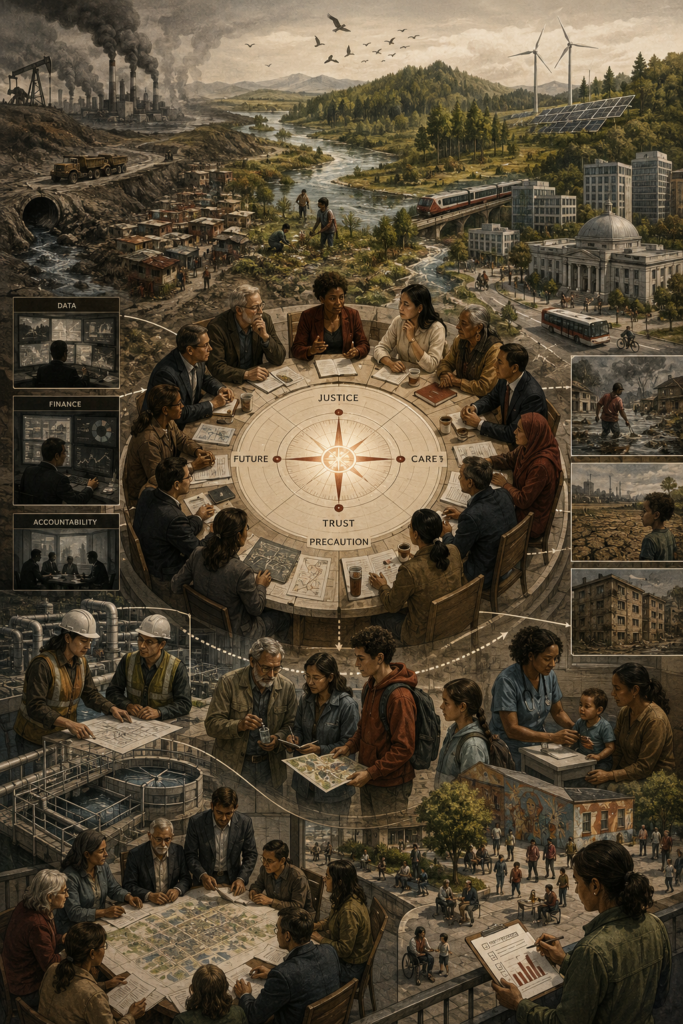
Editorial illustration of a design team working around a large table filled with ecological maps, community sketches, circular planning diagrams, landscape models, renewable infrastructure, gardens, transit, and sustainable settlement designs.

Design Thinking for Sustainability

Design Thinking for Sustainability examines how design thinking can be used to address ecological, social, and economic challenges within systems shaped by planetary limits, institutional constraints, and human behavior. The article argues that sustainability failures often arise not only from weak technology, but from poor system design, inaccessible transitions, behavioral friction, and insufficient attention to adoption, equity, and implementation. It connects design thinking to sustainability science, systems thinking, circular design, regenerative approaches, urban infrastructure, and long-horizon ecological responsibility. It also includes a mathematical lens for modeling sustainable design trade-offs, along with advanced R and Python workflows for evaluating sustainability concepts, comparing ecological and institutional priorities, and analyzing uncertainty before large-scale implementation.

Editorial illustration of a design team studying a large systems map filled with human-centered sketches, stakeholder scenes, feedback loops, model environments, network diagrams, and circular design pathways.

Design Thinking and Systems Thinking

Design Thinking and Systems Thinking examines how human-centered design and structural systems analysis can be integrated to address complex social, organizational, and ecological problems. The article argues that many interventions fail because they improve a local touchpoint while leaving the deeper structures of incentives, information flows, feedback loops, and institutional rules unchanged. It situates design thinking and systems thinking as complementary methods: one focused on lived experience, framing, prototyping, and iteration, the other focused on leverage points, delays, adaptation, and long-run system behavior. It also includes a mathematical lens for modeling intervention trade-offs, along with advanced R and Python workflows for comparing design-system interventions, identifying leverage under competing priorities, and analyzing uncertainty before committing to large-scale system redesign.

Editorial illustration of a design team working around a large table covered with prototype models, rollout pathways, systems maps, implementation diagrams, and scaled deployment clusters.

Implementation and Scaling in Design Thinking

Design Thinking and Systems Thinking examines how human-centered design and structural systems analysis can be integrated to address complex social, organizational, and ecological problems. The article argues that many interventions fail because they improve a local touchpoint while leaving the deeper structures of incentives, information flows, feedback loops, and institutional rules unchanged. It situates design thinking and systems thinking as complementary methods: one focused on lived experience, framing, prototyping, and iteration, the other focused on leverage points, delays, adaptation, and long-run system behavior. It also includes a mathematical lens for modeling intervention trade-offs, along with advanced R and Python workflows for comparing design-system interventions, identifying leverage under competing priorities, and analyzing uncertainty before committing to large-scale system redesign.

Editorial illustration of a design studio table covered with prototype models, testing sequences, sketches, feedback pathways, validation diagrams, and revision cycles.

Testing and Validation in Design Thinking

Testing and Validation in Design Thinking examines how design ideas are evaluated through evidence, observation, and iterative learning rather than intuition alone. The article argues that testing is not a final checkpoint or simple quality-control step, but a serious method of inquiry through which prototypes encounter real users, institutional conditions, and the practical limits of their own assumptions. It explores usability, desirability, feasibility, viability, behavioral observation, testing in organizational and public contexts, and the role of validation in reducing overconfidence and improving judgment. It also includes a mathematical lens for modeling evidence and uncertainty, along with advanced R and Python workflows for comparing tested concepts, clarifying validation criteria, and analyzing how design judgments shift when early evidence remains incomplete.

Editorial illustration of a design studio table covered with paper prototypes, model variations, sketches, tools, feedback paths, and iterative design diagrams.

Prototyping in Design Thinking

Prototyping in Design Thinking examines how ideas are transformed into tangible experiments that can be explored, questioned, and revised before major commitments are made. The article argues that prototyping is not simply an early making step or unfinished version of a final solution, but a serious method of learning under uncertainty. It explores low- and high-fidelity prototypes, prototyping as experimental inquiry, service and system prototypes, rapid iteration, organizational learning, and the limits of prototyping when complex institutional conditions remain unresolved. It also connects prototyping to judgment, bias, and reflective practice, showing how prototypes help expose hidden assumptions and improve collective reasoning. The article includes a mathematical lens for modeling learning value, along with advanced R and Python workflows for comparing prototype portfolios and analyzing uncertainty in early-stage design decisions.

Editorial illustration of a design studio table covered with branching idea maps, exploratory sketches, concept clusters, paper prototypes, and small model variations.

Ideation and Creative Problem Solving in Design Thinking

Ideation in Design Thinking examines how design teams deliberately expand the solution space before narrowing toward more credible interventions. The article argues that ideation is not casual brainstorming or generic creativity, but a structured method for resisting premature convergence, challenging inherited assumptions, and surfacing alternatives that would not emerge through ordinary planning. It explores divergent thinking, How Might We questions, collaborative creativity, productive constraints, convergence, complex-system ideation, and the organizational conditions that either widen or suppress possibility. It also connects ideation to bias, judgment, and group dynamics, showing why idea generation must be disciplined as well as imaginative. The article includes a mathematical lens for modeling idea value and exploratory breadth, along with advanced R and Python workflows for comparing idea portfolios and analyzing uncertainty in early-stage concept selection.

Editorial illustration of a design research table covered with portrait sketches, field observations, clustered themes, network diagrams, synthesis maps, and small prototype models.

Insight Generation in Design Thinking

Insight Generation in Design Thinking examines how designers move from raw observation to meaningful understanding through pattern recognition, interpretation, and research synthesis. The article argues that insights do not arise automatically from interviews, field notes, or stakeholder maps, but must be constructed through disciplined interpretation that identifies underlying needs, tensions, contradictions, and opportunities for intervention. It explores the distinction between observations and insights, affinity mapping, insight statements, opportunity formation, interpretive risk, and the role of systems thinking in more complex environments. The article also connects insight generation to bias, overconfidence, and reasoning under uncertainty, showing why synthesis must be methodical as well as imaginative. It includes a mathematical lens for modeling insight quality, along with advanced R and Python workflows for pattern scoring, insight prioritization, and uncertainty analysis in research synthesis.

Editorial illustration of a design research table covered with stakeholder portraits, interview scenes, community observations, relationship maps, journey pathways, and paper prototypes.

Empathy and Stakeholder Research in Design Thinking

Empathy and Stakeholder Research in Design Thinking examines how designers ground innovation in lived experience rather than institutional assumption. The article argues that empathy in design is not sentimental identification, but a disciplined method for understanding how people interpret systems, navigate constraints, form workarounds, and absorb hidden burdens in ordinary life. It expands the discussion from individual users to wider stakeholder networks and explores interviews, observation, journey mapping, stakeholder mapping, synthesis, and the limits of self-report. It also addresses bias, interpretive discipline, unequal legibility, and the role of power in shaping whose experiences become visible in research. The article includes a mathematical lens for modeling research coverage and insight value, along with advanced R and Python workflows for evaluating stakeholder research quality and analyzing uncertainty in research prioritization.

Scroll to Top