Money, Banking, Credit, and Financial Intermediation
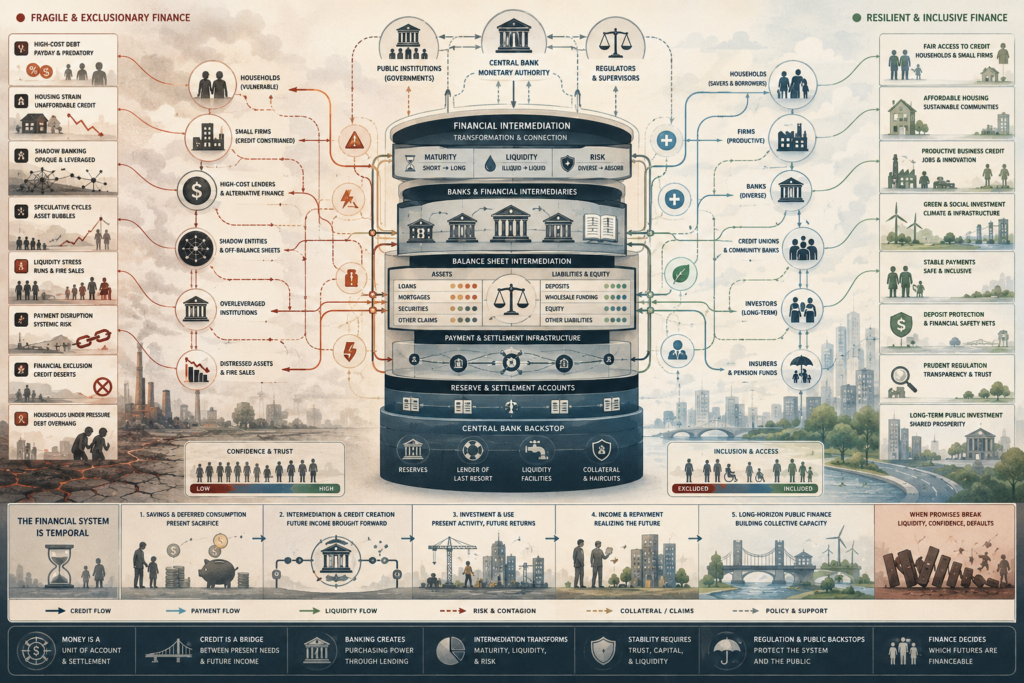
Money, banking, credit, and financial intermediation are central to economic analysis because they shape how modern economies organize promises, payments, liquidity, and access to future claims across time. This article examines money not as a neutral technical instrument, but as a socially accepted and institutionally governed claim used to denominate, settle, and store value. It explores how banks create deposit money through lending, how credit expands purchasing power while generating future obligation, how financial intermediation transforms maturity, liquidity, and risk, and how central banks, payment systems, and public guarantees stabilize a structurally fragile monetary order. It also shows why finance must be judged not only by growth or efficiency, but by who gains access to credit, whose risks are socialized, what kinds of futures become financeable, and whether the financial architecture of the economy supports resilient, inclusive, and sustainable development.