Editorial illustration of Japanese literature and poetic memory featuring manuscripts, seasonal landscapes, courtly and travel motifs, Noh masks, and layered literary symbols

Japanese Literature and Poetic Memory: Waka, Genji, Bashō, and Literary Memory

Japanese literature preserves one of the world’s most refined archives of poetic memory. Across waka, courtly narrative, diaries, war tales, travel writing, linked verse, Noh, urban prose, and modern fiction, Japanese literary culture has carried forward seasonal consciousness, impermanence, allusion, landscape memory, emotional restraint, and the subtle endurance of feeling through forms of extraordinary precision. From Heian poetry and The Tale of Genji to The Tale of the Heike, Bashō, Edo print culture, and the modern literary transformations of Sōseki, Tanizaki, Kawabata, Dazai, and Ōe, this article approaches Japanese literature as a civilizational archive in which memory survives through mood, rhythm, placement, and the quiet persistence of poetic form.


Editorial illustration of Russian literature and moral memory featuring candlelit books, manuscripts, winter cityscapes, and symbolic motifs of conscience, endurance, and historical reflection

Russian Literature and Philosophical Intensity: Freedom, Suffering, and the Human Soul

Russian literature preserves one of the world’s most morally serious literary traditions. Across novel, poetry, drama, memoir, religious prose, prison testimony, exile writing, and philosophical reflection, Russian authors have returned repeatedly to conscience, suffering, redemption, humiliation, spiritual crisis, censorship, and the historical burden of violence and upheaval. From Pushkin and Gogol to Tolstoy, Dostoevsky, Chekhov, Akhmatova, Pasternak, Shalamov, Solzhenitsyn, Grossman, and Brodsky, this article approaches Russian literature not simply as a national canon, but as a long civilizational archive of ethical memory in which inner life, moral responsibility, and historical pressure remain inseparable.

Editorial illustration of South Asian literature and sacred memory featuring manuscripts, temple and shrine architecture, sacred river landscapes, devotional objects, and layered literary traditions

South Asian Literature and Sacred Memory: Epic, Bhakti, Sufi, and Sacred Worlds

South Asian literature preserves one of the world’s richest archives of sacred memory. Across epic, devotional poetry, philosophical verse, classical drama, vernacular retelling, Sufi lyric, and modern writings shaped by empire and partition, the literary cultures of South Asia have carried forward gods, kingdoms, saints, teachers, pilgrims, lovers, and sacred landscapes across extraordinary spans of time. From the Ramayana and Mahabharata to Sanskrit kavya, Tamil devotional worlds, bhakti poetry, Persianate and Urdu literary culture, and the modern afterlives of colonialism and nationalism, this article approaches literature as a living medium of civilizational continuity, reinterpretation, and sacred inheritance.

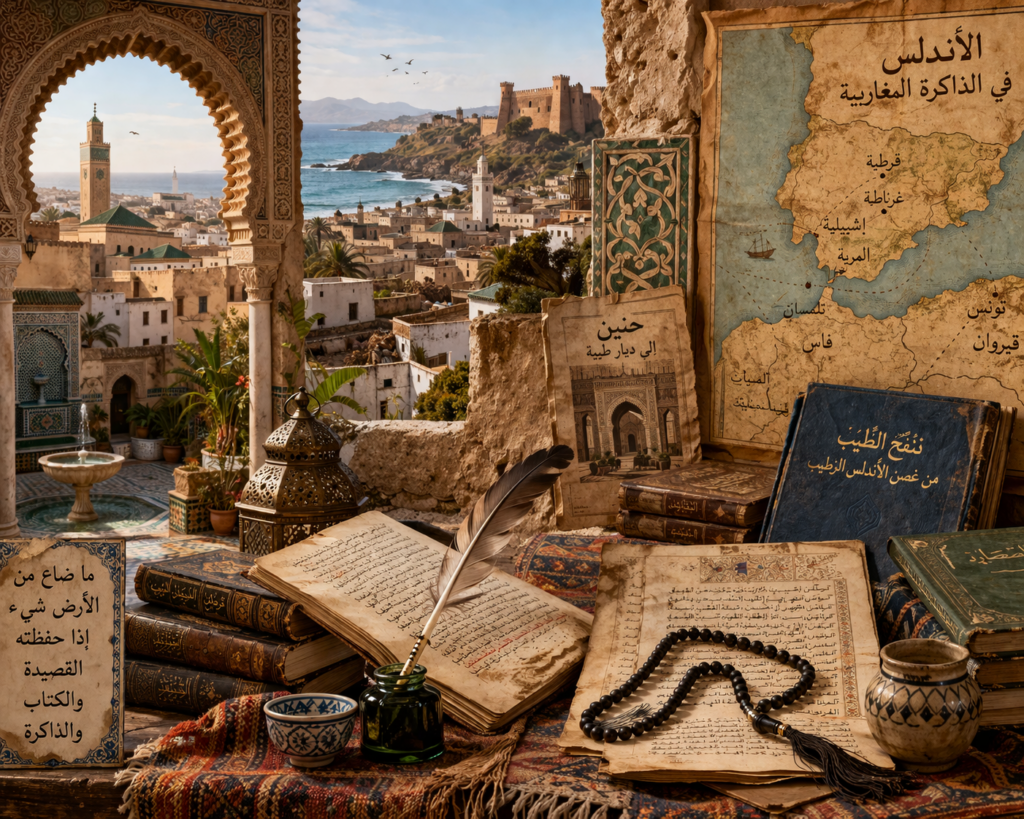
Editorial illustration of Maghrebi and Andalusi literature and cultural memory featuring coastal North African cityscapes, manuscripts, courtyards, Andalusi-Maghrebi architecture, and recollective Mediterranean motifs

Maghrebi and Andalusi Literature and Cultural Memory: Exile, Cities, and Literary Afterlife

Maghrebi and Andalusi literature preserves one of the most layered archives of place, devotion, refinement, exile, and historical remembrance in the wider Mediterranean world. Shaped by Amazigh, Arab, Islamic, Jewish, and Andalusi inheritances, these literary traditions carried forward memories of cities, courts, scholars, saints, gardens, songs, and homelands marked by both flourishing and rupture. From the lyric and courtly splendor of al-Andalus to the urban, devotional, and recollective traditions of North Africa, this article approaches literature as a home for worlds unsettled by conquest, migration, dynastic change, colonial violence, and post-imperial loss.

Editorial illustration of Arabic literature and adab featuring manuscripts, calligraphy, books, lamps, architectural forms, and cultivated literary motifs from the Arabic-speaking world

Arabic Literature and Adab: Poetry, Prose, Eloquence, and Cultivated Memory

Arabic literature preserves one of the world’s great traditions of eloquence, cultivated knowledge, ethical reflection, and literary memory. Through poetry, prose, belles-lettres, biography, travel writing, history, maqamat, and the expansive civilizational ideal of adab, Arabic-speaking societies shaped language into a medium of refinement, education, wit, moral intelligence, and public expression across centuries. From pre-Islamic qasida and Qur’anic rhetorical horizons to Abbasid prose, adab anthologies, court poetry, and the literary cultures of al-Andalus and the Maghrib, this article approaches Arabic literature not simply as a body of texts, but as a broader practice of forming persons, preserving memory, and organizing inherited knowledge through eloquence.

Editorial illustration of Persian poetry and cultural memory featuring illuminated manuscripts, calligraphy, garden imagery, courtly and mystical motifs, and Persianate architectural forms

Persian Poetry and Cultural Memory: Epic, Ghazal, Sufism, and the Persianate World

Persian poetry preserves one of the world’s great traditions of cultural memory. Across epic, court poetry, romance, mystical verse, ghazal, ethical writing, and elegy, Persian literary culture carried forward visions of kingship, justice, beauty, longing, exile, spiritual transformation, and historical endurance across centuries of upheaval and renewal. From the deep memory of ancient Iran to Ferdowsi’s Shahnameh, Nezami’s narrative romances, Attar’s spiritual allegories, Rumi’s metaphysics of love, Saadi’s ethical humanism, and Hafez’s lyric ambiguity, this article approaches Persian poetry as a vast archive through which a civilization remembered itself and transmitted its most enduring symbolic forms.

Editorial illustration of classical literature as civilizational memory, featuring ancient tablets, scrolls, books, and Greco-Roman architecture arranged across a luminous Mediterranean landscape

Classical Literature and Civilizational Memory: Epic, Tragedy, History, and Canon

Classical literature preserves the memory structures through which ancient civilizations narrated origins, war, law, grief, eros, empire, mortality, and the search for lasting name. From The Epic of Gilgamesh to Homer, Greek tragedy, Hellenistic scholarship, Roman epic, satire, historiography, and Suetonius’ The Twelve Caesars, the classical archive carried forward the symbolic forms by which societies understood power, virtue, catastrophe, and inheritance. This article approaches classical literature not simply as a canon of great works, but as a durable civilizational system of transmission shaped by performance, education, commentary, translation, and reinterpretation across centuries.

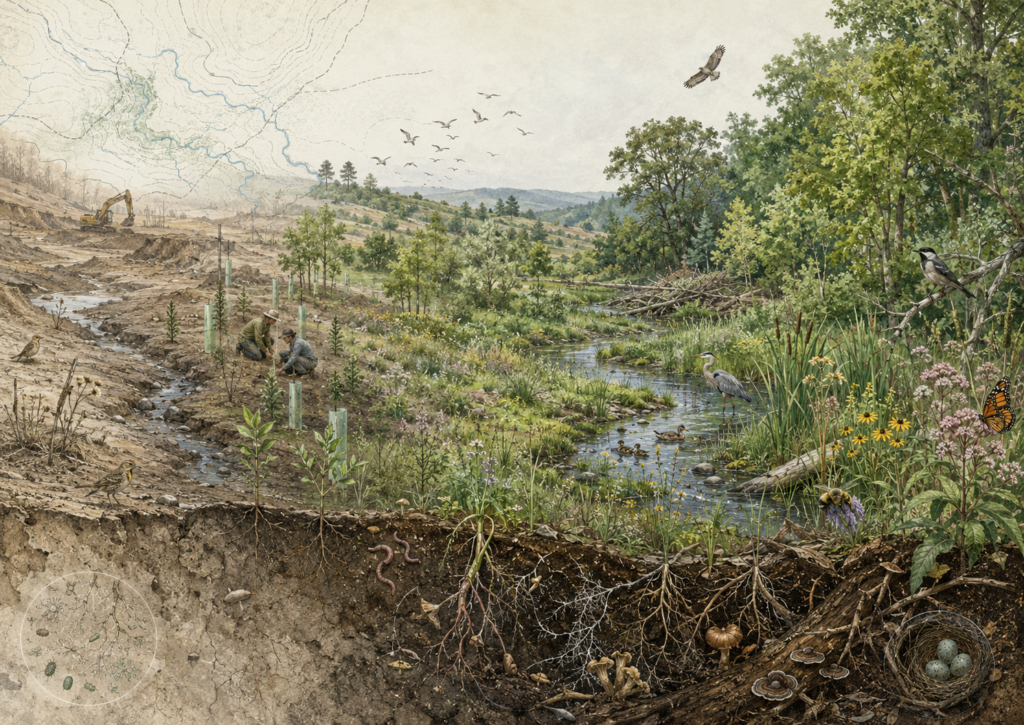
Research-grade ecological restoration illustration showing a degraded landscape transitioning into a restored wetland and forest ecosystem, with native planting, stream recovery, wildlife, soil roots, fungi, and biodiversity returning.

Restoration Ecology and the Repair of Living Systems

Restoration ecology and the repair of living systems examine how damaged ecosystems can recover structure, function, biodiversity, resilience, and ecological process through deliberate intervention, assisted regeneration, disturbance repair, hydrological recovery, soil rebuilding, species reintroduction, and long-term ecological stewardship. Restoration ecology is central to modern biology because the living world is now shaped not only by natural succession and disturbance, but by extraction, fragmentation, pollution, hydrological alteration, invasive species, climate change, biodiversity loss, and systemic ecological simplification. This article explores how degraded systems recover, what can be repaired, how ecological trajectories are redirected, and how ecological integrity can be rebuilt under altered historical and climatic conditions.

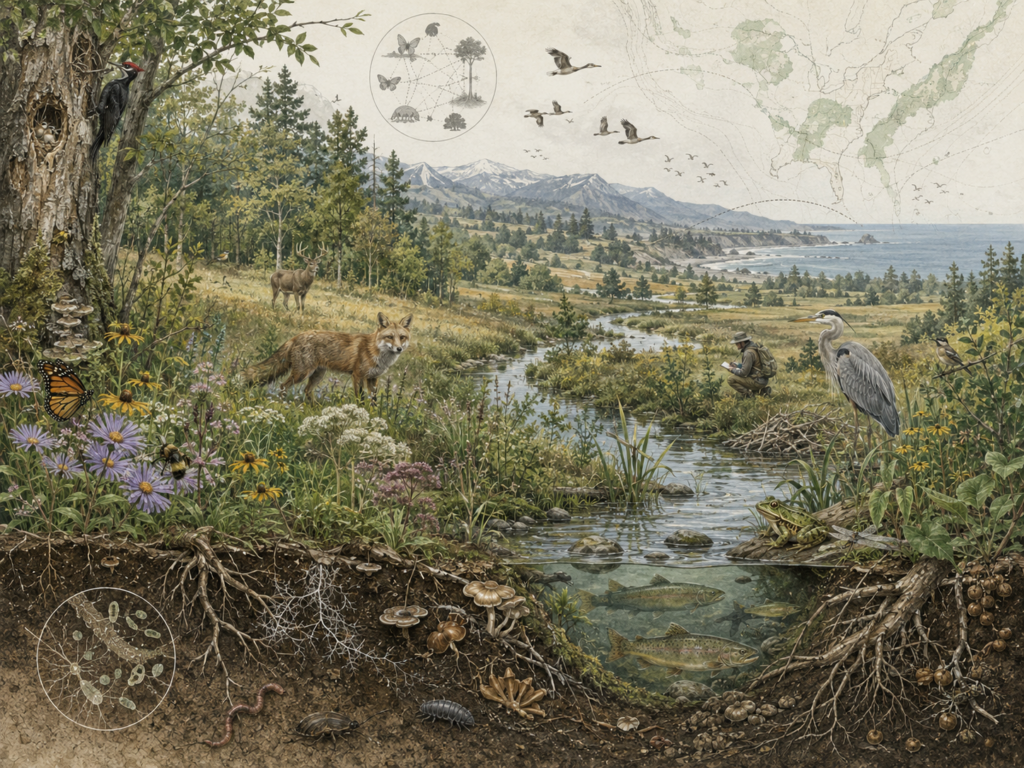
Research-grade conservation biology illustration showing a connected landscape of forest, meadow, wetland, river, and coast with diverse wildlife, native plants, soil roots, fungi, pollinators, fish, birds, and a field biologist observing biodiversity.

Conservation Biology and the Protection of Life

Conservation biology and the protection of life examine how species, populations, ecosystems, and ecological processes can be sustained in the face of extinction risk, habitat loss, fragmentation, overexploitation, invasive species, pollution, and climate-driven environmental change. Conservation biology emerged as a crisis-oriented, interdisciplinary science because the protection of life could no longer be treated as a matter of passive appreciation alone. It required methods for assessing vulnerability, setting priorities, managing uncertainty, restoring damaged systems, and making decisions under conditions in which losses may be irreversible. This article explores extinction risk, population viability, genetic erosion, habitat fragmentation, protected areas, restoration, marine conservation, environmental health relevance, biodiversity governance, and more advanced quantitative approaches in R and Python for conservation decision-making.

Scroll to Top