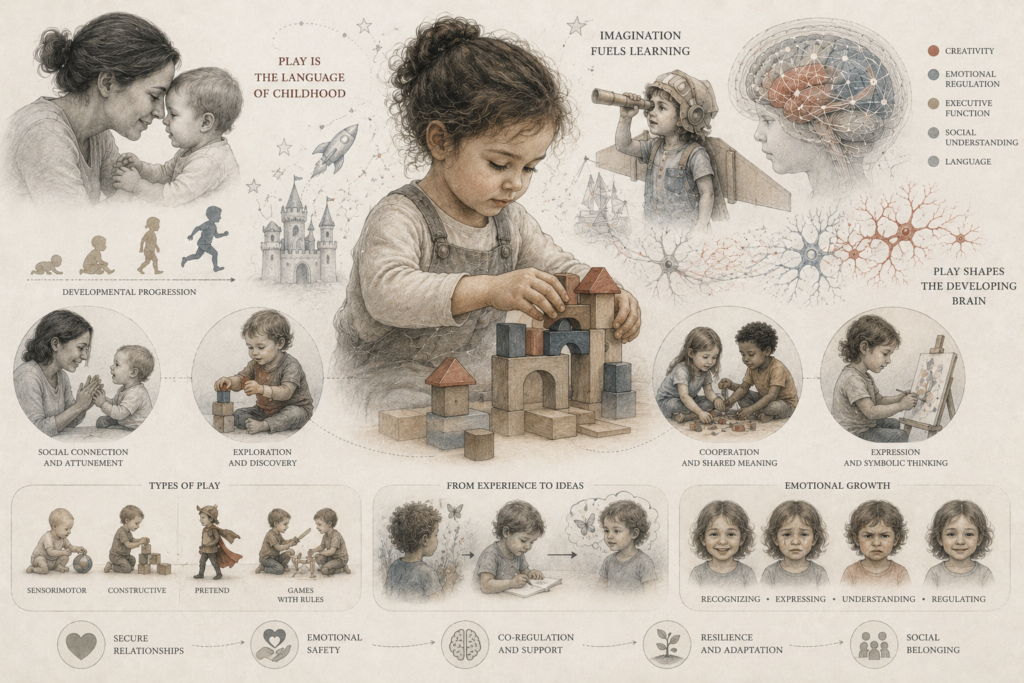
Research-grade illustration of childhood play and imagination, showing children building, pretending, exploring, creating, and interacting, with developmental brain networks and emotional, social, and cognitive growth motifs.

Play, Imagination, and Development

Play is one of the most serious forms of development because it is one of the primary ways children explore objects, roles, symbols, rules, relationships, and imagined worlds. This article examines play as a developmental mode through which cognition, emotion, language, social negotiation, and symbolic thinking grow together. Moving beyond the idea that play is merely recreation, it argues that play is a central medium of learning, regulation, and cultural participation. It also considers pretend play, peer interaction, inequality, disability, and institutional constraints, showing that play is shaped by context as well as by imagination. In that sense, play reveals how development often advances most powerfully where freedom, experimentation, and social world-making meet.
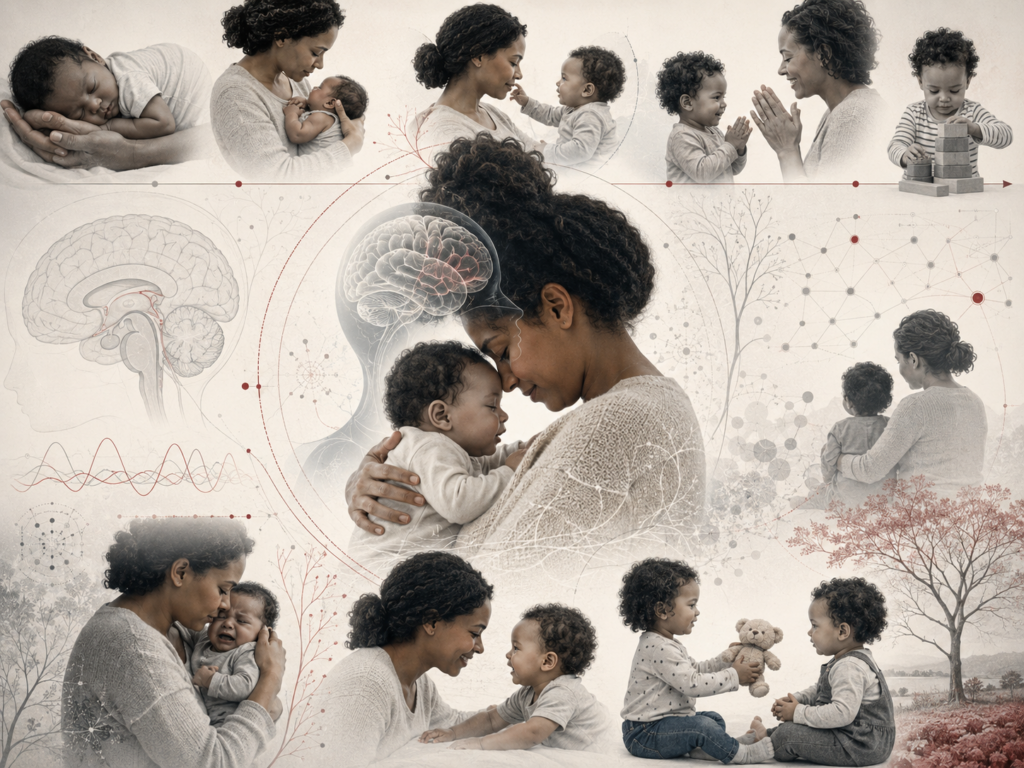
Research-grade illustration of early attachment and caregiving, showing a caregiver and infant in close contact, emotional attunement, developmental stages, neural regulation, and social bonds across early childhood.

Attachment, Caregiving, and Early Emotional Development

Attachment, caregiving, and early emotional development form a single developmental field through which infants first learn safety, distress, comfort, separation, regulation, and trust. This article examines Bowlby and Ainsworth, co-regulation, security and exploration, emotional development, cultural variation, inequality, and developmental risk as parts of one relational system. It argues that attachment is not a sentimental ideal or a total explanation of personality, but a powerful developmental process through which early emotional life is organized under conditions of dependence. In that sense, attachment reveals how human development begins in relationship and how caregiving becomes part of the architecture of mind, behavior, and feeling.

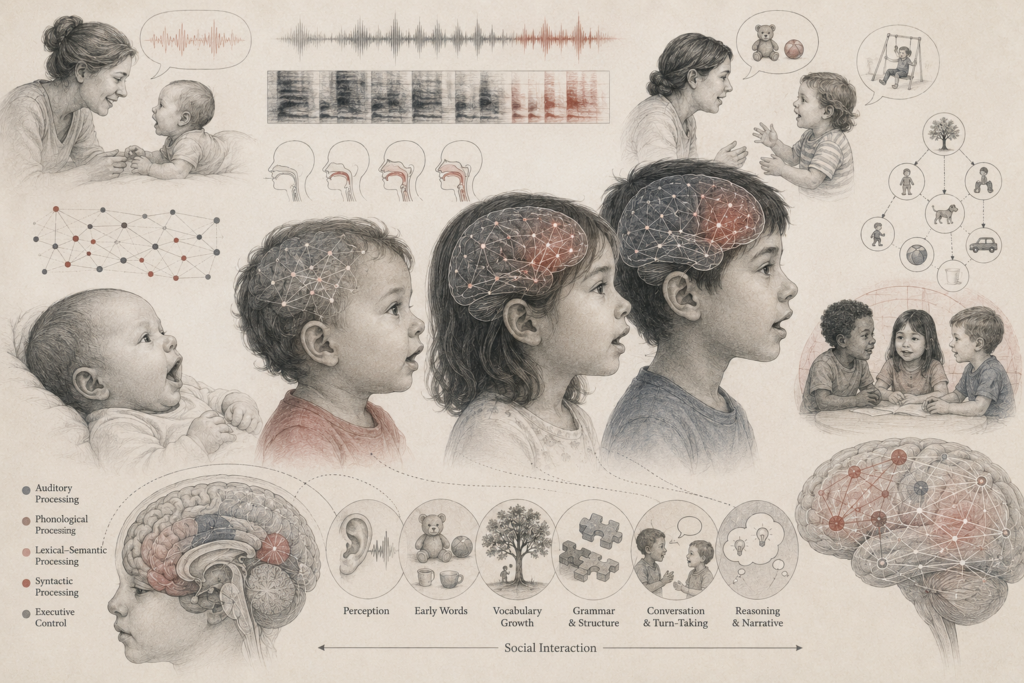
Research-grade illustration of language development showing children at different stages of speech growth, neural language networks, auditory processing, caregiver interaction, vocabulary learning, grammar, conversation, and social communication.

Language Development and the Social Formation of Speech

Language development is the social formation of speech through which children move from sound and gesture into shared meaning, conversation, memory, learning, and cultural participation. This article examines early vocalization, joint attention, caregiver turn-taking, vocabulary growth, grammar, late talking, hearing, cultural variation, and inequality as parts of one developmental process. It argues that language is not simply a skill added onto cognition, but one of the central ways mind becomes social and social life becomes thinkable. In that sense, language development reveals how speech is formed through relation, embodiment, support, hearing, and the unequal communicative worlds in which children grow.

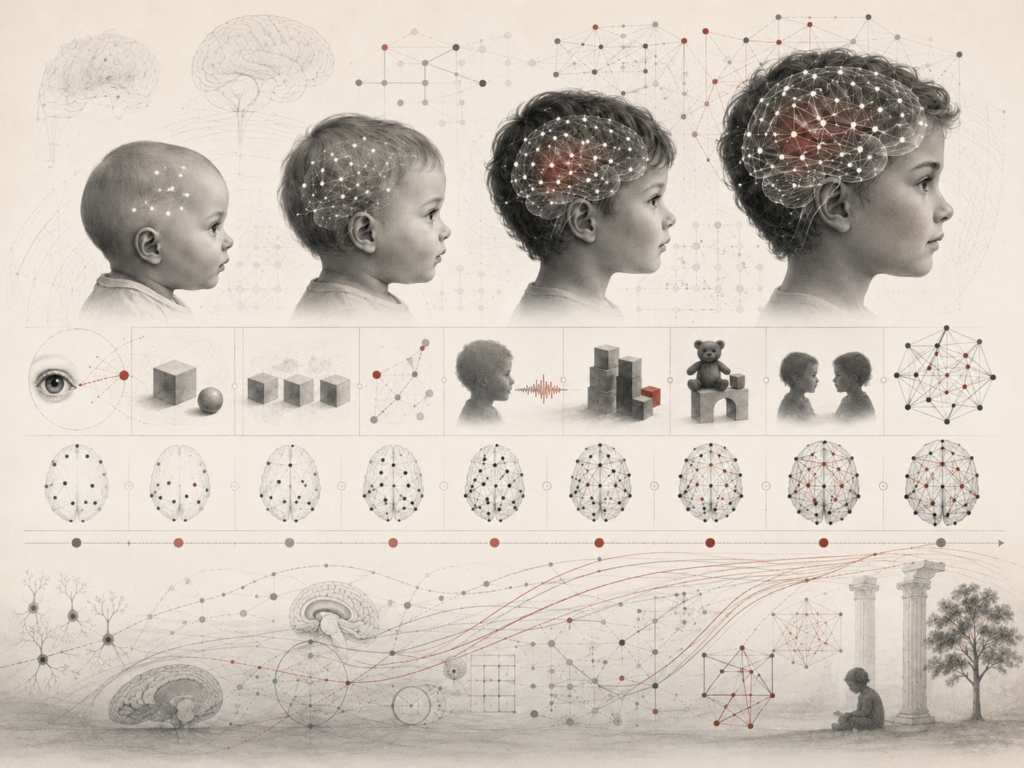
Research-grade illustration showing stages of cognitive development from infancy to childhood, with profiles of children, expanding brain networks, and visual motifs of perception, learning, language, reasoning, and social understanding.

Cognitive Development and the Growth of Mind

Cognitive development is the growth of mind as an organized human capacity: the emergence of attention, perception, memory, language, reasoning, symbolic thought, and self-regulation across development. This article examines classical theories of cognitive development, the movement from perception to representation, the roles of language and executive function, and the effects of schooling, culture, inequality, disability, and stress on cognitive pathways. It argues that cognition is not simply the accumulation of knowledge or school performance, but the development of mind itself through biological maturation, social interaction, cultural mediation, and institutional context. In that sense, cognitive development stands at the center of developmental psychology’s effort to understand how human beings come to know, think, and understand.

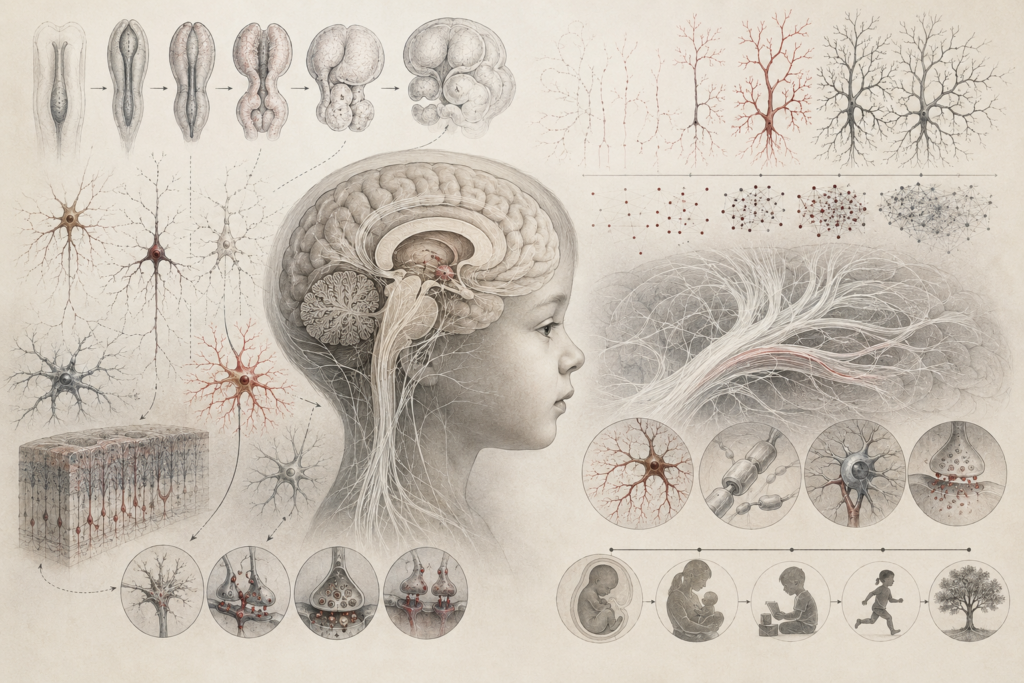
Research-grade illustration of brain development showing a child’s profile with transparent brain anatomy, embryonic neural stages, branching neurons, synaptic connections, and developmental patterns of neural plasticity.

Brain Development, Plasticity, and the Developing Nervous System

Brain development is central to developmental psychology because perception, movement, attention, learning, emotion, language, and self-regulation all emerge through a nervous system that is still developing. This article examines early brain development, neural plasticity, sensitive timing, caregiving, stress, learning, adolescence, and inequality as parts of one developmental process rather than separate biological and social stories. It argues that the developing nervous system is neither fixed destiny nor infinitely malleable. Instead, it is a plastic, structured, and context-sensitive system shaped by growth, experience, support, and adversity across time. In that sense, brain development is one of the clearest places where biology, care, environment, and developmental psychology meet.

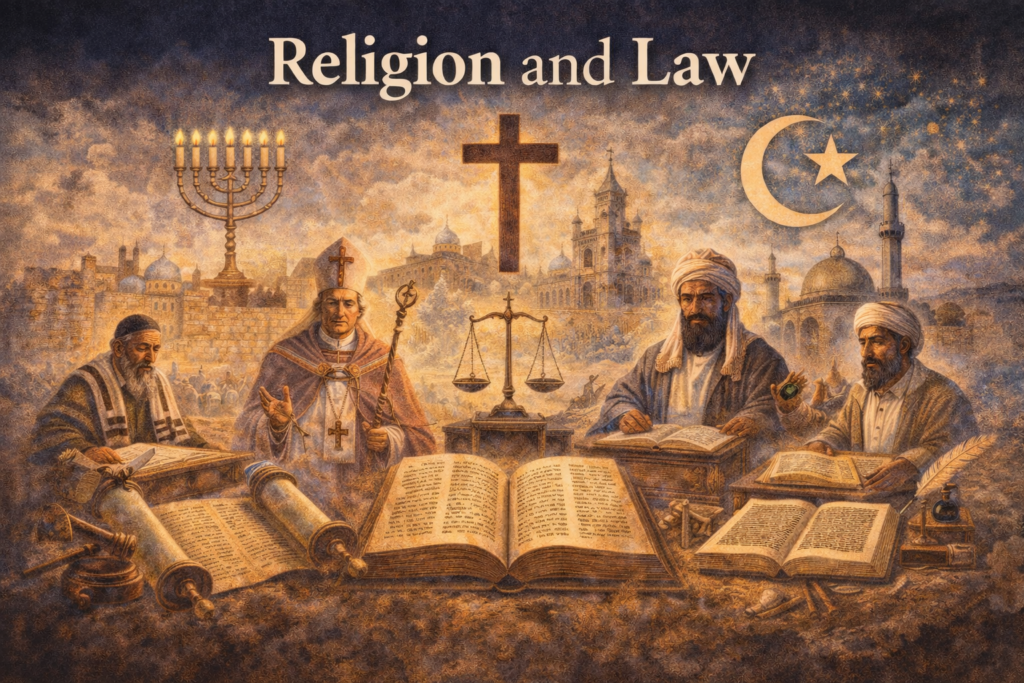
A composite illustration of Jewish, Christian, and Islamic legal traditions featuring a menorah, cross, crescent, scholars with sacred texts, scales of justice, and religious architecture in the background.

Religion and Law: Sacred Authority, Abrahamic Legal Traditions, and the Moral Ordering of Civilization

Religion and Law examines the relationship between sacred authority, moral obligation, legal reasoning, and political order across religious civilizations. This category explores scriptural law, jurisprudence, canon law, halakhah, dharma, legal commentary, religious courts, and the role of sacred normativity in organizing communal and political life. It gives special attention to Judaism, Christianity, and Islam as Abrahamic legal traditions, comparing halakhah, canon law, and Sharia as distinct yet historically related structures of sacred normativity. By linking law to revelation, interpretation, family order, institutional authority, political sovereignty, and historical change, this category illuminates how religious traditions shaped the moral and institutional architecture of civilization.

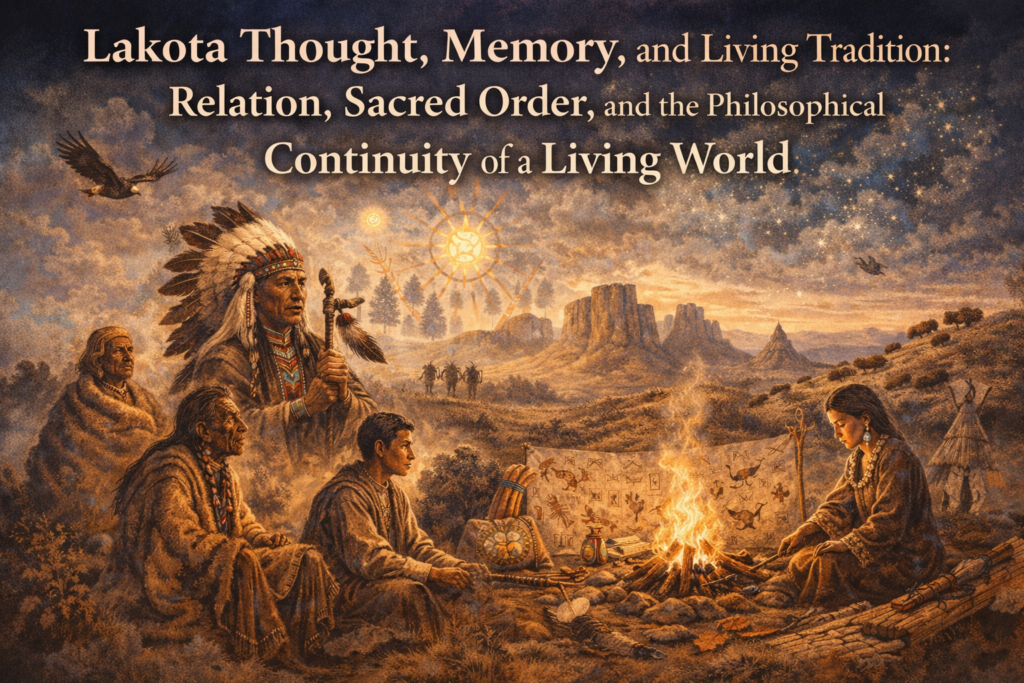
A composite illustration of Lakota cultural continuity showing elders and younger community members gathered around a fire beneath a star-filled sky, with plains landscape, bison, tipi, winter count imagery, and ceremonial symbolism.

Lakota Thought, Memory, and Living Tradition: Relation, Sacred Order, and the Philosophical Continuity of a Living World

Lakota Thought, Memory, and Living Tradition examines the intellectual, moral, spiritual, and historical worlds through which Lakota communities have understood existence, sacred order, land, kinship, and collective continuity across generations. Through oral teaching, language, ceremony, winter counts, sacred geography, governance, treaty memory, and intergenerational transmission, this category approaches Lakota tradition as a serious and enduring field of thought rather than as folklore or anthropological residue. It studies how memory functions as active continuity, how land bears relation and obligation, and how survival itself becomes an archive of knowledge within one of North America’s great living philosophical traditions.

A composite illustration of British cultural memory featuring imperial and industrial imagery, a seated queen, a soldier, working figures, Parliament, ships, factories, books, and a writing woman, representing empire, class, and literary inheritance.

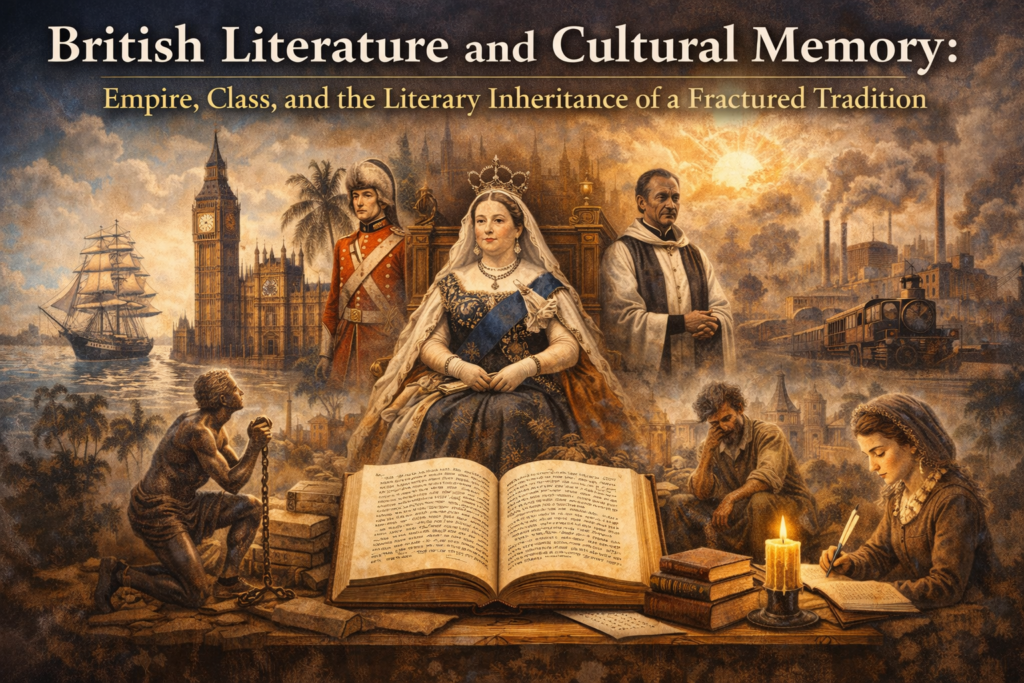
British Literature and Cultural Memory: Empire, Class, and the Literary Inheritance of a Fractured Tradition

British Literature and Cultural Memory explores the literary traditions through which Britain has remembered kingship, empire, class, faith, industrial transformation, domestic life, war, landscape, and the changing moral worlds of modernity. Across poetry, drama, the novel, essay, satire, life writing, and political prose, this category examines how British literature preserved institutions, customs, crises, and moral sensibilities while also exposing the fractures within national memory. It studies literature as a record of both continuity and contradiction, linking literary form to monarchy, religion, class hierarchy, imperial power, metropolitan culture, regional difference, and the global afterlife of one of the modern world’s most consequential literary traditions.

A composite illustration of Yiddish cultural memory showing shtetl buildings, a Yiddish theater scene, candles, a writer at a desk, an open Yiddish book, typewriter, and Holocaust imagery layered against an urban skyline.

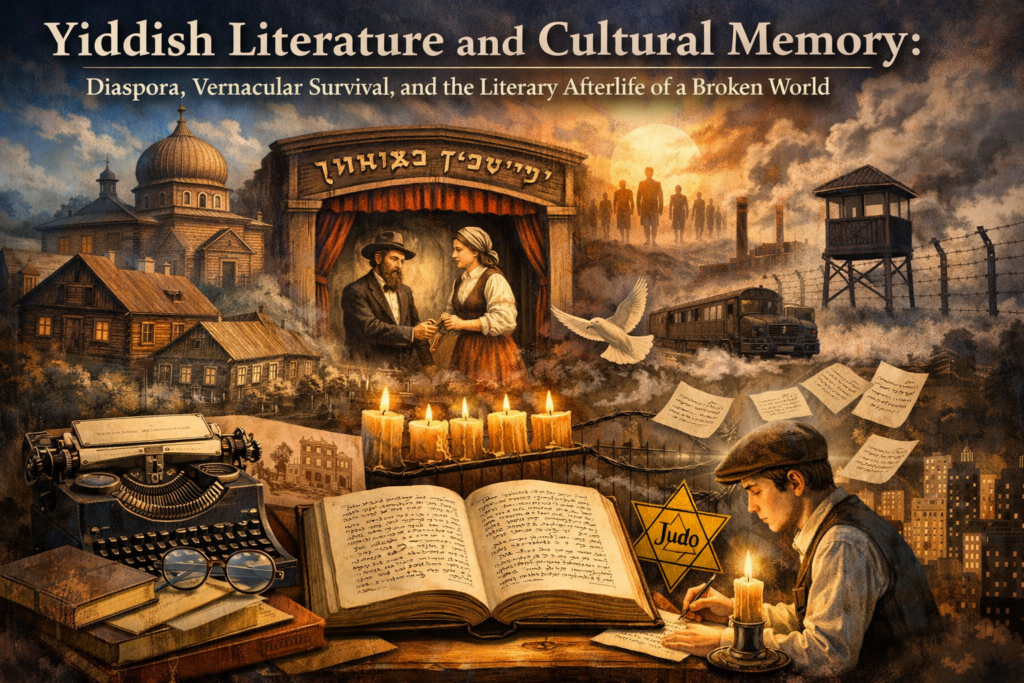
Yiddish Literature and Cultural Memory: Diaspora, Vernacular Survival, and the Literary Afterlife of a Broken World

Yiddish Literature and Cultural Memory explores one of the most important literary traditions of the Jewish diaspora as a medium of communal memory, linguistic survival, religious inheritance, humor, suffering, everyday life, and modern transformation. Through storytelling, poetry, theater, memoir, journalism, satire, folklore, and post-catastrophic remembrance, this category examines how Yiddish literature preserved the textures of vernacular life across towns, cities, migrations, and shattered worlds. It studies Yiddish as a world-making language of intimacy, argument, prayer, irony, domestic memory, and cultural endurance, showing how literature can preserve a civilization not only in its catastrophe, but in its ordinary life, moral complexity, and afterlife of recovery.

Scroll to Top